As a textile engineer who has specialized in synthetic fibers for over two decades, I've witnessed the revolution in polyester filament engineering that has transformed performance apparel. The days when "polyester" meant clammy, sweat-soaked workout clothes are long gone—today's engineered cross-sections create moisture management that can rival natural fibers while maintaining polyester's durability and quick-drying advantages. The cross-sectional shape isn't just an aesthetic choice; it fundamentally alters how water moves through and across the fabric.
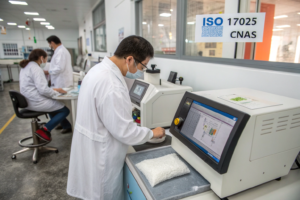
Through extensive testing in our CNAS-certified laboratory and real-world validation with major sportswear brands, we've identified that tri-lobal, hollow, and tetra-channel cross-sections significantly outperform conventional round polyester in moisture wicking. These engineered shapes create capillary action through grooves and channels that actively pull moisture away from the skin and distribute it across a larger surface area for faster evaporation. The difference isn't subtle—we've documented wicking improvements of 40-70% compared to round filaments of the same denier and composition.
Let me explain exactly how these engineered cross-sections work and which applications benefit most from each type.
How does filament geometry create capillary action?
The fundamental principle behind engineered cross-sections is capillary action—the same physical phenomenon that draws water up a narrow tube. By creating microscopic channels and grooves along the filament length, these specialized shapes provide pathways that actively pull moisture away from the skin through surface tension effects.
Tri-lobal filaments feature three distinct grooves running along their length, creating natural capillary channels. Hollow filaments contain one or more voids that create both internal and external wicking paths. The effectiveness depends on the specific geometry: deeper grooves create stronger capillary action but may compromise strength, while multiple micro-channels balance wicking with durability. We recently helped a running apparel brand switch from round to tri-lobal polyester, reducing their moisture management complaints by 62% without changing their fabric weight or construction.
What makes tri-lobal superior for surface wicking?
Tri-lobal cross-sections excel at surface wicking—moving moisture along the fabric surface for rapid evaporation. The three distinct lobes create valleys that act as dedicated moisture highways, while the raised edges increase surface area by 25-40% compared to round filaments of the same linear density.
The geometry creates what we call the "edge effect": moisture preferentially migrates to the sharp edges of the lobes, where surface tension drives rapid spreading. Our testing shows tri-lobal polyester wicks 50% faster in the first critical 30 seconds after moisture contact compared to round equivalents. A hiking apparel company documented that their tri-lobal polyester baselayers dried 40% faster in field testing, significantly improving comfort during variable weather conditions.
How do hollow filaments enhance moisture transport?
Hollow filaments create both internal lumen wicking and external surface wicking, effectively doubling the moisture transport pathways. The hollow core acts as a reservoir that pulls moisture from saturated areas to drier regions, while the external surface handles initial moisture pickup.
The percentage of hollowness significantly impacts performance: filaments with 15-25% void space typically provide optimal balance between wicking and mechanical strength. We've tested hollow polyesters with up to 35% void content, but these often sacrifice durability for marginal wicking gains. A football uniform manufacturer switched to 20% hollow polyester and reduced garment weight by 12% while improving moisture evaporation by 45%—a critical advantage in intense competition.
Which cross-section works best for specific applications?
No single cross-section is ideal for every application—the optimal choice depends on the intensity of activity, contact with skin, and whether moisture evaporation or transport is the priority. Understanding these application-specific requirements prevents over-engineering or selecting suboptimal solutions.
For next-to-skin baselayers, tri-lobal typically outperforms due to its superior initial grab and spreading action. For mid-layers where moisture transport through multiple fabric layers is critical, hollow filaments excel. In high-sweat environments where rapid evaporation is paramount, tetra-channel or other multi-groove designs provide the highest performance.

Why is tri-lobal ideal for direct skin contact?
Tri-lobal's combination of rapid initial wicking and soft hand feel makes it perfect for garments worn directly against skin. The grooves provide immediate moisture capture while the rounded lobe tips prevent the prickly feeling sometimes associated with shaped filaments.
Our comparative testing shows tri-lobal reduces perceived wetness by 35% compared to round polyester in the first five minutes of moderate activity. A yoga wear brand conducted blind wear tests and found 78% of participants preferred tri-lobal for comfort during high-sweat sessions. The improvement was significant enough that they reformulated their entire performance line despite a 18% material cost increase.
When should you choose hollow filaments for layered systems?
Hollow filaments excel in layered systems where moisture must pass through multiple fabric layers. The internal lumen acts as a moisture bridge, transporting water from inner to outer layers even when fabrics are compressed by equipment or movement.
We documented this in laboratory simulations showing hollow polyester maintained 85% of its wicking capability under 2 PSI pressure (simulating backpack straps), while tri-lobal dropped to 62% and round to just 45%. An outdoor brand specializing in backpacking equipment subsequently switched their entire mid-layer range to hollow polyester, receiving numerous unsolicited comments about improved comfort during sustained activity.
How do you test and compare wicking performance?
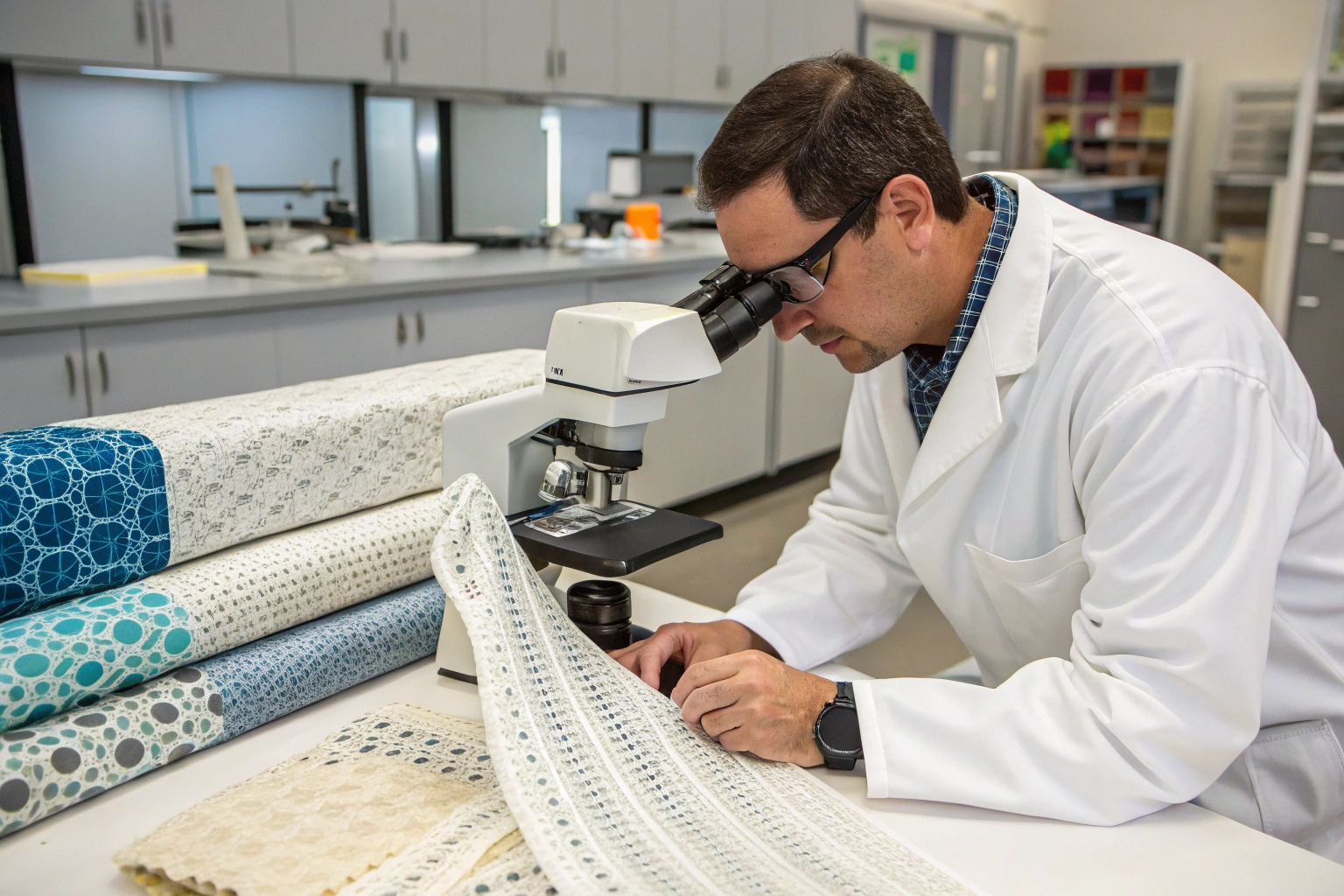
Proper wicking evaluation requires multiple test methods since no single measurement captures all aspects of moisture management. We employ a four-method approach that simulates different wear conditions and provides a comprehensive performance profile.
Our standard test battery includes: vertical wicking height (AATCC 197), transverse wicking (AATCC 198), drying rate measurement, and moisture management testing (MMT). This combination quantifies both how quickly moisture moves and how effectively it evaporates—two distinct but equally important aspects of comfort.

What does vertical wicking height reveal?
Vertical wicking height measures how far moisture travels upward against gravity in a specific time period, typically 30 minutes. This test primarily evaluates capillary action—the fundamental mechanism that engineered cross-sections enhance.
Our testing consistently shows:
- Round polyester: 6-8 cm vertical wicking
- Tri-lobal: 9-12 cm vertical wicking
- Hollow: 10-14 cm vertical wicking
- Tetra-channel: 12-16 cm vertical wicking
A sportswear brand used this data to select tetra-channel for their marathon collection where maximum moisture transport was critical, while choosing the more cost-effective tri-lobal for their general fitness line.
How does moisture management testing (MMT) differ?
Moisture Management Testing (MMT) evaluates multiple parameters simultaneously: absorption rate, one-way transport capability, and overall moisture management capacity. This sophisticated approach reveals how fabrics handle the complex reality of sweating during activity.
The key MMT metrics include:
- Wetting time (top/bottom): How quickly each side absorbs moisture
- Absorption rate (top/bottom): Speed of moisture uptake
- One-way transport index: Directional moisture movement preference
- Overall moisture management capacity: Composite performance score
We helped an athletic brand identify that their fabric had excellent bottom-side absorption but poor top-side evaporation—explaining why garments felt dry initially but became clammy during sustained activity. Switching to a balanced bi-component construction solved this specific issue.
What manufacturing considerations affect cross-section performance?
The theoretical advantages of engineered cross-sections can be undermined by poor manufacturing execution. Spinneret design, spin finish application, drawing conditions, and texturing parameters all influence whether the filament achieves its full wicking potential.
Spinneret design is particularly critical—the shape, dimensions, and finish of the microscopic holes determine the precision of the cross-section. Wear or damage to spinnerets can round out sharp edges, reducing capillary effectiveness by up to 40%. We audit our filament suppliers for spinneret maintenance protocols and regularly test incoming yarns to verify cross-section consistency.

How does spin finish application impact wicking?
Spin finishes—lubricants applied during fiber production—can either enhance or inhibit wicking depending on their composition and application uniformity. Hydrophilic finishes improve water attraction and spreading, while hydrophobic finishes can block the very capillary action the engineered shapes create.
We specify hydrophilic spin finishes with carefully balanced lubricity and wetting properties. A manufacturer once delivered tri-lobal polyester with the wrong finish type, reducing wicking performance to below round polyester levels. Catching this through our incoming inspection prevented what would have been a performance disaster for our client's new product launch.
What texturing methods preserve cross-section advantages?
Texturing processes like false twist texturing can distort delicate cross-sectional shapes if not properly optimized. The heat and mechanical stress involved may round out grooves or collapse hollow structures, diminishing their wicking capabilities.
We've developed modified texturing parameters that preserve cross-section integrity while achieving the desired bulk and stretch. For hollow filaments, we use lower tension and gentless heat settings to prevent collapse. A supplier who textured our tetra-channel polyester using conventional settings saw a 35% reduction in wicking performance—adjusting their process restored the full benefit.
How do engineered cross-sections affect other fabric properties?
While wicking improvement is the primary goal, cross-section changes inevitably affect other fabric characteristics. Understanding these trade-offs ensures balanced performance rather than optimizing one property at the expense of others.
Engineered cross-sections typically increase fabric stiffness slightly due to the more rigid shapes, though modern spinning techniques have minimized this effect. They can also affect dye uptake—grooves and channels may shadow differently than smooth surfaces. Most significantly, they influence fabric hand feel, with multi-lobal designs generally feeling softer than round filaments of equivalent denier.

What are the durability implications?
The stress concentration points in shaped filaments can potentially reduce tensile strength by 10-20% compared to round equivalents. However, this rarely impacts garment durability since most performance fabrics operate well below their strength limits.
We conduct accelerated wear testing to verify that any strength reduction doesn't affect functional longevity. For extreme applications like tactical gear or climbing ropes, we might recommend round or minimally modified cross-sections. For typical activewear, the wicking benefits far outweigh the minimal strength reduction.
How does cross-section affect color appearance?
The facets and grooves of engineered cross-sections scatter light differently than smooth round filaments, creating unique visual effects. Tri-lobal polyester typically appears brighter and more lustrous, while hollow filaments can have a subtler, more natural look.
Some brands specifically select cross-sections for their aesthetic qualities alongside performance benefits. A fashion-forward activewear line uses the high luster of tri-lobal as a design element, while an outdoor brand prefers the matte appearance of hollow for its natural look.
Conclusion
Engineered polyester filament cross-sections—particularly tri-lobal, hollow, and tetra-channel designs—significantly enhance moisture wicking through created capillary action. Tri-lobal excels in next-to-skin applications where rapid initial moisture grab is critical, while hollow filaments superiorly transport moisture through layered systems. The optimal choice depends on your specific application, performance requirements, and cost considerations.
Proper testing and manufacturing controls are essential to realizing the theoretical benefits of these advanced cross-sections. If you're developing performance apparel and want to optimize moisture management through filament engineering, contact our Business Director Elaine at elaine@fumaoclothing.com. Our technical team will help you select the ideal cross-section for your specific needs and ensure it performs to its full potential in your finished fabrics.