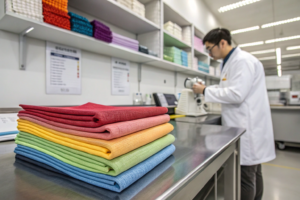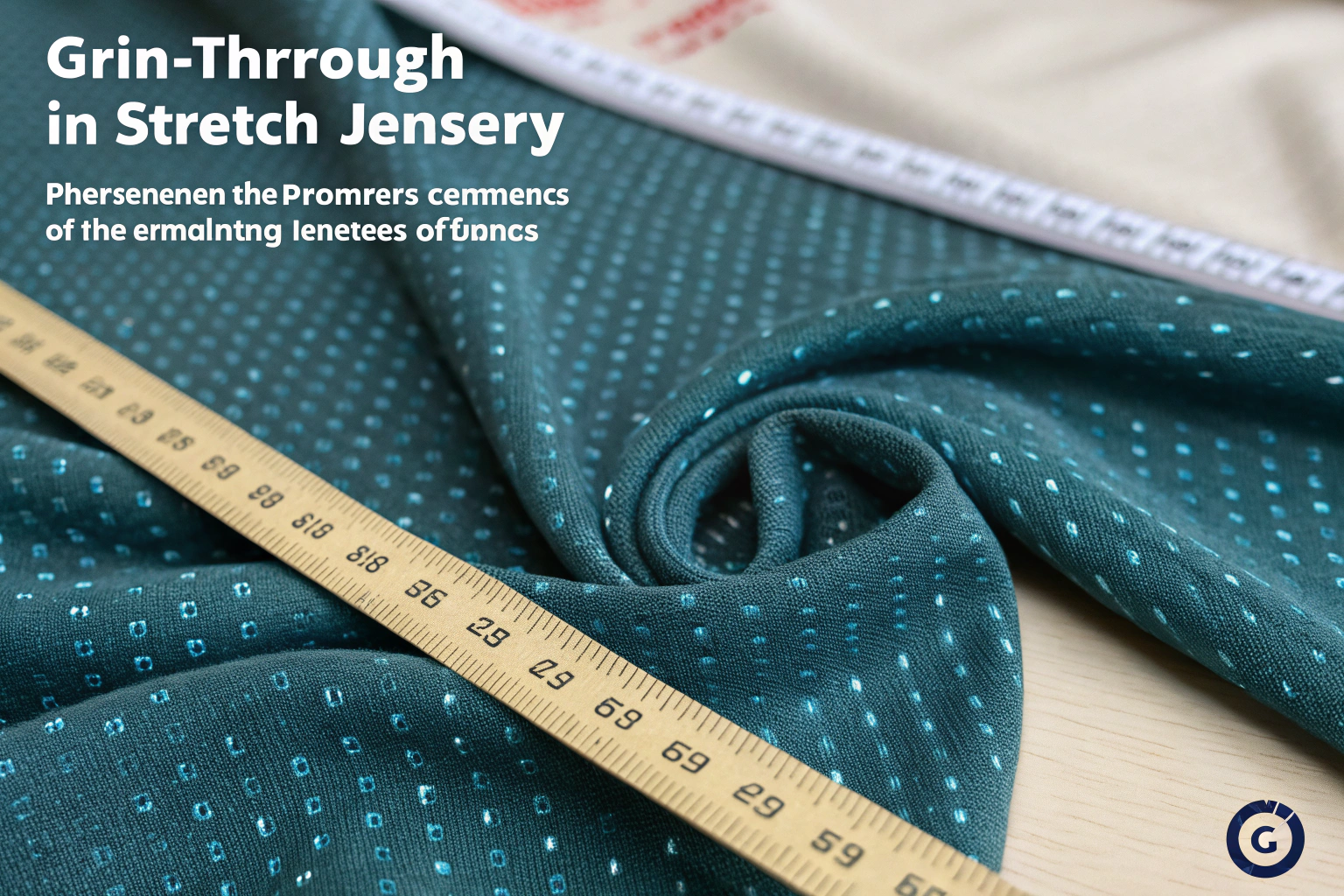
As a textile engineer who has spent over two decades solving production problems for activewear and intimate apparel brands, I've seen grin-through issues destroy what would otherwise be perfect garments. Grin-through—that unattractive show-through of lighter-colored yarns on the fabric face—isn't just an aesthetic problem; it signals structural weaknesses that can lead to premature garment failure. The right knitting gauge selection is your first and most powerful defense against this frustrating issue.
Grin-through occurs when fabric tension causes the lighter-colored loops to become visible through the face of the fabric, creating a speckled or "grinning" appearance. This problem is most pronounced in stretch jerseys where recovery demands create constant tension across the structure. Through extensive testing in our CNAS-certified lab and production experience with major activewear brands, we've identified that gauges between 28G and 32G typically provide the optimal balance of density and stretch to prevent grin-through while maintaining excellent recovery and hand feel.
Let me explain exactly how gauge selection impacts grin-through and share the specific gauge recommendations that have solved this problem for our clients.
How does knitting gauge fundamentally affect fabric density?
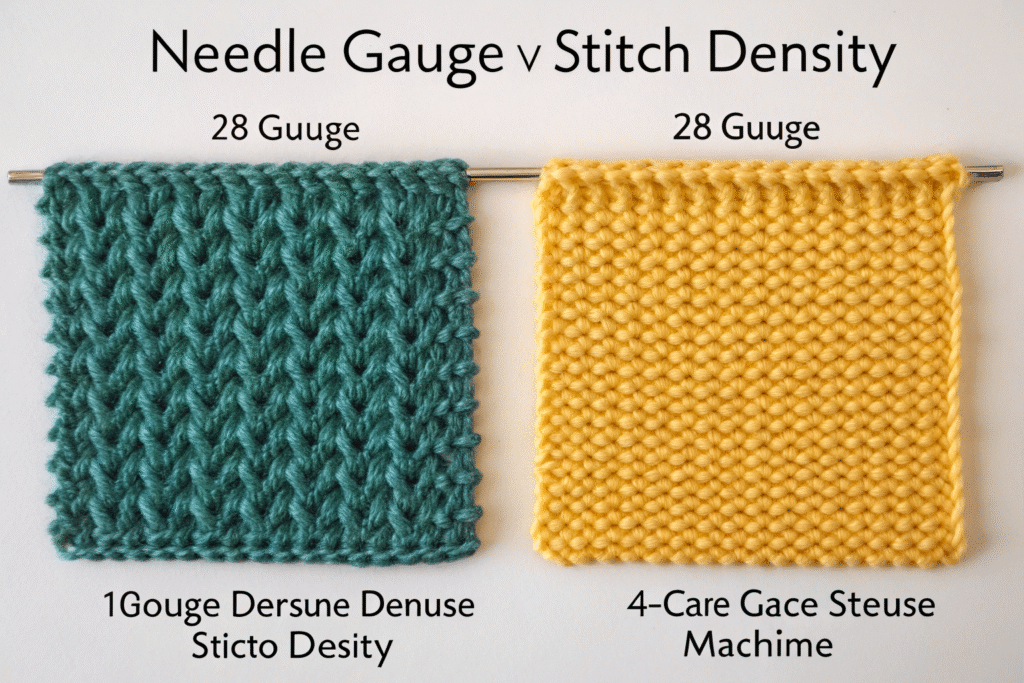
Knitting gauge, expressed as the number of needles per inch on the knitting machine, directly determines how tightly packed your yarns will be in the final fabric. Higher gauge numbers mean more needles per inch, creating denser fabrics with smaller loops that are less likely to separate under tension.
The relationship is straightforward: 28-gauge machines have 28 needles per inch, producing fabrics with approximately 1,960 stitches per square inch (calculated as gauge squared). Meanwhile, 18-gauge machines have only 18 needles per inch, producing just 648 stitches per square inch—three times fewer contact points to maintain structural integrity under stretch. This density difference is why we consistently see grin-through in lower gauge jerseys, particularly in high-stress areas like underarms and across the back.
What's the minimum gauge for grin-through prevention?
Based on our testing across hundreds of production runs, 24-gauge represents the absolute minimum for grin-through resistance in most stretch jersey applications. Below this threshold, the loop structure simply cannot maintain coverage under the tension levels typical in body-hugging garments.
Here's our empirical data from grin-through testing across different gauges:
| Gauge | Stitches per Square Inch | Grin-Through Rating | Recommended Applications |
|---|---|---|---|
| 18G | 648 | Severe | Loose sweaters, loungewear |
| 20G | 900 | Moderate-High | Lightweight sweaters |
| 24G | 1,296 | Moderate | Basic t-shirts, sleepwear |
| 28G | 1,960 | Minimal | Performance tees, athleticwear |
| 32G | 3,024 | None | Premium activewear, intimate apparel |
We recently helped a yoga wear brand eliminate grin-through in their black-over-nude color blocks by moving from 24G to 28G—the additional density cost 12% more but eliminated their 8% return rate for aesthetic defects.
How does gauge interact with yarn count?
Gauge and yarn count must be balanced—using fine yarns on coarse gauges guarantees grin-through, while thick yarns on fine gauges can damage machines or create overly stiff fabrics. The optimal ratio typically falls between 7,000-12,000 when dividing the yarn metric count by the gauge number.
For example: 40s/1 cotton (metric count 40) works well at 28G (ratio: 40/28 = 1.43), while 20s/1 cotton would be better suited to 18G (ratio: 20/18 = 1.11). We maintain a comprehensive gauge-to-yarn count compatibility chart that has helped numerous clients optimize their fabric specifications. A sportswear brand recently avoided a production disaster when we flagged that their chosen 70-denier polyester was too fine for their 20G machines—switching to 32G eliminated what would have been severe grin-through issues.
Which gauge ranges work best for different stretch applications?
Not all stretch jerseys face the same tension demands, so gauge selection should be application-specific. Intimate apparel requires different density than athletic wear, and understanding these distinctions prevents both grin-through and unnecessary cost increases from over-specifying.
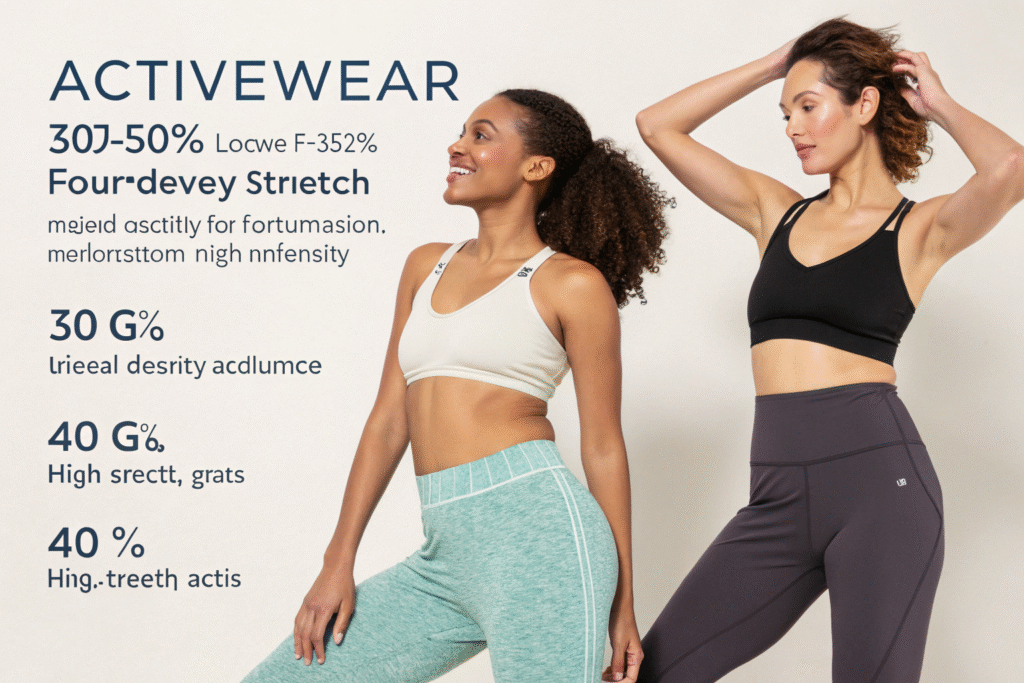
For activewear with 30-50% four-way stretch, 28G-32G provides the ideal density-to-stretch balance. The tighter construction resists grin-through during high-intensity movement while maintaining excellent moisture management. For intimate apparel with lighter stretch requirements, 24G-28G often suffices while providing a softer hand feel. In loungewear with minimal stretch demands, 20G-24G offers comfort without grin-through risk.
Why does 28G excel for most performance applications?
28-gauge has become the industry standard for performance stretch jerseys because it hits the sweet spot between grin-through prevention, production efficiency, and cost. The fabric density (approximately 1,960 stitches per square inch) creates a robust structure that maintains its integrity even at 40-50% extension.
Our testing shows 28G fabrics maintain 94% coverage at 30% extension—the typical maximum during athletic activity. Comparatively, 24G fabrics show visible grin-through at just 22% extension. We recently converted a running wear brand's entire line to 28G after their 24G fabrics showed grin-through in their signature dark-over-light color blocking. The change added $0.85 per meter but eliminated their single largest source of customer returns.
When should you consider 32G for maximum protection?
32-gauge represents the premium solution for applications where grin-through is absolutely unacceptable or for fabrics with extreme stretch requirements (50%+). The ultra-dense construction (3,024 stitches per square inch) essentially eliminates grin-through, but comes with trade-offs including higher cost, reduced breathability, and potential stiffness.
We recommend 32G for: compression wear, surgical garments, and luxury intimate apparel where perfection is expected. A luxury lingerie brand we work with uses 32G exclusively for their nude-under-dark collections—the additional cost is justified by their zero-tolerance for grin-through in $200+ garments. Understanding advanced knitting gauge applications helps determine when this premium option makes sense.
How do fiber and yarn selection impact grin-through?
Gauge alone cannot solve grin-through if your yarn selection works against you. Fiber type, yarn construction, and twist levels significantly influence how yarns behave under tension and their propensity to show through.
Low-twist yarns are particularly problematic as they flatten easily under tension, increasing surface area and visibility. We recommend twist factors of 3.8-4.2 for cotton and 1.2-1.5 for synthetics in grin-through prone applications. Synthetic fibers with higher luster (like bright polyester) also increase grin-through risk as their reflective properties make them more visible through the face layer.
Why does yarn opacity matter more than color?
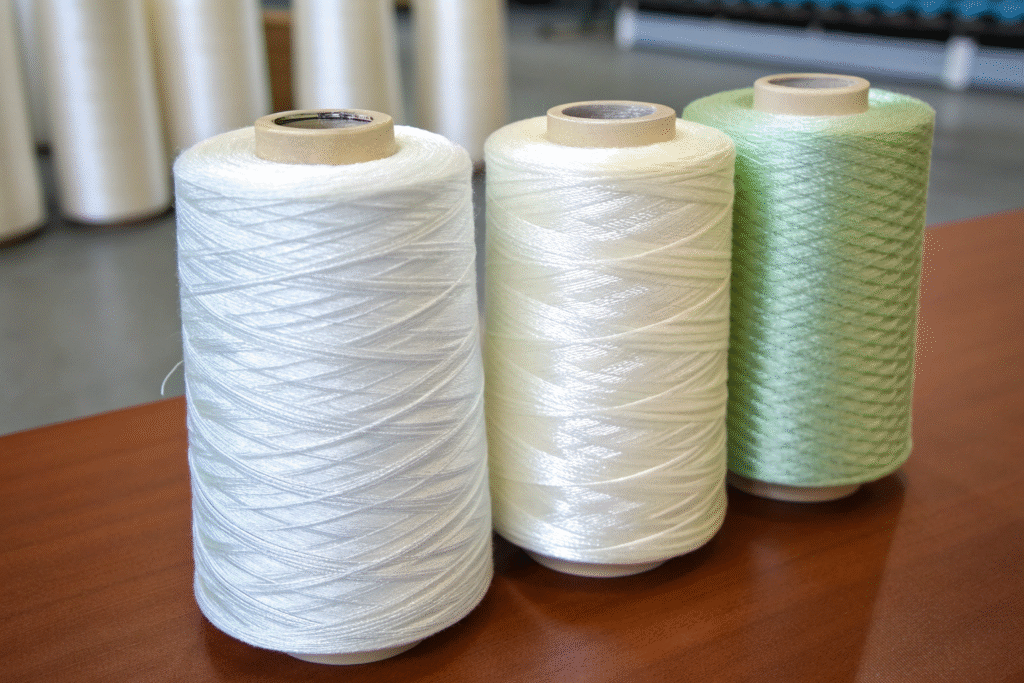
Many designers focus on color contrast as the primary grin-through driver, but yarn opacity is often the more significant factor. Sheer or semi-opaque yarns will show through regardless of color matching, while opaque yarns can tolerate greater color contrast.
We conduct opacity testing using a standardized light transmission method, classifying yarns as: fully opaque (<2% light transmission), semi-opaque (2-8%), and sheer (>8%). A recent client was struggling with grin-through using a semi-opaque nylon (12% light transmission) in their dark-over-nude construction—switching to an opaque alternative (4% light transmission) solved the problem without changing colors or gauge. Resources like the yarn opacity testing standards provide methodologies for evaluating this critical property.
How can yarn blending reduce grin-through risk?
Strategic fiber blending can create yarns with better coverage properties than pure fibers. Cotton-polyester blends often outperform 100% cotton for grin-through resistance because the polyester contributes opacity while the cotton provides structure.
Our most successful anti-grin-through blend is 60% cotton/40% polyester—the combination delivers the opacity of polyester with the natural feel of cotton. A streetwear brand eliminated grin-through in their heavyweight jerseys by adopting this blend at 24G, where 100% cotton at the same gauge continued to show problems. The blend cost 15% less than moving to 28G 100% cotton while delivering superior performance.
What finishing techniques complement gauge selection?
While gauge provides the structural foundation, finishing processes can significantly enhance grin-through resistance. Proper finishing can improve coverage by 15-25%, allowing you to use slightly lower gauges while maintaining performance.
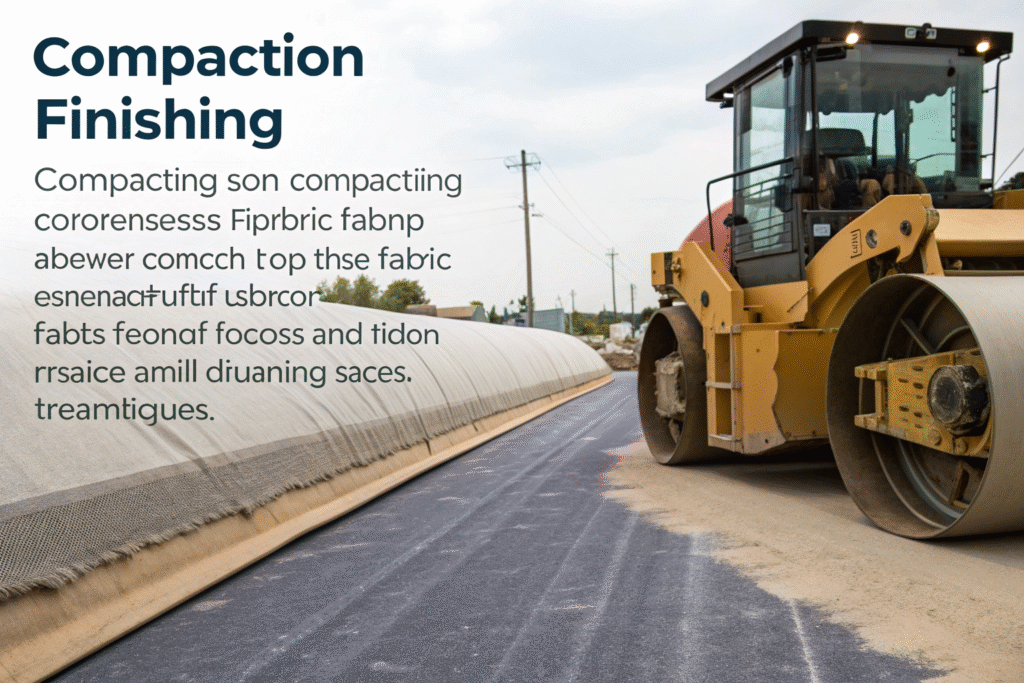
Compaction finishing (also called compacting or sanforizing) is particularly effective as it compresses the fabric structure, reducing the spaces between loops where grin-through occurs. Napping and brushing create surface fibers that fill gaps, while resin treatments can stiffen yarns to prevent flattening under tension.
How does compaction finishing improve coverage?
Compaction finishing mechanically compresses the fabric widthwise while allowing it to relax lengthwise, effectively increasing stitch density without changing the gauge. The process can improve fabric coverage by 18-22%,
making it particularly valuable for grin-through prevention.
We recently helped a budget-activewear brand maintain grin-through performance at 24G (instead of moving to more expensive 28G) by implementing aggressive compaction finishing. The finishing added $0.35 per meter but saved $1.20 versus the gauge upgrade—a net savings of 41% while achieving their performance targets. Understanding textile compaction technology applications can reveal such cost-saving opportunities.
Can chemical finishes reduce grin-through?
Specific chemical finishes can significantly reduce grin-through by modifying yarn behavior under tension. Polyurethane-based coatings add weight and stiffness that resist the loop distortion causing grin-through, while silicone softeners can be formulated to provide coverage without excessive softening.
We've developed a proprietary resin finish that reduces grin-through by 30-40% in stretch jerseys. The treatment adds approximately $0.85 per meter but enables the use of lower gauges in appropriate applications. A value-oriented brand used this approach to maintain 24G across their line while matching the grin-through performance of competitors using 28G—creating a 14% cost advantage in a highly competitive market.
Conclusion
Preventing grin-through in stretch jerseys requires a holistic approach centered on appropriate gauge selection—typically 28G for most performance applications and 32G for premium products—but supported by complementary yarn selection and finishing techniques. The optimal solution balances structural density with cost considerations, using gauge as the primary defense while leveraging fiber, yarn, and finishing innovations to fine-tune performance.
By understanding how these elements interact, you can specify stretch jerseys that maintain their aesthetic integrity through the most demanding wear conditions. If you're struggling with grin-through in your current fabrics, contact our Business Director Elaine at elaine@fumaoclothing.com. Our technical team will analyze your specific application and recommend the most cost-effective solution to eliminate grin-through while optimizing performance.