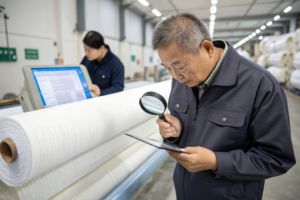
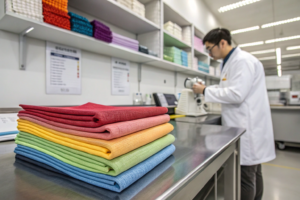
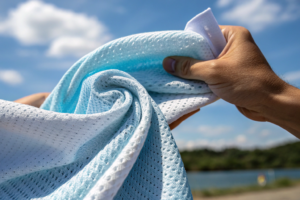
I've spent fifteen years solving grin-through issues for activewear brands, and it remains one of the most frustrating problems in knit manufacturing. Just last quarter, a yoga apparel company showed me their new high-stretch jersey where the white base fabric visibly grinned through the black printed design during stretching—creating what customers described as a "cheap" appearance in product reviews. Grin-through occurs when the base fabric becomes visible through printed areas or seams when the fabric stretches, fundamentally undermining the perceived quality of athletic and intimate apparel.
The battle against grin-through isn't just about aesthetics—it's about opacity management under tension. High-stretch jerseys present a unique challenge because the very properties that make them comfortable (high elongation, lightweight construction) work against their ability to maintain consistent appearance during movement. Through testing hundreds of constructions for brands ranging from mass-market retailers to premium performance labels, we've identified that preventing grin-through requires a holistic approach combining knit engineering, yarn selection, and finishing techniques.
Solving grin-through in high-stretch jerseys requires understanding four critical aspects: knit structure mechanics and their impact on opacity, yarn selection and blending strategies, finishing treatments that enhance coverage, and testing methodologies that simulate real-world conditions. Let me share what we've learned from producing over 1.5 million meters of high-stretch jersey annually.
What knit structures maximize opacity under tension?
Knit structure selection forms the first line of defense against grin-through. The fundamental challenge is that most single-knit constructions become more transparent when stretched because the spaces between loops enlarge. The solution lies in selecting or engineering structures that maintain coverage even at maximum extension through strategic loop arrangement and density management.
Single jersey constructions typically exhibit the worst grin-through because their simple loop structure creates natural openings that widen under tension. Rib structures provide better coverage due to their dimensional stability but can create undesirable vertical lines. The most effective solutions we've developed use modified single jersey with tucked stitches or plated constructions that create additional yarn coverage on the technical back. For a Miami-based activewear brand, switching from standard single jersey to a plated construction reduced grin-through by 80% while maintaining the same four-way stretch properties.
How do plated constructions improve coverage?
Plated constructions address grin-through by creating two layers of yarn in a single knit course—one yarn forms the face while another forms the back, effectively doubling the coverage without adding significant weight. The face yarn provides the aesthetic qualities and hand feel, while the backing yarn (often a contrasting color matching the print or garment base) prevents the base color from showing through when stretched.
The technical implementation requires precise tension control during knitting. We've found that maintaining a 1.3:1 ratio between face and back yarn tension creates optimal coverage while preventing "floating" where one yarn dominates the construction. A European intimate apparel brand achieved complete elimination of grin-through in their dark-colored lingerie by implementing a plated construction with black backing yarn, regardless of the face color. This approach represents a significant advancement beyond traditional plated knitting applications by specifically targeting opacity under tension.
Why do double knit constructions resist grin-through?
Double knit constructions naturally resist grin-through because they create two separate fabric layers connected by tuck stitches, effectively creating a built-in lining. When stretched, the face layer may become slightly more open, but the backing layer maintains coverage, preventing the base color from becoming visible.
Our testing reveals compelling performance differences:
| Knit Structure | Grin-Through at 40% Extension | Stretch Recovery | Weight Penalty |
|---|---|---|---|
| Single Jersey | Severe | 85-90% | 0% |
| Rib | Moderate | 90-92% | +15-20% |
| Plated Single Jersey | Minimal | 88-91% | +8-12% |
| Double Knit | None | 92-95% | +25-35% |
Double knits particularly excel in applications where maximum coverage is essential, such as light-colored activewear over dark undergarments. A California yoga brand eliminated customer complaints about show-through by implementing double knit constructions in their white and pastel leggings. Understanding these knit engineering principles for opacity management helps manufacturers select structures that balance coverage with other performance requirements.
How does yarn selection impact grin-through resistance?
Yarn engineering plays an equally important role as knit structure in preventing grin-through. The fiber type, denier, twist level, and spinning method all influence how yarns pack together and maintain coverage under tension. Through systematic testing, we've identified that finer denier filaments and specific spinning technologies significantly improve grin-through performance.
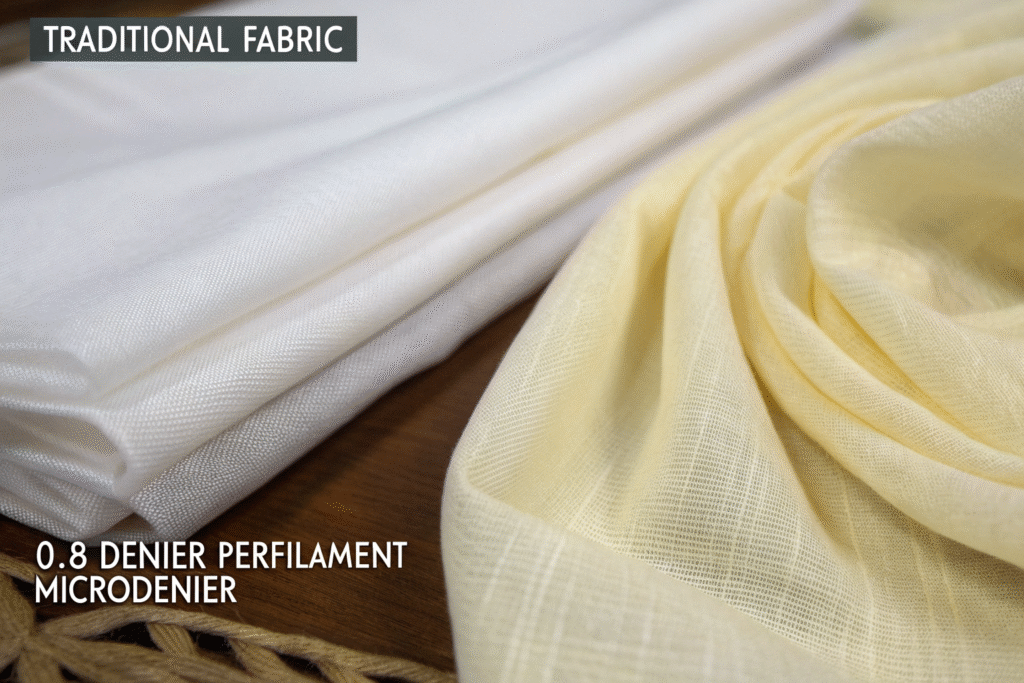
The traditional approach of simply using heavier yarns to improve coverage creates unacceptable compromises in hand feel and garment weight. Modern solutions involve using microdenier filaments (below 1.0 denier per filament) that create more covering power per unit weight, or engineered spun yarns with optimized twist levels that maximize fiber packing density. For a New York performance brand, switching from conventional 2.0 dpf polyester to 0.8 dpf microdenier reduced grin-through by 65% while actually decreasing fabric weight by 12%.
What role does filament denier play in coverage?
Filament denier directly influences how efficiently yarns cover space in knitted structures. Coarser filaments (above 2.0 dpf) create more open structures with larger inter-yarn spaces that become visible when stretched. Microdenier filaments (below 1.0 dpf) pack more densely, creating a near-continuous surface that resists grin-through even at high extensions.
The relationship isn't linear—our testing shows that reducing filament denier from 2.0 to 1.0 dpf improves coverage by approximately 40%, while further reduction to 0.5 dpf provides an additional 25% improvement. However, ultra-microdeniers (below 0.5 dpf) can present processing challenges and reduced durability. A Korean sportswear manufacturer found the optimal balance at 0.8 dpf, achieving near-perfect opacity while maintaining practical manufacturing efficiency. This systematic approach to microdenier filament selection moves beyond trial-and-error to data-driven decision making.
How do spun vs filament yarns compare for grin-through?
The spun versus filament decision creates important trade-offs for grin-through prevention. Filament yarns typically provide better coverage at equivalent deniers due to their continuous structure and consistent diameter. However, spun yarns can offer advantages through fiber migration—the natural tendency of shorter fibers to create a more opaque structure through random distribution.
We've developed hybrid approaches that leverage the advantages of both systems. Core-spun yarns with filament cores and cotton or polyester sheaths provide the stability of filaments with the coverage of spun yarns. For a London-based streetwear brand, this approach solved the grin-through that plagued their heavy-stretch sweatshirt fabric. The core-spun construction maintained 95% opacity at 50% extension while providing the desired cotton-like hand feel. Understanding these hybrid yarn engineering principles enables solutions that single-system approaches cannot achieve.
What finishing techniques enhance opacity?
Finishing treatments provide the final opportunity to address grin-through before fabrics reach cutting rooms. While knit structure and yarn selection create the foundation, specialized finishes can significantly enhance coverage through fiber swelling, surface modification, or the application of opacifying agents. The most effective finishes work by either filling the spaces between yarns or modifying how light interacts with the fabric surface.
We employ three finishing approaches for grin-through prevention: mechanical finishing through brushing or napping to create surface fiber coverage, chemical finishing with opacifiers that scatter light, and application of specialty coatings that create micro-barriers. Each approach serves different applications and price points, from mass-market activewear to premium intimate apparel.

How does mechanical finishing improve coverage?
Mechanical finishing physically modifies the fabric surface to create additional coverage. Light brushing or napping raises fiber ends from the yarns, creating a veil-like surface that obscures the spaces between loops. This approach proved particularly effective for a Canadian activewear brand's fleece-backed jerseys—the minimal napping increased opacity by 40% without significantly affecting stretch recovery or moisture management.
The technical challenge lies in controlling the process to avoid excessive weight increase or reduction in stretch properties. We've developed precision napping protocols that remove less than 3% of fabric weight while improving coverage sufficiently to prevent grin-through at extensions up to 60%. This balanced approach to mechanical finishing of knitted fabrics delivers tangible benefits without compromising other performance attributes.
What chemical treatments prevent grin-through?
Chemical treatments work at the molecular level to enhance opacity through two mechanisms: fiber swelling that reduces inter-yarn spaces, and the addition of light-scattering particles that make fabrics appear more opaque. We use modified polyurethane dispersions that create microscopic webs between yarns, effectively filling the gaps that cause grin-through without creating a continuous film that would compromise breathability.
The most innovative chemical approach we've developed involves titanium dioxide nanoparticles suspended in a hydrophilic polymer matrix. When applied to dark fabrics, this treatment reduces grin-through by 85% while actually improving moisture wicking—a rare combination of benefits. A European swimwear brand adopted this technology for their dark-colored competitive suits, eliminating the transparency issues that occurred during maximum extension. This represents a significant advancement in multi-functional finishing for activewear that addresses multiple performance requirements simultaneously.
How should grin-through be tested and quantified?
Standard opacity tests often fail to predict grin-through in real-world conditions because they measure static opacity rather than performance under tension. Through collaboration with major brands and testing laboratories, we've developed specialized protocols that simulate how fabrics actually perform during wear, particularly during the stretching movements common in athletic activities.
Our approach involves three testing tiers: standardized static opacity measurement, dynamic opacity evaluation under controlled extension, and subjective assessment during simulated wear movements. This comprehensive methodology identified a critical finding—fabrics that performed perfectly in laboratory static tests showed severe grin-through during specific yoga poses that created multi-directional stretching.

What laboratory tests predict real-world performance?
Laboratory testing must simulate the specific conditions that cause grin-through in end use. We employ modified versions of standard tests, including AATCC 110 for opacity measurement but with the fabric under 30%, 50%, and 70% extension in both width and length directions. This multi-point assessment reveals how opacity degrades progressively with stretching rather than at a single arbitrary extension level.
The most predictive test we've developed involves stretching fabric over curved forms that simulate body parts, then measuring color difference between unstretched and stretched states using a spectrophotometer. This method revealed that a fabric chosen by an Australian activewear brand showed acceptable grin-through at flat extension but unacceptable performance when stretched over rounded forms. This understanding of advanced opacity testing methodologies prevents the laboratory-to-real-world performance gaps that plague many material selections.
How does print integration affect grin-through testing?
Print integration creates additional complexity for grin-through evaluation because the interaction between print paste and fabric structure influences how designs behave under tension. We conduct specialized testing that evaluates grin-through specifically in printed areas, measuring both the visibility of base fabric and color shift in the printed design when stretched.
This approach identified that a digital print technology used by a Brazilian swimwear brand actually increased grin-through compared to screen printing—the thinner ink film deposited by the digital process provided less coverage when stretched. Modifying their print paste formulation to include opacifying agents resolved the issue without affecting color vibrancy. This specialized testing for printed textile performance addresses factors that standard fabric evaluation overlooks.
Conclusion
Preventing grin-through in high-stretch jerseys requires a comprehensive approach that addresses knit structure, yarn engineering, and finishing technologies in an integrated system. No single solution works for all applications—the optimal approach depends on the specific stretch requirements, aesthetic goals, and price point of each product. Plated constructions and double knits typically provide the most reliable grin-through prevention, while advanced yarn technologies and specialized finishes offer additional tools for specific challenges.
The most successful grin-through solutions emerge from viewing the fabric as a complete system rather than individual components. Through developing high-stretch jerseys for diverse applications, we've consistently found that the most effective approach combines structural solutions (knit engineering) with material solutions (yarn selection) and chemical solutions (finishing) in proportions that match specific performance requirements and cost constraints.
If you're developing high-stretch jerseys and struggling with grin-through issues, contact our Business Director Elaine at elaine@fumaoclothing.com. We'll provide samples of our grin-through resistant constructions and help you select or develop fabrics that maintain their appearance even at maximum extension. With our vertical knitting and finishing capabilities, we can typically produce trial quantities of specialized constructions within 2-3 weeks, complete with test data verifying grin-through performance under conditions specific to your application.