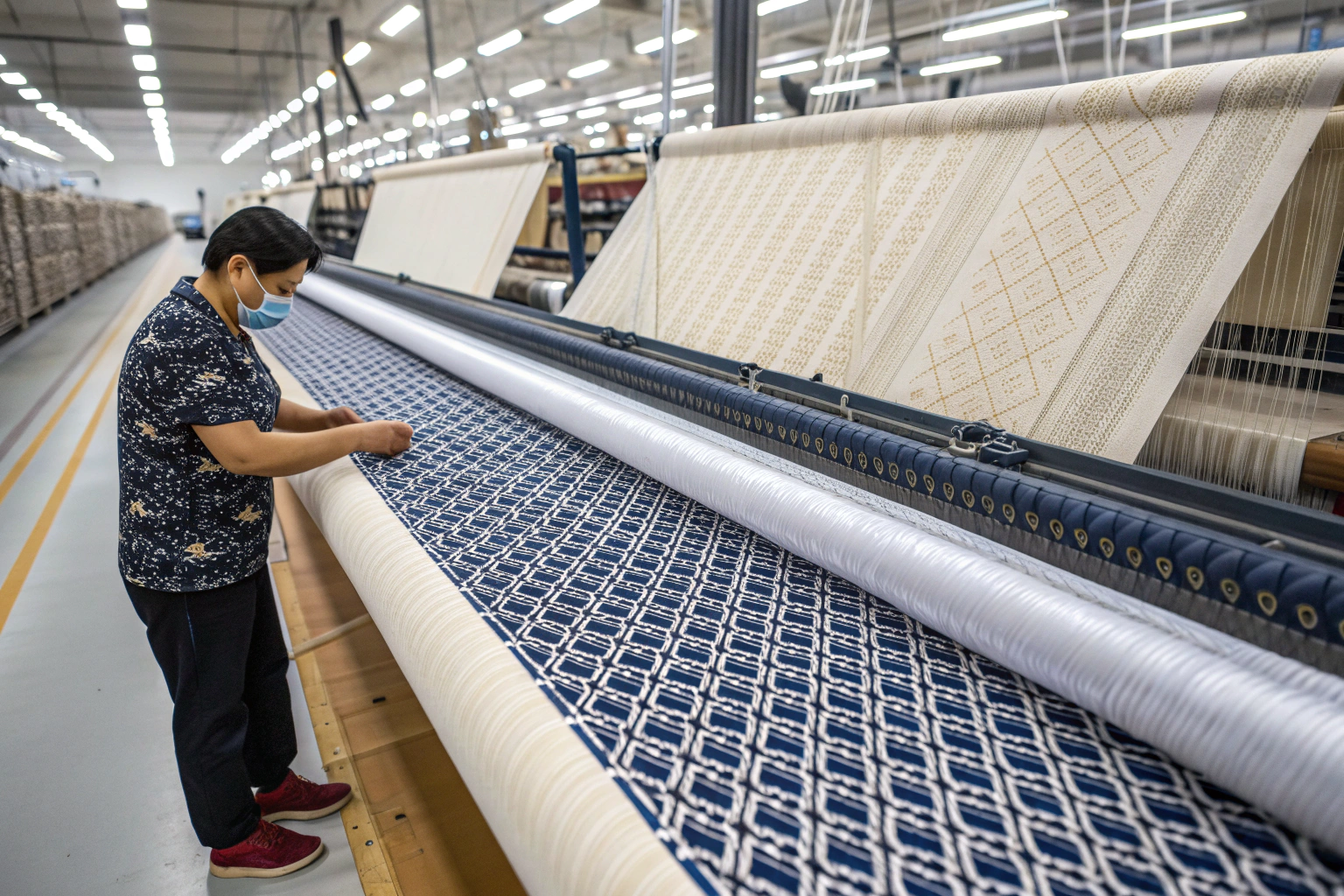
For fabric buyers and fashion brand owners, the term "double-cloth" often sounds complex, maybe even a bit intimidating. You might wonder if it's simply two fabrics glued together, or a process so complicated that it will blow your budget and timeline. I get it. You're sourcing fabrics from China, juggling quality, cost, and logistics, and the last thing you need is a production mystery. But here's the reality: double-cloth isn't just a fabric; it's a sophisticated solution for creating garments with structure, reversible textures, and high-end appeal. And when you understand the process, it becomes a powerful tool in your collection.
Double-cloth, or double-weave, is exactly what it sounds like: a fabric constructed on a loom that weaves two separate layers of cloth simultaneously. These layers can be completely independent, or they can be strategically woven together at specific points to create a single, unified fabric with remarkable properties. Think of it as building a two-story house where the floors can be connected or separate, depending on what you need. The process involves using at least four sets of yarns—two for the top layer's warp and weft, and two for the bottom layer's—all interlaced on a specialized loom to create a fabric that is greater than the sum of its parts.
Now, why should you, as someone who needs to ship fabric from Asia to the US or Europe, care about this? Because understanding the "how" unlocks the "why." It explains the pricing, the lead times, and the incredible design possibilities. Over my 20 years at Shanghai Fumao, rooted in the heart of Keqiao's textile cluster, I've seen firsthand how mastering this process can solve a buyer's biggest problems: creating substantial winter coatings without adding a lining, developing reversible jackets that double a garment's style options, or engineering a high-performance fabric with a beautiful face and a functional, moisture-wicking back. It’s about delivering value that goes skin-deep.
How Does Double-Weave Construction Actually Solve My Fabric Sourcing Problems?
The biggest headache for my clients, like Ron, a 44-year-old buyer from the US, is often finding a fabric that ticks multiple boxes. You want a coat fabric that's warm and structured on the outside but soft and comfortable against the skin. Traditionally, that meant sourcing a shell fabric and then a separate lining, adding cost, time, and complexity to your supply chain. Double-cloth eliminates this. It's an integrated solution. When we talk about the construction process, we're really talking about how we engineer solutions for you before a single yard is even woven.
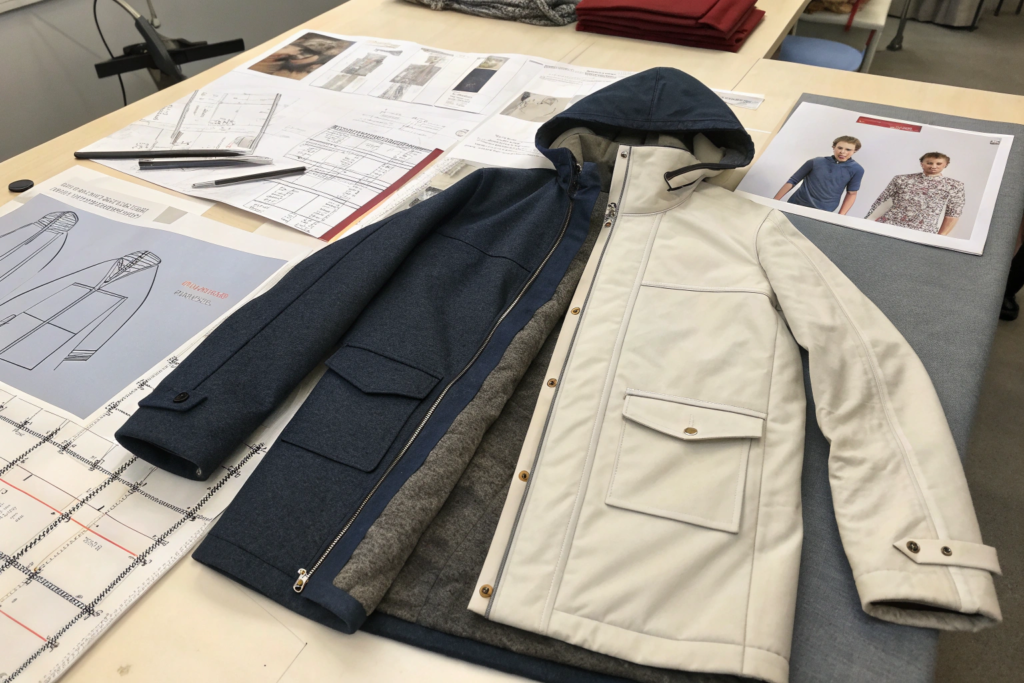
Why is double-cloth better than using separate face fabric and lining?
From a sourcing perspective, it's a game-changer for efficiency and quality. When you order a traditional lined garment, you are essentially managing two supply chains: sourcing the outer fabric, sourcing the lining fabric, then paying a factory to cut and join them. That’s double the logistics, double the quality control points, and double the potential for things to go wrong. With double-cloth, you have one supplier, one production line, and one fabric to inspect.
Here's a concrete example from our own experience producing double-cloth for European fashion brands who were struggling with lining mismatches. In early 2023, a German outerwear brand came to us with this exact problem. Their lined wool coat had a 15% defect rate due to the lining shrinking at a different rate than the outer shell after customer washing. We developed a double-cloth for them: the face was a luxurious 80/20 wool-nylon blend for structure and durability, and the back layer was a 100% viscose for comfort. Because the two layers were woven together, their dimensional stability was synchronized. We ran a simulated home laundry test in our CNAS-accredited lab and confirmed the shrinkage was under 3% for both layers, solving their quality issue at the source. They went from managing two suppliers to one, and their defect rate dropped to under 2%. It simplified their entire operation.
How do you control the weight and warmth of a double-woven fabric?
This is where the engineering gets really interesting. We aren't just weaving two layers; we are designing the air between them. The weight and warmth are controlled by three main factors during construction: the yarn count, the weave density, and the method of joining the layers.
For a lighter-weight double-cloth, say for a spring jacket or a designer shirtdress, we might use finer yarns for both layers and weave them relatively loosely. The connection points might be further apart, creating small, airy pockets. For a heavy winter coat, we do the opposite. We use thicker, often woolen or blended yarns. We increase the picks per inch (the density of the weft yarns) to create a tighter, more wind-resistant structure. And crucially, we can even weave a third set of yarns—a "stuffing" or "wadding" yarn—that floats in between the two layers, dramatically increasing warmth without adding visible bulk to the face of the fabric. This is essentially creating a built-in, fabric-based insulation. In November 2022, we worked with a Canadian outdoor brand to create a double-cloth for their parka line. By using a recycled polyester "wadding" yarn between a water-repellent treated outer face and a soft, brushed inner layer, we achieved a warmth-to-weight ratio that eliminated the need for a separate detachable liner, saving them roughly $4.50 per garment in manufacturing costs.
What Are the Key Technical Steps in Manufacturing Double-Cloth?
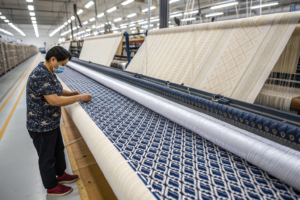
Moving from the benefits back to the loom, the actual manufacturing process requires precision at every stage. It’s not something every mill can do well, because it demands a deep understanding of yarn tension, weave design, and loom mechanics. At Shanghai Fumao, our 20+ R&D experts and skilled weavers treat this as a craft, blending traditional techniques with modern, AI-driven quality control. Let me walk you through the critical stages we focus on in our Keqiao facility.
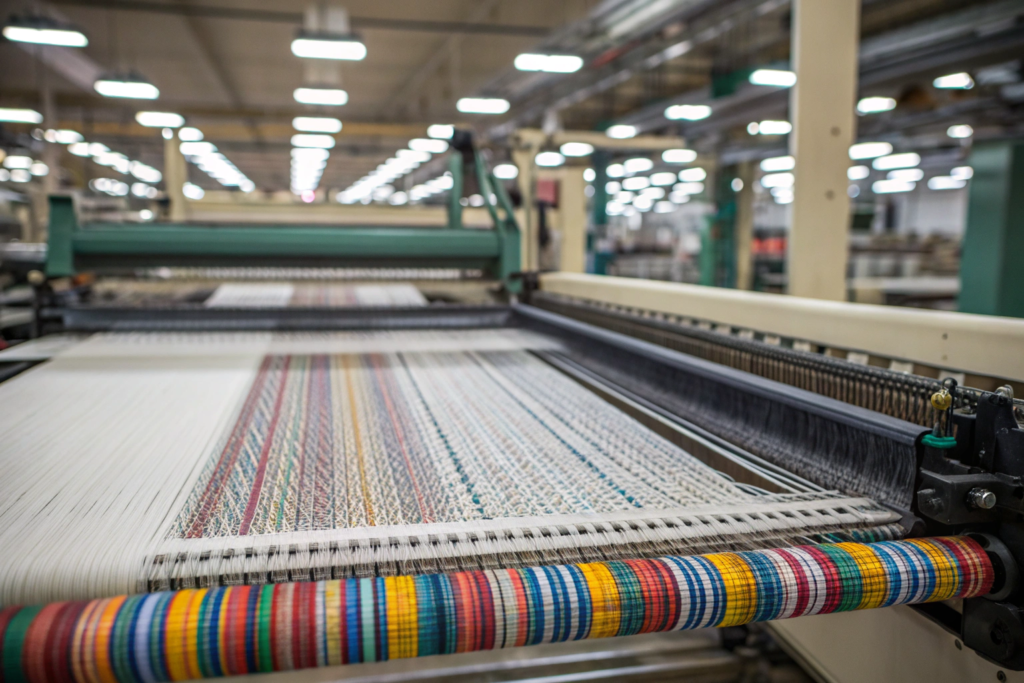
How do you set up the loom for a double-weave pattern?
The setup is the most critical part, and it all starts with the design and the warp beam. Unlike a single cloth where you might have one set of warp yarns, double-cloth requires at least two, and often more, separate warp beams. Each beam holds the warp yarns for one layer. Why separate beams? Because each layer might need to feed at a different tension. A textured, stretchy back layer, for example, might need to be fed more loosely than a stable, flat front layer.
We use advanced computerized systems to calculate the precise let-off rate for each beam. In our mill, we recently produced a double-cloth for a high-end US brand that wanted a neoprene-like structure for a utility vest. The face was a stiff, technical polyester, and the back was a soft, circular-knit-style surface. Getting that contrast required the back beam to feed yarn 15% faster than the front beam during weaving. Our technicians, using data from our previous projects archived in our internal knowledge base, dialed in these tensions before a single shot was woven, preventing the common issues of puckering or tension breaks that can ruin an entire run.
Can you create patterns and textures in double-cloth, and how?
Absolutely. This is where double-cloth becomes an art form. Because we are weaving two layers, we can play with color, fiber, and structure in ways impossible with single-layer fabrics. Patterns are created by selectively swapping the layers. Imagine weaving a plaid on the top layer and a solid on the bottom. By having the design software instruct the loom to switch which layer is on top at certain interlacing points, the solid bottom layer can "pop up" to the surface, creating a geometric pattern on the face. This is how you get those beautiful, intricate reversible blankets and scarves.
We also use different weave structures within each layer. For a recent project with a French luxury scarf brand, we wove a top layer in a fine, lustrous satin weave using silk, and a bottom layer in a soft, insulating twill using cashmere. The two layers were joined only at the very edges, creating a true, two-in-one fabric. The client was able to market it as a "reversible silk-cashmere scarf," a product that commands a premium price. The precision required for this, especially ensuring the delicate cashmere weft doesn't get damaged during the high-speed weaving, comes down to the skill of our weavers and the quality of our Italian-made looms, which are known for their gentle yet precise yarn handling. (Here's a little insider tip: we regularly maintain our looms to a tolerance of 0.1mm to ensure this level of quality).
How Long Does Double-Cloth Production Take, and How Do I Plan for It?
This is always the million-dollar question from my clients. You have a season to hit, a launch date to meet. And as you've learned from the background on Chinese manufacturing, timing is everything. Double-cloth, with its complexity, isn't a "grab-and-go" fabric, but with the right planning, it can fit seamlessly into your production calendar. It’s all about aligning the technical process with the realities of the Chinese production calendar.
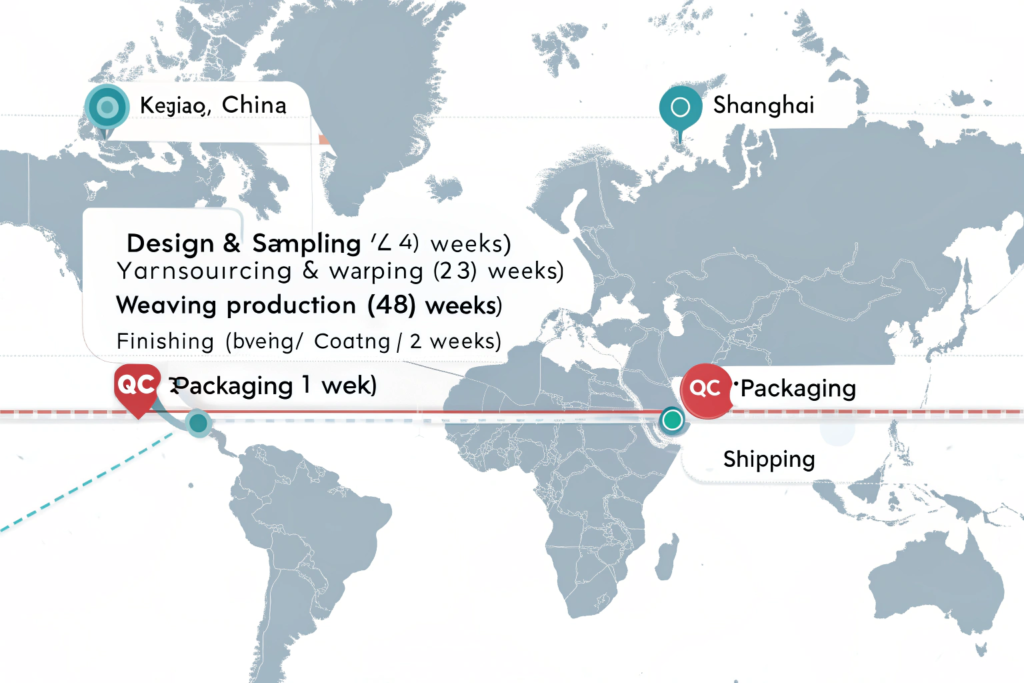
What are the realistic lead times for custom double-cloth orders from China?
Let’s be realistic. A standard fabric from stock might ship in a week. Custom double-cloth is a different beast. You're not buying a product; you're commissioning an engineering project. For a completely new double-cloth design—meaning we are developing the weave structure from scratch based on your tech pack—you should budget 10 to 14 weeks from sample approval to bulk shipment. This includes time for us to program the loom, create a sample length (usually 5-10 meters), get your feedback, make any adjustments, and then scale up for bulk production on multiple looms.
If you have an existing design or we have a base structure similar to what you need, we can often cut that down to 8-10 weeks. The key variable is the yarn. If we need to specially spin or dye a yarn for you, that adds 2-3 weeks. This is where understanding the peak production periods in China, especially March-May and August-October, is vital. Booking your loom time during these periods requires even more lead time. During the slower months, like last July, we were able to turn around a complex double-cloth order for an Australian swimwear cover-up line in just 7 weeks because our looms and finishing lines had immediate availability. We actually expedited their order because we had the capacity.
How can I use the Chinese holiday calendar to my advantage with complex fabrics?
Proactive planning is your best friend here. The background you provided mentioned a European brand planning six weeks before Chinese New Year. That's smart, but for double-cloth, I'd suggest an even more aggressive timeline. Because the setup is so intricate, you don't want to be in the middle of a sampling run right as a 3-4 week shutdown begins.
My advice is to think in reverse from your desired in-hands date. If you need fabric in your warehouse by, say, August 1st for your Fall/Winter line, and we estimate 12 weeks of production, we need to start in early May. But May is a peak month. So, we should have your design finalized, yarns selected, and the sample approved by the end of March. This means the critical technical work is done before the post-CNY rush fully hits. We can then schedule your production run for April or May with confidence.
I recall working with a London-based tailoring brand in 2023. They had a brilliant design for a double-cloth suiting fabric but completely forgot about China's Golden Week in October. They sent us the request on September 20th, expecting samples in two weeks. We had to explain that the mills and our own offices would be closed. Instead of losing momentum, we used that time. We had a detailed video call on September 28th, finalizing every technical detail of their GOTS-certified organic cotton and recycled polyester double-cloth. When we returned from the holiday on October 8th, our R&D team immediately started programming the loom. By planning through the holiday, we turned a potential delay into a focused start, and they had their 50-meter strike-off by early November.
How Do You Ensure Consistent Quality for Double-Cloth from China?
Quality. It's the word on every buyer's mind, especially when dealing with complex textiles shipped halfway around the world. You can't just hop over to the factory for a quick check. At Shanghai Fumao, we've built our entire operation around this challenge. Our CNAS-accredited lab and our professional QC team aren't just buzzwords; they are the final, critical checkpoints in the double-cloth creation process, ensuring that what we pack in the container is exactly what you approved.
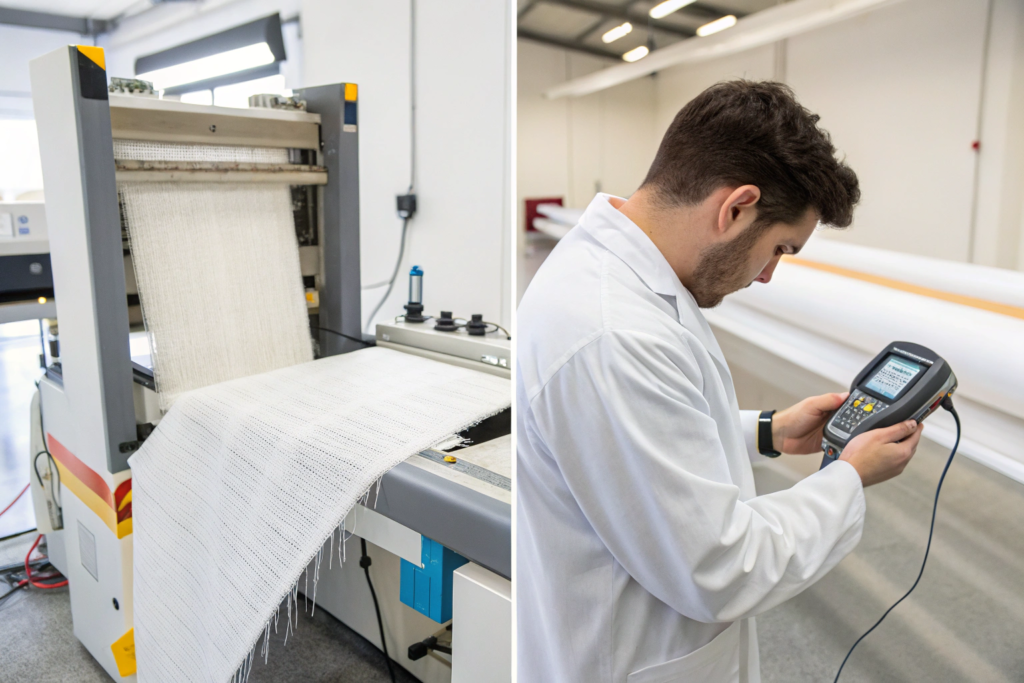
What specific defects are common in double-weave, and how do you catch them?
Double-cloth has its own unique set of potential problems. It's not just about a broken thread. Because you're managing two layers, the defects can be hidden. One common issue is "layer misregistration," where the pattern on the top layer doesn't perfectly align with the joining points to the bottom layer, causing a subtle but visible distortion. Another is "tension bubbling," where one layer is slightly looser than the other, creating a pucker or bubble in the final fabric that can ruin the drape of a garment.
Our inspection process is multi-layered. First, during weaving, our automated looms have sensors that stop the machine if a warp thread breaks on either layer. This immediate halt prevents a small break from turning into yards of damaged fabric. Then, after the fabric is woven and finished, it goes to our dedicated fabric inspection factory. Here, trained inspectors run every single meter over an illuminated table. For double-cloth, they are trained to look specifically at the edges and at high-stress points in the pattern. We also use a calibrated thickness gauge to randomly measure the fabric's thickness. For a recent order of double-cloth for a US workwear brand, the spec called for a thickness of 2.2mm +/- 0.1mm. Our QC team flagged a roll where the gauge read 2.15mm. It was still within tolerance, but we investigated and found a slight tension variation on one of the warp beams. We corrected it for the remaining production, ensuring absolute consistency. That's the level of detail we insist on.
Can you test the performance of double-cloth (like water resistance or breathability) before shipping?
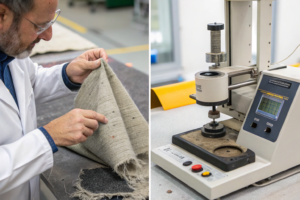
Absolutely. And we do it in our own lab, which saves you the time and cost of sending samples to a third party like SGS or ITS, though we are fully equipped to pass those tests too. Because double-cloth is often used in outerwear and performance wear, these tests are crucial. We test for everything from colorfastness to light and perspiration to more complex physical properties.
For water-resistant double-cloths, we use a spray test (AATCC 22) to rate how well the surface repels water. For fabrics that claim to be breathable, we use a "moisture vapor transmission rate" test. We actually did this for a client from Sweden who wanted a waterproof but breathable double-cloth for a cycling jacket. The face was a tightly woven polyester with a DWR coating, and the back was a more open, moisture-wicking structure. Our lab tests showed the fabric had a hydrostatic head of over 10,000mm (making it waterproof) and an MVTR of 8,000 g/m²/24hrs (making it breathable). We provided them with the certified test report from our CNAS lab, which gave them the confidence to place a bulk order without waiting for their own independent testing, saving them three weeks in their development cycle.
Conclusion
Understanding the process of creating double-cloth and double-weave fabric demystifies what can seem like a complicated textile choice. It's not magic; it's a precise, engineered process that starts with a design, moves through careful loom setup and tension control, and ends with rigorous quality inspection. By seeing it as a series of manageable steps, you can appreciate its value—not just as a fabric, but as a solution for creating superior garments with built-in functionality, simplified supply chains, and a high-end, complex aesthetic.
For you, as a buyer navigating the intricacies of global sourcing, this knowledge is power. It allows you to ask the right questions, set realistic timelines that respect the Chinese manufacturing calendar, and ultimately, bring more innovative and higher-quality products to your market without unnecessary delays or cost overruns.
If you have a project that demands the structural integrity, design flexibility, or pure luxury of double-cloth, I invite you to bring that challenge to us. At Shanghai Fumao, we have the looms, the lab, and the 20 years of hands-on experience to turn your vision into a fabric you can hold, test, and trust. Let's co-create your next best-seller. Contact our Business Director, Elaine, directly at elaine@fumaoclothing.com to discuss your specific needs and start the conversation. We're ready when you are.