As a fabric supplier who has helped hundreds of startups and small brands navigate their first production runs, I understand the delicate balancing act you face: you need enough fabric to launch your collection profitably, but not so much that you're stuck with dead stock that ties up capital and storage space. The "optimal MOQ" isn't a single magic number—it's a calculation that balances production efficiency, cost per meter, and your actual business needs. Getting this wrong in either direction has sunk many promising brands before they even got started.
The optimal MOQ for small-batch development typically ranges from 500-2,000 meters depending on fabric complexity, with sweet spots around 800-1,200 meters for most wovens and 600-1,000 meters for knits. This range allows economical production while minimizing overstock risk. Through working with emerging designers and DTC brands, we've identified that the true optimal MOQ is where your cost per meter becomes reasonable without creating inventory that would take more than 6-9 months to sell through. I've seen brands order 5,000 meters to get a slightly better price, only to discover three years later that they've only sold through half of it—effectively making their "cheaper" fabric twice as expensive due to tied-up capital.
Let me break down exactly how to calculate your ideal MOQ based on your specific business model and fabric requirements.
How does fabric type influence minimum order quantities?
Different fabric constructions have dramatically different minimum economical production runs due to their manufacturing processes and setup requirements. Understanding these technical constraints helps you select fabrics that match both your creative vision and your business scale.
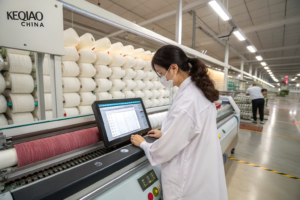
Woven fabrics typically have higher MOQs than knits because loom setup is more complex and time-consuming. A basic cotton poplin might have an MOQ of 800-1,200 meters, while complex jacquards often require 1,500-3,000 meters. Knits generally start at 500-800 meters because knitting machine setup is faster. Specialty fabrics with complex finishing or functional treatments usually command higher minimums—for instance, waterproof laminations might start at 2,000 meters due to coating line setup requirements.

What are typical MOQ ranges by fabric category?
Based on our production data across thousands of small-batch orders, here are realistic MOQ expectations:
| Fabric Type | Typical MOQ Range | Key Factors Affecting MOQ |
|---|---|---|
| Basic Cotton Wovens | 800-1,500 meters | Width, yarn count, finishing requirements |
| Synthetic Knits | 600-1,000 meters | Gauge, composition, weight |
| Complex Jacquards | 1,500-3,000 meters | Pattern complexity, number of harnesses |
| Performance Fabrics | 1,000-2,000 meters | Special finishes, certifications |
| Natural Fiber Blends | 700-1,200 meters | Fiber availability, spinning requirements |
We recently helped a sustainable activewear brand optimize their MOQ strategy by mixing 800 meters of their signature performance fabric with 500 meters of complementary basics—this approach gave them collection variety while keeping individual fabric quantities manageable. Understanding small-batch textile production constraints helps set realistic expectations.
How can you reduce MOQs through strategic fabric selection?
Choosing widely available fiber compositions, standard widths, and common constructions can significantly lower your MOQs. Manufacturers maintain inventory of popular yarns and have standard settings for common constructions, reducing setup requirements.
Strategies include: selecting 58/60" widths (most common loom configurations), using yarn counts regularly stocked by spinners, and avoiding custom dye lots when possible. A client recently reduced their MOQ from 2,000 to 800 meters simply by switching from a custom 54" width to the standard 60"—the mill could slot their order into a regular production run. This strategic compromise saved them approximately $4,000 in potential dead stock while maintaining their design integrity.
How to calculate your true economic order quantity?
Your Economic Order Quantity (EOQ) is the point where ordering costs and carrying costs balance optimally. For small batches, this calculation needs modification since traditional EOQ models assume continuous replenishment, while fashion businesses typically order seasonally.
The modified EOQ formula for fashion fabrics considers: your projected sales volume, cost per meter at different quantity tiers, storage costs, and the risk of obsolescence. We help clients calculate this using a simple framework: (Projected 12-month usage × Cost per meter) / (Storage cost % + Risk factor %). The risk factor represents the probability your fabric becomes obsolete—for trend-sensitive designs, this can be 25-40%, while for basics it might be 10-15%.

What cost variables should you include in EOQ calculations?
Most brands make the mistake of only considering the obvious fabric cost, missing significant hidden expenses that impact the true optimal order quantity.
The complete cost picture includes:
- Direct fabric cost (decreases with quantity)
- Setup charges (often fixed regardless of quantity)
- Shipping costs (quantity-dependent)
- Storage costs (typically 18-25% annually of inventory value)
- Cost of capital (8-12% for most small businesses)
- Obsolescence risk (10-40% depending on fabric trendiness)
We recently analyzed a client's order and discovered their "cheap" 5,000-meter purchase actually cost 32% more per meter used than a 1,200-meter order once storage, financing, and dead stock write-offs were considered. Using a comprehensive textile inventory cost calculator helps avoid such miscalculations.
How does sales velocity affect ideal order quantity?
Your sell-through rate should directly determine your order quantity. Fabrics that turn quickly can support higher MOQs, while slower-moving designs require smaller quantities despite potentially higher per-meter costs.
The formula we recommend: (Monthly projected sales × 8) + safety stock of 15-20%. The 8-month coverage balances quantity discounts against obsolescence risk. For a client with consistent monthly sales of 150 meters of their core twill, this meant ordering 1,200-1,400 meters quarterly—enough for production efficiency without excessive inventory. For newer designs with uncertain demand, we recommend starting with 3-4 months of projected sales.
What strategies reduce MOQs without increasing costs?
Several innovative approaches can help you access economical small-batch production without paying premium prices. The key is understanding how manufacturers think about production efficiency and finding win-win solutions.
Pooling orders with complementary production requirements is one powerful strategy. We regularly combine orders from multiple clients with similar fabric requirements but different color ways. The mill runs a full production lot with divided color assignments, giving each client their lower MOQ while the manufacturer maintains economical run sizes. This approach recently helped three emerging designers access a premium organic cotton twill at 600 meters each instead of the usual 2,000-meter MOQ.

How does fabric development timing affect MOQs?
Strategic timing can significantly impact your MOQ requirements. Placing orders during manufacturers' slower periods often yields more flexible minimums, while peak season demands typically come with higher thresholds.
We've identified distinct seasonal patterns: January-March and June-August typically offer more MOQ flexibility as mills seek to fill capacity. A client recently secured a 700-meter MOQ on a fabric that normally requires 1,500 meters by scheduling production during the late summer lull. The seasonal planning guide for textile production helps optimize this timing.
Can sample yardage programs reduce initial commitments?
Many mills offer sample yardage programs that allow 100-300 meter orders for market testing before full production. While per-meter costs are higher, these programs dramatically reduce risk while validating demand.
We maintain relationships with several mills offering such programs, particularly for innovative sustainable fabrics. A DTC menswear brand used this approach to test three different fabric innovations with 200-meter runs each before committing to their 2,000-meter production order. The additional $1,200 in sample costs potentially saved them from a $25,000 dead stock situation when one fabric underperformed in the market.
How to manage inventory risk with small-batch ordering?
Even with optimized MOQs, some inventory risk remains. The key is implementing strategies that maximize flexibility while minimizing exposure to dead stock.
We recommend a core-and-exploration approach: 70-80% of your budget allocated to proven performers with predictable sales, and 20-30% for new developments with higher risk but potentially higher reward. This balanced portfolio approach has helped our clients maintain innovation while protecting their financial stability. One contemporary womenswear brand structures their seasonal fabric budget with 75% toward their three core fabrics that consistently sell through, and 25% divided among 2-3 new experimental textiles.

What contingency planning reduces overstock liability?
Smart contingency planning includes identifying alternative uses for fabrics that underperform in their intended application. A fabric that doesn't work as a dress weight might become successful as a blouse or accessory material.
We help clients develop contingency plans that include: potential alternative product categories, minimum alteration requirements to adapt designs, and potential secondary markets for excess inventory. When a client's linen-cotton blend underperformed as intended for trousers, we helped them quickly pivot to shirtings where the fabric became a surprise bestseller. Having these inventory contingency planning frameworks prepared in advance transforms potential losses into manageable challenges.
How can strategic partnerships mitigate MOQ challenges?
Forming partnerships with non-competing brands using similar fabrics can create collective ordering power that accesses better MOQs. We facilitate these connections through our client network when appropriate.
The most successful partnerships involve: brands with complementary seasonal timing, similar quality standards but different customer bases, and compatible business values. Two of our eco-friendly brands recently collaborated on a GOTS-certified organic cotton jersey order, allowing them to access the 1,500-meter MOQ price point while each taking only 750 meters. This collaboration saved each brand approximately $2.80 per meter compared to their individual small-batch options.
Conclusion
The optimal MOQ for small-batch fabric development balances production economics with realistic sales projections, typically falling between 500-2,000 meters depending on fabric complexity. By understanding the technical constraints behind MOQs, calculating your true economic order quantity, and implementing strategies like order pooling and strategic timing, you can access quality production without dangerous overstock. The goal isn't necessarily the absolute lowest MOQ, but the smartest quantity that supports your business growth while managing risk.
Finding this balance transforms fabric sourcing from a constant compromise into a strategic advantage. If you need help determining the optimal MOQ for your specific collection and business model, contact our Business Director Elaine at elaine@fumaoclothing.com. We'll analyze your requirements and recommend quantities that support your creative vision while protecting your financial health.