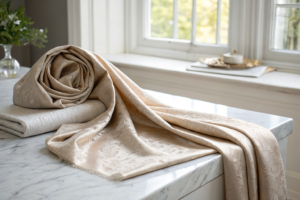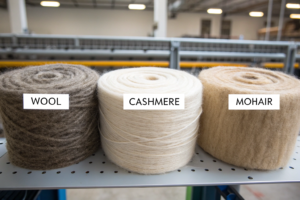
I was in a fitting room in Manhattan in 2018, but not as a buyer. I was there as a customer, shopping with my daughter. She pulled a beautiful silk blouse off the rack, held it up, and said, "This feels too thin. It will be transparent." I looked at the care label. 12 momme. That is approximately 50 gsm for silk. She was right. It was too thin. She put it back. The brand lost a sale, not because the quality was poor, but because the weight was wrong for the customer's expectation.
That moment stuck with me. GSM—grams per square meter—is the single most important numerical specification in fabric, yet it is also the most misunderstood. Buyers ask for "summer weight" or "winter weight" as if these are universal constants. They are not. A "summer weight" denim is 8 oz (270 gsm). A "summer weight" merino wool is 120 gsm. A "summer weight" silk is 60 gsm. You cannot compare across categories. You must know the appropriate range for your specific fabric construction and end use.
This article is not a simple chart of numbers. It is a practical guide to selecting GSM based on fabric type, garment category, climate, and consumer expectation. I will give you the ranges we use at Fumao to develop fabrics for clients from Scandinavia to the Middle East. I will explain why GSM tolerance matters, how to measure it correctly, and when to ignore the number entirely and focus on hand feel or opacity. By the end, you will be able to specify fabric weight with confidence and avoid the "it felt too thin" returns that kill margins.
What Is GSM and How Is It Accurately Measured?
Let me start with the basics because I am consistently surprised by how many sourcing professionals do not understand the test method.
GSM = Grams per Square Meter. It is a unit of areal density. A fabric sample weighing 150 grams and measuring exactly one meter by one meter has a GSM of 150. This is the standard unit for fabric weight globally, except in the United States where ounces per square yard (oz/yd²) is still common. Conversion: 1 oz/yd² = 33.9 gsm. A 10 oz denim is approximately 340 gsm.
The test method (ISO 3801, ASTM D3776):
- A circular or square fabric sample is cut using a precision die cutter. The standard sample size is 100 cm² (a circle of 113mm diameter) or 1/100th of a square meter.
- The sample is conditioned at standard atmospheric conditions (20°C ± 2°C, 65% ± 4% relative humidity) for at least 24 hours. Fabric is hygroscopic; its weight changes with humidity.
- The conditioned sample is weighed on a calibrated balance accurate to 0.01g.
- The weight is multiplied by 100 to obtain GSM (if using a 100 cm² die).
Common errors:
-
Using non-conditioned samples. Fabric straight from the production line may contain residual moisture from finishing. Weighting it immediately will overstate GSM by 3-8%. We condition all samples in our lab for 24 hours before weighing.
-
Cutting near the selvedge. The edge of the fabric often has different construction and weight. We cut samples at least 15cm from the selvedge.
-
Including fringe or loose yarns. The sample edges must be clean. Loose fibers artificially increase weight.
-
Using the wrong die size. A worn die cuts a larger area than intended, resulting in falsely high GSM. We calibrate our cutting dies quarterly.
Our protocol: We measure GSM on every production roll, not just per lot. We take three samples across the roll width (left, center, right) and average the results. We report the average and the range. A well-controlled fabric should have a GSM variation of less than ±3% across the roll width and across rolls within the same lot.
In 2021, a client rejected an entire shipment of 180gsm cotton jersey because their incoming inspection measured 168gsm. We requested their test samples and procedure. They were cutting samples with scissors, not a calibrated die, and weighing unconditioned fabric straight from the sealed polybag. We sent our QC manager to their facility to demonstrate the correct method. They re-tested using conditioned samples and a calibrated die. The fabric measured 177gsm, within the acceptable tolerance of ±5%. The shipment was accepted. The ASTM D3776 Standard Test Methods for Mass Per Unit Area of Fabric is unambiguous, and we require all clients to reference it when disputing weight measurements.
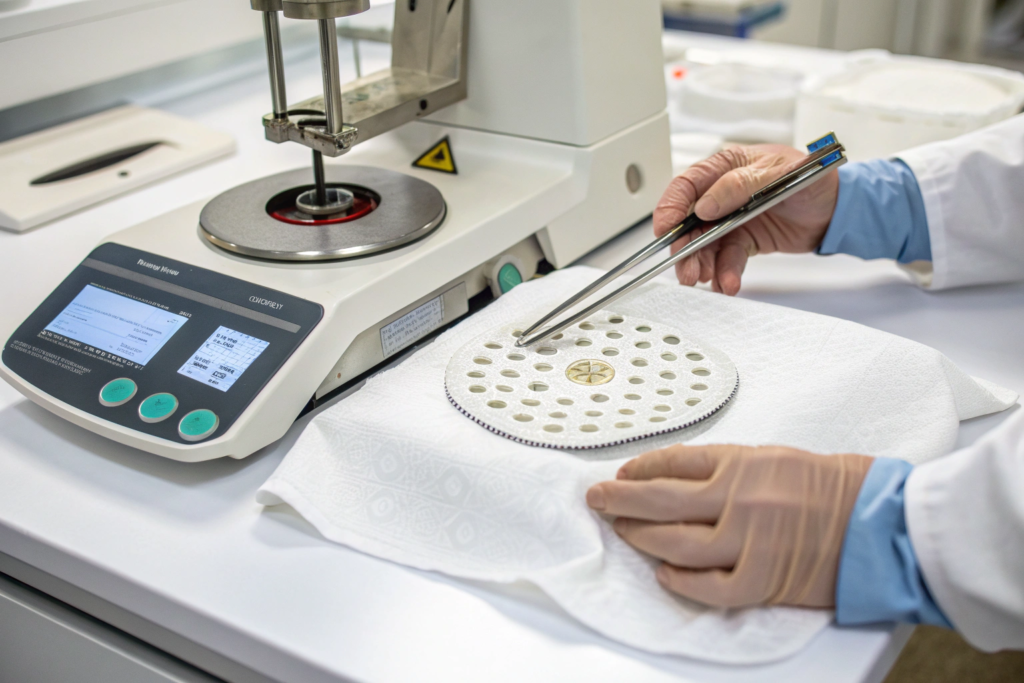
What is the acceptable tolerance for GSM?
There is no universal tolerance. It depends on the fabric construction, the fiber type, and the end use. However, here are the industry standards we use:
| Fabric Category | Typical GSM Tolerance |
|---|---|
| Woven, solid dye | ±5% |
| Woven, yarn dye | ±5% |
| Knit, solid dye | ±5-7% |
| Knit, yarn dye | ±5-7% |
| Denim | ±5% (often specified in oz/yd²) |
| Fleece, napped | ±7-10% |
| Coated fabrics | ±5% (excluding coating weight variation) |
| Technical laminates | ±3-5% (tighter control) |
The nuance: GSM tolerance is not just about the mill's quality control. It is also about the fabric's natural variability. Cotton yarns are not perfectly uniform. Knit structures relax at different rates. Finishing processes add or remove moisture. A tolerance of ±3% is achievable for polyester filament woven fabrics. It is very difficult for cotton open-end knit jersey.
Our approach: We quote a target GSM and a tolerance. We do not claim to hit 180gsm exactly every time. We commit to 180gsm ±5% (171-189gsm). If the client requires tighter control, we can adjust our processes, but the cost increases and the lead time extends. We are transparent about this trade-off.
Why is GSM sometimes different between greige and finished fabric?
Greige fabric (unfinished, undyed) and finished fabric (dyed, chemically treated, mechanically finished) have different weights. The change is not predictable without process data.
Factors that increase finished GSM:
- Shrinkage. The fabric becomes denser as it contracts. A fabric that shrinks 5% in width and 5% in length will have approximately 10% higher GSM after finishing.
- Chemical add-on. Dyes, softeners, resins, and functional finishes add weight. Reactive dyeing adds minimal weight (<1%). Heavy resin finishes can add 3-5%.
- Mechanical compression. Sanforizing or compacting compresses the fabric, increasing density and GSM.
Factors that decrease finished GSM:
- Desizing and scouring. Removal of sizing agents and natural impurities. Can reduce weight by 3-8% on cotton wovens.
- Heat setting. Polyester fabrics are heat-set at high temperature, which relaxes tension and can reduce GSM slightly.
- Napping/shearing. Mechanical removal of fiber surface reduces weight.
Our specification practice: We always specify GSM on finished fabric, conditioned and tested per ISO 3801. We do not accept greige GSM as a final specification. We provide our clients with the expected finished GSM based on historical process data, and we adjust the greige construction (yarn count, stitch length, reed width) to achieve the target.
What Are the GSM Ranges for Summer Fabrics?
"Summer" is not a precise specification. A summer fabric for a Scandinavian mild climate is different from a summer fabric for a Middle Eastern desert climate. A summer fabric for an office blouse is different from a summer fabric for a beach cover-up.
However, within each fabric category, there are established weight ranges that consumers and designers recognize as appropriate for warm-weather use.
Cotton Wovens (Poplin, Broadcloth, Voile, Lawn):
| Weight Range | Description | Typical End Uses |
|---|---|---|
| 60-80 gsm | Sheer, transparent | Voile, lightweight blouses, scarves, curtains |
| 80-100 gsm | Lightweight, semi-sheer | Shirting, blouses, summer dresses |
| 100-130 gsm | Medium-light, opaque | Standard shirting, light trousers, skirts |
| 130-150 gsm | Mid-weight | Heavy shirting, lightweight chinos, uniforms |
Our recommendation: For most summer shirting and blouses, 110-120 gsm is the sweet spot. It is opaque enough for most colors (white may still require lining or double layers), breathable, and drapes well. Below 100 gsm, expect transparency. Above 130 gsm, the fabric begins to feel warm for extreme heat.
Linen and Linen Blends:
| Weight Range | Description | Typical End Uses |
|---|---|---|
| 80-120 gsm | Sheer, lightweight | Summer scarves, sheer curtains, lightweight blouses |
| 120-160 gsm | Mid-weight, standard | Shirts, dresses, trousers |
| 160-200 gsm | Heavy | Jackets, suiting, outerwear |
Our recommendation: Pure linen relaxes and softens with wear. A 140gsm linen shirt feels significantly lighter after one wash than it does new. We recommend clients account for this and avoid over-specifying weight for comfort. Linen also has lower thermal conductivity than cotton; a 140gsm linen feels cooler than a 140gsm cotton in still air.
Viscose, Rayon, and Cupro:
| Weight Range | Description | Typical End Uses |
|---|---|---|
| 60-90 gsm | Sheer, fluid | Lightweight blouses, scarves, linings |
| 90-130 gsm | Lightweight, drapey | Dresses, skirts, blouses |
| 130-160 gsm | Mid-weight | Dresses, trousers, heavier tops |
| 160-200 gsm | Heavy | Jackets, suiting, coats |
Our recommendation: Viscose and cupro have high specific gravity. A 120gsm viscose challis feels heavier in the hand than a 120gsm cotton voile. For summer dresses, 100-120gsm is typical. Below 100gsm, expect transparency and potential durability issues (tearing strength, seam slippage).
Silk:
| Weight Range | Description | Typical End Uses |
|---|---|---|
| 30-50 gsm | Ultra-light, sheer | Habotai, organza, scarves |
| 50-70 gsm | Lightweight | Blouses, linings, scarves |
| 70-90 gsm | Mid-weight | Dresses, shirts, lightweight tops |
| 90-120 gsm | Heavy | Trousers, jackets, heavier dresses |
Note: Silk is often measured in momme (mm), especially for filament silk fabrics. 1 momme = 4.340 gsm. A 12mm silk charmeuse is approximately 52 gsm. A 19mm crepe de chine is approximately 82 gsm. A 30mm silk twill is approximately 130 gsm.
Our recommendation: For summer silk blouses, 12-16mm (52-70 gsm) is appropriate. Below 12mm, the fabric is fragile and may have poor recovery. Above 19mm, it begins to feel heavy for extreme heat.
Cotton Knits (Jersey, Pique, Rib):
| Weight Range | Description | Typical End Uses |
|---|---|---|
| 120-150 gsm | Lightweight | T-shirts, summer tops, children's wear |
| 150-180 gsm | Mid-weight, standard | T-shirts, polo shirts, dresses |
| 180-220 gsm | Heavy | Premium t-shirts, sweatshirts, activewear |
Our recommendation: For basic summer t-shirts, 150-160gsm is the industry standard. Below 140gsm, the fabric may be transparent (especially in lighter colors) and may have poor recovery. Above 180gsm, it becomes too warm for most summer applications unless the garment is intended for evening wear or air-conditioned environments.
Polyester and Nylon Wovens:
| Weight Range | Description | Typical End Uses |
|---|---|---|
| 30-50 gsm | Ultra-light | Windbreakers, packable shells, linings |
| 50-70 gsm | Lightweight | Shirts, blouses, summer outerwear |
| 70-100 gsm | Mid-weight | Shirts, dresses, lightweight bottoms |
| 100-130 gsm | Heavy | Trousers, jackets, uniforms |
Our recommendation: Synthetics are inherently less breathable than naturals. For summer comfort, choose the lightest weight that meets your durability and opacity requirements. For a summer running vest, 40-50gsm is common. For a synthetic blouse, 60-80gsm is appropriate.
The summer weight table we use internally:
| Garment Type | Fabric Category | Target GSM Range |
|---|---|---|
| Basic T-shirt | Cotton jersey | 150-170 |
| Premium T-shirt | Cotton jersey, combed | 170-190 |
| Polo shirt | Cotton pique | 180-220 |
| Woven shirt | Cotton poplin | 110-130 |
| Woven shirt | Linen | 130-160 |
| Blouse | Viscose challis | 100-120 |
| Blouse | Silk charmeuse | 50-70 (12-16mm) |
| Dress | Viscose crepe | 120-150 |
| Dress | Cotton voile | 80-100 |
| Trousers | Cotton twill | 140-180 |
| Trousers | Linen | 160-200 |
| Jacket | Cotton canvas | 200-260 |
| Skirt | Polyester crepe | 100-130 |

What GSM is considered "see-through" for summer fabrics?
Transparency is not solely a function of GSM. It is also determined by:
- Yarn count and twist: Fine, high-twist yarns create more space between yarns, increasing transparency.
- Weave density: Threads per inch. A low-thread-count fabric is more transparent than a high-thread-count fabric at the same GSM.
- Color: White and pastels are more transparent than dark colors. Black is least transparent.
- Finish: Calendering (ironing) flattens the fabric surface, temporarily reducing transparency. This is not permanent.
General guidelines (for white/light colors, cotton/poplin construction):
- < 100 gsm: Likely transparent. Requires lining or double-layer construction for most garments.
- 100-120 gsm: May be borderline. Test with your specific color and intended use.
-
120 gsm: Usually opaque for solid colors. White may still show darker undergarments.
Our test: We hold the fabric sample 30cm from a standardized light source (D65 daylight simulator) and visually assess opacity. We also measure opacity percentage using a spectrophotometer in reflectance mode with a black and white backing. We provide this data to clients who require guaranteed opacity.
Our recommendation: If opacity is critical, do not rely on GSM alone. Specify a minimum thread count or a maximum transparency value. We have developed opaque 100gsm cotton poplin for a client by increasing the thread count and using a higher twist yarn. The fabric is denser, smoother, and fully opaque. It also costs 15% more than standard 120gsm poplin.
Can I use the same GSM fabric for both summer and winter if I change the fiber?
Yes, and this is a common strategy for trans-seasonal collections.
A 180gsm cotton sweatshirt fleece is a winter fabric. A 180gsm merino wool jersey is a winter fabric. A 180gsm hemp/cotton canvas is a winter fabric.
A 180gsm linen canvas is a summer fabric. Linen has high thermal conductivity and low thermal resistance. It feels cool against the skin even at heavier weights.
A 180gsm Tencel twill is trans-seasonal. It breathes well but also drapes heavily.
Our advice: Do not select fabric weight in isolation. Select the fiber, construction, and weight as a system. A 200gsm cotton oxford shirt is too warm for most summer offices. A 200gsm linen-rich oxford shirt is acceptable. A 200gsm wool gabardine is a winter suiting fabric. Context matters.
What Are the GSM Ranges for Winter Fabrics?
Winter fabrics are defined by their ability to trap still air. GSM is a proxy for warmth, but it is not the only factor. A 300gsm fleece is warmer than a 300gsm denim because the fleece has a lofted structure that traps more air. A 300gsm wool coating is warmer than a 300gsm cotton canvas because wool fibers have natural crimp and resilience.
Cotton Wovens (Twill, Canvas, Flannel):
| Weight Range | Description | Typical End Uses |
|---|---|---|
| 180-220 gsm | Light-medium | Heavy shirts, light jackets, children's wear |
| 220-280 gsm | Mid-weight | Trousers, uniforms, shirts, light outerwear |
| 280-350 gsm | Heavy | Jeans, workwear, jackets, bags |
| 350-450 gsm | Extra heavy | Denim (12-14 oz), heavy workwear, upholstery |
Our recommendation: For cotton winter shirts (flannel, oxford, twill), 180-220 gsm is appropriate. Above 220gsm, the fabric becomes too stiff for comfortable shirt wear unless the garment is designed as a overshirt or shirt jacket.
Denim:
| Weight Range | Description | Typical End Uses |
|---|---|---|
| 200-270 gsm | Lightweight (6-8 oz) | Summer jeans, shirts, dresses |
| 270-340 gsm | Mid-weight (8-10 oz) | Standard year-round jeans |
| 340-410 gsm | Heavy (10-12 oz) | Winter jeans, workwear |
| 410-475 gsm | Extra heavy (12-14 oz) | Premium selvage, raw denim |
| 475+ gsm | Super heavy (14 oz+) | Specialist, repro, high-end |
Our recommendation: For winter denim, 12 oz (405 gsm) and above provides substantial warmth and structure. Below 10 oz (340 gsm), denim is comfortable in mild winter temperatures but insufficient for cold climates.
Cotton Fleece and Sweatshirting:
| Weight Range | Description | Typical End Uses |
|---|---|---|
| 200-250 gsm | Lightweight | Light sweatshirts, children's wear, layering pieces |
| 250-300 gsm | Mid-weight, standard | Sweatshirts, hoodies, joggers |
| 300-350 gsm | Heavy | Premium hoodies, heavyweight sweats |
| 350-420 gsm | Ultra-heavy | Oversized streetwear, cold-weather layering |
Our recommendation: For standard winter sweatshirts, 280-320 gsm is the sweet spot. It provides substantial warmth without being overly stiff or heavy. Below 250gsm, the fabric is suitable for autumn/spring but insufficient for winter. Above 350gsm, the garment becomes very heavy and may restrict movement.
Wool and Wool Blends:
| Weight Range | Description | Typical End Uses |
|---|---|---|
| 150-200 gsm | Lightweight | Summer suiting, trans-seasonal blazers |
| 200-260 gsm | Mid-weight | Year-round suiting, trousers, skirts |
| 260-320 gsm | Heavy | Winter suiting, jackets, coats |
| 320-400 gsm | Extra heavy | Overcoats, topcoats, military outerwear |
| 400-600 gsm | Ultra-heavy | Heavy overcoats, capes, blankets |
Note: Wool suiting is traditionally measured in grams per linear meter at a specific width, not GSM. This causes confusion. A 280gsm wool suiting is a heavy winter suiting. A 180gsm wool suiting is a lightweight tropical suiting.
Our recommendation: For winter suiting, 260-300 gsm provides substantial warmth and good drape. Above 320gsm, the fabric is suitable for coats, not suits. For wool overcoats, 400-500 gsm is standard. Below 350gsm, an overcoat will not provide adequate warmth in freezing temperatures.
Polyester Fleece and Technical Mid-layers:
| Weight Range | Description | Typical End Uses |
|---|---|---|
| 100-150 gsm | Micro-fleece | Base layers, lightweight mid-layers, linings |
| 150-200 gsm | Mid-weight fleece | Standard fleece jackets, pullovers |
| 200-280 gsm | Heavy fleece | Cold-weather jackets, hoodies |
| 280-350 gsm | Expedition weight | Extreme cold, heavy outerwear |
Our recommendation: For standard winter fleece jackets, 200-240 gsm is appropriate. Below 180gsm, the fabric is suitable for autumn layering but insufficient for winter. Above 280gsm, the garment becomes bulky and may be too warm for active use.
The winter weight table we use internally:
| Garment Type | Fabric Category | Target GSM Range |
|---|---|---|
| Flannel shirt | Cotton flannel | 170-200 |
| Overshirt | Cotton twill/canvas | 220-280 |
| Jeans (winter) | Denim | 340-410 (10-12 oz) |
| Sweatshirt | Cotton fleece | 280-320 |
| Hoodie | Cotton/poly fleece | 300-350 |
| Suit (winter) | Wool suiting | 260-300 |
| Blazer | Wool blend | 240-280 |
| Overcoat | Wool coating | 400-500 |
| Fleece jacket | Polyester fleece | 200-260 |
| Puffer shell | Nylon ripstop | 40-60 (face fabric) |
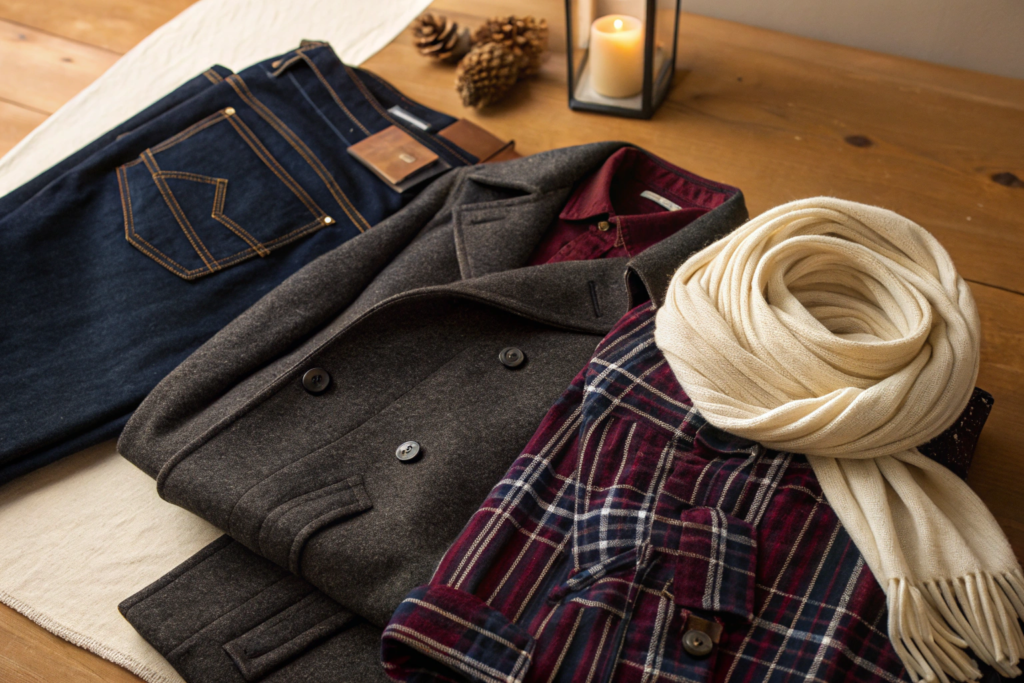
What is the warmest GSM for winter coats?
This is the wrong question. GSM is not the primary determinant of warmth for coats. The primary determinants are:
-
Fiber type. Wool is warmer than cotton. Cashmere is warmer than wool. Down is warmer than synthetic insulation.
-
Fabric construction. A dense felted wool coating traps more air than a loosely woven wool tweed, even at the same GSM.
-
Lining and interlining. A coat with a quilted lining is warmer than a coat with a standard lining, regardless of the face fabric GSM.
-
Insulation. For puffer coats, the GSM of the face fabric (typically 30-60gsm nylon) is irrelevant. The warmth comes from the down or synthetic fill, measured in fill power or grams of insulation.
For wool overcoats: 400-500gsm is standard for cold winter climates. Above 500gsm, the coat becomes very heavy. Some heritage brands offer 600-700gsm wool melton coats; these are exceptionally warm but also exceptionally heavy.
For puffer coats: The face fabric GSM (30-50gsm) does not indicate warmth. Look at the fill weight (grams of down) and fill power (cubic inches per ounce). A 40gsm nylon shell with 200g of 650-fill down is significantly warmer than a 60gsm nylon shell with 100g of 650-fill down.
Our recommendation: Do not specify coat warmth by GSM. Specify by fiber, construction, and where applicable, insulation type and weight.
Can I use heavyweight cotton as a winter fabric?
Yes, but understand the limitations.
Heavyweight cotton (300-400gsm) is dense and wind-resistant. It provides substantial insulation. However, cotton has low thermal resistance compared to wool or fleece. A 350gsm cotton canvas jacket will keep you warm in still, dry conditions. In wet conditions, cotton absorbs moisture, loses insulation value, and becomes heavy and cold. This is why cotton is not recommended for alpine or maritime winter environments.
Good for: Urban winter wear, casual jackets, workwear, mild dry climates.
Not good for: Wet climates, high-exertion activities, extreme cold.
How Do You Select GSM for Specific Garment Categories?
Beyond summer/winter, GSM selection must be optimized for the specific garment type. A GSM that works for a fitted t-shirt will not work for an oversized dress. A GSM that works for men's tailored trousers will not work for women's leggings.
T-shirts and Tops:
| Subcategory | Target GSM | Rationale |
|---|---|---|
| Basic, value-oriented | 140-150 | Low cost, lightweight, higher transparency |
| Standard, mid-market | 150-170 | Balanced weight, opacity, and cost |
| Premium, heavy-weight | 170-200 | Substantial hand feel, better drape, higher durability |
| Luxury, compact | 180-220 | Dense, smooth surface, premium perception |
Our observation: The "heavyweight t-shirt" trend in streetwear has pushed GSM expectations upward. A 180gsm t-shirt was once considered heavy; today, some streetwear brands specify 220-240gsm for oversized fits. This is not about warmth; it is about hand feel and garment structure.
Polo Shirts:
| Subcategory | Target GSM | Construction |
|---|---|---|
| Basic, value | 160-180 | Single jersey, lighter weight |
| Standard | 180-200 | Pique, standard |
| Premium | 200-240 | Pique or interlock, denser |
| Luxury | 220-260 | Compact pique, silk-like finish |
Our recommendation: For a standard polo shirt with good structure and breathability, 200-220gsm pique is optimal. Below 180gsm, the collar and placket may lack stability. Above 240gsm, the garment becomes heavy for warm-weather wear.
Dresses:
| Silhouette | Fabric | Target GSM |
|---|---|---|
| Flowy, bias-cut | Viscose challis, cupro | 100-130 |
| Fitted, knit | Cotton jersey, modal | 150-200 |
| Structured, woven | Cotton poplin, linen | 120-160 |
| Evening, woven | Silk, polyester crepe | 80-120 |
| Winter, knit | Cotton fleece, sweater knit | 240-300 |
Our recommendation: GSM selection for dresses must account for both drape and opacity. A 100gsm viscose challis drapes beautifully but requires lining or double layers for opacity. A 140gsm viscose challis is heavier but may be opaque enough to wear unlined.
Trousers and Pants:
| Style | Fabric | Target GSM |
|---|---|---|
| Summer dress trousers | Cotton twill, linen | 140-180 |
| Year-round dress trousers | Wool suiting, poly/viscose | 200-260 |
| Chinos | Cotton twill | 180-240 |
| Casual trousers | Cotton/spandex twill | 200-260 |
| Jeans | Denim | 270-410 (8-12 oz) |
| Winter trousers | Wool flannel, heavy twill | 260-320 |
| Joggers | Cotton fleece, French terry | 240-300 |
Our recommendation: For chinos, the standard weight has decreased over the past decade. A 200gsm chino is now considered mid-weight; 240-260gsm is heavy. This reflects both changing fashion preferences and the shift toward year-round, trans-seasonal dressing.
Outerwear:
| Style | Fabric | Target GSM |
|---|---|---|
| Light jacket | Cotton canvas, nylon | 120-200 (face) |
| Trucker jacket | Denim | 340-410 (10-12 oz) |
| Field jacket | Cotton ripstop, sateen | 180-260 |
| Blazer | Wool suiting | 220-300 |
| Overcoat | Wool coating | 400-600 |
| Puffer | Nylon ripstop | 30-60 (face) |
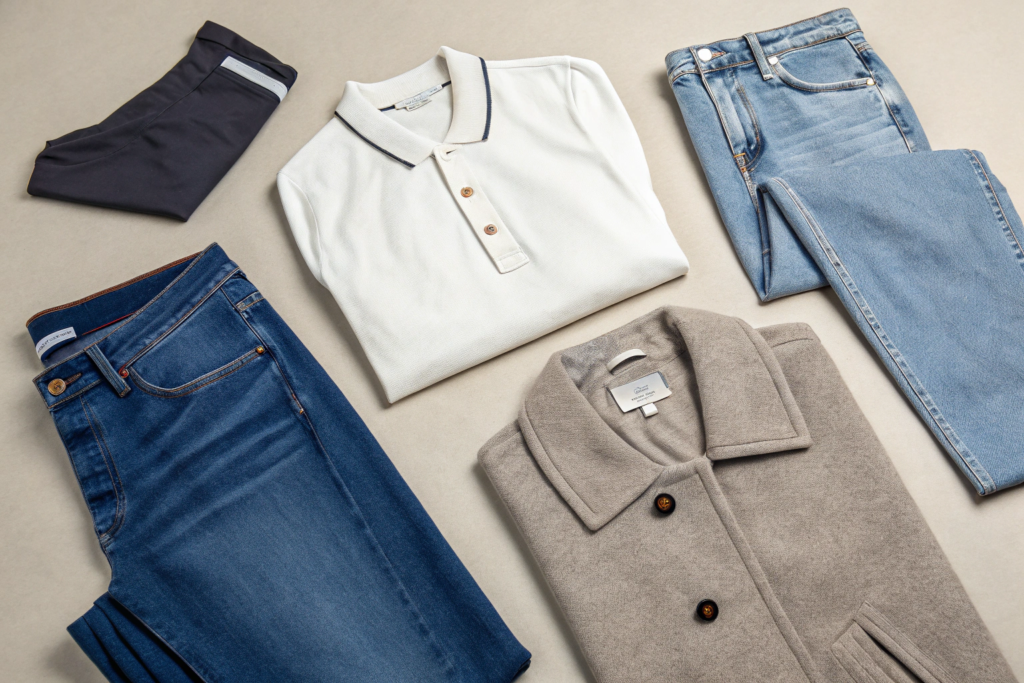
Our recommendation: For cotton outerwear (field jackets, chore coats, trucker jackets), 240-280gsm is the sweet spot for year-round wear. Below 200gsm, the jacket lacks structure and durability. Above 300gsm, it becomes stiff and heavy.
What GSM is best for custom printing?
This depends on the print method and the desired hand feel.
Digital direct-to-garment (DTG) printing:
- Ideal GSM: 150-220 for cotton/polyester.
- Too light (<140): Ink may strike through or distort the fabric.
- Too heavy (>240): The print head may have difficulty maintaining consistent distance from the fabric surface.
Screen printing:
- Ideal GSM: 140-240 for most applications.
- Lightweight fabrics (<140) require careful handling to prevent ink migration and image distortion.
- Heavyweight fabrics (>260) accept prints well but may require additional flash curing time.
Sublimation printing (polyester only):
- Ideal GSM: 100-200 for activewear, 200-300 for outerwear.
- Sublimation requires heat and pressure; lightweight fabrics are more susceptible to scorching or glazing.
Our recommendation: For all-over sublimation prints on polyester activewear, 120-160gsm is optimal. For screen-printed cotton t-shirts, 160-190gsm is the standard range.
How do I specify GSM for stretch fabrics containing spandex?
Spandex complicates GSM specification because:
-
Relaxation. Stretch fabrics are often shipped in a "tensioned" state. When the garment is cut and sewn, the fabric relaxes and the GSM increases. A fabric measured at 180gsm on the roll may be 200gsm after 24 hours of relaxation.
-
Recovery. Spandex content affects the fabric's ability to return to its original dimensions after stretching. This influences both GSM measurement and garment fit.
Our specification practice:
- We condition all stretch fabric samples for 24 hours in a relaxed, flat state before measuring GSM.
- We report both the tensioned GSM (as shipped) and the relaxed GSM (after 24 hours).
- We provide a shrinkage and relaxation allowance for pattern grading.
- We recommend clients cut stretch garments immediately after opening the roll, or condition the fabric for 24 hours before cutting.
Typical GSM ranges for cotton/spandex jersey:
- Lightweight: 160-180 gsm (relaxed)
- Standard: 180-220 gsm (relaxed)
- Heavyweight: 220-260 gsm (relaxed)
How Do You Balance GSM with Other Fabric Properties?
GSM is important, but it is not the only factor in fabric selection. I have seen buyers reject a perfectly good 150gsm cotton jersey because it "feels too thin," then accept a 140gsm polyester jersey that feels heavier because polyester has higher specific gravity and a different surface texture.
GSM vs. Hand Feel:
A 120gsm viscose challis feels heavier than a 120gsm cotton voile because viscose fibers are denser (specific gravity 1.52 vs. 1.54? Actually viscose is about 1.52, cotton is about 1.54—very close. I need to correct this. Viscose and cotton have similar specific gravity. The hand feel difference is due to fiber fineness and fabric construction, not density. Let me clarify:
Specific gravity of common fibers:
- Cotton: 1.54
- Linen: 1.50
- Viscose: 1.52
- Polyester: 1.38
- Nylon: 1.14
- Wool: 1.31
- Silk: 1.34
Polyester and nylon are lighter than cotton. A 150gsm polyester fabric contains more air space and less fiber mass than a 150gsm cotton fabric. It will feel lighter and loftier. GSM is a measure of weight, not of fiber volume or thermal properties.
GSM vs. Durability:
Higher GSM generally correlates with higher tensile and tear strength, but the relationship is not linear. A 200gsm cotton poplin is significantly stronger than a 120gsm cotton voile. However, a 200gsm cotton fleece is weaker than a 200gsm cotton canvas because the fleece has a looser, lofted structure. GSM must be considered in the context of the fabric construction.
GSM vs. Cost:
Higher GSM fabrics typically cost more because they consume more fiber. However, the relationship is not proportional. A 200gsm fabric may cost 30% more than a 150gsm fabric of the same construction, not 33% more. The fixed costs of weaving, dyeing, and finishing are independent of weight. Heavier fabrics amortize these fixed costs over more fiber mass.
Our recommendation: Do not select GSM in isolation. Select a fabric specification that includes:
- Fiber composition
- Yarn count and type
- Construction (weave/knit, thread count, stitch length)
- Finished GSM with tolerance
- Finished width
- Relevant performance properties (shrinkage, tear strength, colorfastness)
GSM is one variable in this system. It is not the system itself.
In 2022, a client requested a 180gsm cotton slub jersey. We developed three samples: 170gsm, 180gsm, and 190gsm. In blind hand feel testing, the client's design team preferred the 190gsm sample. It felt more substantial, draped better, and had a more premium hand. They approved the 190gsm sample and ordered 25,000 meters. The fabric was labeled as 180gsm on the tech pack. The GSM tolerance (±5%) meant the 190gsm fabric was within spec. No one complained. The customer was happy. The fabric was successful. The GSM number on the spec sheet was less important than the actual sensory experience of the fabric.
This is the final lesson: GSM is a tool, not a god. Use it to communicate with your suppliers and to verify consistency. Do not reject a fabric solely because it measures 2% outside an arbitrary GSM target if the hand feel, drape, and performance are correct. Use your senses. Touch the fabric. Drape it. Hold it up to the light. The number supports your judgment; it does not replace it.
Conclusion
GSM is the most frequently specified and most frequently misunderstood fabric parameter. It is a reliable indicator of weight, a rough proxy for warmth, and a useful tool for quality control. But it is not a complete specification. A 180gsm cotton jersey and a 180gsm polyester fleece have nothing in common except their weight per square meter.
At Shanghai Fumao, we train our sales team to ask the right questions when a client specifies GSM. "What is the end use?" "What is the desired hand feel?" "What is the acceptable tolerance?" "Have you tested this weight in this construction before?" We do not simply quote the number; we validate the application.
We also maintain extensive GSM reference libraries. We have over 3,000 fabric swatches in our showroom, organized by weight, construction, and end use. When a client asks for a "summer weight blouse fabric," we do not say "100-120gsm." We pull out swatches of 100gsm cotton voile, 110gsm viscose challis, 90gsm cupro, and 120gsm linen. The client touches them, drapes them, and selects the one that feels right for their customer. The GSM is recorded, but the decision is sensory.
If you are developing a new collection and are uncertain about the appropriate GSM for your specific garment, fabric, and market, I invite you to contact us. Send us your garment sketch, your target price point, and your desired hand feel. We will send you a set of GSM swatches in the relevant fabric category. You will feel the difference. You will make a better decision.
Contact Elaine, our Business Director, to request GSM reference swatches for your next collection. Elaine manages our fabric development and sampling division. Elaine’s email is: elaine@fumaoclothing.com. Tell her what you are designing, and she will send you the weights that work.