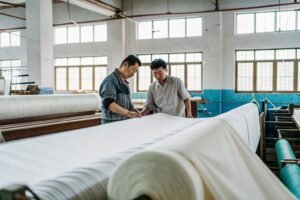
Drawing from twenty years of textile expertise in Keqiao’s manufacturing hub, we consistently observe clients navigating challenges in cotton yarn selection. The fundamental distinctions between ring-spun and open-end production methods profoundly influence fabric performance characteristics. While pricing remains crucial in procurement decisions, comprehending spinning mechanics proves essential for maximizing product value.
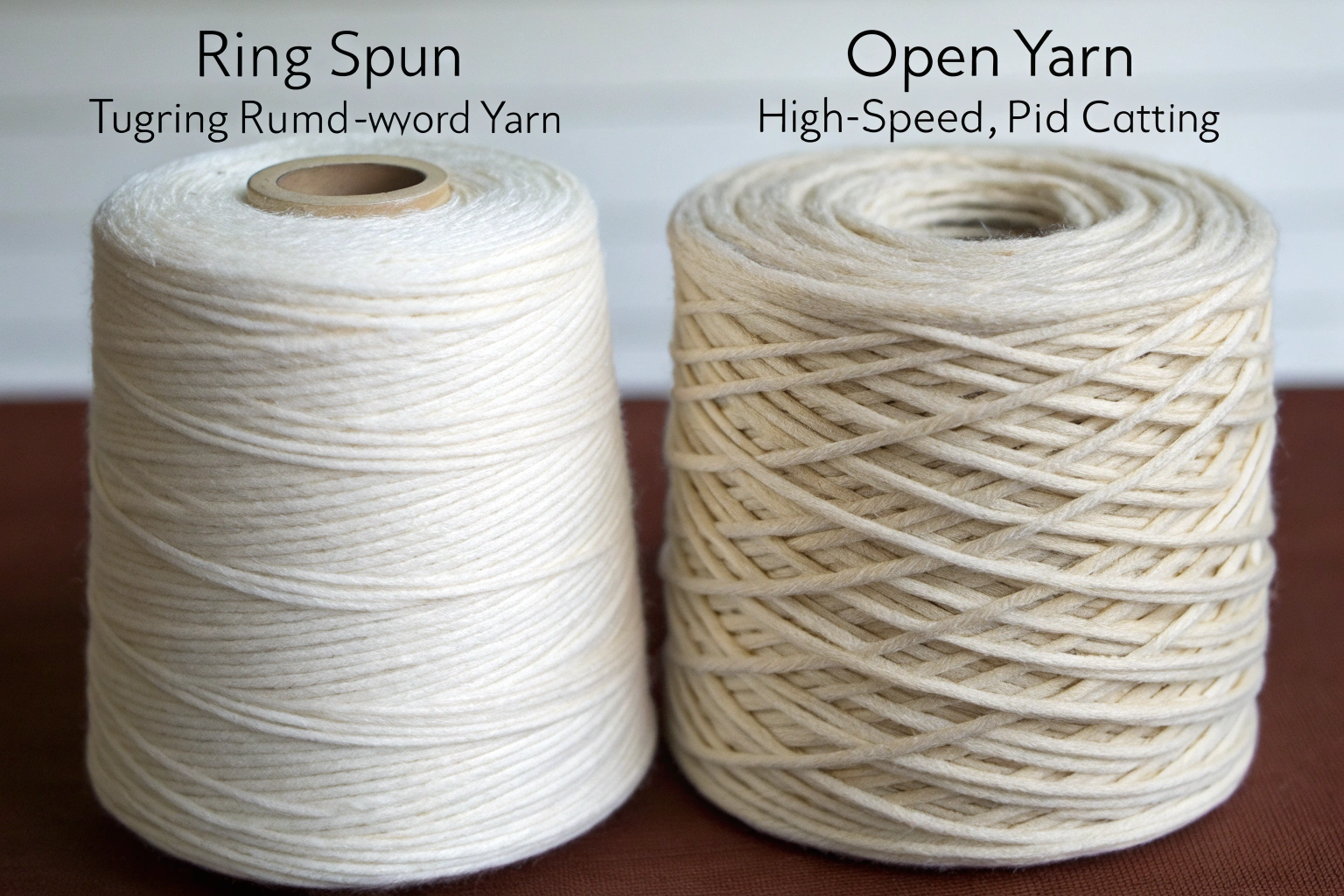
Core differentiations originate from unique formation processes. Ring-spun yarn develops through continuous twisting around rings, creating tightly woven spiral configurations during fiber drafting. Open-end manufacturing employs high-speed rotor centrifugal forces, directly condensing and twisting fibers within collection grooves. This technological divergence produces ring-spun yarn’s flexible, refined qualities, while open-end variants demonstrate more textured, economical characteristics.
Technical Attributes of Ring-Spun Yarn
A detailed, photorealistic close-up of soft, luxurious ring-spun cotton yarn fibers twisting together smoothly, showing their long, parallel structure. The image should convey a sense of premium quality and softness, with a professional textile background. No text or maps. Human hands should be visible, holding the yarn, with realistic skin texture and no facial distortion.
Premium apparel producers particularly value the exceptional tactile experiences achieved through ring-spun manufacturing. The terminology derives from the twisting mechanism surrounding spindles, where three-roller drafting systems maintain precise fiber control. During yarn formation, fibers remain completely secured at both extremities, establishing stable structures with predominant spiral fiber orientation. This distinctive arrangement generates delicate skin contact sensations, positioning it as the preferred material for high-grade shirts, intimate wear, and luxury home textiles.
From mechanical perspectives, ring-spun yarn demonstrates remarkable resilience advantages. The uninterrupted twisting action creates substantial fiber cohesion, typically enhancing breaking strength by 15-20% compared to equivalent open-end alternatives. Practical implementations transform this characteristic into superior laundering endurance and anti-pilling performance. Our laboratory documentation confirms that following fifty standard wash cycles, ring-spun cotton merchandise preserves over 85% of initial bursting strength.

Ring-Spun Implementation in High-End Fashion
Selecting ring-spun technology reflects dedication to quality perfection. The manufactured yarn accomplishes diameter variation coefficients below 1.5%, establishing foundations for high-count dense textiles. Notably, international fashion houses maintain explicit requirements for yarn specifications in skin-contact garments, where ring-spun pure cotton yarns exceeding 60 counts have evolved into industry benchmarks. These textiles exhibit outstanding drape characteristics while achieving Grade A surface refinement.
Longevity Enhancement via Ring-Spinning
Microstructural analysis reveals that spiral fiber organization in ring-spun yarn generates optimal mechanical models. When experiencing external forces, stress distributes uniformly along fiber helices, effectively preventing localized stress concentration. Our accelerated durability testing demonstrates that ring-spun twill fabrics endure 20,000 friction cycles under ISO 12947-2 standards before displaying noticeable pilling. This endurance quality renders it especially appropriate for frequently worn professional uniforms and educational institution clothing.
Open-End Yarn Manufacturing Characteristics
A dynamic, photorealistic shot of the open-end spinning process inside a modern textile factory, showing fibers being fed into a high-speed rotor. The image should focus on the machine’s efficiency and speed, with a slightly coarser yarn being produced. No text or maps. Include a factory worker’s hands operating the controls, with realistic skin texture and no facial distortion.
Mass-produced essential textiles extensively adopt open-end spinning methodologies. This contemporary manufacturing approach channels fibers into rapid rotors, employing centrifugal energy for immediate yarn formation, achieving 3-5 times greater production efficiency than ring-spinning. The streamlined procedure eliminates roving and winding phases, reducing manufacturing expenses by approximately 30%. For fast-fashion corporations requiring annual procurement of thousands of tons of basic fabrics, this economic benefit proves determinative.
Although financial advantages represent open-end yarn’s prominent benefit, objective recognition of performance constraints remains imperative. Random fiber distribution inside rotors generates loose yarn configurations, typically displaying 10-15% reduced strength compared to analogous ring-spun products. Simultaneously, fiber extremities exposed on yarn surfaces produce hairiness that compromises fabric smoothness and intensifies pilling risks. Nevertheless, for non-contact implementations like lining and interlining, these limitations frequently reside within acceptable parameters.

Practical Applications for Open-End Yarn
Open-end spinning exhibits distinctive value in functional implementations. Industrial denim utilizes its volumetric properties for enhanced thermal retention; canvas merchandise leverages high fiber preservation for improved abrasion resistance; decorative textiles employ its textured appearance for specialized visual impacts. Our manufacturing metrics confirm that 32-count open-end yarn canvas completely satisfies technical prerequisites for outdoor products.
Technical Constraints in Open-End Production
Scanning electron microscopy discloses disordered network formations in open-end yarns, directly provoking two technical complications: inadequate fiber cohesion results in frequent breakage during rapid sewing, while randomly allocated fiber ends quickly extract from yarn bodies under friction, generating pilling concerns. Additionally, inconsistent yarn density might induce color variations throughout dyeing operations, necessitating vigilant monitoring in contemporary garment production pursuing uniformity.
Performance Evaluation: Comparative Analysis
A split-screen infographic style image, visually comparing two fabric swatches. On the left, a smooth, sleek ring-spun cotton surface. On the right, a slightly coarser, more textured open-end cotton surface. The contrast in texture and quality should be clear and photorealistic. No text or maps. A person’s hands should be feeling the fabrics, with realistic skin texture and no facial distortion.
Establishing methodical assessment frameworks enables clearer comprehension of characteristic variations. Selection considerations should extend beyond initial expenses to embrace complete lifecycle value. Ring-spun yarn exhibits superior economics in prolonged use products through enhanced durability, while open-end yarn reveals definite benefits in high-volume temporary applications.
| Evaluation Parameter | Ring-Spun Cotton Yarn | Open-End Cotton Yarn |
|---|---|---|
| Fiber Configuration | Spiral organized structure | Network disordered arrangement |
| Strength Maintenance | Exceeding 85% | Near 70% |
| Surface Hairiness | 1.8-2.5 index | 3.5-4.2 index |
| Manufacturing Energy | Standard reference 100% | Standard reference 65% |
| Appropriate Count Range | 10-200 English counts | 6-60 English counts |
| Specialized Uses | Premium fashion, medical textiles | Decorative materials, industrial textiles |

Elements Affecting Yarn Strength
From material science viewpoints, yarn strength relies on synergistic interactions between fiber friction and contact surface. In ring-spun procedures, fiber helix angles customarily span 35-45°, ensuring adequate fiber interaction while delivering ideal stress distribution. Experimental evidence indicates that when twist intensifies from 80 to 100 twists/10cm, ring-spun yarn robustness improves by roughly 12%, whereas open-end yarn merely increases by 6%. This differential plainly reflects contrasting structural reactions to twisting.
Structural Impact on Textile Aesthetics
Fabric tactile perception substantially depends on yarn surface morphology. The regulated fiber alignment in ring-spun yarn produces polished cylindrical formations, generating gentle diffuse light reflection. Conversely, irregular open-end yarn surfaces cause light dispersion, creating somewhat muted visual effects. When engineering silk-inspired products, employing ring-spun combed cotton yarns beyond 80 counts has become industry consensus, accomplishing drape coefficients under 35% to thoroughly satisfy luxury women’s apparel design requirements.
Strategic Yarn Selection Methodology
A professional business setting where a confident fashion designer (like Ron) is discussing fabric swatches with a textile expert. They are looking at a tablet displaying yarn comparison data. The atmosphere is collaborative and decisive. No text or maps. Both individuals should have realistic, non-distorted facial features and expressive, confident body language.
Developing systematic yarn selection protocols demands multidimensional evaluations. Initially, clarify utilization contexts: skin-contact garments should prioritize ring-spun comfort, while external workwear can assess open-end economics. Subsequently, examine product lifecycle: extended use merchandise recommends ring-spun yarns, temporary products might contemplate open-end options. Finally, appraise product value positioning: premium items suit ring-spun quality augmentation, mass-market goods can utilize open-end expenditure management.

Essential Technical Dialogue with Suppliers
Supplier technical communications should concentrate on four fundamental dimensions: request certified inspection reports emphasizing strength, uniformity, and color fastness; acquire physical specimens, ideally comparative samples from different processes; comprehend production apparatus models, acknowledging significant variations between modern compact spinning and conventional ring-spinning; discuss customization potential including blend proportions and specialized twist designs. We advise purchasers to maintain reference samples as benchmarks for bulk verification.
Innovative Blended Spinning Applications
Contemporary textile technologies transcend traditional process boundaries. Revolutionary composite spinning techniques integrate ring-spun and open-end technologies, applying open-end spinning in yarn cores for volume while utilizing ring-spun surfaces for refinement. These combination methodologies produce composite yarns retaining open-end economics while accomplishing ring-spun-like textile effects. Furthermore, blending cotton with Modal, Tencel and additional fibers further optimizes fabric performance, with our research division successfully creating multiple innovative blending formulations.
Conclusion
Spinning technology selection fundamentally represents balancing performance against investment. Ring-spun yarn generates exceptional quality through refined processing, while open-end yarn attains economics via efficient manufacturing. Informed decisions require comprehensive examination of product positioning, implementation environments, and lifecycle expenses. With progressive textile technology developments, both methodologies are advancing through mutual knowledge exchange and integrated evolution, providing expanded innovation opportunities for textile development.
For specialized technical selection guidance, please connect with our technical leadership. Leveraging beyond twenty years of textile experience, we deliver optimal yarn solutions for diverse applications. Comprehensive testing laboratories guarantee every consignment meets stipulated technical standards. Arrange professional consultations through elaine@fumaoclothing.com for complete spinning solution support.