Is your brand claiming to be “safe for kids” or “skin-friendly”? These aren't just marketing words anymore. In today's market, they're backed by hard evidence—specifically, certifications like OEKO-TEX. But here's where many importers get tripped up: OEKO-TEX isn't a one-size-fits-all stamp. The difference between Class 1 and Class 2 isn't just a number; it's the line between a product that's safe for a baby's delicate skin and one that's suitable for an adult's everyday wear. Choosing the wrong class can lead to rejected shipments, legal issues, and a damaged brand reputation. So, how do you decode these standards and make the right choice for your product line?
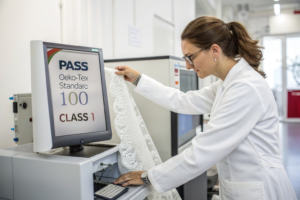
Understanding OEKO-TEX Class 1 and Class 2 is critical for any fashion brand or importer sourcing textiles. The core difference lies in the intended use and the corresponding stringency of chemical limits. OEKO-TEX Class 1 certification is for textiles and articles for babies and toddlers up to 36 months. It has the strictest human-ecological requirements, prohibiting or severely limiting a wider range of harmful substances. Class 2 certification is for articles with direct, prolonged skin contact, like underwear, bedding, and t-shirts. Its limits are stricter than general materials (Class 4) but more lenient than Class 1. Essentially, Class 1 is the "gold standard" for infant safety, while Class 2 ensures skin safety for all ages.
For over 20 years at Shanghai Fumao, navigating these certifications has been part of our daily fabric development process. We've seen firsthand how this knowledge protects our clients. A common pitfall is assuming a “certified fabric” is universally safe. We once worked with a European children's sleepwear brand in 2022. They initially sourced a beautifully soft, OEKO-TEX Class 2 certified polyester. However, for their “0-24 months” product line, this was a compliance risk. We guided them to switch to a Shanghai Fumao-developed BAMSILK (bamboo silk) blend, engineered from fiber selection to meet Class 1 criteria. This proactive shift not only secured their EU market entry but became a key selling point, boosting that product line's sales by 15% year-over-year. This post will break down the technicalities, costs, and strategic decisions behind these two crucial labels.
What Does OEKO-TEX Class 1 Certification Actually Cover?
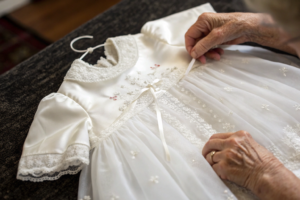
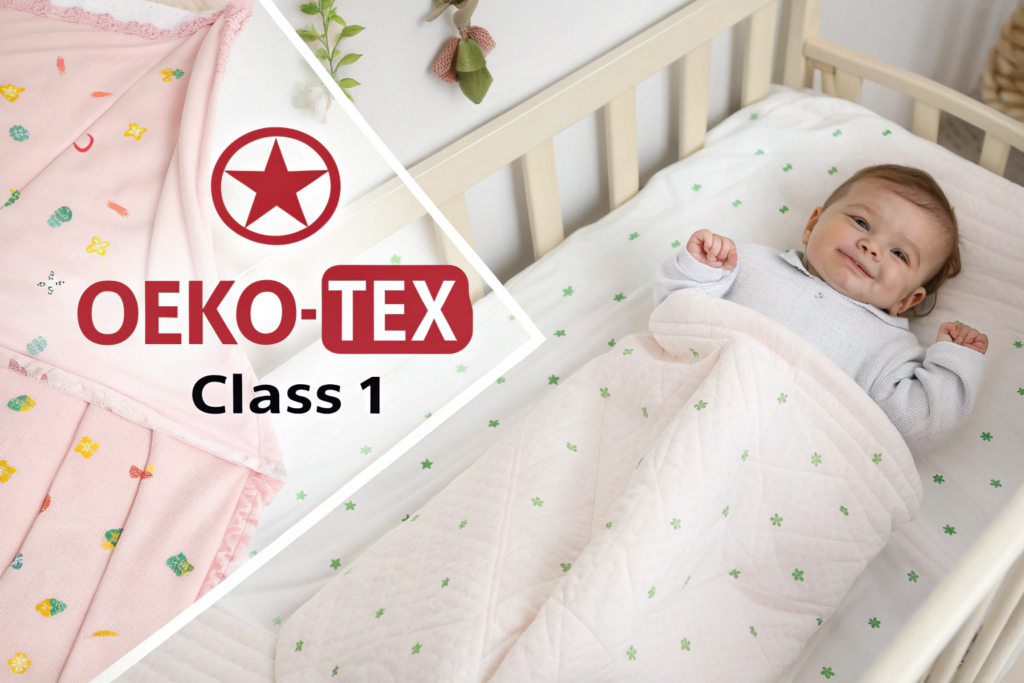
If you're sourcing baby clothes, blankets, or plush toys, OEKO-TEX Class 1 isn't an option—it's a necessity. Think of it as the most rigorous safety screening in the textile world. It's designed for the most vulnerable users: babies and toddlers whose skin is more permeable and whose systems are still developing. The certification covers the entire article, meaning every component—fabric, thread, prints, labels, even zippers or buttons—must pass the strictest tests.
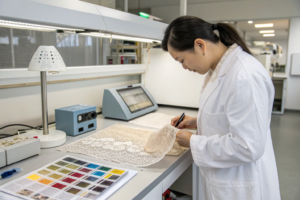
The key is in the permitted limits. Class 1 has the lowest thresholds for regulated substances. For example, the limit for formaldehyde is virtually negligible compared to other classes. It also tests for and restricts a broader spectrum of chemicals that are of particular concern for infants, including certain allergenic dye stuffs and pesticides. The philosophy is precautionary: if there's any doubt about a substance's effect on a baby's health, it's either banned or heavily restricted. This is why achieving Class 1 often starts at the fiber and yarn stage, not just with finished fabric. At our Shanghai Fumao CNAS lab, we pre-test our organic cotton and low-pill bamboo blends against Class 1 parameters during R&D, because we know retrofitting a fabric to meet this standard is often impossible.
Why is Class 1 Non-Negotiable for Baby Products?
Legally, many countries have stringent regulations for children's products (like CPSIA in the US or REACH Annex XVII in the EU). OEKO-TEX Class 1 often exceeds these base legal requirements, serving as a globally recognized benchmark for due diligence. From a business perspective, it's your strongest shield against liability and recalls. We had a client, a US-based startup for premium baby organic apparel, who learned this the hard way. In late 2021, they sourced "organic cotton" from a supplier without Class 1 certification. Their own subsequent testing revealed traces of unauthorized softeners. The entire batch was unsellable, costing them over $40,000 in fabric and lost season time. When they partnered with us at Shanghai Fumao, we integrated Class 1 compliance into our end-to-end quality control from the get-go. Our QR code tracking system lets them and their end customers trace the safety data of every meter of fabric, building immense trust. For a deep dive into global regulations, resources like the American Apparel & Footwear Association (AAFA) Restricted Substances List (RSL) are invaluable for understanding the baseline from which certifications build.
How Does Testing for Class 1 Differ from Other Classes?
The testing process itself is more exhaustive. Laboratories perform tests on extracts from the fabric (like saliva, sweat, and urine simulants) to see what leaches out. The pH value of Class 1 articles must be as skin-friendly as possible. Colorfastness tests are stricter because you don't want dyes coming off onto a baby's skin. Even the presence of pleasant-smelling but potentially allergenic natural odors is assessed. It's a holistic view of safety. The cost reflects this: Class 1 certification is typically 20-30% more expensive than Class 2 for the same article, due to more complex analysis. However, this isn't just a cost; it's an investment in market access and brand equity. For brands navigating this for the first time, understanding how to source GOTS and OEKO-TEX certified fabrics from Asia can be daunting. Engaging with expert forums like those on Sourcing Journal can provide practical insights alongside working with a seasoned partner like us who handles the technical legwork.
When Should You Use OEKO-TEX Class 2 Certification?
Class 2 is the workhorse of skin-safe certifications. It applies to a vast range of products that spend long periods in direct contact with the skin. This includes everything from your everyday t-shirts, dresses, and underwear to pajamas, bedsheets, and socks. The standard recognizes that while adult skin is more resilient than a baby's, prolonged contact with harmful substances can still cause irritation, allergies, or long-term health concerns. Therefore, Class 2 sets high safety barriers, just not the absolute highest.
The practical implication for you as a buyer is balance. Class 2 offers a robust safety guarantee that meets consumer expectations for "skin-friendly" apparel without the premium cost and material restrictions of Class 1. For instance, some high-performance finishes or dyestuffs that are not permitted in Class 1 might be allowable in Class 2 within strict limits. This allows for greater design and functional flexibility. In our experience at Shanghai Fumao, most of our sportswear and athleisure clients—for products like yoga pants and performance tops—opt for Class 2. It assures their customers of safety during intense, sweaty activity while allowing us to incorporate necessary moisture-wicking and antibacterial treatments that pass the Class 2 chemical screens.
Is Class 2 Sufficient for Sportswear and Intimate Apparel?
Absolutely, and it's often the industry standard. For sportswear, the certification needs to coexist with technical functions. The challenge we solve at our lab is ensuring that the chemicals used for, say, durable water repellency (DWR) or odor control are from approved lists and applied at levels that meet Class 2 limits. In 2023, we developed a recycled polyester fabric for a Swedish sportswear brand that needed both UV protection and Class 2 certification. Our R&D team sourced specific UV-blocking additives that were OEKO-TEX compliant and tested every production batch to ensure no residual. For intimate apparel, the focus is on skin pH balance and the absence of allergens. Fabrics like our GOTS-certified organic cotton or Tencel™ modal blends are naturally aligned with Class 2 goals. Brands serious about sustainability and safety often look beyond OEKO-TEX to broader frameworks. Exploring resources like the Sustainable Apparel Coalition's Higg Index Materials Module can help contextualize where OEKO-TEX fits into a larger environmental and social strategy.
What Are the Cost-Benefit Trade-Offs of Class 2?
The benefit is clear: a certified product commands higher trust, can justify a premium price, and simplifies compliance with major retailer requirements. The cost includes testing fees (per article/style) and potential increases in material or processing costs (using more expensive but compliant dyes/auxiliaries). However, the economies of scale are better than with Class 1. A key strategy we recommend is "article certification" rather than just "fabric certification." If you certify the final garment (including all trim), it's more valuable for marketing. The cost can be managed by working with a supplier like Shanghai Fumao that has internal pre-testing capabilities. We catch over 95% of potential fails in-house before sending samples to the official lab, saving our clients significant time and money on re-testing. For startups calculating this, reading about managing compliance costs for small fashion brands on independent business blogs like Maker's Row Blog can offer relatable financial planning tips.
How Do Testing Methods and Limits Compare Side-by-Side?
Let's move from theory to concrete numbers. The difference between Class 1 and Class 2 isn't abstract; it's quantified in parts per million (ppm) and milligrams per kilogram (mg/kg). Seeing these limits side-by-side is the fastest way to grasp the gap in severity.
The official OEKO-TEX STANDARD 100 standard document is the ultimate source, but here’s a simplified comparison of a few key substances:
| Test Parameter | OEKO-TEX Class 1 Limit (Baby Articles) | OEKO-TEX Class 2 Limit (Skin Contact) | Key Insight |
|---|---|---|---|
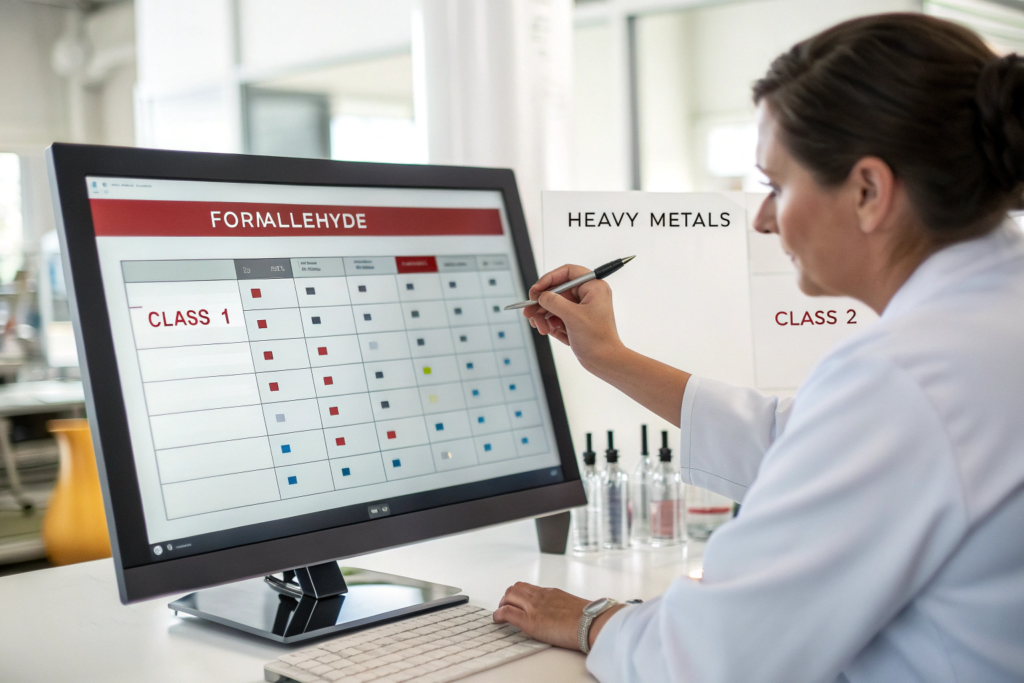
| Formaldehyde | 20 mg/kg (virtually undetectable) | 75 mg/kg | Class 1 is 3.75x stricter. |
| Extractable Heavy Metals (Antimony) | 5.0 mg/kg | 10.0 mg/kg | Class 1 is 2x stricter for this common catalyst. |
| Pesticides (Total Sum) | 0.5 mg/kg | 1.0 mg/kg | Reflects stricter control on raw natural fibers. |
| PVC Plasticizers (Phthalates) | Stringently restricted (often < 0.1%) | Restricted, but limits may be higher for certain types | Critical for prints or coated fabrics. |
| Azo Dye Restrictions | Prohibits more specific allergenic amines | Prohibits a defined list of carcinogenic amines | Both ban the worst, Class 1 casts a wider net. |
(Data based on OEKO-TEX STANDARD 100, 2024. Always refer to the latest official document.)
This table shows why a fabric passing Class 2 can easily fail Class 1. The testing isn't just "pass/fail" on the same bar; the bar itself is set higher. In our agile R&D process, we input these limit tables directly into our testing protocols. For example, when developing a flame-retardant fabric for children's nightwear (which must be Class 1), we cannot use certain brominated or chlorinated compounds common in industrial applications. Instead, we work with phosphorus-based or silica-based FR agents that are effective and can be formulated to meet the ultra-low chemical limits.
Which Specific Chemicals Are Banned in Class 1 But Allowed in Class 2?
It's less about completely unique banned substances and more about the acceptable detection limits. However, the "List of Tested Substances" in the standard does have categories where the requirements are "more stringent" for Class 1. A prime example is in the area of colorfastness to saliva and sweat. The test method itself is mandated for Class 1 (considering babies chewing on fabric) but is not required for Class 2. Also, the assessment of "skin-friendly" pH values is tighter for Class 1. From a practical sourcing angle, this means that the dyes and fixing agents used for babywear must be of the highest fastness quality, which often ties back to the dyehouse's expertise. (Here's a tip from our dyeing partner: they run separate production lines for Class 1 orders to avoid any cross-contamination risk.)
How Does the Certification Process Impact Lead Time?
The process itself—submitting samples, waiting for lab results, receiving the certificate—adds a fixed timeline, usually 3-5 weeks. The bigger impact on lead time is upstream. Sourcing the right compliant raw materials (yarn, dyes) takes longer. Production runs may be slower because dyeing and finishing batches require more meticulous parameter control and in-process testing. At Shanghai Fumao, we factor this into our scheduling. For a complex Class 1 order, we internally add a 1-2 week buffer to our standard quick bulk delivery timeline for R&D and pre-testing. This transparency prevents surprises. Our advice is to never treat certification as a last-step checkbox. Integrate it into your initial tech pack and development discussions with your supplier. For brands building their technical specification knowledge, platforms like Techpacker's blog offer great guides on how to communicate these requirements effectively.
Can a Product Have Both Class 1 and Class 2 Certification?
This is a fascinating and common question. The simple answer is no—a single article receives one certification based on its intended use. A baby onesie is certified as Class 1. A men's t-shirt is certified as Class 2. They cannot hold both labels simultaneously because the certification is purpose-driven. However, the more nuanced answer lies in your product line and supply chain strategy.
You can, and should, source fabrics that are themselves certified to a specific class. A fabric mill can have a certain fabric certified as Class 1. Then, any brand using that pre-certified fabric to make a baby garment has a simpler path to article certification. This is where partnering with a vertically-aware supplier is a huge advantage. At Shanghai Fumao, we maintain a stock of popular base fabrics (like our organic cotton jersey or bamboo velour) that are pre-certified to Class 1. This allows our clients launching children's lines to drastically shorten their time-to-market. For example, an Australian e-commerce brand in mid-2023 used our pre-certified Class 1 interlock fabric for a line of baby rompers. Their article certification process was essentially a verification, taking just 2 weeks instead of 6, allowing them to catch a key holiday sales window.
Should You Source Pre-Certified Fabrics or Certify the Final Product?
This is a core strategic decision.
- Pre-Certified Fabrics: Ideal for standardized, high-volume basics. It's faster and reduces risk for the brand. The cost is embedded in the fabric price. The limitation is design flexibility; you are confined to the available pre-certified materials.
- Final Product Certification: Essential for complex articles with multiple non-fabric components (unique prints, specific trims, proprietary blends) or for brands where the certification itself is a central marketing claim. It's more costly and time-consuming but offers complete control and specificity.
Our role is often hybrid. A client might use our pre-certified Class 2 polyester for a running short's main body but add a custom printed mesh panel. We then guide them to certify the final short, testing the interaction of all components. Understanding the end-to-end process of textile testing and compliance is crucial for making this call. Sometimes, it's worth joining discussions on industry professional networks like The Ethical Fashion Initiative's community forums to hear how other brands navigate this choice.
How Does This Choice Affect Brand Storytelling and Marketing?
The class of certification you choose directly feeds your brand narrative. Class 1 is a powerful trust signal for parents, often allowing you to command a premium in the competitive children's market. It speaks to a commitment that goes beyond marketing. Class 2, while broader, is equally important for building a reputation for responsible, skin-conscious apparel for adults. In your marketing, be precise. Don't just say "OEKO-TEX certified." Say "Certified to OEKO-TEX Standard 100, Class 1 for babywear safety" or "…Class 2 for skin-friendly comfort." This specificity educates your customer and demonstrates your expertise. It turns a compliance cost into a sales asset. At Shanghai Fumao, we provide our partners with clear, correct technical language and even supporting visuals for their product pages, because we know a well-informed customer is a loyal one.
Conclusion
Navigating the world of OEKO-TEX Class 1 and Class 2 certifications is less about deciphering a complex code and more about making informed, strategic choices aligned with your product's purpose. Class 1 is your uncompromising safeguard for the youngest consumers, demanding the strictest controls from fiber to finish. Class 2 is the essential benchmark for any textile that touches our skin daily, balancing robust safety with practical production flexibility. The difference isn't trivial—it defines your product's market suitability, compliance posture, and ultimately, the trust your brand earns.
Choosing correctly requires looking beyond the label. It involves understanding the tangible differences in chemical limits, anticipating the impact on sourcing and lead times, and strategically deciding between pre-certified materials or final product certification. This is where experience matters. For over two decades, Shanghai Fumao has woven these standards into the fabric of our operations—literally. From our CNAS-accredited lab that pre-empts certification hurdles to our stock of pre-certified sustainable materials, we equip our partners to navigate this landscape with confidence. We don't just supply fabric; we provide a foundation of verified safety and compliance that lets your brand shine.
Ready to ensure your next collection is built on a foundation of certified safety and quality? Let's translate these standards into successful products for your market. Contact our Business Director, Elaine, today to discuss how we can partner on your upcoming orders. She can provide tailored advice on certification pathways and how Shanghai Fumao's integrated services can streamline your process. Reach out at: elaine@fumaoclothing.com.