
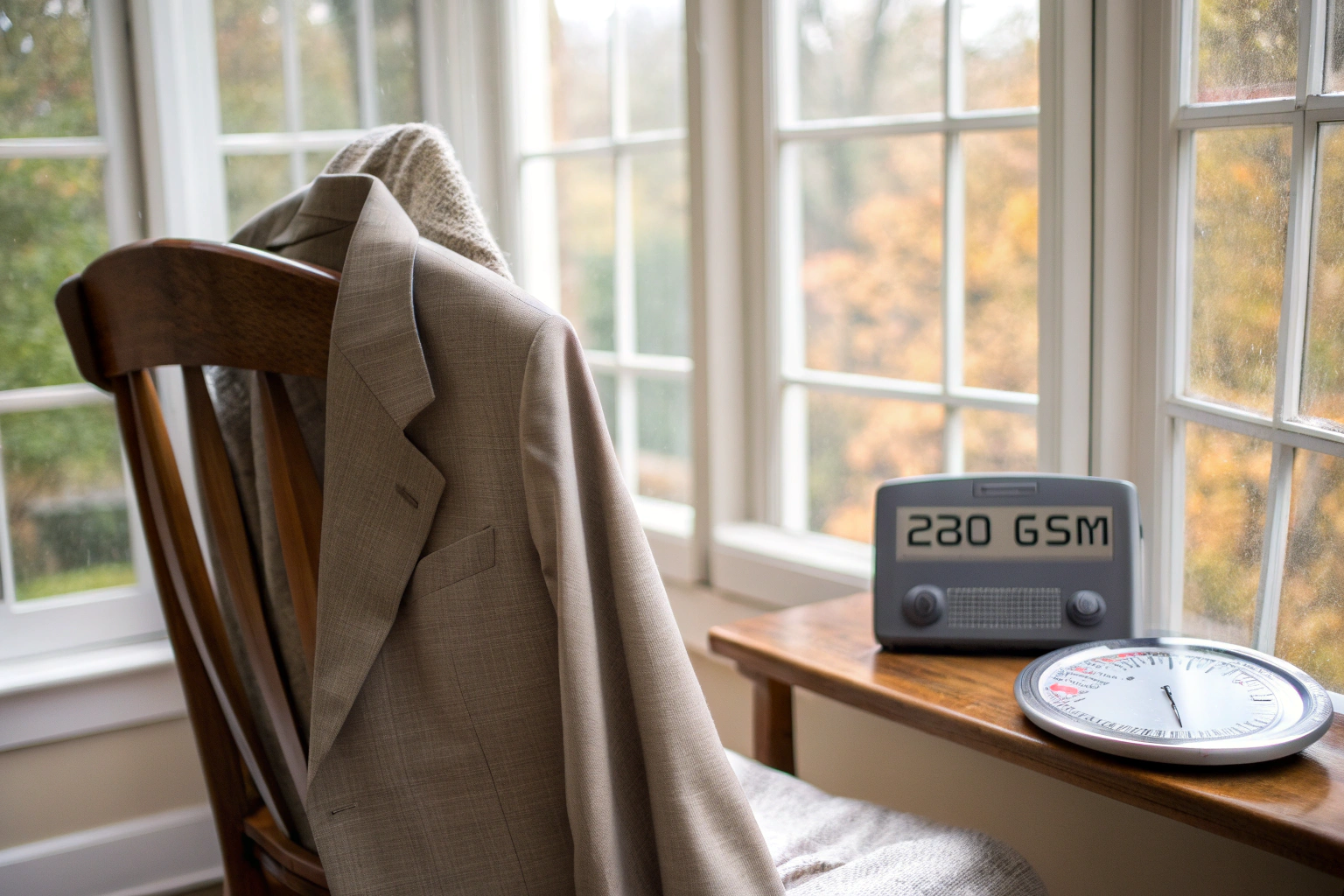
You found the perfect blazer. It fits like it was measured by a Savile Row tailor, the lapel roll is exactly right, and the color is a versatile charcoal that works with everything from denim to tailored trousers. You wear it to a spring wedding, comfortable and confident. You wear it to an air-conditioned summer dinner, still comfortable. Then October hits. You throw the blazer on over a lightweight sweater, step outside into a 55°F breeze, and within ten minutes your arms are cold. The blazer that felt substantial in the fitting room is too light for three seasons and too heavy for one. You now own a one-season blazer that you paid a four-season price for.
A year-round blazer requires a fabric weight that is heavy enough to provide structure and some insulation in cool weather, yet light enough to remain comfortable when the temperature climbs. There is no single magic number, but there is a narrow GSM range and a set of fiber and weave characteristics that define the year-round blazer fabric. At Shanghai Fumao, I develop blazer fabrics for menswear and womenswear brands across the seasonal spectrum, and I have learned exactly where the year-round sweet spot sits. I am going to define that GSM range, explain how fiber choice shifts the thermal window, and show you how to specify a blazer fabric that your customer reaches for in April, July, and November equally.
What GSM Range Defines a True Year-Round Blazer?
The blazer fabric weight spectrum runs from lightweight summer hopsacks at 200 GSM to heavyweight winter tweeds at 400 GSM and above. The year-round sweet spot is narrow. Too light, and the blazer loses structure and warmth. Too heavy, and it becomes unwearable in warm weather. After two decades of developing blazer fabrics and tracking wearer feedback, I place the year-round GSM range at 260 to 320 GSM for woven blazer fabrics. Within that range, 280 to 300 GSM is the center of the bullseye.

Why Does 280 GSM Offer the Best Balance of Drape and Breathability?
Fabric weight determines three critical blazer properties: drape, structure, and thermal insulation. At 280 GSM, a woven wool or wool-blend blazer fabric has enough mass to drape cleanly from the shoulders without collapsing. The fabric falls in smooth, elegant lines rather than crumpling or billowing. The lapel holds its roll. The chest canvas, if present, has a stable substrate to work against.
Simultaneously, 280 GSM is not so dense that it traps excessive body heat. Air can still move through the interstices between the yarns, especially in an open-weave construction like a hopsack or a mock leno. The wearer stays comfortable in an air-conditioned office, in a climate-controlled car, and on a mild outdoor day. When the temperature drops, layering a sweater underneath pushes the thermal comfort window down by 10 to 15 degrees Fahrenheit. When the temperature rises, removing the blazer or wearing it over a lightweight shirt keeps the wearer comfortable into the mid-70s Fahrenheit. At 280 GSM, the blazer adapts to the wearer’s environment rather than dictating it.
What Happens Below 240 GSM and Above 340 GSM?
Below 240 GSM, a blazer fabric enters the summer-only zone. The fabric is too light to hold structured tailoring details. The lapel loses its crisp roll. The shoulder line softens. The sleeves bag at the elbow after a few hours of wear. The blazer behaves more like a shirt jacket or an overshirt than a tailored garment. This can be a deliberate design choice—unstructured summer blazers are a legitimate category—but the garment cannot function as a year-round blazer.
Above 340 GSM, the blazer fabric enters the winter-only zone. The fabric is heavy enough to generate noticeable body heat within minutes of indoor wear. The wearer will be uncomfortable in any environment above 65°F. The blazer becomes a cold-weather garment, worn from November to March and stored for the rest of the year. The year-round blazer must live between these two extremes. The range is narrow because the human thermal comfort window is narrow.
How Does Fiber Choice Shift the Wearable Temperature Window?
GSM is the primary driver of blazer fabric performance, but fiber choice shifts the thermal comfort window by 5 to 10 degrees in either direction. A 280 GSM worsted wool blazer and a 280 GSM wool-linen blend blazer have identical weight, identical drape, and very different thermal behavior. The fiber’s inherent properties—its moisture absorption, its thermal conductivity, its breathability—add a second dimension to the year-round equation. You can fine-tune a blazer fabric for a specific climate or a specific wear pattern by adjusting the fiber blend while keeping the weight constant.

Why Does Wool Remain the Gold Standard for Year-Round Blazers?
Wool is a natural thermostat. The crimped structure of wool fibers creates millions of tiny air pockets within the yarn, providing insulation when the air is still and ventilation when the air moves. Wool absorbs up to 35% of its own weight in moisture vapor without feeling damp, wicking perspiration away from the body and releasing it into the atmosphere. This hygroscopic buffering smooths out the microclimate between the skin and the fabric.
A 280 GSM super 110s or super 130s worsted wool blazer is the classic year-round garment for a reason. It breathes in summer. It insulates in winter. It resists wrinkling through a full day of wear. It drapes beautifully on the body. The wool fibers’ natural elasticity allows the fabric to stretch and recover with the wearer’s movement, maintaining the blazer’s shape through sitting, standing, and reaching. No synthetic fiber has yet fully replicated this combination of properties. At Shanghai Fumao, I develop wool blazer fabrics in the 280 to 300 GSM range for menswear brands that need a single SKU to work across three selling seasons.
How Do Linen and Tencel Blends Extend the Warm-Weather Range?
Adding linen to a wool blazer fabric shifts the thermal comfort window upward by approximately 5 degrees Fahrenheit. Linen is a hollow bast fiber with high thermal conductivity—it moves heat away from the body more efficiently than wool. A 280 GSM wool-linen blend, typically 70/30 or 50/50, will feel noticeably cooler in warm weather than a 100% wool blazer of the same weight. The trade-off is increased wrinkling and a slightly rougher, drier hand feel.
Adding Tencel to a wool blazer fabric shifts the thermal comfort window upward by a smaller amount—roughly 2 to 3 degrees Fahrenheit—while improving the smoothness and the moisture absorption. Tencel is a cellulosic fiber with a cool, silky hand. A 280 GSM wool-Tencel blend, typically 70/30, will feel smoother against the skin than 100% wool and will manage perspiration marginally better. The trade-off is a slight loss of the springy recovery that makes wool blazers hold their shape. For a year-round blazer targeting a warm climate like the American Southeast or Southern Europe, I often recommend a wool-linen or wool-Tencel blend at 280 GSM rather than a pure wool at a lighter weight. The blend provides the warm-weather comfort without sacrificing the structure that the 280 GSM weight provides.
What Weave Structures Optimize a Blazer for Variable Temperatures?
The weave structure is the third variable, alongside weight and fiber, that determines a blazer’s year-round performance. A tight twill weave restricts airflow and traps heat. A loose hopsack or mock leno weave allows air to circulate freely. Two blazer fabrics of identical weight and identical fiber composition, woven in different structures, will feel completely different on the body. The weave is the thermal ventilation system of the blazer.

Why Is a "Hopsack" Weave the Classic Year-Round Choice?
Hopsack is a plain weave variation in which two or more warp yarns and two or more weft yarns are grouped together and woven as if they were single yarns. The result is a fabric with a distinctive basketweave appearance and, critically, more space between the yarn groups than a standard plain weave. The open structure allows air to move through the fabric, carrying away excess body heat and moisture vapor. The fabric breathes.
A 280 GSM wool hopsack blazer is the archetypal year-round garment. It has the weight for drape and structure. It has the wool for thermoregulation. And it has the hopsack weave for ventilation. The combination works in more environments, for more months of the year, than any other blazer construction. I produce a 290 GSM super 120s wool hopsack for a menswear brand that markets it as their "365 Blazer." The name is not hyperbole. With appropriate layering underneath, the blazer genuinely works year-round in a temperate climate.
How Does a "Mock Leno" Weave Add Texture and Airflow?
Mock leno is a decorative weave in which the warp yarns are deliberately crossed and spaced to create an open, lacy appearance. The structure is highly breathable—more so than hopsack—and has a distinctive surface texture that adds visual interest to a solid-colored blazer. Mock leno is typically used for summer blazers, but at 280 to 300 GSM, it can function as a year-round fabric in warmer climates.
The trade-off with mock leno is durability. The open structure is more prone to snagging and tearing than a tighter weave. The fabric requires a high-twist, strong yarn to compensate for the reduced yarn-to-yarn contact. I develop mock leno blazer fabrics for brands targeting the Florida, Texas, and Southern California markets, where the year-round temperature range is skewed warm. A 280 GSM wool-linen mock leno blazer is the ultimate warm-climate tailored garment—structured enough to read as a blazer, open enough to wear in 80°F weather.
How to Specify a Year-Round Blazer Fabric for Your Brand?
A year-round blazer fabric does not happen by accident. It requires a deliberate specification that combines the right weight, the right fiber blend, the right weave, and the right finishing. A generic PO for "wool blazer fabric" will get you whatever the mill has in stock, which is usually a standard 240 GSM worsted twill designed for spring suits. A proper year-round specification gets you a fabric that performs across seasons.

What Fiber Blend and Finish Balance Softness with Shape Retention?
For a year-round wool blazer, I recommend a 70/30 or 80/20 wool-Tencel or wool-linen blend at 280 to 300 GSM. The wool provides the thermal regulation, the elastic recovery, and the drape. The Tencel adds a cooler hand and smoother surface. The linen adds ventilation and a distinctive texture. Both blends shift the thermal comfort window upward without sacrificing the structured tailoring characteristics.
The finishing is critical. A soft press—a controlled pressure and temperature pressing process—sets the fabric surface without creating a hard, shiny finish that would look out of place on a casual blazer. An anti-curl treatment stabilizes the fabric edges and prevents the lapel and hem from rolling outward during wear. I also recommend a light enzyme wash or bio-wash to pre-soften the fabric and remove any surface hairiness that could lead to pilling. The blazer should feel comfortable from the first wear, not require a "break-in" period.
What Is the "Thermal Comfort Score" and How Can It Guide Your Selection?
The thermal comfort score is a concept I developed for my clients at Shanghai Fumao to simplify blazer fabric selection. It is a single number from 1 to 10 that represents the width of the temperature range in which a blazer is comfortable. A score of 1 means a very narrow range—the blazer works only in specific conditions. A score of 10 means a very wide range—the blazer works across diverse temperatures and humidity levels.
The score is calculated from three inputs: the fabric weight (GSM), the fiber blend’s breathability coefficient, and the weave structure’s openness factor. A 280 GSM wool hopsack scores around 8. A 280 GSM wool-linen mock leno scores around 9. A 350 GSM wool twill scores around 4. A 220 GSM linen plain weave scores around 6, limited by its lack of cool-weather warmth. I use this scoring system to help buyers compare fabrics objectively. If you are developing a blazer program, ask your supplier to provide the weight, the fiber blend percentages, and the weave structure. You can evaluate the year-round potential yourself with those three data points.
Conclusion
The best fabric weight for a year-round blazer sits in the 260 to 320 GSM range, with 280 to 300 GSM as the center of the bullseye. At this weight, the fabric has enough mass to drape cleanly and hold a structured lapel, but not so much mass that it traps excessive heat. Wool remains the gold-standard fiber for its unmatched combination of thermoregulation, elastic recovery, and moisture buffering. Wool-linen and wool-Tencel blends shift the thermal comfort window upward for warmer climates. The hopsack weave is the classic year-round structure, with its open basketweave pattern providing ventilation without sacrificing durability. A proper specification combines the weight, the fiber blend, and the weave into a single performance package.
At Shanghai Fumao, I develop blazer fabrics across the full seasonal spectrum and maintain a stock program of year-round weights in wool, wool-linen, and wool-Tencel blends. If you are planning a blazer program and want to ensure the fabric works across selling seasons, please contact our Business Director, Elaine. She can send you a blazer fabric swatch pack with the key year-round weights and weaves, so you can evaluate drape, hand feel, and breathability yourself. Email her at strong>elaine@fumaoclothing.com. Let us build a blazer your customer wears twelve months a year.








