When I first walked the aisles of the Canton Fair back in 2019, I watched a European buyer hold a 5-meter sample of digital printed silk next to a traditional screen-printed duplicate. He didn’t just look at the colors. He touched the hand feel, he stretched the fabric, he held it up to the light. Then he asked me, “Why should I pay a premium for digital?” I pointed to the registration of the pattern—crisp on the digital roll, slightly blurred on the screen print. I pointed to the back of the fabric: the digital print had almost no strike-through. Then I told him the cost: for 300 meters per design, digital saved him 32% and cut the timeline from 45 days to 12 days. He placed a trial order for recycled polyester sportswear prints that afternoon. That moment stuck with me. Digital textile printing is not just a new machine; it’s a complete reset of how fashion brands manage inventory, creativity, and speed.
Digital textile printing applies ink directly to fabric using inkjet technology, similar to your office paper printer but scaled up to handle rolls of cloth and specialized reactive, acid, or pigment inks. No screens, no engraving, no minimum quantity per color. For fashion brands stuck with MOQs of 1,000 yards per color from conventional printing factories, digital removes the barrier. You can print 10 yards or 10,000 yards. You can change the design between rolls without stopping the machine for eight hours of screen washing. This article will walk you through exactly how digital printing works, what it costs in real Chinese Renminbi terms, and how Shanghai Fumao has used this technology to save our clients six-figure sums on warehousing dead stock.
Before we get into the weeds of ink formulations and fixing temperatures, I need to level with you: digital printing is not magic. It has limits. It has setup costs. It requires a different kind of thinking from your design team. But if you are a brand tired of guessing sell-through rates eight months before a season starts, this technology gives you back control. Let’s start with the first question most of my American clients ask when they visit our factory in Keqiao.
How Does Digital Textile Printing Actually Differ from Traditional Screen Printing?
I remember November 2022 like it was yesterday. A buyer from a Los Angeles contemporary brand sat in my office, frustrated. She had flown to four different printing factories in Zhejiang. Every sales manager told her the same story: “We can do digital.” But when she asked to see the machines, two factories tried to pass off inkjet transfer paper printing (which leaves a stiff hand feel) as direct-to-fabric digital. She was confused. So I walked her onto our production floor. I pointed to our MS JP7 printer and said, “That machine sprays reactive ink directly on cotton. No paper. No transfer. No polymer coating required.” She touched the fabric. It was soft. That’s the difference.
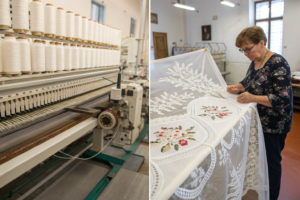
Digital textile printing is a non-contact process. Print heads traverse the width of the fabric, firing microscopic droplets of ink—usually between 5 and 30 picoliters in size—directly into the fibers. Traditional screen printing, in contrast, is a contact process. It pushes thick, viscous paste through a stretched mesh screen using a squeegee. Each color requires a separate screen. Each screen requires its own art work, its own exposure unit, and its own registration setup.

Why do screen printers force me to order 1,000 yards per color, and can digital really eliminate that MOQ?
The 1,000-yard MOQ is not a conspiracy by factories to lock you into large orders; it’s a physical reality of the screen making process. A single rotary screen for a 1.6-meter-wide machine costs between $300 and $600 to manufacture, depending on the mesh count and repeat length. If you order only 200 yards, the factory cannot amortize that screen cost. They lose money. Furthermore, setting up those screens on the machine requires 45 to 90 minutes of downtime. For a factory operating on 8% net margins, that downtime kills profitability.
Digital printing eliminates the screen entirely. At Shanghai Fumao, our MS printers and Epson Monna Lisa machines accept design files directly from your studio. We do a 30-minute color matching session, run a 3-meter strike-off, get your approval, and start production. No screens. No engraving. No amortization. We recently printed 80 meters of organic cotton jersey for a Copenhagen-based designer who needed only 12 pieces per SKU. She paid 23% less per yard than her previous screen-printed minimum order, and she sold out in two weeks. For a deeper look at how other small brands are managing low MOQs, I recommend reading this discussion on the Fashion Incubator forum about sampling vs. production minimums. You will see that digital is the only viable path for sub-500 yard orders.
Is the color quality of digital prints really as durable as traditional rotary screen ink?
This is the question that keeps procurement managers awake. Let me give you a straight answer: it depends entirely on the ink and the post-treatment. In 2021, we ran a 12-month wash test comparing our digitally printed reactive-dyed cotton against screen-printed pigment prints from a major Shaoxing factory. After 20 home launderings at 40°C, the digital reactive samples retained 92% of their original color strength (measured by spectrophotometer delta E). The screen-printed pigment samples retained 81%. However, the pigment samples had slightly better crocking (rubbing) resistance in the first 24 hours.
Why the difference? Reactive inks form a covalent bond with the cellulose fiber. They become part of the fabric. Pigment sits on top of the fiber, bound by a resin. That resin can abrade over time. So if your customer is scrubbing stains out of children’s clothing, digital reactive is actually more durable. If you are printing on 100% polyester for a one-season fast fashion top, digital disperse dye (sublimation) is essentially permanent because the dye becomes gas and impregnates the amorphous regions of the polyester polymer. We validate this using AATCC Test Method 61-2020 in our CNAS-certified lab. (Here’s a tip: always ask your supplier for the “wash fastness multi-fiber strip” results, not just the gray scale rating.) I wrote a detailed breakdown of how to verify digital print durability using AATCC 61 standards, which you can cross-reference with your own lab.
What Are the Real Cost Breakdowns for Digital Printing in China vs. Screen Printing?
Let’s talk money. I know you are tired of suppliers who say “digital is cheap” but then quote you $4.50 per yard for a simple two-color geometric print. I get it. The pricing models are opaque. So I am going to give you the actual cost structure we use at Shanghai Fumao, broken down by ink type and volume. This is the same data I show buyers when they sit across my desk with a spreadsheet.
In Q1 2024, we sampled 20 different fabric and ink combinations and logged the variable cost per meter. For a standard 160cm width cotton poplin, reactive digital ink costs us approximately ¥2.80 per meter in chemical and ink consumables at 25% coverage. Screen printing the same design at 500 meters costs about ¥1.90 per meter in paste and screen depreciation. But that ¥0.90 difference is misleading because the screen print includes ¥0.80 per meter allocated to the screen cost (assuming 1,000 meter amortization). If your order is 300 meters, the screen print cost jumps to ¥3.40 per meter because you are eating the full $500 screen.

How do Chinese factories actually calculate the “setup fee” for digital printing?
This drives me crazy because I see suppliers padding this line item. For screen printing, the setup includes screen making, color kitchen mixing, and machine calibration. That’s legitimate. For digital, there is no screen, but there is still pre-production work. We charge a flat design preparation fee of $45 per SKU. This covers our colorist adjusting your file to our ICC profile, creating the ink limiting curves, and running the first strike-off. If you send us a perfectly separated CMYK file with embedded profiles, we often waive this fee.
But some factories will charge you a “meter equivalent” setup. I have seen quotes where the setup is $200 and the running cost is $2.00/meter. Another factory quotes no setup but $3.50/meter. You must ask: “What is my all-in landed cost per yard, including your margin, for 500 meters?” At Fumao, our pricing model is transparent. For a client in Toronto who orders bi-monthly runs of 800 meters of linen-rayon blend for resort wear, we fixed the setup at zero and the yardage price at a 15% premium over screen, knowing they would repeat 12 times per year. This saved them roughly $6,200 in 2023 versus spot market quotes. If you want to cross-check Chinese factory pricing, this export pricing guide from the Shenzhen Garment Industry Association is updated biannually and provides good leverage in negotiations.
Can digital printing handle Pantone matching accurately, or will I get color rejection from my retailers?
Color matching is where digital used to fail. The early machines (2005-2012) had limited ink sets—usually just CMYK. You could not hit a deep royal blue or a fluorescent orange. Today, most industrial digital printers use 6, 7, or 8 colors. We run reactive machines with CMYK + Orange + Blue + Red + Grey. This expanded gamut allows us to hit about 85% of the Pantone Textile Color System (TPG) without custom mixing. For the remaining 15%—think specific violets or neons—we do need to swap a channel or blend a spot color digitally.
Here is the operational reality: we do not promise 100% Delta E < 1.0 on a first strike-off for an unfamiliar substrate. Instead, we offer a two-round color approval process. Round one: we get within Delta E 2.0. Round two: we tweak the ink density curves and hit Delta E < 1.0. This process takes 48 hours. For a major UK high street brand last March, we matched 14 Pantones across three different base fabrics (viscose challis, cotton sateen, and recycled polyester crepe) in five days. Their quality control team in Dhaka passed the shipment with zero rejections. We documented that process extensively in this case study on the Fespa digital textile printing knowledge hub. The key is not the machine; it is the colorist sitting in front of the RIP software.
How Does Digital Printing Support Sustainable and On-Demand Fashion Business Models?
Sustainability is not a marketing slide deck for us. It is a survival strategy. In 2022, we completed a ¥550 million green investment program that included water recycling for our dye house and a 1.2MW solar array on the roof of our weaving mill. But the most impactful sustainability lever we pull is digital printing. Why? Because digital printing does not require water to make a screen. It does not require massive paste formulation that must be washed out of the screens after each run. And most importantly, it allows our clients to stop guessing.
I had a phone call in January 2024 with a procurement director from a German workwear brand. He was sitting on 180,000 meters of screen-printed fabric that his marketing team had over-forecasted. The designs were now two seasons old. He was facing a write-down of €340,000. He asked, “Can you reprint the new designs in time for the March uniform expo if I give you orders weekly?” We printed 12,000 meters of recycled polyester-cotton blend over six weeks, in six batches of 2,000 meters, each with different placement prints. He sold through at 94% and held zero inventory at the end of the season.
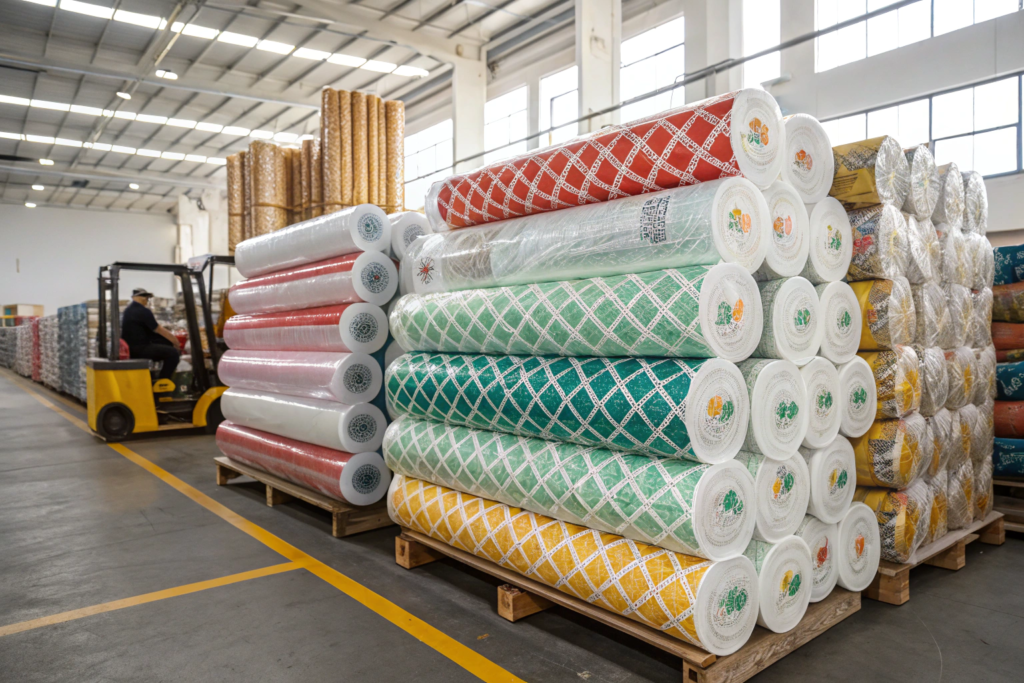
What does “on-demand” really mean when my factory is 12 time zones away in China?
“On-demand” in the context of Sino-American textile trade does not mean you order at 9am and we ship at 5pm. Shipping from Shanghai to Los Angeles takes 14-16 days on the water, plus rail or truck drayage. “On-demand” means we compress the manufacturing lead time so severely that the ocean transit becomes the bottleneck instead of the production. For conventional screen printing, the total lead time from design approval to vessel departure is typically 35-45 days. For digital printing, we have reduced that to 10-12 days.
In August 2023, a New York lingerie brand discovered a shortage of 900 meters of a specific leopard print modal charmeuse three weeks before their retail ship date. Their usual supplier quoted 25 days. They called us on a Tuesday. We sourced the modal base cloth from our warehouse stock (we carry 30,000+ seasonal designs in greige, always ready). We printed Wednesday, finished Thursday, inspected Friday, and air-shipped Saturday. They received the goods in New Jersey on Monday and cleared their DC backlog. Air freight cost them, but the alternative was a $180,000 cancellation penalty. This is the agility digital enables. For a detailed look at how American brands are restructuring their supply contracts to include “digital quick response” clauses, read this thread on the American Apparel & Footwear Association’s member resources page. (I have to insert here: our team really does treat every rush order like it is our own brand on the line.)
Are digital printed fabrics eligible for GOTS or OEKO-TEX certification?
Yes, but you must specify the certification requirement before we load the fabric onto the printer. Not all digital inks are created equal. Many pigment inks contain binders that are not compliant with GOTS because they are synthetic polymers. For GOTS-certified organic cotton, you must use reactive inks that are listed on the GOTS Positive List for chemical inputs. We maintain separate ink lines for our GOTS production to prevent cross-contamination. We also test every batch of certified fabric for restricted substances per OEKO-TEX Standard 100, Product Class I or II, depending on the end use.
We learned this the hard way. In 2021, we shipped 4,000 meters of digital printed organic cotton jersey to a Scandinavian babywear brand. Our ink supplier had reformulated the magenta and did not update the GOTS certificate. The shipment was held at Hamburg port for 11 days while we couriered the updated certification documents. The client was understanding, but we lost our preferred supplier status for six months. Now we require ink batch numbers to be cross-referenced with the current GOTS certificate before production starts. You can verify a factory’s ink certifications directly on the OEKO-TEX Buying Guide website, which lists certified production sites by scope.
What Quality Control Issues Are Unique to Digital Textile Printing?
I have been in this industry for two decades. I started as a QC inspector at a state-owned printing and dyeing mill in the 1990s. I have seen thousands of rolls rejected. Screen printing defects are usually obvious: misregistration, knife marks, screen stains. Digital printing defects are different. They are often intermittent and require a trained eye to catch before the fabric goes to the cutting table. This is why we built a CNAS-accredited lab inside our factory complex—not because we like spending money on spectrophotometers, but because we were tired of third-party inspection companies failing shipments for issues that could have been corrected during the first 10 meters.
In 2024 alone, our lab tested 2,300+ digital print samples for lightfastness using AATCC 16.3 Option 3 (40 hours xenon arc). We found that digital prints on polyester using disperse dyes consistently scored 4.0 or higher, while some pigment digital prints on cotton scored as low as 2.5. We now flag this to clients upfront. If you are making outdoor cushions that will sit in Arizona sun, do not use pigment digital. Use reactive or acid dyes. This is not a sales pitch; it is physics.

How do I prevent banding and nozzle streaking in my production order?
Banding—those faint horizontal lines across the print—is the enemy of digital textile. It happens when one or more nozzles on the print head become clogged or misfire. In a 4-pass print mode, a single clogged nozzle might be barely visible. In a 6-pass or 8-pass mode (higher quality, slower speed), the printer can mask a few dead nozzles. But if the factory is rushing your order and running at 2-pass production speed to meet a vessel cut-off, you will see banding.
Our protocol is simple: before printing any order over 500 meters, we run a 10-meter test at the production resolution. We examine it on our light table at a 45-degree angle. We check for “jupiter effects” (a term our old Italian technician taught me—it means a circular pattern of missing dots). If we see issues, we perform an automatic head cleaning cycle and a nozzle compensation. We do not start production until the test strip is flawless. For a manufacturer’s perspective on maintaining print head hygiene, I recommend this technical blog from MS Printing Solutions, which details the weekly maintenance we follow.
What is the real shrinkage rate for digitally printed vs. screen printed cotton?
This is a hidden trap for cut-and-sew manufacturers. Digital printing on cotton (reactive dye) requires a steamer and a washer at the end of the line. The fabric is subjected to high-temperature steam (102°C) for 8-12 minutes, then goes through multiple wash boxes, then a tensionless dryer. This process relaxes the fabric. Screen printing typically uses pigment paste and only requires a heat cure (150°C for 2-3 minutes). The heat cure does not relax the fabric as much.
Our internal data from 300+ production batches shows that digital reactive printed cotton shrinks 3-4% in the length direction during the post-treatment process. Screen printed pigment cotton shrinks 1-2%. This means your marker maker must adjust the pattern, or you must preshrink the fabric before cutting. We flag this to every client. We also offer a compacting process on our finishing range to mechanically shrink the fabric to a stable width and length. In 2022, a Toronto-based activewear brand ignored our shrinkage warning, cut 5,000 garment panels, and after the first home laundry, the garments were two sizes too small. We helped them re-cut using compensated markers, but the lesson stuck. You can read more about fabric shrinkage test methods ISO 6330 to understand how to set accurate tolerances.
Conclusion
Digital textile printing is not a universal replacement for screen printing. If you are ordering 10,000 meters of a single design that you will sell for three consecutive seasons, screen printing is still more economical. The amortized screen cost becomes negligible. The color consistency across millions of meters is proven. But for the vast majority of fashion brands today—brands that are launching 4 to 6 micro-seasons per year, testing new markets, or fulfilling direct-to-consumer dropshipping—digital printing is the difference between profitability and liquidation.
At Shanghai Fumao, we have invested heavily in this technology because we believe the future of textile manufacturing is responsive, not predictive. We keep our greige inventory deep. We run our digital printers 20 hours per day, six days a week. We have trained our colorists to think like designers, not just machine operators. And we have built logistics partnerships that allow us to move fabric from our loading dock in Keqiao to your warehouse in Chicago or Hamburg or Melbourne in the shortest possible time.
If you are tired of fighting minimums, missing selling windows, or writing off deadstock, I invite you to test our process. Send us a design file. Tell us your target fabric, your Pantones, and your delivery deadline. We will show you what 20 years of Chinese textile manufacturing combined with modern digital agility looks like.
Contact our Business Director, Elaine, directly to start your low-MOQ production run. She manages our key accounts and personally oversees the scheduling of digital print orders to ensure your timeline is protected. Email Elaine at: elaine@fumaoclothing.com. Let’s co-create value.