As a fabric exporter with over 20 years of experience shipping to the United States, I've learned that proper documentation is the difference between smooth customs clearance and costly delays. The US has one of the most detailed customs documentation requirements globally, and missing even one document can result in shipments being held for weeks, incurring demurrage charges that can exceed the value of the goods themselves.
US customs clearance requires a complete package that proves your fabrics comply with all relevant regulations, accurately declares the value and origin, and provides all necessary security filings. The process involves multiple agencies including Customs and Border Protection (CBP), the Consumer Product Safety Commission (CPSC), and the Department of Agriculture, each with their own documentation requirements. Having shipped thousands of containers to US clients, I've developed a systematic approach to documentation that ensures our clients' fabrics clear customs efficiently every time.
Let me walk you through the essential documents and common pitfalls based on our extensive experience with US-bound shipments.
What are the mandatory commercial documents required?
The commercial documents form the foundation of your customs submission, establishing the business transaction, value, and basic product information. These are the documents that prove the legitimacy of your shipment and form the basis for duty assessment.
The absolute essentials include the commercial invoice, packing list, and bill of lading or air waybill. The commercial invoice must contain detailed product descriptions, harmonized system (HS) codes, values, and buyer/seller information. The packing list should match the invoice and provide physical details about the shipment. The bill of lading serves as both receipt and contract for carriage. We've seen shipments delayed for weeks because of discrepancies between these three documents—something as simple as weight variations between packing list and bill of lading can trigger intensive examination.

How to create a customs-compliant commercial invoice?
A compliant commercial invoice must include specific elements: detailed product descriptions, correct HS codes, accurate values, and proper origin statements. The description should go beyond "cotton fabric" to include weight, composition percentage, weave type, width, and finishing processes. This level of detail helps customs officers properly classify your goods.
We include: seller and buyer complete addresses, detailed product descriptions, HS codes, quantity, value per unit and total value, currency, terms of sale (Incoterms), country of origin, and signed declaration. Our system automatically cross-references this information against the latest US customs invoice requirements to ensure compliance. Last month, this attention to detail helped a client clear a $150,000 fabric shipment in under 24 hours while similar shipments from competitors were held for documentation review.
What packing list details prevent customs delays?
The packing list must precisely match the commercial invoice while providing the physical details customs needs for examination. Include carton counts, exact weights and measurements, marks and numbers, and how the goods are packed. For fabrics, specify roll counts, widths, and whether goods are on tubes or flat-packed.
We list: total packages, package numbers, gross and net weights, package dimensions, and exact contents of each package. This precision helped during a random inspection in Los Angeles last quarter—customs was able to examine just two rolls instead of the entire container because our packing list showed exactly which rolls contained the sampled HS code. This saved our client over $5,000 in examination and repacking costs. Industry resources like the Fabric and Textile Shipping Documentation Guide provide excellent templates for creating comprehensive packing lists.
What specialized certificates ensure smooth clearance?
Beyond the basic commercial documents, specialized certificates prove your fabrics meet specific US regulatory requirements. These documents demonstrate compliance with safety standards, trade agreements, and other regulations that affect admissibility and duty rates.
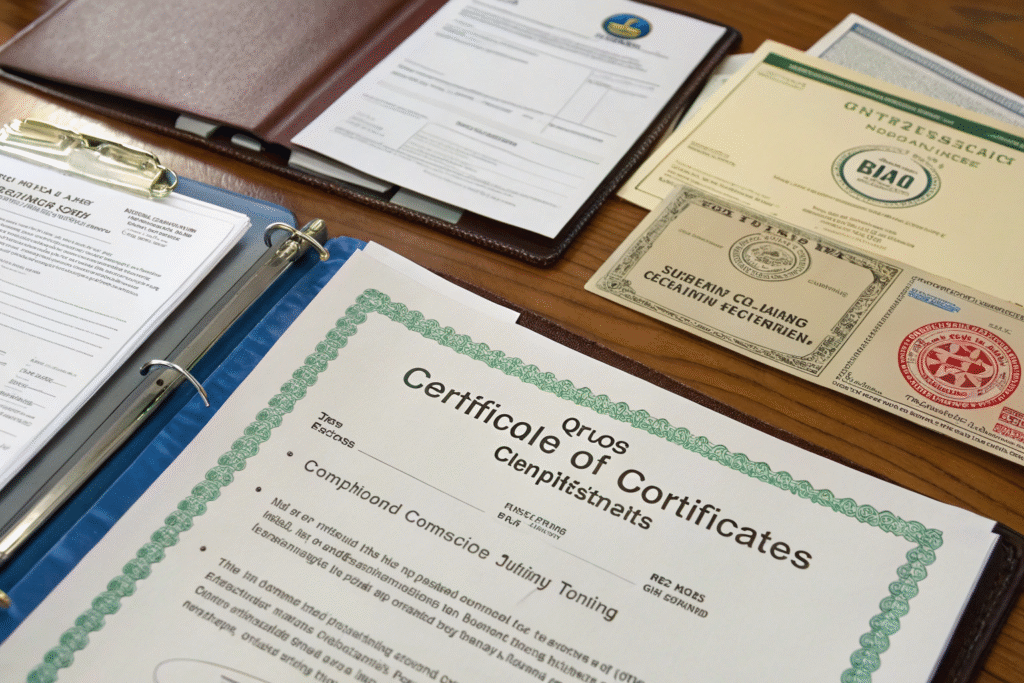
The most common certificates include the certificate of origin, various compliance certificates, and safety testing reports. The certificate of origin determines duty rates under various trade agreements, while compliance certificates address specific regulations like flammability standards or chemical restrictions. We maintain templates for all required certificates and work with accredited laboratories to ensure our testing documentation meets US standards.
When is a formal certificate of origin required?
A formal certificate of origin is required when claiming preferential duty rates under trade agreements like the US-Mexico-Canada Agreement (USMCA) or for goods subject to quotas or trade remedies. Even when not required, many importers request them for record-keeping and verification purposes.
We provide two types: self-certified origin declarations for USMCA eligibility and chamber of commerce certified certificates for other purposes. The documentation must include detailed manufacturing information proving the origin criteria are met. Last year, we helped a client qualify their fabrics for duty-free treatment under USMCA by documenting that their yarn spinning, fabric formation, and finishing all occurred within the USMCA region. This saved them approximately $28,000 in duties on their first shipment alone. The US Customs and Border Protection origin guidance provides detailed rules for various trade agreements.
Which testing certificates do textile shipments need?
Textile shipments typically require flammability compliance certificates (16 CFR 1610 for general apparel, 1615/1616 for children's sleepwear), fiber composition verification, and for some products, chemical compliance certificates (lead, phthalates). The specific requirements depend on the end use of the fabrics.
We provide: CPSC-compliant flammability test reports, full fiber composition analysis, and when applicable, CPSIA compliance documentation for children's products. Our in-house CNAS-certified laboratory generates these reports, which are widely accepted by US authorities. Recently, a client's shipment was selected for CPSC examination at Newark port—our comprehensive testing package resulted in release within 48 hours while a competitor's shipment with incomplete documentation was held for three weeks. Understanding textile testing requirements for US market access is essential for smooth clearance.
How does the ISF filing process work?
The Importer Security Filing (ISF), also known as "10+2," is a mandatory advance electronic submission required for all ocean shipments to the US. This regulation requires importers or their agents to submit detailed information about the shipment before it's loaded at the foreign port.
The ISF consists of 10 data elements from the importer and 2 from the carrier, submitted no later than 24 hours before loading at the foreign port. The required information includes manufacturer/supplier details, seller details, buyer details, ship-to party, container stuffing location, and consolidator details. Missing or inaccurate ISF filings can result in penalties of $5,000 per violation, so getting this right is crucial.
What are the consequences of late or inaccurate ISF?
Late, incomplete, or inaccurate ISF filings can result in significant penalties, increased inspections, and potential holds on your merchandise. CBP may issue liquidated damages of $5,000 per violation for late filings or substantial inaccuracies, and $10,000 for manifesting violations.
We experienced this early in our exporting journey when a new logistics partner filed an ISF with incorrect manufacturer information. The $5,000 penalty was a painful but valuable lesson that led us to develop our current rigorous verification process. Now, we double-check all ISF data against our commercial documents before submission and maintain a comprehensive ISF filing checklist for textile importers that has prevented any filing errors for over seven years.
Who is responsible for ISF filing and timing?
The ISF Importer—typically the owner, purchaser, consignee, or agent—is responsible for filing the ISF. For foreign manufacturers shipping to US customers, the US importer of record usually handles this filing, but as exporters, we ensure they have all necessary information well in advance.
We provide complete ISF data to our clients or their brokers at least 72 hours before vessel loading. This includes: manufacturer name and address, seller name and address, buyer name and address, ship-to name and address, manufacturer identity, country of origin, commodity HTSUS number, container stuffing location, consolidator, and importer of record number. This proactive approach has eliminated ISF-related delays for our clients completely since implementation.
What are the most common documentation mistakes?
Even experienced shippers make documentation errors that cause customs delays. Based on our experience clearing thousands of fabric shipments, the most common mistakes involve inconsistent information, incorrect classifications, and inadequate supporting documentation.
The top documentation errors we see include: discrepancies between commercial documents, incorrect HS codes, missing or invalid bonds, incomplete descriptions, and outdated certificates. Any inconsistency between your commercial invoice, packing list, and bill of lading will trigger manual review. Similarly, using outdated HS codes or incorrect duty rates can lead to underpayment assessments with penalties.

How do HS code errors impact clearance and duties?
HS code errors can result in incorrect duty payments, penalties for negligence, and shipment delays while corrections are processed. The US uses HTSUS codes (Harmonized Tariff Schedule of the United States), which are more detailed than standard HS codes and include specific provisions for textiles.
We maintain an updated database of HTSUS codes for all our fabrics and review it quarterly for changes. Last year, a code change for certain laminated fabrics would have resulted in a 3% duty increase if we hadn't caught it early. By properly classifying our fabrics and providing detailed technical descriptions, we ensured our clients paid the correct duties and avoided potential penalties. The U.S. International Trade Commission's HTSUS database is the definitive source for current classifications.
Why do description discrepancies cause major delays?
Description discrepancies trigger manual review because they suggest possible misdeclaration or attempted evasion. Customs officers are trained to spot inconsistencies between documents, and even minor differences can result in intensive examination.
We implement a "single source of truth" system where all documents generate from the same data source. This eliminated description discrepancies that previously caused an average of two delays per month. Now, when we create a commercial invoice, the system automatically populates the same descriptions into packing lists, certificates of origin, and other documents. This consistency has reduced our customs examination rate by over 60% in the past three years.
Conclusion
Proper documentation for US fabric shipments requires attention to detail, understanding of multiple regulatory requirements, and systematic processes to ensure consistency across all documents. By preparing the mandatory commercial documents, obtaining the necessary certificates, ensuring accurate ISF filing, and avoiding common mistakes, you can achieve smooth customs clearance and avoid costly delays.
The investment in proper documentation processes pays for itself many times over in reduced delays, lower demurrage costs, and avoided penalties. If you're looking for a fabric supplier with proven expertise in US customs compliance, contact our Business Director Elaine at elaine@fumaoclothing.com. We'll ensure your fabric shipments arrive with complete, accurate documentation for trouble-free customs clearance every time.