You’re sourcing fabrics from China, and you know quality matters. But how do you really prove it to your own customers and ensure you’re not getting stuck with non-compliant, unsafe, or falsely advertised materials? The answer lies in the certifications. Think of them as your fabric's passport—they verify its origin, safety, and ethical journey. Without the right stamps of approval, your shipment can get turned away at the border, or worse, damage your brand’s reputation. In the complex world of global textile sourcing, certificates are your non-negotiable proof of trust.
At its core, you should look for a combination of quality assurance, safety, and sustainability certifications from a Chinese fabric supplier. The essential trio includes SGS for comprehensive quality and compliance testing, OEKO-TEX for human-ecological safety, and GRS (Global Recycled Standard) for verifying recycled content. But it’s not just about collecting certificates; it’s about understanding what each one actually guarantees and ensuring your supplier has a genuine, integrated system behind them.
Many buyers see the logos on a website and assume everything is fine. The real challenge is separating marketing from reality. A genuine supplier doesn’t just have certificates; they operate by them. Their testing is in-house or tightly partnered, their processes are transparent, and they can explain the why behind every standard. Let’s break down exactly which certifications protect your business and how to verify they are more than just paper.
How Do SGS Reports Protect My Fabric Quality and Compliance?
You’ve placed a bulk order for 10,000 meters of polyester satin. The samples looked perfect. But when the container arrives, the color is off, the hand-feel is rough, and you suspect the composition isn’t 100% polyester as promised. Who do you turn to, and how do you file a claim? This is where an SGS report shifts from a nice-to-have to your most powerful legal and quality defense tool.
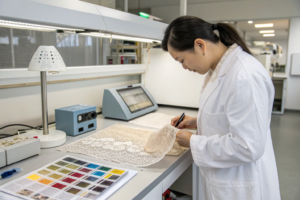
An SGS report protects your fabric quality and compliance by providing an independent, third-party verification of the product’s specifications against agreed-upon standards or international regulations. It acts as an unbiased scientific record that details the fabric’s physical properties (like tensile strength, colorfastness, pilling resistance) and chemical compliance (like the absence of banned AZO dyes or heavy metals). For us at Shanghai Fumao, this isn't just a report we get at the end; it's a guide for our entire production process. Our in-house CNAS-accredited lab runs pre-tests that mirror SGS standards, so we’re confident before the official inspector arrives.

What specific tests are included in a standard SGS fabric inspection?
A standard SGS fabric inspection for garments or home textiles typically covers a “Full Test Package”. This isn't a single test; it's a battery of checks. From my 20 years on the factory floor, I group them into three pillars. First, dimensional stability tests: this includes shrinkage after washing and drying, and skewness distortion check for twills and knits. Second, colorfastness tests: rubbing (dry and wet), washing, perspiration, and light. I once had a client who skipped the lightfastness test for curtains, and the sun-facing panels faded in 3 months—a costly lesson. Third, physical performance tests: tensile and tear strength, seam slippage, and pilling resistance (like the Martindale test). For example, in 2022, a German sportswear brand challenged us to produce a nylon-spandex blend with a pilling rating of 4+ after 50,000 cycles. Our in-house lab data guided the yarn twist adjustment, and the subsequent SGS report confirmed the pass, securing a 2-year contract.
Beyond these, the most critical part for compliance is the chemical test. This screens for regulated substances like formaldehyde, pH value, extractable heavy metals, and allergenic disperse dyes. It’s the non-negotiable ticket to enter markets like the EU and US. A common pitfall is only testing the final fabric but forgetting the accessories. Zippers, buttons, and even sewing threads need compliance checks. A helpful resource to understand the scope is the guide to international textile testing requirements on platforms like Textech Global, which breaks down standards by region.
Why is third-party verification more reliable than supplier self-declaration?
Third-party verification is more reliable because it removes the inherent conflict of interest. As a supplier, I can tell you my fabric is perfect. But SGS, as a globally recognized entity with its own reputation on the line, has no incentive to lie. Their report is evidence. In practice, this reliability comes from two things: standardized methodology and chain-of-custody. SGS inspectors follow internationally accepted test methods (ISO, AATCC, ASTM), so the results are reproducible anywhere in the world. Their sampling is also random and done post-production, not on pre-selected "golden samples".
Let me share a case from last year. An American client was sourcing recycled cotton canvas from another vendor who provided a self-declared composition report. Suspicious of the low price, the client asked us at Shanghai Fumao for a second opinion. We facilitated a third-party SGS test which revealed the recycled content was below 30%, not the 50% claimed. This wasn't just dishonesty; it was a legal risk for the client's marketing. The importance of third-party lab testing for import compliance is a frequent topic on industry forums like Fashion-Incubator, where many share similar "gotcha" stories. Self-declaration is a good internal check, but for payment releases and legal protection, an SGS report is your insurance policy. It turns subjective claims into objective, defensible data.
Is OEKO-TEX STANDARD 100 Enough to Guarantee Fabric Safety?
You're sourcing cozy baby fleece or intimate apparel. The last thing you want is a headline about harmful chemicals found in your products. You see the OEKO-TEX label and breathe a sigh of relief. But does that single label cover everything from the yarn to the finished garment sitting on the retail shelf? The answer is more nuanced than a simple yes.
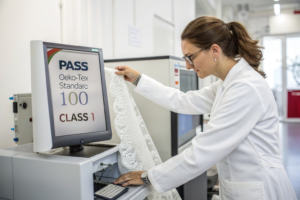
OEKO-TEX STANDARD 100 is a robust and globally recognized certification that guarantees a textile product has been tested for a wide array of harmful substances and is safe for human ecological health in its final form. It is "enough" for verifying the safety of the final product you are purchasing. The key is in the product class (I to IV, with IV being for baby products), which sets the strictest limits. When you buy fabric with a valid OEKO-TEX certificate, you are buying a promise that it’s free from levels of nasties like pesticides, chlorinated phenols, and nickel that could harm end-users.
However, "guarantee" is a strong word. It guarantees safety at the point of testing. The certification is for a specific article (e.g., "100% cotton jersey, dyed blue, 180gsm") from a specific supplier. If that supplier later changes dye batches or finishing chemicals without recertifying, the guarantee lapses. That’s why at our Fumao Textiles operations, we integrate OEKO-TEX compliance into our sourcing. We use pre-approved chemicals from our dyeing partners, and our in-house QC runs preliminary tests to avoid costly certification failures. For instance, in 2023 Q3, we supplied OEKO-TEX Class IV certified organic cotton interlock to a Scandinavian children's wear brand. Their own due diligence audit confirmed a perfect match between our bulk and certified sample, which they credited to our controlled supply chain.

What harmful substances does OEKO-TEX actually test for?
OEKO-TEX STANDARD 100 tests for over 100 individual regulated and harmful substances, grouped into logical categories. It’s not just about what's banned today; it often includes substances under scientific discussion, making it a proactive standard. The list is comprehensive, but I’ll highlight the ones that most commonly trip up suppliers. First, Illegal Azo dyes and colorants that can cleave into carcinogenic amines. Second, Formaldehyde, used in anti-wrinkle finishes—its limits are extremely low, especially for Class I and II. Third, Heavy metals like cadmium, lead, and mercury, which can be present in certain dyes or pigments.
A less-known but critical category is Pentachlorophenol (PCP) and Tetrachlorophenol (TeCP), wood preservatives sometimes found in natural fiber bales stored in certain conditions. I recall a situation in 2021 where a shipment of hemp fabric from a new farm failed for elevated PCP. The issue was traced back to the storage pallets used at the ginning stage. It took us 6 weeks to decontaminate and recertify. This experience taught us to also check for Phthalates (used in plastisol prints) and PFAS (for water repellency), which are increasingly scrutinized. For brands wanting to dive deeper, the OEKO-TEX official banned substances list is publicly available, but interpreting it requires expertise. A great external resource that explains these in layman's terms is the blog "EcoTextile News," which often publishes articles on understanding chemical limits in eco-textile certifications.
How does OEKO-TEX differ from REACH compliance in the EU?
This is a crucial distinction. Think of OEKO-TEX as a private, voluntary safety standard for the product itself, while REACH is a mandatory legal regulation governing chemicals in the European Union. OEKO-TEX is a specific certificate you apply for and receive. REACH compliance is a legal obligation for anyone placing substances, mixtures, or articles on the EU market; there's no "REACH certificate" per se, only a dossier of due diligence.
Here’s the practical difference: OEKO-TEX tests the finished article for residue substances. REACH regulates substances throughout the supply chain, focusing on the intentional use and registration of chemicals. A fabric can be OEKO-TEX certified but still violate REACH if, for example, a chemical used in its production (which may not remain as a residue) is not authorized under REACH Annex XVII. The most straightforward way to navigate this is to ensure your chemical suppliers are REACH-compliant. In our dyeing cooperative, we only source colorants and auxiliaries from vendors who provide full REACH SVHC (Substances of Very High Concern) statements. This dual-layer approach—OEKO-TEX for product safety and REACH-compliant inputs for production—is what sophisticated brands demand. Discussions on navigating REACH vs OEKO-TEX for apparel brands are common in professional groups on LinkedIn, where compliance managers share best practices.
Why is GRS Certification Critical for Sourcing Recycled Fabrics?
The market is flooded with claims of "recycled" or "eco-friendly" fabric. As a buyer, you're paying a premium and marketing this virtue to your customers. But how can you be sure that the recycled polyester in your performance jacket actually contains post-consumer plastic bottles and isn't just a blend with a tiny percentage of recycled content? This is where the Global Recycled Standard (GRS) moves from critical to indispensable.
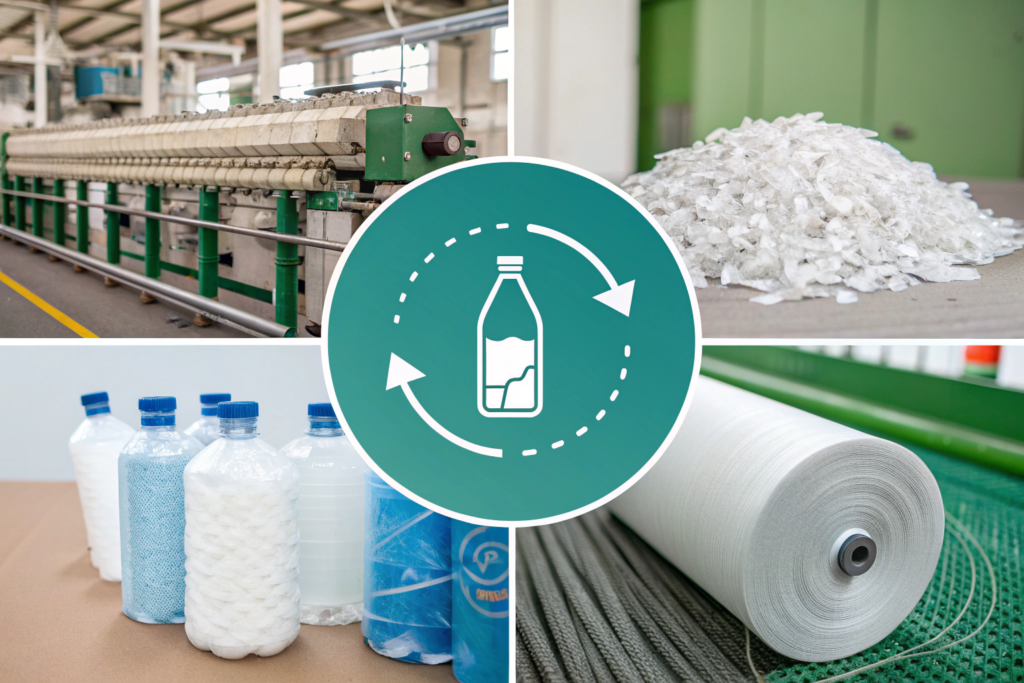
GRS certification is critical because it provides a verified, traceable chain of custody for recycled materials. It doesn't just ask "Is there recycled content?" It asks "How much?", "From where?", and "How is it handled throughout production?" The GRS logo on a fabric hangtag is a credible story you can tell: from collected plastic bottles to flakes, to yarn, to your fabric, with documented mass-balance at every step. Without it, you're often taking the supplier's word on faith, which is a significant risk for greenwashing accusations.
For us, GRS is part of our core sustainability commitment. Our investment in recycled fabrics isn't just a marketing line. In 2023, we supplied over 200,000 meters of GRS-certified rPET twill to a European workwear brand. Their audit team physically traced the material from our warehouse back to the certified recycler, checking transaction certificates (TCs) at each link. This transparency won us a 3-year framework agreement. The brand wasn't just buying fabric; they were buying verifiable environmental impact data. (Here’s a pro tip: always ask for the Transaction Certificate for your specific batch—it's the birth certificate for your recycled material.)
What is the minimum recycled content required for GRS certification?
The GRS has a clear, tiered threshold system. To be GRS certified, a product must contain a minimum of 20% recycled content by weight. However, the standard recognizes different levels of achievement:
- GRS Certified (Blended): 20% - 49% recycled content. The product can be labeled as containing recycled materials, but the specific percentage must be displayed.
- GRS Certified (Standard): 50% - 95% recycled content. The product can use the standard GRS label.
- GRS Certified (High Content): 96% - 100% recycled content. The product can use a special "High Content" label.
This is where due diligence matters. A supplier can be "GRS certified" as a company, but each product has its own percentage. I always advise clients to specify the exact recycled content percentage in the purchase contract. For example, don't just order "GRS rPET"; order "GRS-certified rPET fabric with 100% post-consumer recycled content." We make this easy with QR codes on our rolls that link directly to the composition and certificate data. Understanding these tiers is vital for accurate marketing and cost calculation. Resources like the Textile Exchange website (the standard owner) offer detailed guides on calculating recycled content in textile products, which is invaluable for product developers.
How does GRS ensure environmental and social responsibility beyond recycling?
This is what sets GRS apart from a simple content claim standard. GRS is a holistic standard that includes mandatory criteria in three other key areas, making it a powerful tool for responsible sourcing:
- Environmental Management: Certified facilities must have an environmental policy, record energy/water use, and wastewater treatment, and restrict hazardous chemical inputs (linking back to OEKO-TEX or ZDHC).
- Social Responsibility: Based on International Labor Organization (ILO) conventions, it requires safe working conditions, no child or forced labor, freedom of association, and legal employment contracts. This is audited on-site.
- Chemical Use and Restrictions: It explicitly bans certain chemicals and requires compliance with local and international regulations.
Here’s a table from our own internal compliance checklist that shows how we align with GRS requirements:
| GRS Requirement Category | What It Means for Our Factory | Client Benefit |
|---|---|---|
| Recycled Content Traceability | Mass-balance system tracked from supplier TC to our finished fabric TC. | You get a Transaction Certificate proving your order's recycled content. |
| Environmental Management | We monitor dyehouse water consumption and have a wastewater pre-treatment agreement. | Reduces the risk of your brand being linked to pollution. |
| Social Compliance | Regular internal audits on working hours, wages, and safety equipment. | Mitigates supply chain social risks. |
| Chemical Restrictions | Our dyeing partners are ZDHC Gateway compliant, and we use a restricted substances list (RSL). | Ensures the fabric is safe and manufactured responsibly. |
This multi-faceted approach means that when you source GRS-certified fabric from a reputable partner like Shanghai Fumao, you're supporting broader ethical and environmental practices. Forums like Sustainable Textile Forum often have threads debating the real-world impact of GRS social audits, providing ground-level insights beyond the certification paperwork.
How to Verify the Authenticity of a Supplier's Certificates?
You've found a supplier whose website is plastered with certification logos. Their sales rep promises all certificates are valid and available. But in an era of digital editing, how do you move from trust to verification? Failing to do this step can render all your previous research meaningless and leave you exposed.
Verifying the authenticity of a supplier's certificates requires a proactive, multi-step process that goes beyond accepting a PDF copy. You must independently confirm the certificate's validity with the issuing body, check its scope and dates, and ideally, visit the facility to see the certified systems in action. A genuine supplier will welcome this scrutiny because their certifications are a point of pride and a operational reality, not just a sales tool.
Let me be blunt: we've won clients because we could instantly pass this verification test when their previous "certified" supplier could not. A U.S. outdoor brand in 2024 asked us for our OEKO-TEX certificate. We didn't just email a PDF. We gave them the unique license number and directed them to the OEKO-TEX certification database to look it up themselves. We also shared the audit report summary from our last GRS surveillance visit. This transparency, which took us 5 minutes, built more trust than a month of emails.

What are the red flags in a fake or misused certificate?
Spotting a fake requires a keen eye. Here are the most common red flags I've encountered over two decades:
- Blurred or Poor-Resolution Logos: Official certificates from bodies like SGS or Control Union have crisp, clear logos. A pixelated or smudged logo is a major warning sign.
- "Applicant" vs. "Manufacturer" Mismatch: Check the "Applicant" field. It should be the company you are buying from or their exact manufacturing entity. If the applicant is a different, unrelated trading company, the certificate may not cover the actual production site. I've seen certificates where the applicant was a Hong Kong trader, but the fabric was made in a completely uncertified mainland factory.
- Vague or Overly Broad Product Scope: The "Product Description" should be specific (e.g., "Knitted fabric, 95% Recycled Polyester, 5% Spandex, Dyed"). Descriptions like "All textile products" or "Various fabrics" are invalid for GRS or OEKO-TEX. Each distinct product type needs its own certification.
- Expired Dates: This sounds obvious, but it's the most common issue. Certificates have validity periods (usually 1 year for OEKO-TEX, GRS requires annual surveillance). Check the issue and expiry dates.
- No Unique Certificate Number or Fake Verification Link: Every real certificate has a unique ID. Be wary of PDFs that are just images, preventing text copying of the number. Also, don't click verification links provided in the PDF unless they direct you to the official certification body's domain (e.g., oeko-tex.com, gs.th.com). A great independent resource that discusses these pitfalls is the Sourcing Journal article on avoiding counterfeit textile certifications in global trade.
What questions should I ask the supplier to test their certification knowledge?
Your questions should probe their operational familiarity, not just their ability to send a file. Ask these:
- "Can you provide the unique certificate/license number for this specific product so I can verify it on the certifier's public database?" A legitimate supplier will provide this immediately.
- "Is the manufacturing facility listed on this certificate the same factory where my order will be produced? Can we arrange a video tour of that facility?" This tests traceability. They should be able to show you the certified site.
- "For this GRS-certified fabric, what is the specific recycled content percentage, and can you provide the Transaction Certificate (TC) for the batch of recycled material used?" This goes beyond the product certificate to the chain of custody. If they hesitate, they may not have a real mass-balance system.
- "What internal processes do you have to ensure consistency between the certified sample and bulk production?" Listen for answers about in-house lab testing, approved chemical lists, and raw material control. For example, we would explain our CNAS-lab pre-checks and how our QC team uses the same testing standards as SGS for in-process control.
Asking these questions separates the professionals from the pretenders. The conversation often moves from price to partnership. Industry networks like the Fashion Industry Association sometimes publish sample supplier qualification questionnaires that include detailed certification verification sections, which you can adapt for your own use.
Conclusion
Navigating the world of textile certifications from Chinese suppliers isn't about collecting the most logos; it's about understanding the story and security each one provides. SGS is your unbiased quality and compliance guardian, OEKO-TEX is your promise of human-ecological safety, and GRS is your verifiable passport into the circular economy. But the ultimate key is verification—treating these documents not as holy grails but as starting points for deep, trusting partnerships.
Your fabric is the foundation of your brand. Its quality, safety, and sustainability claims must be unshakeable. By insisting on these certifications and knowing how to validate them, you transform risk management into a competitive advantage. You gain the confidence to market your products, the data to defend your value, and the supply chain resilience to grow.
Ready to source fabrics with verified confidence? Let's build a partnership grounded in transparency and proven results. Shanghai Fumao is more than a supplier; we are your integrated fabric solutions partner, with the certifications, in-house labs, and operational integrity to back up every claim. For a detailed discussion on how we can meet your specific certification and quality requirements for your next order, reach out to our Business Director, Elaine. She and her team will provide you with direct access to our certificates, factory insights, and a sample development plan tailored to your needs. Contact Elaine at: elaine@fumaoclothing.com.