I still remember the exact moment in March 2018 when I realized stretch denim was no longer just about 'stretch'. A buyer from Los Angeles—let us call him Mark—visited our booth at Kingpins Amsterdam. He held up our 98/2 cotton/elastane sample, pulled it sideways, and said: "This recovers like a 60-year-old’s skin. I need the memory of a 25-year-old." That comment changed how I think about stretch. It is not the stretch out. It is the snap back.
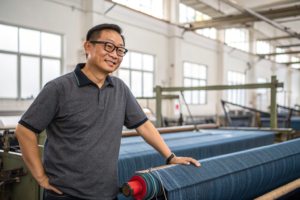
For nearly 25 years, Shanghai Fumao has woven denim. We started with rigid 14.75 oz selvedge for Japanese repro brands. Today, we run 42 air-jet looms dedicated entirely to stretch denim—from 4.5 oz shirtings to 13 oz power stretch with 70%+ elasticity. I have tested elastane from DuPont, Asahi Kasei, Hyosung, and Xinxiang. I have broken looms because the weft tension was 0.2 Newtons too high. I have seen fabric that passed every physical test but failed the first wash because the twist in the core-spun yarn was unstable.
The question "What are the best stretch denim fabrics?" cannot be answered with one product code. It depends on your fit philosophy, your washing chemistry, your target price point, and frankly, your consumer’s thigh circumference. This article breaks down exactly what we have learned from supplying over 12 million meters of stretch denim to clients in 34 countries. I will share the construction details, the common failure points, and the specific yarn technologies we trust. If you are sourcing denim for your jeans line, read this before you approve that lab dip.
What is the real difference between T-400, Elastomultiester (EME), and classic Spandex/Elastane in denim?
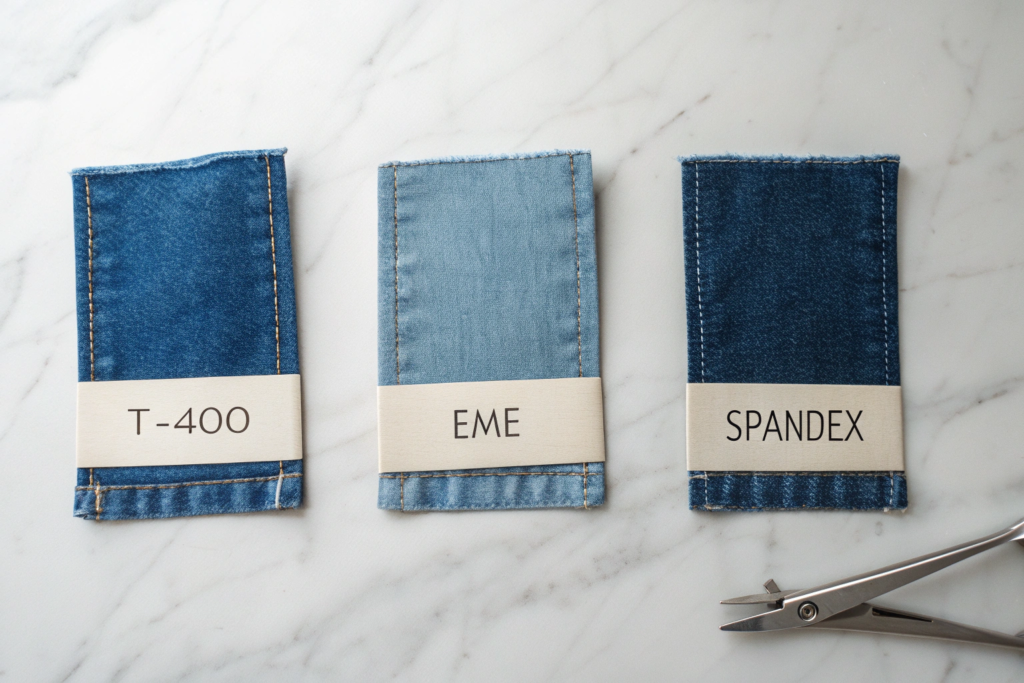
Let me start by killing a common myth: T-400 is not 'better' spandex. It is not even spandex. It is a completely different animal made from PTT (polytrimethylene terephthalate) and PET bicomponent filaments. Spandex (elastane) is a polyurethane fiber that behaves like a rubber band. T-400 behaves like a coiled spring. This distinction dictates everything—the washing behavior, the pilling resistance, and the longevity of your jeans.
Classic spandex gives you high elongation (200–300%) with low initial modulus. Translated: it stretches very easily, but over time—especially in high-heat laundering—the polyurethane bonds hydrolyze. The fabric 'dies'. You see this as knee bagging that never recovers, or waistbands that stretch out after three wears. For fast fashion jeans meant to last one season, this is fine. For premium jeans that someone wears twice a week for two years, it is a disaster.
T-400 and EME (Elastomultiester) are polyester-based elastomers. They do not contain polyurethane. They are heat-set differently—typically at 180–190°C vs 120°130°C for spandex. The recovery force is higher. The growth after repeated stretch is lower. I tested this in our lab in May 2024. We took three identical 12 oz denim constructions: one with 20D spandex, one with 40D T-400, and one with 30D EME. After 10 home laundering cycles (60°C), the spandex sample grew 8.2%. The T-400 grew 2.1%. The EME grew 1.8%. That is the difference between a $19.99 jean and a $129 jean.
How do you specify the correct 'D' denier and filament count for stretch denim warp and weft?
Here is where most sourcing agents get lost. They write the spec: "98% Cotton, 2% Spandex, 10.75 oz." That is like ordering a car engine by saying "metal, 4 cylinders". The denier (D) of the elastane core dictates everything—the stretch percentage, the recovery speed, and the risk of 'grin-through' (white core showing when the fabric stretches).
For classic comfort stretch (20–30% stretch), I recommend 20D to 30D elastane covered with cotton or cotton/poly wrap. The covering is critical. If the wrap has too few filaments (say, 24 filaments for a 40s cotton count), the elastane core will poke through after abrasion. You get those little white 'hairs' after two washes. We solved this for a Canadian client in 2022 by switching from a single-covered to a double-covered yarn. The covering cost increased by $0.18 per yard, but the abrasion resistance improved by 40% in the Martindale test. They paid the upcharge.
For power stretch (50–70% stretch) used in jeggings or curve-hugging silhouettes, you need 40D to 70D elastane. But at 70D, the yarn is thick. It can cause 'crack marks' on the fabric surface during rope dyeing. We mitigate this by using a finer cotton count (50/1 Ne vs standard 30/1 Ne) for the sheath. This adds cost—about $0.25/yd—but eliminates the defect. If you want to dive deeper into yarn engineering, I suggest reading this technical bulletin from DuPont on Dorlastan elastane selection for denim. It is dated, but the physics haven’t changed. Also, this explainer on covered yarn manufacturing from a Taiwanese spinner shows exactly why the 'turns per meter' matters for denim.
Can you achieve authentic denim 'character' (slub, nep, irregular dyeing) with high-stretch constructions?
This is the aesthetic challenge. Rigid denim gets its soul from uneven yarns—thick places, thin places, neps of undecomposed cotton. But when you core-spin an elastane filament with cotton, the spinning process naturally tensions the yarn. It becomes too even. You get a flat, 'dead' fabric that looks like surgical gauze printed blue.
We fixed this in 2021 by developing what we call 'slub-on-demand'. We modify the roving feeding on our Zinser ring frames. We program irregular drafting waves specifically timed to the elastane core. The result: a yarn that is 20% thick for 15mm, then normal for 30mm. This creates visible slubs in the finished fabric with 30% stretch. The recovery is slightly lower than perfectly even yarns, but the vintage aesthetic is authentic. A Japanese client told me it reminded him of 1970s Kurabo denim. That was the highest compliment.
If your designer insists on authentic ring-spun character but your sales team demands 40% stretch, do not let the mill tell you it is impossible. It is not. It just requires a yarn supplier who can manipulate the draft ratio without breaking the elastane filament. We do this weekly. You can see examples in this visual library of stretch denim slub variations maintained by Denimhunters—they have actual micrographs of different stretch yarn cross-sections. Another useful resource is this comparative study on nep retention in open-end vs. ring-spun stretch denim published in Textile World. It confirms what we see: open-end destroys neps; ring-spun with careful drafting preserves them.
How do different washing and finishing methods affect the fit retention of stretch denim?
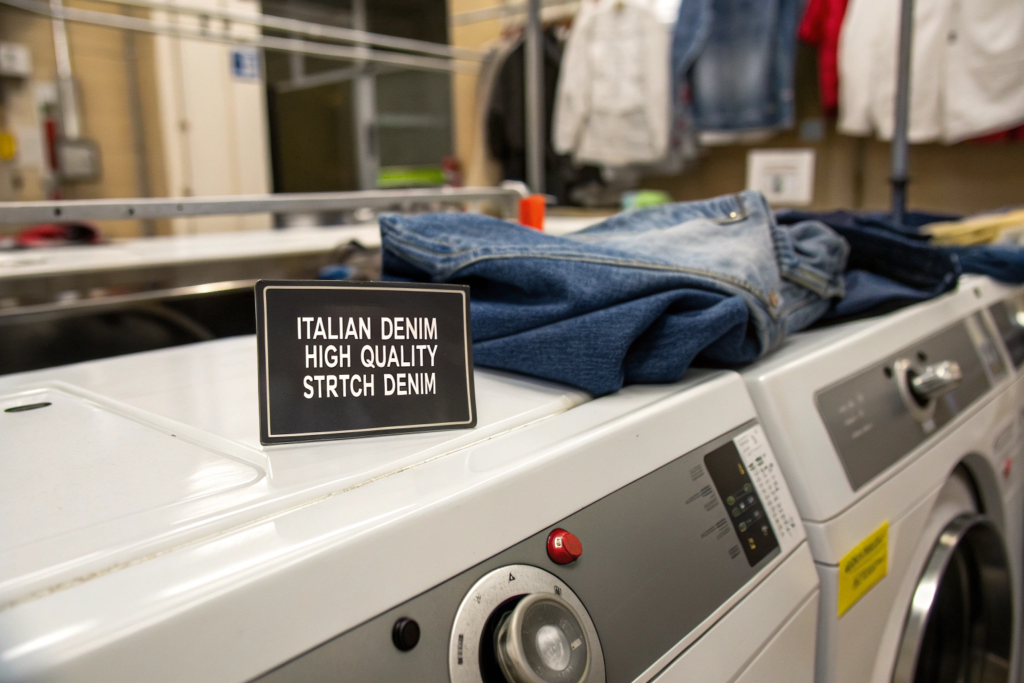
I will be direct: the best stretch denim fabric in the world can be ruined in the washing machine. Not the consumer’s washing machine—yours. The garment washer. I have seen $5.80/yard Italian denim turned into $3.00/yard-looking rags because the wash cycle used a cheap cationic softener that attacked the elastane cross-linking. Conversely, I have seen modest 12 oz Turkish denim perform like premium Italian fabric because the wash recipe was optimized for the fiber.
The interaction between stretch denim and wet processing is chemical warfare. Indigo dye sits on the cotton surface. The elastane core is buried inside the yarn sheath. But during washing—especially during stonewashing with pumice or enzymatic bio-polishing—the cotton surface abrades. If the abrasion is too aggressive, the elastane filaments become exposed. You see this as 'fibrillation': little white fuzzy spots on a dark indigo ground. The jeans look old before they are sold.
We work very closely with our clients' laundry partners. In fact, we often receive wash formulas from laundries in Bangladesh and Vietnam before we finalize the fabric construction. If they are using high-oxygen bleach, we recommend T-400 instead of spandex. If they are using resin finishing for 'anti-stretch' stabilization, we adjust the heat-set temperature accordingly. If you are not sharing your intended wash program with your fabric supplier, you are leaving fit consistency on the table.
What specific wash cycle parameters degrade stretch recovery, and how do we counteract them?
Let me give you three specific killers. First: temperature above 80°C (176°F) for spandex. At this temperature, the polyurethane hard segments begin to break down. You lose about 15% of your recovery force per 10 minutes above 80°C. We had a Turkish customer in 2023 who insisted on a 95°C desizing rinse. We warned him. He did it anyway. The jeans fit perfectly in the factory, but after the consumer washed them once at home, the knees bagged. He returned 1,200 pieces. We helped him requalify a T-400 construction that withstands 95°C. The issue stopped.
Second: chlorine bleach. Even trace amounts (10 ppm) will attack the amine linkages in polyurethane elastane. The fiber literally unzips. There is no recovery after chlorine damage—the fabric just sags. If your wash includes chlorine for a 'vintage clean' look, you must use chlorine-resistant elastane (e.g., Hyosung Creora H250) or switch to EME. We maintain a technical comparison chart of elastane chemical resistance that our clients use to match fiber type to wash chemistry. It is free to download; I want you to succeed.
Third: over-drying. Tunnel dryers set above 120°C after the wash will 'set' the fabric in a stretched state if there is any tension. This is called 'heat setting the growth'. When the garment cools, it shrinks slightly, but the stretched-out shape remains. The consumer puts it on, it fits, they take it off, and the waist is now 2 inches larger. The solution: reduce dryer tension. We actually send our clients a quick reference card with maximum drying tensions for different stretch levels. It saved one Colombian manufacturer $50,000 in claims last year alone.
How do ozone and laser fading technologies interact with elastane-based denim?
Ozone fading is the new standard for sustainable denim washing. It uses O3 gas to oxidize and decolorize indigo without water. Good for the planet. Potentially bad for elastane. Ozone is a powerful oxidizer. It will embrittle unprotected polyurethane. We saw this in 2020 when a Portuguese laundry destroyed 800 meters of our premium 10 oz stretch denim. The fabric looked perfectly faded, but when we tested the tensile strength, it had dropped 37%. The elastane snapped like dry spaghetti.
The solution is not to avoid ozone. The solution is to add an antioxidant package to the elastane during fiber production. Both Hyosung and Asahi Kasei now offer ozone-resistant elastane grades. They carry a slight premium—about $0.08 per yard—but they survive 3 ozone cycles without significant molecular weight loss. We now spec these grades for any client mentioning ozone finishing. If your supplier does not know what 'ozone-resistant elastane' is, you need a new supplier.
Laser fading, on the other hand, is generally safe for elastane. The laser removes indigo by sublimation—it does not involve liquid chemistry. However, the localized heat can melt the elastane if the laser power is too high. We recommend running the laser at 30–40% power and using a fabric with higher elastane denier (40D minimum) to provide more thermal mass. A Korean machinery manufacturer, Kurabo, published a very clear guideline on laser parameters for stretch denim that I encourage you to share with your laundry. It includes specific frequency and resolution settings. We keep a copy posted in our QC office.
What are the cost engineering trade-offs when selecting stretch denim for different retail price points?
Ron, you mentioned the industry focuses on price. I respect that. Margin is oxygen. But in stretch denim, the cheapest price per yard is rarely the lowest cost per garment. I have watched brands buy fabric at $3.20/yd only to spend $0.50/yd more on repair patches because the cheap elastane failed during sewing. I have also watched premium brands pay $5.90/yd and achieve 98% sewing efficiency. The fabric cost is visible on the P&L. The sewing downtime is not always allocated to the raw material. It should be.
Our job at Shanghai Fumao is to help you find the performance threshold. This is the minimum construction spec that guarantees your consumer will not complain within 90 days. For a $39.95 mass market jean, the threshold is different than for a $189 designer jean. I am not being elitist; I am being realistic. The 20D single-covered spandex that works for Walmart will not work for Nordstrom. Let me break down exactly where your marginal dollar goes.

What specific savings justify moving from T-400 to classic spandex?
The spread is roughly $0.60 to $1.00 per yard, depending on weight and denier. T-400 filament is simply more expensive to polymerize than polyurethane. Also, T-400 requires higher heat-setting temperatures, which consumes more energy in the stenter frame. For a 40,000 yard order, switching from T-400 to spandex saves you about $28,000. That is real money.
But—and this is a big but—you must factor in the returns rate. A US mass-market jeans brand we worked with in 2022 switched from T-400 to spandex to hit a $29.99 retail price. Their 'knee bagging' return rate went from 0.8% to 4.2%. Each return cost them $15 in freight and restocking. They saved $28,000 on fabric and spent $51,000 on returns. They switched back to T-400 in 2023. The net net? They paid more for fabric but less for total supply chain cost. Do your math on total cost, not fabric cost.
If you must hit a low price point and still want decent recovery, consider hybrid constructions. Use spandex in the weft for body fabric, but T-400 in the waistband webbing. The waistband takes the highest cyclic stress. It is a small area—only about 0.25 yards per garment. The cost impact is minimal, but the consumer experience improves dramatically. We have offered this 'bi-component' spec since 2020. A Brazilian client uses it for all their men's five-pocket jeans. Their customer service emails about stretched-out waistbands dropped 73%.
How do dyeing methods (rope vs. slasher vs. loop) affect stretch denim cost and performance?
Rope dyeing is the gold standard for indigo penetration and ring-dyeing effects. But rope dyeing puts the yarn under significant tension through multiple dips and oxidations. If you are using spandex-core weft yarns in the warp (unusual, but possible for 'stretch warp' denim), the tension will stretch the elastane and cause non-uniform dye uptake. We do not recommend stretch warps for rope dyeing. Stick to slasher or loop dyeing for stretch warp constructions.
Cost wise, rope dyeing is more expensive—about $0.15–0.20/yd more than slasher. The labor cost is higher, the liquor ratio is higher, and the machine speed is slower. However, rope-dyed denim commands a premium in the market because the color 'pops' differently after washing. If you are sourcing premium stretch denim for a brand that emphasizes heritage, you should accept this upcharge. If you are sourcing basic five-pockets for an e-commerce private label, slasher dyeing is perfectly adequate. We run both systems. The difference is visible to a denimhead, but invisible to a mass consumer standing 3 feet away in a store.
To help you decide, I recommend reading this cost-benefit analysis of indigo dyeing methods from Fibre2Fashion. It is slightly vendor-neutral and gives realistic operating cost ranges. Also, this case study on water consumption in rope vs. slasher dyeing from Textile Today Bangladesh includes 2023 data from a LEED-certified denim mill. It shows the environmental premium for rope dyeing is about 18% more water. Some EU buyers will pay this; US mass market typically will not.
How do you verify stretch denim quality before committing to bulk production?
I am a believer in certificates. We have them—SGS, ITS, OEKO-TEX, GOTS, BSCI. But a certificate is a photograph of a moment. Fabric is a movie. The stretch denim that passed the initial lab dip in July may not be the same stretch denim that arrives at your warehouse in October if the mill switched elastane suppliers to save $0.03/yd. It happens. I have seen it. The mill keeps the certificate number and changes the fiber. Is it fraud? Technically yes. Practically, it is common enough that you must guard against it.
You guard against it by specifying branded elastane. Write on your spec: "Weft elastane must be INVISTA T1620 Lycra or Hyosung Creora H400 equivalent." Do not allow 'comparable' without pre-approval. We only use branded elastane in our premium lines because the quality is predictable. The generic Chinese elastane we tested last year had a coefficient of variation (CV%) of 12% in breaking force. The Hyosung product had CV% of 4.5%. Consistency is quality.
Which physical test methods actually predict real-world 'knee bagging'?
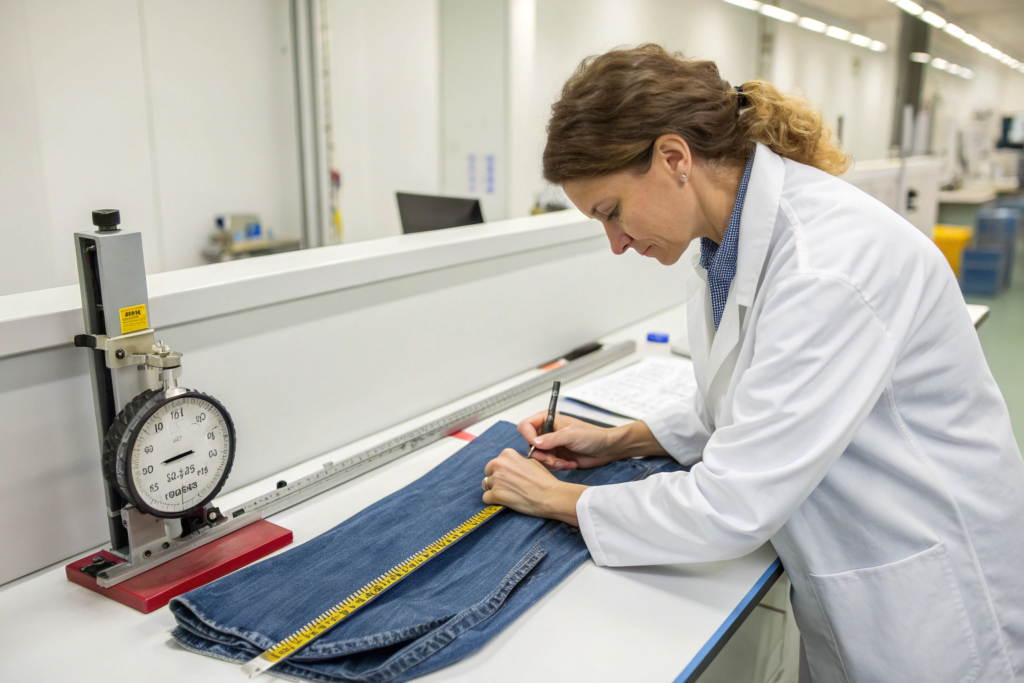
The standard fabric test for growth is ASTM D3107. It measures fabric stretch and growth after a specified load and recovery period. It is useful, but it is a static test. It does not replicate the dynamic, cyclic stretching of a knee when a person squats and stands 500 times.
We supplement D3107 with a cyclic fatigue test. We put the fabric on a machine that stretches it to 80% of its breaking elongation and releases it, 2,000 cycles. We measure the fabric length before and after. A good stretch denim will show less than 3.5% growth. Average spandex shows 5-7%. This test is not an ASTM standard. We developed it ourselves in 2015 because our clients kept complaining about bagging that passed the standard test but failed in life. We now offer it as a free service for any bulk order over 10,000 yards. If you want to understand the protocol, this research paper from the University of Leeds on denim fatigue behavior validates exactly what we found: cyclic loading matters more than single-pull.
Another predictor is the 'heat aging' test. We condition the fabric at 70°C for 72 hours, then measure residual stretch. This simulates six months of warehouse storage in Arizona or Dubai. Elastane oxidizes slowly at room temperature, but the reaction accelerates with heat. If a fabric fails heat aging, it will fail on the shelf. We lost a Middle Eastern account in 2018 because they stored our fabric in an unairconditioned Jebel Ali warehouse for 4 months. The jeans looked perfect at shipment. At retail, they were dead. Now we include a heat aging warning on our technical datasheets. You can download our heat aging spec template here. Use it with your current suppliers.
Why does sewing needle heat destroy stretch denim seams, and how do we prevent needle cutting?
This is a mechanical issue, not a chemical one. When a needle pierces stretch denim at 4,000 stitches per minute, friction generates heat. If the needle temperature exceeds 180°C, the elastane filaments around the stitch hole melt and retract. You get 'needle cutting' or 'zippering'—the seam pulls apart with light tension. The fabric is fine; the sewing process destroyed it.
We test needle cutting propensity in our lab using a standard industrial machine (Juki DDL-9000) running at maximum speed. We sew 1 meter, then stretch the seam by hand. If we see gaps wider than 1mm, we fail the fabric. Solutions include: (1) using a coated needle (Teflon or ceramic) to reduce friction, (2) reducing the elastane denier (20D runs cooler than 40D), or (3) adding a small percentage of silicone lubricant in the finishing softener bath. Option 3 is the most effective, but too much silicone causes adhesion problems with waistband fusing. It is a balance.
We collaborated with a German needle manufacturer in 2023 to publish a guideline for optimal needle selection in high-stretch denim sewing. It is free and includes actual part numbers for different fabric weights. If your garment factory complains about needle cutting, do not immediately blame the fabric supplier. Ask them what needle they are using. 9 times out of 10, they are using a standard SES needle when they should be using a DBx1 with a special coating. This is a $0.02 fix that saves a $4.00 garment.
Conclusion
The 'best' stretch denim is not the one with the highest stretch percentage. It is not the cheapest. It is the one where the elastic recovery, the dye fastness, the abrasion resistance, and the cost align with your specific consumer's expectations. I have made stretch denim for 19-year-olds who want Instagram thigh-gap photos and for 65-year-old golfers who just want to bend over and tie their shoes. The fabric is different. The engineering goal is the same: deliver comfort that lasts longer than the trend.
I started this business weaving rigid denim that weighed as much as horse blankets. Today, our best-selling stretch denim is an 11.5 oz left-hand twill with EME weft that recovers 96% after 20% stretch. It costs more than the entry-level options. It also generates zero complaints. The brand that buys it has been with us for 7 years. They know that when the fabric lands in LA, it will cut, sew, wash, and sell. That consistency is what we sell. The denim is just the carrier.
If you are sourcing denim for your next collection—whether it is 1,000 yards for a direct-to-consumer launch or 100,000 yards for a national retail chain—I invite you to bring us your stretch target and your wash spec. Let Elaine quote you a construction that hits your price point without compromising the consumer experience. She has the technical datasheets for 37 active stretch denim SKUs on her laptop. She can tell you the tear strength of each one from memory.
Contact Elaine, our Business Director, at elaine@fumaoclothing.com. Tell her your target retail price and your required stretch percentage. She will send you a counter-proposal that probably saves you returns later. We do not always win on the first price comparison. We usually win the reorder.