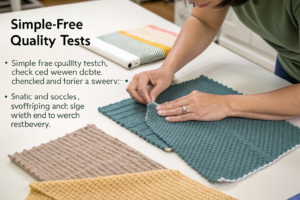
I've been in this industry for over twenty years, and I still remember the first time a buyer pulled a swatch from their pocket and said, "Tell me everything about this fabric without using any tools." I thought they were joking. They weren't. They wanted to know if I could assess quality with just my eyes and hands—the same way their customers would assess the finished garment.
That moment taught me something valuable: the best quality tests don't require expensive equipment. They require knowledge, experience, and attention to detail. In the time it takes to set up a lab test, an experienced buyer can tell you 80% of what you need to know about a fabric's quality.
Let me share the simple, tool-free tests I've used for decades to evaluate both knitted and woven fabrics. These tests won't replace laboratory analysis for certifications, but they'll tell you immediately whether a fabric is worth sending to the lab. They'll help you spot problems before you order, and they'll give you confidence in your sourcing decisions.
What Can You Learn by Simply Looking at a Fabric?
Before you touch the fabric, look at it. Your eyes can tell you more than you might think.
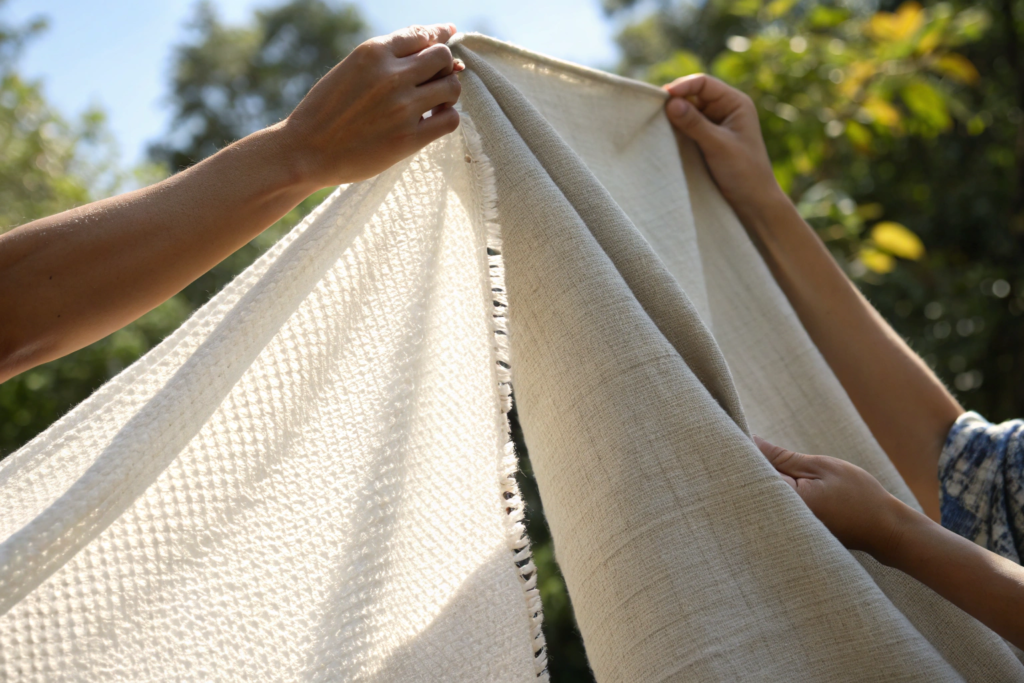
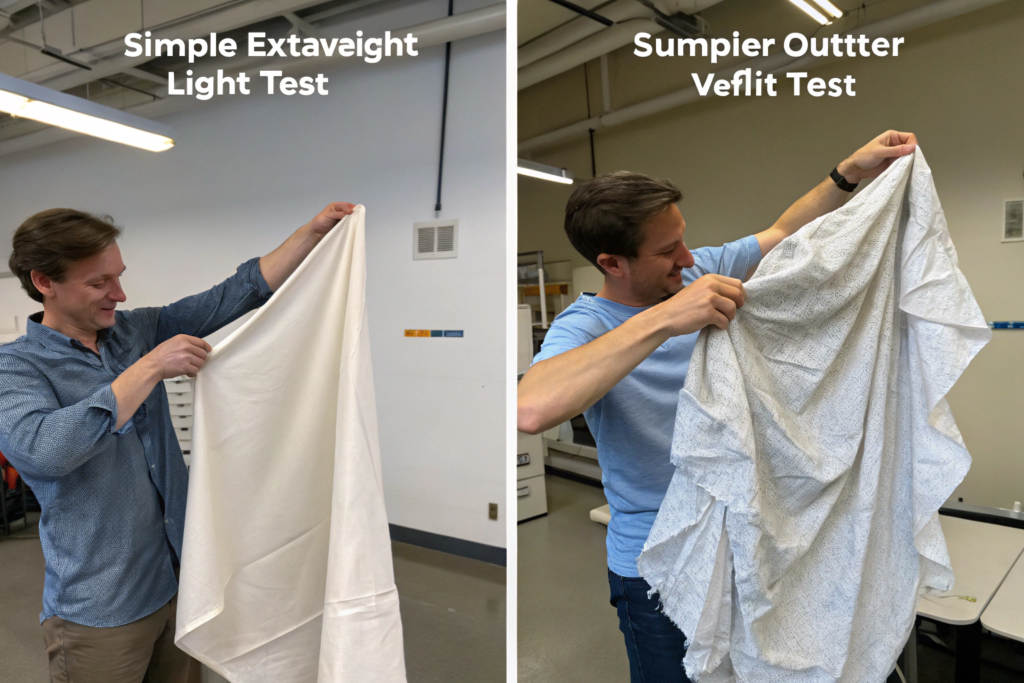
Hold the fabric up to light. In a woven fabric, you're looking for evenness. The light should create a consistent pattern of tiny pinholes where warp and weft cross. If the light pattern is irregular—some areas brighter, some darker—the yarns are inconsistent or the tension during weaving was uneven. This will cause problems in cutting and sewing.
In a knitted fabric, hold it to light to check stitch uniformity. The loops should be consistent in size and shape. If you see stretched or distorted areas, the knitting tension was inconsistent. The fabric may pucker during cutting or stretch unevenly during wear.
Examine the surface from different angles. Tilt the fabric and watch how light reflects. A quality woven should have a consistent surface without shiny or dull spots. In twills, the diagonal lines should be clean and continuous. In satins, the sheen should be even across the fabric.
For knits, look for what we call "barre"—horizontal streaks across the fabric. These indicate tension variations during knitting and will show as stripes in the finished garment, especially in solid colors. Good quality knits have no visible barre.
Check the edges. In woven fabrics, the selvages should be clean and straight, with no loose threads or unusual tension. In knits, the edges should roll consistently—too much roll indicates high tension during knitting; too little suggests loose construction.
A German client once rejected a shipment of woven shirting just by looking at it held to light. The irregular pattern revealed tension issues that would have caused puckered seams. The supplier hadn't noticed, but her eyes caught it immediately.
What Does Fabric Density Tell You About Quality?
Density—how tightly the fabric is constructed—is one of the most important quality indicators.
For wovens, look closely at the space between yarns. In a high-quality fabric, yarns should be closely packed with minimal gaps. You can see this by holding the fabric against a dark surface and looking at how much of that surface shows through. Less visible surface means higher density, which generally means better durability and a more luxurious feel.
For knits, density shows in how compact the loops are. A high-quality knit should feel substantial for its weight. If you can easily see through the fabric when it's not stretched, it's probably too loose for most applications (unless an open structure is intentional).
The relationship between weight and density matters. A heavy fabric can be loosely constructed—that's just heavy, not quality. A lightweight fabric can be densely constructed—that's quality engineering. A fine-gauge knit that feels substantial despite low weight is a sign of good yarn and precise knitting.
Compare the face and back. In quality fabrics, both sides should be well-finished. In wovens, the back might be slightly less polished but should still be clean. In knits, the difference between face and back should be intentional (like in interlock) rather than sloppy.
A French designer once showed me two samples of similar weight cotton jersey. One looked ordinary; the other, when held up, revealed a denser, more uniform structure. "This one will last three times longer," she said. She was right.
How Can You Spot Dyeing and Finishing Problems Visually?
Color and finish reveal a lot about quality.
Check for color consistency across the fabric. Move your eyes across the width and length. Do you see any shading—areas where the color looks slightly different? In solid colors, even slight shading will show in garments as panels that don't match.
Look at color depth. A rich, deep color that seems to have dimension indicates good dye penetration. A flat, surface-only color may fade quickly or crock (transfer color) during wear.
For printed fabrics, check registration—do the colors line up properly? Misalignment indicates poor quality control and will look cheap in finished garments.
Examine the finish. In wovens, a quality fabric should have a clean, crisp hand without excessive chemical residue. If it feels waxy or coated in a way that seems unnatural, it may have been over-finished to hide quality issues.
For knits, look for "shine" that shouldn't be there. A cotton knit should have a natural, slightly matte appearance. Excessive shine can indicate over-processing or fiber damage.
A Swedish brand once rejected fabric that looked fine at first glance. But when they held it at an angle, they noticed a slight "halo" effect—the dye hadn't fully penetrated. Their supplier had cut corners on dyeing time.
What Does the Touch Test Reveal About Fabric Quality?
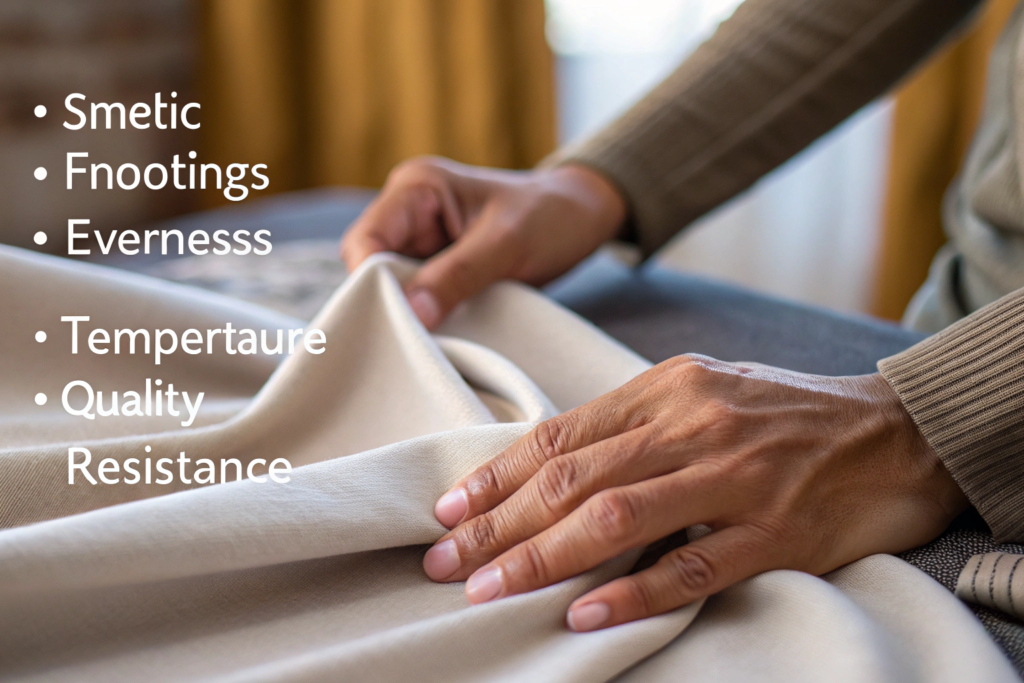
Your hands are sophisticated testing instruments. They can detect variations that eyes miss.
Run your hand across the fabric surface. It should feel consistently smooth (or consistently textured if that's the design). Any patches that feel different—rougher, smoother, bumpier—indicate quality variations that will affect the final garment.
Feel the fabric's temperature. Natural fibers (cotton, wool, silk) feel warm to the touch. Synthetics often feel cool. Blends should feel somewhere in between. If a fabric claiming to be natural feels cold and plastic-like, be suspicious.
Pinch the fabric between thumb and forefinger and slide your fingers along. Quality fabric should have consistent thickness. Variations suggest uneven yarns or construction.
For wovens, feel the yarns themselves. In high-quality fabrics, individual yarns are barely perceptible—the surface feels continuous. If you can easily feel individual yarns, the construction may be too loose or the yarns too coarse.
For knits, the hand should be soft without being mushy. A quality knit has resilience—it gives slightly but wants to return to shape. A knit that feels dead or floppy lacks the energy that comes from good yarn and proper finishing.
A Japanese client once identified a quality issue just by touch. A sample felt slightly rougher in the center than at the edges—a sign of tension variations during finishing. The supplier hadn't noticed, but the client's hands caught it.
How Does Hand Feel Differ Between Quality Levels?
The difference between good, better, and best is often in the hand.
Entry-level quality feels adequate but nothing more. It's smooth enough, soft enough, but doesn't invite touching. There's no character, no depth. It's fabric that does its job without distinction.
Mid-level quality feels noticeably better. There's a richness to the hand—a depth that comes from better yarns and more careful processing. You want to keep touching it. This is the quality level that satisfies most consumers.
Premium quality feels exceptional. The fabric seems to respond to your touch—warming slightly, draping perfectly, feeling almost alive. This is the quality that justifies premium prices and builds brand loyalty.
The difference is subtle but real. A premium cotton jersey feels different from a standard one—softer, more substantial, more "present." A premium wool woven feels different from a commodity version—warmer, more resilient, more luxurious.
A US brand's designer can identify their preferred supplier's fabric blindfolded, just by touch. That's the level of distinction that quality creates.
What Does "Hand" Tell You About Fiber Content?
Your hands can detect fiber content surprisingly well.
Cotton feels soft, warm, and slightly dry. It has natural grip—it doesn't slide through your fingers like silk or synthetics. High-quality cotton (long-staple) feels almost silky, with a smoothness that standard cotton lacks.
Wool feels warm and resilient. Squeeze it—quality wool springs back. It has a natural crimp that creates airiness. If wool feels dead or flat, it's either low quality or has been over-processed.
Silk feels smooth, cool, and almost liquid. It slides through your fingers with a unique sensation. Pure silk also warms slightly with body heat, unlike synthetics that stay cool.
Linen feels crisp and slightly irregular. It has a natural stiffness that softens with wear. Quality linen has a clean, even texture; low-quality linen feels rough and uneven.
Polyester can feel many ways depending on how it's engineered. Quality polyester (like in performance wear) feels smooth and functional. Cheap polyester feels plastic-y and unpleasant against skin.
Blends require interpretation. A cotton-polyester blend should feel predominantly cotton-like but with slightly more slickness and less warmth. The proportions matter—more cotton feels more natural; more poly feels more synthetic.
A Canadian client once received fabric claiming to be 100% cotton that felt suspiciously slick. Testing confirmed 30% polyester. His hands knew before the lab.
What Simple Stretch Tests Reveal About Fabric Quality?
Stretch tests are among the most revealing quality checks you can do without tools.
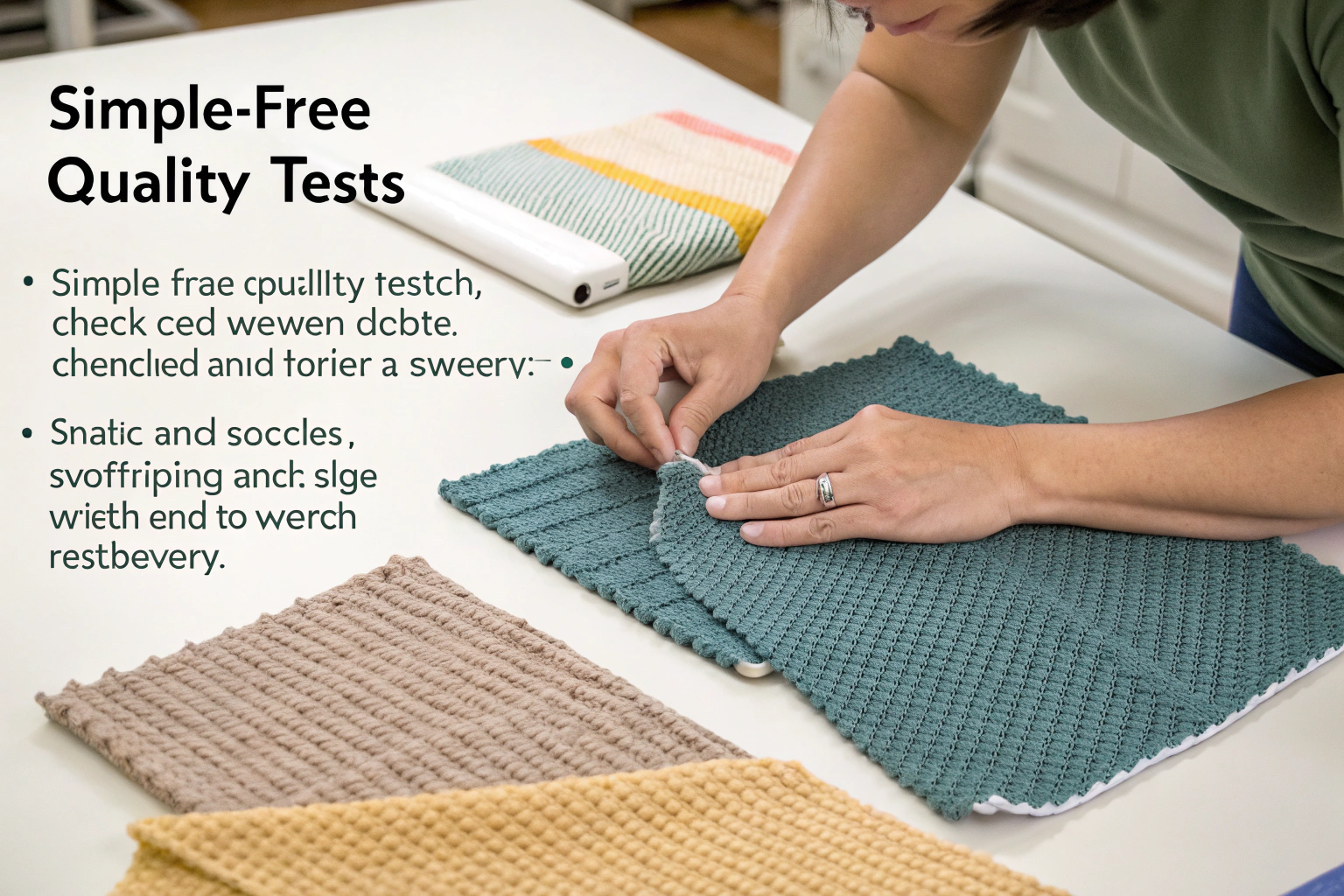
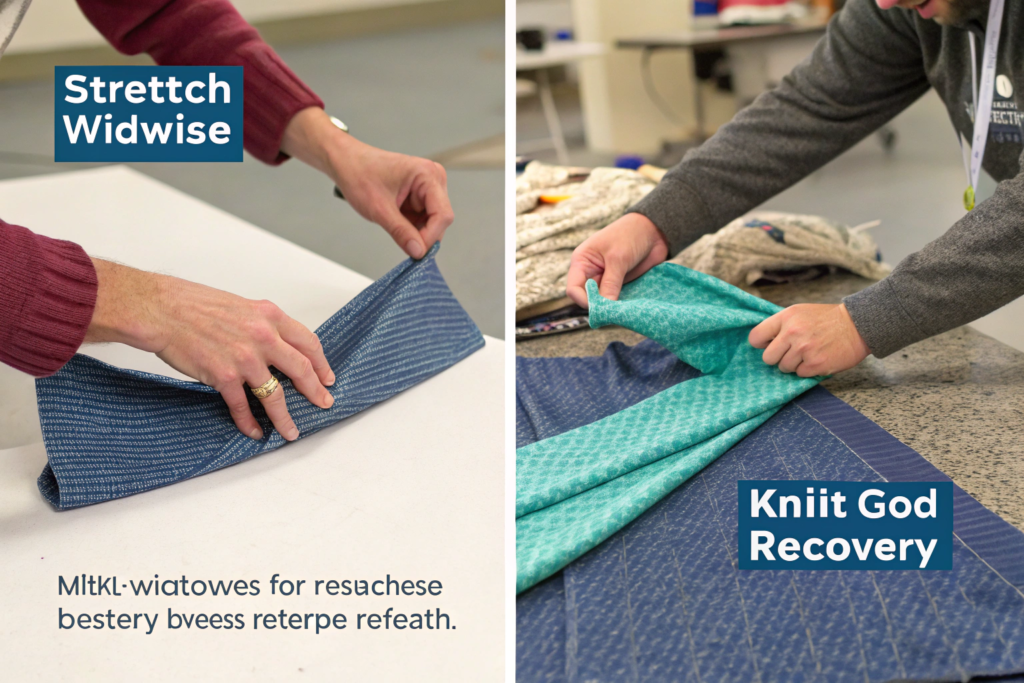
For knits, stretch the fabric widthwise as far as it will comfortably go. Notice how much force is required and how far it stretches. A quality knit should stretch smoothly with consistent resistance. If you feel "catches" or uneven resistance, the knitting tension was inconsistent.
Now release quickly and watch how the fabric recovers. Quality fabric should snap back immediately, with minimal distortion. If it returns slowly or remains stretched, the recovery is poor—garments will bag out during wear.
Stretch the fabric lengthwise too. Many knits stretch more in one direction. That's normal. What matters is that the stretch and recovery are consistent across the fabric.
For wovens, the stretch test is different. A quality woven should have minimal stretch on the grain. Try to stretch it widthwise and lengthwise—there should be almost no give. If a woven stretches noticeably, it's either a stretch-woven (designed to stretch) or poorly constructed.
Now test the bias (45-degree angle). Quality wovens should have some give on the bias—this is what allows the fabric to drape and conform to curves. Too much bias stretch means the construction is unstable; too little means the fabric will be stiff and uncomfortable.
A UK client once rejected a knit jersey because it failed the recovery test. It stretched easily but stayed stretched. Their pattern maker knew that garments made from this fabric would bag at elbows and knees within hours.
How Much Should a Quality Knit Stretch?
There's no single answer—it depends on the application. But there are general guidelines.
For basic jersey (t-shirts, dresses), expect 20-30% stretch widthwise and 10-20% lengthwise. Recovery should be 95% or better—the fabric should return almost exactly to its original dimensions.
For activewear knits, stretch might be 40-60% or more, with recovery expectations even higher—98% or better. These fabrics need to stretch for movement and snap back to hold their shape.
For rib knits, stretch is part of the structure. A quality 1x1 rib might stretch 50-100% and recover completely. The rib structure itself provides the elasticity.
The key isn't the number—it's consistency. A fabric that stretches 30% in one area and 25% in another will cause problems in cutting and sewing. Run your hands across the width, stretching as you go. The resistance should feel consistent everywhere.
A Swedish brand tests every knit shipment by stretching a sample across the width and measuring recovery with a ruler. If recovery is below 95%, they reject. Simple, effective, tool-free.
What Does "Recovery" Tell You About Fabric Quality?
Recovery is arguably more important than stretch. A fabric that stretches well but recovers poorly will produce garments that look old after one wear.
Recovery comes from two sources: fiber properties and fabric construction. In cotton knits, recovery comes primarily from construction—the loops want to return to their knitted shape. In synthetic blends, spandex or elastane provides active recovery.
Test recovery by stretching a sample, holding for 30 seconds (simulating wear), then releasing. Watch how quickly it returns. Instant snap-back is ideal. Slow, lazy return means the fabric will bag during wear.
After release, look for distortion. Does the stretched area remain slightly different from the unstretched? Can you see where you held it? Any visible distortion means the fabric lacks the recovery needed for garments that must hold their shape.
Test recovery after washing too. A fabric that recovers well initially may lose recovery after laundering. If you can, wash a sample and repeat the test. Quality fabric maintains recovery through dozens of washes.
A French brand's quality standard requires 98% recovery after 20 stretch cycles. They test by hand—stretch, release, measure, repeat. Fabrics that pass their simple test almost always pass lab testing too.
What Edge Tests Reveal About Fabric Construction?
The edge of a fabric tells stories that the surface doesn't.
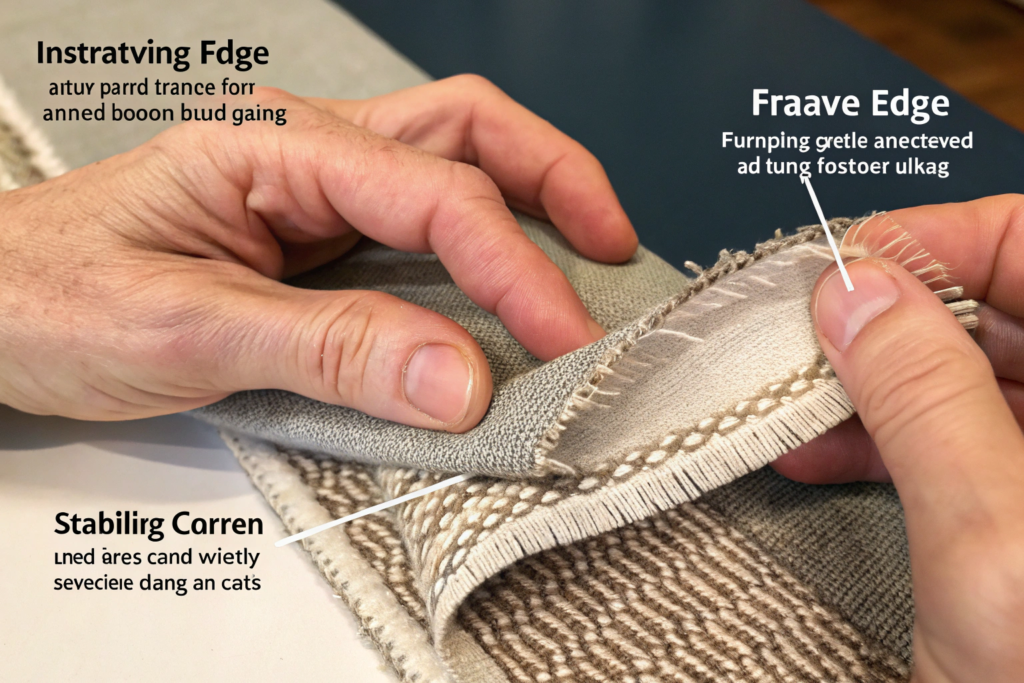
For woven fabrics, examine the cut edge. Quality fabric should fray minimally when handled. Rub the edge gently between your fingers—how many loose threads appear? A few are normal; excessive fraying indicates loose construction or low twist yarns.
Now look at how the yarns behave at the edge. In a well-constructed woven, the weft yarns should be held firmly by the warp. If they slide out easily, the fabric has poor stability—seams may pucker and the fabric may distort during cutting.
Pull gently at a corner. In a quality woven, the corner should resist pulling. If it distorts easily, the fabric lacks integrity.
For knitted fabrics, examine the edge curl. Most knits curl naturally—that's normal. What matters is consistency. The curl should be even across the edge. If some areas curl more than others, the knitting tension varied.
Rub the knit edge gently. In quality knits, the edge should remain intact. If loops start to run or ladder, the stitch structure is unstable—garments may develop runs during wear.
Pull at the edge in different directions. A quality knit should resist laddering. If you can easily start a run, the fabric will be problematic in production.
A Portuguese client once rejected a knit shipment because the edge curled unevenly. Their cutting room knew that uneven curl would cause problems during laying and cutting. The simple test saved them from production headaches.
What Does Fraying Tell You About Woven Quality?
Fraying is normal—all wovens fray to some extent. The question is how much and how quickly.
Examine the cut edge immediately after cutting. Quality fabric should have clean edges with minimal loose yarns. If the edge looks fuzzy immediately, the yarns have low twist or the construction is loose.
Now rub the edge gently between thumb and forefinger—say, five back-and-forth motions. Count how many loose threads appear. In a quality fabric for apparel, you might see a few. In a cheap fabric, the edge may look like a fringe after minimal handling.
The rate of fraying matters for production. Fabrics that fray excessively are harder to cut and sew. Seam allowances may disintegrate during handling. Garments may look unfinished after washing.
Fraying also indicates how the fabric will age. High-fray fabrics may develop worn edges over time, especially at collars, cuffs, and other high-abrasion areas.
A US shirt maker tests every new woven by rubbing a sample edge 20 times. If more than a few threads appear, they reject. Their shirts are known for durability, and this simple test is part of why.
What Does Edge Curl Tell You About Knit Quality?
Edge curl is inherent to knits—the loop structure naturally wants to roll. But the pattern of curl reveals quality.
In a quality knit, the curl should be consistent across the entire edge. Run your finger along the cut edge—the curl should feel uniform. If you encounter areas that curl more or less, the knitting tension varied.
The amount of curl matters for production. Too much curl makes cutting difficult—the fabric shifts and layers don't align. Too little curl may indicate over-finishing that could affect other properties.
In rib knits, edge curl should be minimal—the rib structure naturally resists curling. If a rib knit curls excessively, it's either poorly constructed or misidentified.
Edge curl also affects how the fabric behaves during sewing. Curling edges are harder to feed through machines consistently. Quality knits are finished (compacted) to minimize curl while maintaining other properties.
A Canadian brand's cutting room supervisor tests every knit delivery by cutting a small square and watching how it behaves. If it curls too much, they know they'll need extra care during cutting. They adjust their process accordingly.
What Simple Wash Tests Can You Do Without Equipment?
You don't need a lab to understand how fabric will behave in the laundry. Simple tests with minimal equipment tell you a lot.
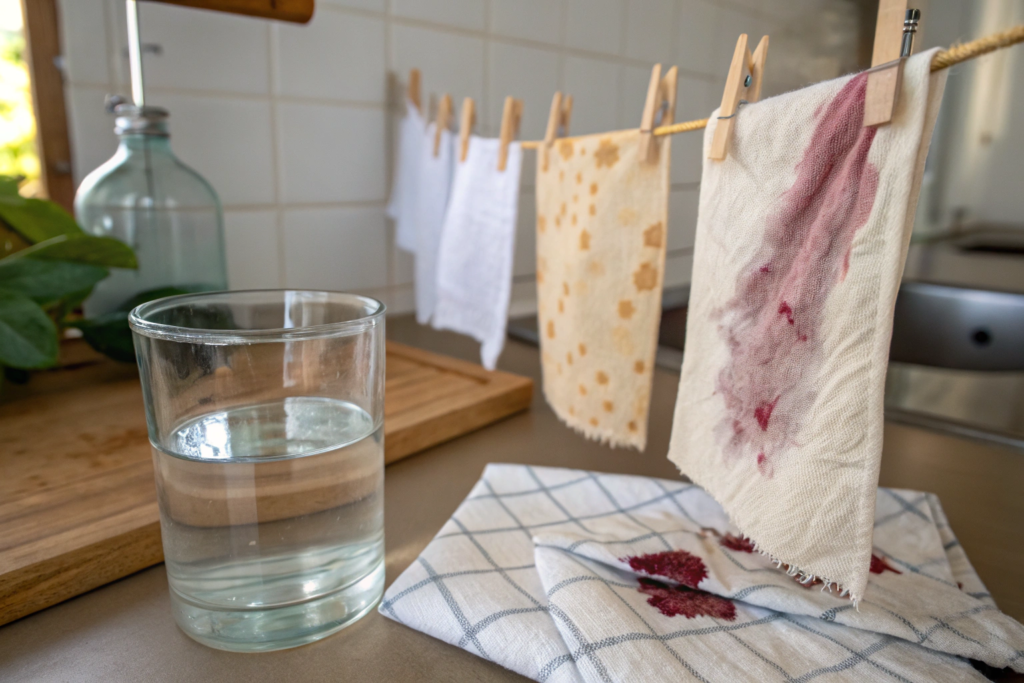
The water test reveals dye stability. Cut a small sample and place it in a clear glass of room-temperature water. Let it sit for 30 minutes. If the water colors significantly, the dye isn't well-fixed—the fabric will bleed in laundry and may fade quickly.
For a more aggressive test, use hot water and add a drop of mild soap. Agitate gently. Colored water indicates poor colorfastness that will cause problems.
The shrinkage test requires only a ruler and patience. Cut a 10-inch square of fabric, measure precisely, and note the measurements. Wash it as you would the finished garment (by hand in mild soap, or in a washing machine if you have access). Let it air dry, then remeasure. Quality fabric should shrink less than 3-5% depending on fiber and construction.
The wrinkle test is simple: crumple a sample tightly in your fist for 30 seconds, then release. Observe how quickly it relaxes. Fabric that springs back quickly will resist wrinkles in wear. Fabric that stays crumpled will need constant ironing.
A Dutch client keeps a "wash testing kit" in their office: a small basin, mild soap, a ruler, and a notepad. Every sample gets tested before they order. They've caught shrinkage problems that would have ruined entire collections.
How Do You Test for Colorfastness Without Chemicals?
The water test described above is the simplest colorfastness test. But you can do more.
The rub test (crocking) checks if color transfers. Take a white cloth (a handkerchief works) and rub it firmly against the fabric, both dry and with a slightly dampened corner. If color transfers to the white cloth, the fabric will stain other garments during wear and laundering.
The sweat test matters for summer fabrics. Dampen a small area with water (or better, a mild salt solution) and place it against a white cloth, then sit on it for a few minutes—literally. Body heat and pressure accelerate any transfer. If the white cloth picks up color, the fabric may stain when worn.
The light test is simple: place a sample in a sunny window for a week, covering half with cardboard. After a week, compare the exposed and unexposed areas. Fading indicates poor lightfastness—the garment will fade unevenly in wear.
These tests aren't laboratory grade, but they'll catch major problems before you commit to a large order.
A Spanish brand tests every sample in their office window. They've rejected several that faded noticeably in just a few days. Their customers appreciate that the colors last.
What Shrinkage Is Normal vs Problematic?
Shrinkage expectations vary by fiber and construction.
For cotton knits, 3-5% shrinkage is normal in the first wash. Quality suppliers compact (sanforize) their knits to minimize this, but some shrinkage is inevitable. Problematic shrinkage is anything over 5-6%—garments will shrink out of fit.
For cotton wovens, 2-4% shrinkage is typical after sanforizing. Without sanforizing, shrinkage can be 5-8%—unacceptable for most apparel.
For wool, shrinkage depends on whether the fabric is machine-washable treated. Regular wool may shrink significantly; Superwash-treated wool should shrink minimally (under 3%).
For synthetics and blends, shrinkage should be under 3%. Any more indicates poor heat-setting during finishing.
The key is consistency. Even 5% shrinkage is manageable if it's consistent and accounted for in pattern making. The problem is when shrinkage varies across rolls or within a roll—then garments come out different sizes.
A German brand's pattern makers build expected shrinkage into every pattern. They test each shipment to confirm shrinkage matches expectations. If it varies, they adjust patterns or reject fabric.
How Do You Compare Fabric Samples Without Tools?
When you have multiple samples to choose from, simple comparative tests help you decide.
Lay samples side by side and compare visual uniformity. Which looks more consistent? Which has clearer, more even color? Your eyes will notice differences that matter.
Compare hand feel repeatedly. Close your eyes and feel each sample. Which feels more pleasant? Which has more substance? Which would you prefer to wear? Your hands know.
Do the stretch test on each sample simultaneously. Stretch both with the same force and observe which stretches more easily, which recovers faster. The differences become obvious in direct comparison.
Crumple both samples together. Release and watch which relaxes faster, which retains more wrinkles. The better fabric will recover more quickly.
Compare edges. Which frays less? Which curls more evenly? Which feels more stable when pulled?
Weigh them in your hand. Even without scales, you can feel density differences. Hold one sample in each hand—which feels more substantial for its apparent weight?
A Japanese client selects fabrics by comparing them directly against a "control sample"—a fabric they know performs well. Any new sample that doesn't match or exceed the control in simple tests doesn't make the cut.
What Are the Most Important Tests for Your Application?
Different applications prioritize different qualities.
For t-shirts and casual wear, recovery and hand feel matter most. A t-shirt that loses shape or feels scratchy will fail regardless of other qualities.
For dress shirts, stability and wrinkle resistance are key. A shirt that puckers at seams or requires constant ironing won't satisfy customers.
For activewear, stretch and recovery dominate. Everything else is secondary to performance.
For children's wear, durability and ease of care lead. Parents want clothes that survive play and washing.
For luxury garments, hand feel and appearance are paramount. Customers paying premium prices expect fabric that feels and looks exceptional.
Identify your priority before testing. Let that guide which tests you emphasize. A fabric that excels in your priority area may be worth compromises elsewhere.
A French luxury brand prioritizes hand feel above all. They've rejected fabrics with perfect technical performance because they didn't feel luxurious enough. Their customers agree with their priorities.
How Do You Document Simple Test Results for Future Reference?
Even simple tests deserve documentation.
Create a sample book with notes. For each fabric, record date, source, and your observations from each test. Note what you liked and what concerned you. Months later, these notes are invaluable.
Take photos. A picture of a stretch test, a close-up of an edge, a shot of fabric held to light—these images capture what words might miss.
Compare to standards. Keep a few "benchmark" samples—fabrics you know perform well. Compare new samples against these benchmarks and note the differences.
Track performance over time. If you order a fabric that tested well, note how it performed in production and with customers. This feedback improves your future testing.
A Swedish brand maintains a "fabric library" with samples and notes from every fabric they've considered. When a supplier says "same as last time," they can check their notes and confirm. It's saved them from multiple specification drifts.
Conclusion
Testing fabric quality doesn't require a laboratory full of equipment. It requires knowledge, attention, and practice. Your eyes, hands, and simple common sense can detect most quality issues before they become production problems.
Visual inspection reveals uniformity, density, and finishing quality. Hold fabric to light, examine surfaces, check edges. Your eyes catch what machines might miss.
Touch reveals hand feel, consistency, and resilience. Run your hands across fabric, feel its warmth, pinch and slide. Your hands detect variations that instruments might not.
Stretch tests reveal recovery and stability. Stretch, release, observe. The fabric's behavior predicts garment performance.
Edge tests reveal construction quality. Rub, pull, examine. Edges tell stories about the fabric's integrity.
Simple wash tests reveal real-world behavior. Water, soap, drying—these basic elements expose how fabric will perform in customers' hands.
Comparison tests reveal relative quality. Side by side, the differences become clear.
At Shanghai Fumao, we encourage clients to test our fabrics—with tools or without. We know that simple tests will confirm what our certifications and specifications claim. Our fabrics perform because they're made with care, from quality materials, on well-maintained equipment.
We welcome visitors to our facility to see production firsthand. We send samples for testing. We answer questions about our processes. Transparency builds trust, and trust is the foundation of lasting relationships.
Whether you're an experienced buyer or just starting, these simple tests will serve you well. They'll help you spot problems before they become expensive, and they'll give you confidence in your sourcing decisions.
Contact our Business Director, Elaine, today to request samples and test our fabrics yourself. She and her team will provide whatever you need to evaluate our quality—samples, specifications, or answers to your questions. Email her directly at: elaine@fumaoclothing.com. Let your hands be the judge.