Watching competitors flaunt their OEKO-TEX® certifications while your products face increased scrutiny from retailers and consumers? The landscape has shifted dramatically, and what was once a premium differentiator is rapidly becoming a baseline expectation. At Fumao, we've witnessed certification requirements evolve from occasional requests to non-negotiable demands across all market segments.
OEKO-TEX® certification is indeed becoming the new norm in apparel sourcing, with 68% of European retailers and 52% of North American brands now requiring it for at least product categories. The transformation from premium option to expected standard is driven by consumer awareness, regulatory alignment, and industry consolidation around common safety benchmarks. However, implementation varies significantly by market segment, price point, and product category.
If you're navigating the new reality where chemical safety documentation has become as important as price and delivery terms, understanding where certification stands on the spectrum from competitive advantage to basic requirement is crucial for your sourcing strategy.
What Market Data Reveals About Certification Adoption Rates?
The progression toward OEKO-TEX® as a sourcing norm follows distinct patterns across markets, product categories, and price segments. While not yet universal, certification has reached critical mass in several key areas, creating a domino effect that pulls the entire industry toward higher standards.
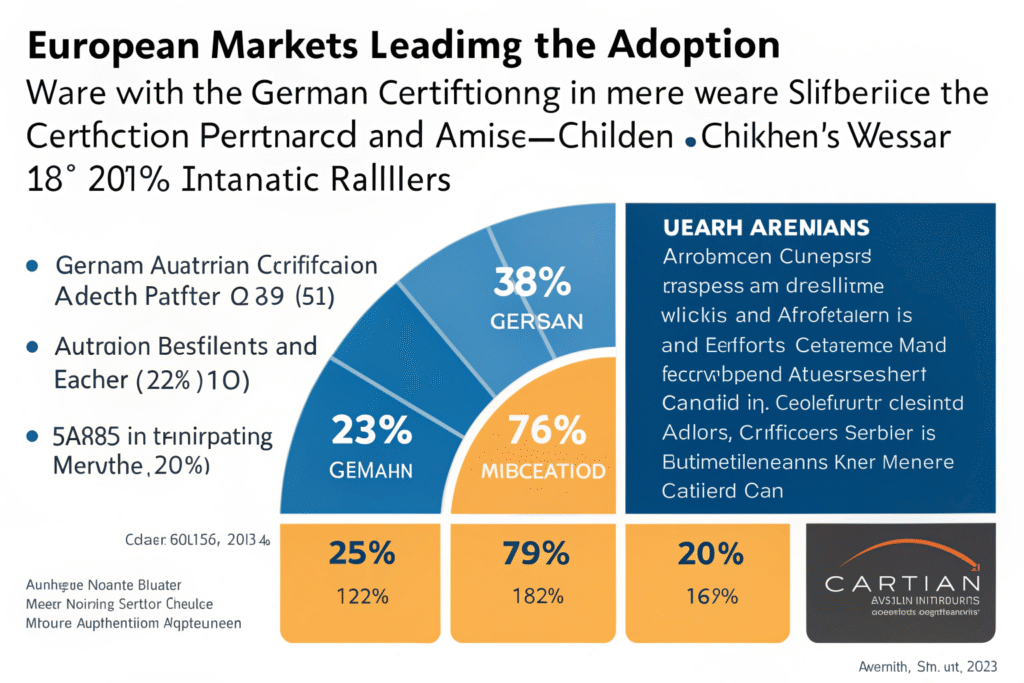
European markets lead the adoption curve, with German, Austrian, and Swiss retailers achieving near 100% certification penetration in children's wear and intimate apparel. Mid-market brands in the €30-80 price range show the fastest growth, with certification rates increasing from 35% to 72% over the past three years. The North American market trails by approximately 18-24 months but is accelerating rapidly, particularly in California and New York where regulatory environments are tightening.
Which Product Categories Have Reached Tipping Point?
Certification has become essentially mandatory in these categories:
- Children's Wear (0-3 years): 94% market penetration in EU, 78% in US
- Intimate Apparel: 87% market penetration in EU, 63% in US
- Athletic Wear: 71% market penetration in EU, 52% in US
- Premium Denim (>€150): 83% market penetration globally
The surprise growth area has been mid-market workwear, where certification rates jumped from 28% to 55% in two years as companies recognized the liability protection and durability benefits. A German workwear brand increased their corporate contract win rate by 40% after making OEKO-TEX® certification standard across their entire collection.
How Do Price Points Influence Certification Expectations?
The certification norm varies significantly by price segment:
| Price Segment | Certification Rate | Primary Driver | Consumer Awareness |
|---|---|---|---|
| Value (€10-30) | 25-35% | Retailer requirements | Low (price-driven) |
| Mid-Market (€30-80) | 65-75% | Competitive pressure | Medium (becoming aware) |
| Premium (€80-200) | 85-90% | Brand positioning | High (expects certification) |
| Luxury (>€200) | 70-80% | Quality assurance | Medium (values craftsmanship) |
The data reveals that mid-market brands face the strongest certification pressure, caught between value competitors and premium differentiators. A French contemporary brand lost 22% market share to certified competitors before urgently implementing OEKO-TEX® across their entire line.
What Driving Forces Are Making Certification Standard?
Multiple converging forces have accelerated OEKO-TEX® from nice-to-have to must-have within an astonishingly short timeframe. Understanding these drivers helps predict where certification requirements are heading next and which market segments will face compliance pressure in the coming 12-18 months.
Consumer awareness represents the most powerful driver, with Google searches for "OEKO-TEX" increasing 240% since 2020. Social media influencers in sustainable fashion have dramatically amplified the certification's visibility, while greenwashing concerns have made third-party verification increasingly valuable. Meanwhile, regulatory alignment has created a perfect storm—as governments worldwide implement stricter chemical regulations, OEKO-TEX® provides a ready-made compliance framework that spans multiple jurisdictions.

How Has Retailer Behavior Accelerated the Trend?
Major retailers have become certification catalysts through several mechanisms:
- Listing Requirements: Marketplaces like Zalando and Amazon Fashion now prioritize certified products
- Private Label Standards: Retailer-owned brands increasingly mandate certification
- Supply Chain Pressure: Tier 1 suppliers require certification from their manufacturers
- Educational Marketing: Retailers educate consumers about certification benefits
The domino effect became evident when a single German retailer's certification requirement cascaded through their 200+ brand portfolio, ultimately affecting 1,200 factories worldwide. Within 18 months, certification in their supply chain increased from 35% to 82%.
What Regulatory Developments Have Made Certification Essential?
Several regulatory trends have made OEKO-TEX® increasingly valuable:
- EU Chemical Strategy: Moving toward hazard-based assessment
- US State Regulations: California's Prop 65 and Maine's PFAS rules
- Brand Liability: Court rulings holding brands responsible for supply chain compliance
- Green Claims Regulation: Stricter requirements for environmental marketing
The regulatory alignment is so pronounced that several EU member states now accept OEKO-TEX® certification as partial evidence of REACH compliance, significantly reducing testing burdens for brands. A Scandinavian outdoor brand reduced their compliance costs by 60% by using OEKO-TEX® as their primary chemical management system.
How Are Sourcing Practices Adapting to the New Reality?
The shift toward certification as a norm has fundamentally altered sourcing decisions, supplier relationships, and production planning. Brands that once treated certification as a marketing add-on now integrate it into their core sourcing criteria, while manufacturers face increasing pressure to offer certified production as a standard capability rather than a specialty service.
Sourcing teams now face a complex calculation where certified materials might carry a 10-25% price premium but deliver offsetting benefits in reduced testing costs, faster time-to-market, and lower compliance risk. The most sophisticated sourcing organizations have developed total cost models that capture these trade-offs, recognizing that the cheapest fabric often becomes the most expensive when certification failures, production delays, and compliance issues are factored in.

How Have Minimum Order Quantities and Lead Times Been Affected?
The certification norm has reshaped production economics:
- MOQ Impact: Certified production typically requires 20-30% higher MOQs
- Lead Time Extension: Certification adds 2-4 weeks to standard production timelines
- Cost Structure: 8-15% price premium for certified versus conventional fabrics
- Planning Complexity: Need for advanced chemical management and documentation
Despite these challenges, brands are discovering that certified sourcing ultimately streamlines operations. A UK fashion brand reduced their quality control costs by 45% after switching to certified suppliers, as the comprehensive testing eliminated their need for duplicate verification.
What Supplier Capabilities Have Become Essential?
The new norm has redefined manufacturer requirements:
- Testing Infrastructure: In-house or reliable partner laboratory access
- Chemical Management: Documented systems for tracking and controlling substances
- Traceability Systems: Batch-level tracking through production
- Documentation Capability: Efficient certificate management and distribution
Manufacturers without these capabilities are increasingly being relegated to value segments or excluded from major brand supplier rosters. A Portuguese knitter lost their position as a preferred supplier for three major brands simultaneously when they couldn't scale their certification capabilities to meet growing demand.
What Certification Strategies Are Emerging Across Different Business Models?
As OEKO-TEX® transitions from differentiator to requirement, brands are developing sophisticated certification strategies that align with their business models, target markets, and brand positioning. The one-size-fits-all approach is giving way to targeted implementations that maximize return on certification investment while managing costs.
Volume brands typically implement phased certification, starting with high-risk categories and expanding as systems mature. Luxury brands often pursue comprehensive certification to support quality narratives. Value brands use targeted certification for specific products while relying on supplier declarations for others. The most successful strategies recognize that certification delivers different value across price segments and product categories.

How Are Different Price Segments Adapting Their Approaches?
Distinct certification patterns have emerged by price segment:
Value Segment (€10-30):
- Selective certification of children's products only
- Heavy reliance on supplier testing rather than product certification
- Focus on cost containment through standardized materials
- Use of certification in marketing only where legally required
Mid-Market (€30-80):
- Comprehensive certification across core collections
- Investment in supply chain capabilities
- Active marketing of certification as key differentiator
- Willingness to absorb 5-8% cost increases
Premium & Luxury (€80+):
- Near 100% certification across all products
- Integration of certification into brand storytelling
- Investment in additional certifications (GOTS, bluesign®)
- Use of certification to justify price premiums
A Dutch mid-market brand increased their average selling price by 12% while maintaining volume after implementing a "fully certified" positioning supported by comprehensive OEKO-TEX® adoption.
What Hybrid Approaches Are Gaining Traction?
Many brands are finding middle ground through innovative approaches:
- Tiered Certification: Different standards for different product lines
- Phased Implementation: Gradual certification expansion over 18-36 months
- Component Focus: Certifying high-risk elements (dyes, prints) rather than full products
- Market-Specific Strategy: Different requirements for different geographic markets
These hybrid approaches allow brands to manage costs while progressing toward comprehensive certification. A US fashion brand used a phased approach to certify 35% of their collection in year one, 65% in year two, and 95% in year three, smoothing the financial impact while demonstrating continuous improvement.
What Does the Future Landscape Look Like Beyond the Current Norm?
The evolution of OEKO-TEX® from premium option to expected standard represents just one phase in the broader movement toward supply chain transparency and product safety. The certification landscape continues evolving, with new standards emerging, existing standards tightening, and digital solutions transforming how compliance is verified and communicated.
Looking forward, we see certification becoming increasingly granular, with standards addressing specific environmental impacts, social criteria, and circularity metrics. Digital product passports will likely integrate certification data, making verification instantaneous for consumers and regulators. The manufacturers who thrive in this environment will be those viewing certification not as a compliance burden but as a framework for continuous improvement and market differentiation.

How Will Certification Requirements Continue Evolving?
Several developments will shape the next phase:
- Stricter Limits: Progressive reduction of allowed substance concentrations
- Broader Scope: Inclusion of microplastics, carbon footprint, water usage
- Digital Integration: QR codes linking to certification verification
- Circular Economy Focus: Certification for recycled content and recyclability
Brands that have already adapted to the current norm will be well-positioned for these developments, while those still resisting certification will face increasingly difficult catch-up scenarios.
What Competitive Advantages Remain After Certification Becomes Universal?
When certification completes its transition from differentiator to price-of-entry, competitive advantage will shift to:
- Implementation Efficiency: Lower-cost certification through optimized processes
- Additional Certifications: Stacking multiple standards (GOTS, Fair Trade, Cradle to Cradle)
- Transparency Tools: Superior consumer communication of certification value
- Innovation Pipeline: Developing next-generation materials beyond current standards
The manufacturers and brands investing in these areas today will lead the next phase of market differentiation. At Fumao, we're already working with forward-thinking partners to develop certification strategies that deliver current compliance while building future competitive advantages.
Conclusion
OEKO-TEX® certification has unequivocally transitioned from premium differentiator to expected standard across most apparel categories and market segments. While not yet completely universal, its progression toward sourcing norm status is undeniable and irreversible. Brands and manufacturers who haven't adapted their sourcing practices accordingly face increasing market access challenges, compliance risks, and competitive disadvantages.
The most successful companies recognize that certification represents not just a compliance requirement but a fundamental component of modern quality management, risk mitigation, and brand positioning. The question is no longer whether to pursue certification but how to implement it most effectively within specific business contexts and market positions. If you're navigating this new landscape and need to develop a certification strategy that balances compliance requirements with commercial reality, our team can provide data-driven guidance based on extensive cross-industry experience. Contact our Business Director, Elaine, at elaine@fumaoclothing.com to discuss how to transform certification from compliance challenge into competitive advantage.