So, you’ve designed a breathtaking lace dress. The silhouette is perfect, the detailing is exquisite. But the entire vision hinges on one crucial, often frustrating, element: getting the lace color exactly right. It’s not just “ivory” or “blush”; it’s a specific, subtle shade that makes your design sing. This is where the lab dip process comes in, and it can be a make-or-break moment in your production timeline, especially when working across continents. Get it wrong, and you’re stuck with expensive, unusable fabric or massive delays. Get it right, and your collection comes to life as envisioned.
The secret to flawless lace color matching lies not in luck, but in a strategic, collaborative partnership with your supplier. It’s a technical dance between your creative vision and their manufacturing expertise. For buyers sourcing from Asia, understanding this process is the single most effective way to safeguard quality, control costs, and hit critical market deadlines. A smooth lab dip process translates directly into fewer revisions, faster production starts, and a final product that matches your sample perfectly.
Let’s be honest, color matching delicate fabrics like lace over email and samples shipped around the world can feel like a gamble. But it doesn’t have to be. By mastering a few key steps and knowing what to expect from a proficient partner, you can transform this potential bottleneck into a streamlined, predictable phase of your development. This guide will walk you through the exact process, from your initial request to final approval, sharing insider tips and real-world case studies to ensure your next lace order is a chromatic success.
What Exactly is a Lab Dip and Why is it Non-Negotiable for Lace?
You send a color standard, and a few weeks later, a small fabric swatch arrives in the mail. This is a lab dip. But it’s far more than just a colored piece of cloth. A lab dip is the first physical, dyed prototype of your specified color on the exact base fabric you’ll use in production. For lace, this is absolutely critical because the final color is a result of the dye interacting with the specific fiber content and construction of your lace. A polyester guipure lace will dye differently than a cotton-nylon blend lace, even with the same dye formula.
Think of it as a color contract between you and the factory. Approving the lab dip means you are saying, “Match this swatch in bulk production.” It is your primary quality control checkpoint for color before thousands of meters are committed. Skipping this step or rushing it is the most common reason for color disasters in bulk orders. The lab dip process validates the dye formula, the dyeing procedure, and the fabric’s reaction, ensuring consistency and reproducibility.
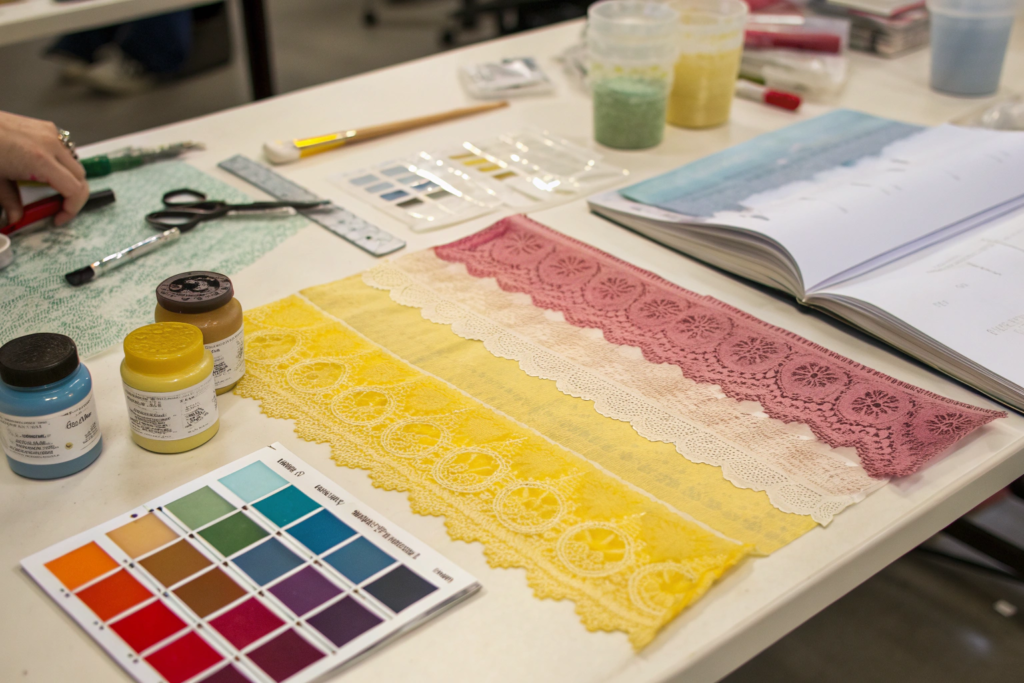
Many buyers wonder if they can just provide a Pantone number and be done with it. For solid fabrics, this can sometimes be a starting point, but for lace, it’s rarely sufficient. How to effectively communicate color standards beyond Pantone for textiles is a key skill. Pantone colors are printed on paper, while dyes are absorbed into fibers. The texture, sheen, and density of lace create a different visual effect. A matte paper Pantone and a glossy silk-thread lace in the same formula will look different. Therefore, the best practice is to provide a physical standard—a swatch of fabric, a thread, or a trim from a previous collection that embodies your target color. This gives the dye house a tangible, textile-based target to match under controlled lighting.
How do I prepare and send the perfect color standard to my supplier?
Clarity is king. Your goal is to eliminate all ambiguity for the dye master. Start by attaching a physical swatch of your desired color to a form or card. Write the reference number, your company name, and the date directly on it. Always provide two identical standards: one for the dye house to use (and potentially destroy in testing), and one kept as a master reference for final approval. Alongside the physical standard, provide digital references. Take a high-quality, color-accurate photo under natural daylight, and note the Pantone TPX or TCX number if it’s a close match, but always label it as “for reference only.” Crucially, specify the light source for evaluation. Commercial contracts often require a match under D65 daylight and an indoor tungsten light source to check for metamerism, where colors shift under different lights. A simple note like “Match to standard under D65. Must also pass visual check under store LED lighting” provides invaluable guidance. For more on establishing a robust color workflow, industry resources like the Textile Industry Exchange forum often have threads discussing best practices for building a physical color library for fashion sourcing.
What information must I include in my lab dip request to avoid delays?
A detailed lab dip request form is your best friend. It should include: Your company/design name, style number, fabric description (e.g., “100% Polyester Embroidered Lace, Code: LF-203”), and the color name/number. Most importantly, specify the acceptance tolerance. Are you requiring an exact match, or is a commercial match acceptable? An exact match is nearly impossible in textiles; a commercial match means the colors are visually indistinguishable to the average person under the specified light sources. You should also state the required turnaround time (e.g., 7-10 working days) and the number of revisions included in your cost (typically 2-3). Don’t forget shipping instructions. Clearly state where to send the lab dips. At Shanghai Fumao, we provide a digital request form that populates all this data, and we always recommend clients send their standards via reliable courier services like DHL or FedEx for tracking and speed. To understand the full scope of technical packages, you can explore guides on what to include in a complete tech pack for garment manufacturing.
What Does a Professional Lace Lab Dip Process Look Like Step-by-Step?
A transparent and methodical process from your supplier is the hallmark of a reliable partner. The journey from your standard to an approved lab dip should follow a clear, documented sequence. At its core, the supplier’s team is working to translate your visual concept into a chemical formula and a repeatable factory procedure. For intricate laces, this often involves sampling on multiple thread types within the same lace piece.
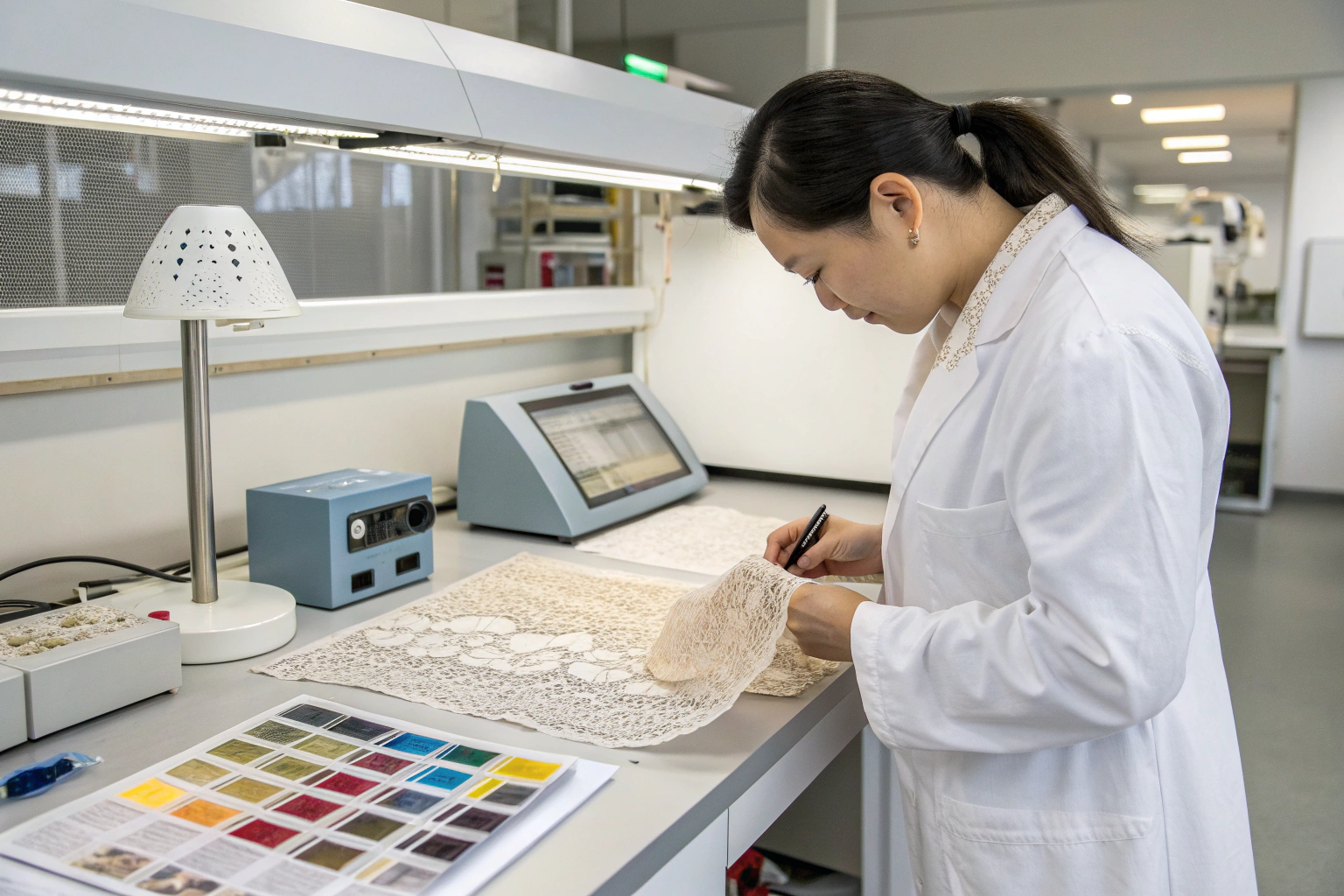
The process typically kicks off the moment your standard is received in their lab. A technician will first analyze the color under standard lights using a spectrophotometer to get an initial digital reading. However, with lace, the machine can struggle due to the open spaces and texture, so the dyer’s expert eye is irreplaceable. Based on this analysis, a seasoned dyer will create a preliminary dye recipe. They will then dye a small sample (usually 50-100 grams) of the exact production lace. After dyeing and finishing, the swatch is dried and prepared. A professional supplier will then mount it neatly on a card, labeling it with all relevant data: your reference, their internal dye formula, and the submission number (e.g., “1st Submission”).
The prepared lab dip is then evaluated internally by the supplier’s QC team against your standard under the required light sources. Only after passing this internal gate is it sent to you. This internal check is vital—it shows a commitment to quality and saves weeks of back-and-forth. For example, in early 2023, we worked with a French lingerie brand on a complex “mocha” shade for a nylon-Lycra lace. Their standard was a faded vintage piece. Our dyer made three internal iterations adjusting for the Lycra’s uptake before even sending the first official lab dip to the client. The client approved it on the second submission, saving nearly a month of potential revisions.
Step 1: Initial Analysis & Formula Creation
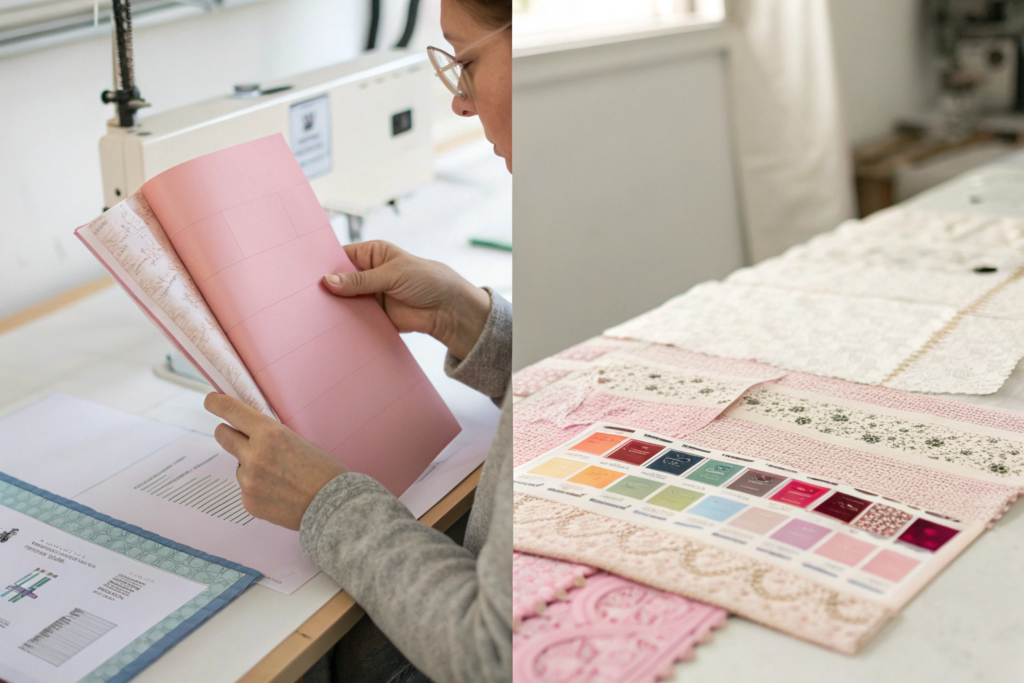
Upon receiving your standard, the technical team springs into action. The first task is a thorough physical inspection of the lace: identifying the fiber blend (using a quick burn test if unknown), assessing the construction, and noting any existing finishes that might affect dye absorption. The color is then measured with a spectrophotometer, though the reading is considered a guide. The head dyer, drawing on decades of experience—especially with tricky dyes like reds on polyester or pastels on cotton—creates the first dye recipe. This recipe isn’t just about color; it specifies dye types, chemicals, pH levels, dyeing temperature, and time. For lace, the dyeing method is crucial: is it jet-dyed, beam-dyed, or dipped? Each method affects the hand-feel and color penetration of the delicate structure.
Step 2: Sample Dyeing & Internal Approval
This is where the formula meets the fabric. A small batch is dyed in a pilot lab machine that simulates factory conditions. The dyed sample is then fixed, washed, and dried. It’s ironed or steamed and mounted. Here’s a critical step: a senior colorist compares the lab dip to the standard under multiple light sources in a light booth. They check for depth, hue, and saturation. If it doesn’t pass, they note the deviation (e.g., “too blue,” “too pale”) and adjust the formula. This loop continues internally until they have a match they are confident will meet the client’s commercial standard. Only then does it leave the building. This rigorous internal process is what separates true partners from middlemen. Understanding these key factors affecting color fastness in dyed fabrics can help you appreciate the complexity behind a simple swatch.
How Should I Evaluate and Comment on Received Lab Dips?
The lab dip arrives. Now what? Your evaluation method can mean the difference between a smooth approval and a confusing, drawn-out revision cycle. First, always evaluate under consistent, correct lighting. If you specified a D65 light source, you must check it under a D65 bulb or in a professional light booth. Checking it under your office fluorescent lights or by the window at sunset will give you a false reading. This is the number one cause of subjective disagreements on color.
Place the lab dip directly on top of your physical standard. Look for a match in three aspects: Hue (is it the same base color—red, blue, yellow?), Value (is it the same lightness or darkness?), and Chroma (is it the same intensity or dullness?). For lace, also check the color consistency across different thread types—sometimes the base net and the embroidered pattern can dye slightly differently. Feel the hand-feel (is it too stiff from over-dyeing?) and check for any staining or unevenness. If you have a spectrophotometer, you can measure the Delta E (dE) value, which quantifies the color difference. A dE below 1.0 is typically imperceptible to the human eye, while 2.0-3.0 is usually an acceptable commercial match. (Here’s a pro tip from our QC head: always flip the swatches over and check from the back as well—it reveals penetration issues.)
| Evaluation Aspect | What to Look For | Common Comment Example |
|---|---|---|
| Hue | Is the base color correct? | “2nd submission is too green compared to standard. Please adjust to be more neutral/yellow.” |
| Value | Is it too light or too dark? | “Please make lab dip 10% darker to match depth of standard.” |
| Chroma | Is it too bright/dull? | “Color is too saturated. Please reduce chroma to match the dusty tone of the standard.” |
| Metamerism | Does color shift under another light? | “Match is good under D65 but fails under tungsten (turns too brown). Please correct.” |
| Hand-Feel | Has dyeing altered the texture? | “Fabric has become stiff. Please ensure softener is applied in final process.” |
What are the right tools and environment for accurate color assessment?
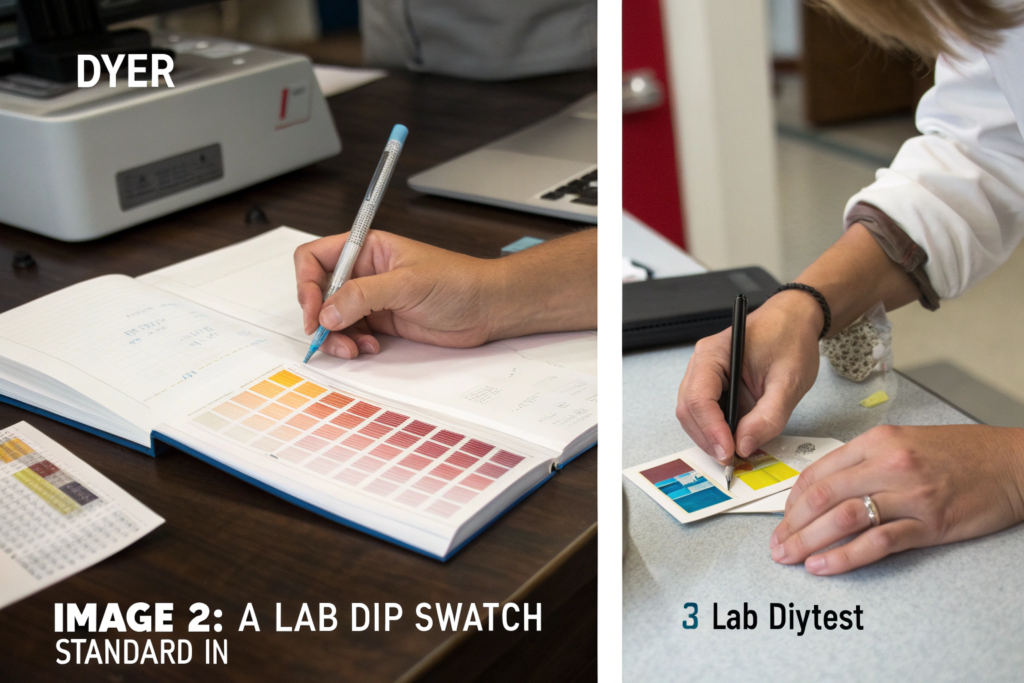
Invest in a small, desktop light booth. It’s one of the most cost-effective tools for any serious apparel buyer. Brands like GTI or Just Normlicht offer reliable models. Use it consistently. Your environment matters too; avoid brightly colored walls near your evaluation area, as they can cast reflective tints. When providing feedback, be specific and objective. Instead of saying “This is wrong,” say “The submitted lab dip is lighter and bluer than the standard under D65 light. Please adjust dye formula to increase depth and reduce blue cast.” Attach a photo of the two swatches side-by-side in the light booth with a neutral gray background. Digital tools can help; some suppliers, including Shanghai Fumao, offer digital color review platforms where you can approve or comment online, creating a permanent audit trail. For those managing color across multiple suppliers, learning about implementing a digital color management system for global supply chains is becoming essential.
How to give clear, actionable feedback to get the right revision fast?
Precision and clarity speed up the process exponentially. Use a standardized lab dip comment form. Mark the submission clearly: “REJECT” or “APPROVE WITH COMMENTS.” Number your comments. For example: “Comment 1: Hue – Please reduce the red tone by approximately 15%. Comment 2: Value – Please increase depth to match standard.” If the match is close but not perfect, you can sometimes approve it “as is” for production with a note: “Approved for bulk at dE 2.5. Ensure bulk does not deviate further.” This is called setting a bulk tolerance. Always send your feedback to a single, designated point of contact at the supplier to prevent confusion. And remember, the clock starts ticking on revisions only after they receive your clear feedback. A case in point: Last August, a UK-based e-commerce brand was struggling with a mint green lace. Their feedback was vague: “Make it more mint.” We asked for a reference photo. They sent a picture of a mint leaf. Our dyer matched that, but it was too yellow-green. Finally, on a call, they held up a specific retail garment to the camera. That was the “mint” they wanted. We matched it in the next dip. The lesson? Use every tool—photos, video calls, even couriering a secondary standard if needed—to bridge the perception gap.
How Can I Streamline the Entire Process for Faster Time-to-Market?
In fashion, time is money, and the development phase is often where schedules slip. Streamlining the lab dip process requires a combination of smart planning, technology, and choosing the right partner. It starts even before you send a standard. Building a long-term relationship with a vertically integrated supplier like Shanghai Fumao means they build a historical database of your color preferences, fiber choices, and approval patterns, which can dramatically accelerate initial formula creation.
Leverage digital tools whenever possible. Instead of waiting for international couriers for every revision, many suppliers now offer digital lab dip approval. They send high-resolution, color-managed images of the swatch under standard lighting. While not a replacement for final physical approval for critical colors, it can be used for initial screening to catch major discrepancies, saving a full shipping cycle. For example, we had an Australian activewear client in November 2023 who needed a custom coral color for a performance mesh. We sent digital images first; they confirmed the hue was correct but requested a slight adjustment in value. We made the correction and shipped the physical dip, which they approved outright. This shaved 10 days off their timeline.
Finally, plan your development calendar with the Chinese manufacturing cycle in mind. As mentioned, peak periods (Mar-May, Aug-Oct) add 1-2 weeks to any timeline. If your lace development overlaps with the Chinese New Year (a 3-4 week shutdown), you must complete pre-production, including lab dip approval, at least 6 weeks before the holiday. A savvy European brand we work with now mandates all lab dips for their Autumn/Winter lace collections be approved by early December, ensuring production can start the moment factories reopen after CNY, giving them a crucial 4-week head start.

Can digital approvals replace physical swatches for faster turnaround?
For non-critical colors or early-stage development, yes, digital approvals are a powerful tool. They rely on calibrated monitors and specialized software to ensure color accuracy from screen to screen. The supplier uses a calibrated camera to capture the lab dip in a controlled environment, and the image is embedded with color profile data. You view it on a (preferably) calibrated monitor. This allows for a “conditional approval”: you approve the color direction digitally, authorizing the supplier to proceed with cutting or other preparatory work, pending final physical sign-off. The key is to use it as a screening step, not the final gate. The physical swatch is still the legal contract for bulk dyeing. This hybrid approach is a game-changer for speed.
How does supplier selection and vertical integration impact lab dip speed?
This is perhaps the most significant factor. Working with a trading company that then sources lace from a mill, who then sends it to a separate dye house, adds multiple communication layers and shipping steps. Each handoff can add 3-5 days. A vertically integrated supplier controls, or has tightly partnered facilities for, weaving, dyeing, and finishing under one management umbrella. When our lab at Shanghai Fumao develops a dye formula, it’s done in direct collaboration with our partnered dyeing factory’s master dyer, often in the same industrial park in Keqiao. The sample is dyed on the same equipment used for bulk. This eliminates translation errors and drastically reduces the “internal loop” time. Furthermore, their deep inventory of lace base fabrics means they often have the exact greige good ready for sampling immediately, avoiding a 2-week wait for loom time. This vertical control is why we can often deliver the first lab dip in 7-10 days when the industry standard is 14-21.
Conclusion
Mastering the lab dip process for lace is fundamentally about replacing uncertainty with a structured, collaborative workflow. It begins with providing a crystal-clear physical standard and a detailed request, continues through a transparent, step-by-step development process with your supplier, and culminates in your precise, objective evaluation under the right conditions. By understanding the technical steps—from formula creation to internal approval—you become an informed partner, not just a passive client. Embracing tools like light boxes and digital approvals can compress timelines, while strategic planning around industry cycles safeguards your launch dates.
Ultimately, the consistency and beauty of your final lace garments hinge on these early, meticulous steps. It’s an investment of time and attention that pays dividends in quality, customer satisfaction, and brand reputation. By implementing the strategies outlined here, you transform color matching from a stressful bottleneck into a reliable, even rewarding, part of your creative production journey.
If you’re looking for a partner who treats your lace color with the same precision and care as you do, let’s connect. At Shanghai Fumao, with our vertically integrated capabilities from yarn to finished fabric right in the heart of Keqiao’s textile cluster, we specialize in navigating these complexities for our clients every day. We offer a streamlined, transparent lab dip process with fast turnaround times, backed by our CNAS-accredited lab. To discuss how we can help bring your next lace-intensive collection to life with perfect color fidelity, please reach out to our Business Director Elaine. She can guide you through our process and provide a quote. You can contact her directly at: elaine@fumaoclothing.com.