You've found a garment factory in China that claims to be OCS (Organic Content Standard) certified. Their price is competitive, communication is good, and they promise to deliver certified organic cotton garments. This is where most buyers make a critical mistake: they take the factory's word for it. In my two decades running Shanghai Fumao, I've seen too many brands get burned by fake or misrepresented certifications. A factory saying "Yes, we are certified" is meaningless without verification. The question isn't if they are certified, but how you can independently prove it. Your brand's reputation and legal compliance depend on getting this right.
Verifying OCS certification legitimacy is a forensic process, not a casual check. It's about moving from trust to verification. An illegitimate certification isn't just a paperwork error—it's a supply chain bomb that can detonate as retailer chargebacks, customs seizures, or public greenwashing scandals. I'll show you the exact, step-by-step due diligence process we use and recommend to our clients. This isn't theoretical; it's the hardened practice developed from resolving certification disputes for brands that came to us only after they were defrauded.
Think of it this way: you wouldn't accept a banknote just because someone says it's real. You'd check the watermark, the security thread, the serial number. Verifying a factory's OCS certification requires the same level of scrutiny. Let's break down the authentication process.
Step 1: Demand & Scrutinize The Core Documents.
The verification starts with two non-negotiable documents. If a factory hesitates to provide these immediately, consider it a major red flag.
Document 1: The OCS Scope Certificate. This is the factory's "license" to operate under the standard. It is issued by an accredited certification body (CB) like Control Union, SGS, ITS, or Ecocert.
- What to look for:
- Issuing Body & Logo: Is it from a recognized, accredited CB?
- Certificate Number: A unique ID (e.g., CU-123456). This is your key for verification.
- Company Name & Address: Does it match exactly the factory you are dealing with? Beware of trading companies using a parent company's certificate.
- Scope of Certification: This is the most critical line. It must explicitly include "garment manufacturing," "cut and sew," or "sewing." If it only says "trading," they are NOT certified to manufacture OCS garments; they can only buy and sell certified goods. This is the #1 deception.
- Issue and Expiry Date: Is it current? Certificates typically expire annually.
Document 2: A Sample Transaction Certificate (TC). This proves they actually execute the system. Request an anonymized TC from a previous OCS garment shipment.
- What to look for:
- Issued to/Consignee: Should be a past client.
- Product Description: Should be a finished garment (e.g., "Ladies' 100% Organic Cotton T-Shirt"), not just fabric.
- Reference to Input TC: It should list the TC number of the OCS fabric they used, proving chain of custody.
- Mass/Quantity: Clearly stated.
- Signed/Stamped by the CB: Confirming it's an official document.

Why is the "scope" so important?
A factory certified only for "trading" cannot transform materials. They must outsource cutting and sewing to another, uncertified factory, breaking the chain of custody. Your organic fabric enters their certified trading office but then goes into a black box for production. The final garment cannot be legitimately certified. We uncovered this in 2023 for a European brand. Their "certified" factory provided a valid scope certificate, but the scope was only "trading." The actual sewing was done in an uncertified workshop with no oversight. The brand's entire shipment was rejected by their retailer. This is why you must understand the critical difference between trading and manufacturing scope in OCS.
Can a certificate be faked?
Yes, and it happens. We've seen Photoshop-edited certificates with changed dates or company names. That's why digital verification (Step 2) is mandatory. A fake paper certificate is useless if it doesn't exist in the certifier's database.
Step 2: Conduct Independent Digital Verification.
Never rely solely on documents the factory sends you. You must independently confirm their validity through the certification body's public channels. This is your most powerful verification tool.
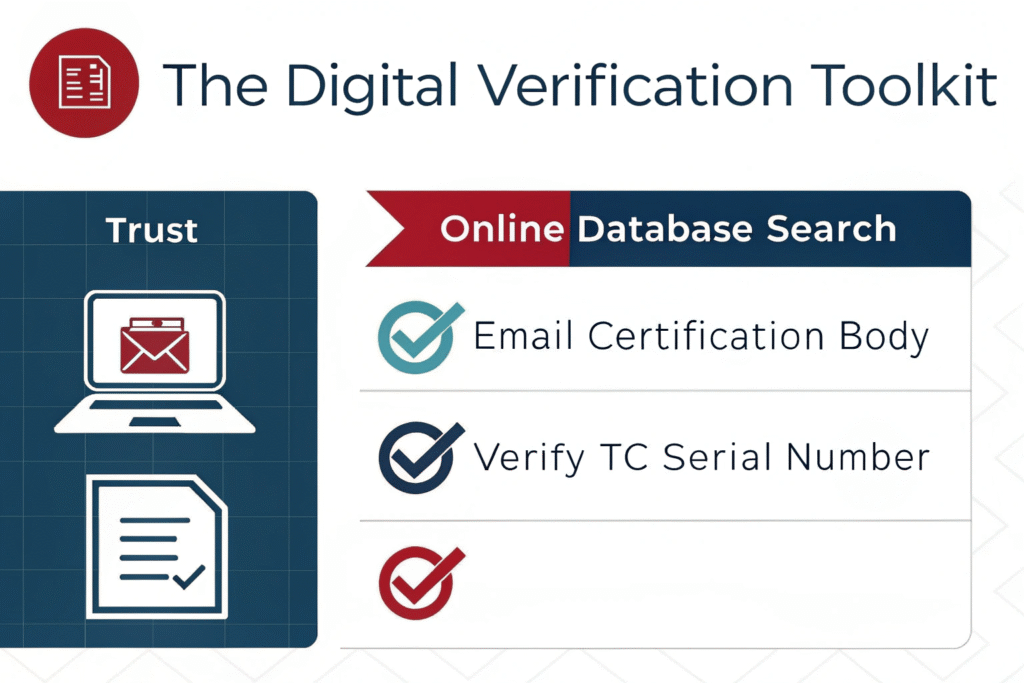
Method A: Online Certificate Database. Most major certification bodies maintain online directories.
- Go to the certifier's official website (e.g.,
controlunion.com,sgs.com). - Look for a "Certificate Database," "Client List," or "Certificate Verification" page.
- Enter the factory's exact name or the certificate number from the scope certificate they provided.
- Verify all details match: company name, address, scope, and validity status.
Method B: Direct Contact with the Certification Body. If an online search is inconclusive, email the CB directly. Use the contact from their official website, not an email provided by the factory. A simple email: "Could you please confirm the validity of OCS certificate number [ABC-123456] for [Factory Name]?" Reputable CBs will confirm active status.
Method C: Verify the Sample TC. The sample TC should also be verifiable. It has a unique number. You can ask the factory, "Can your certification body confirm that TC #XXX was issued to you?" While CBs may not divulge client shipment details to third parties, the factory's willingness to facilitate this check is a good sign.

What if the factory says, "The database isn't updated"?
This is a common excuse. While there can be a slight lag (a few days), major CBs update their databases frequently. If a certificate is more than a month old and not found, it is highly suspicious. Insist on seeing the official certificate issuance email from the CB to the factory as interim proof, but continue to follow up until it appears online. Do not place an order until it's verified.
A real case from our network:
A potential partner factory presented a beautiful OCS scope certificate from a known CB. Our team checked the database. The certificate number was valid, but it was issued to a different company in a different city. It was a blatant forgery. Confronted, the factory manager claimed it was a "printing mistake." We terminated the discussion immediately. This level of fraud is why digital cross-referencing is non-negotiable. It's a basic practice in supply chain due diligence for ethical sourcing.
Step 3: The On-Site or Virtual Audit of Physical Controls.
Certificates prove the system exists on paper. Your visit (or virtual tour) proves it exists on the factory floor. You need to see the physical manifestation of their OCS controls.
Key Areas to Inspect:
- Segregated Storage: Is there a clearly marked, dedicated area for storing OCS fabrics and components? Look for labels, signs, or separate racks.
- Production Line Segregation: How do they prevent mixing during cutting and sewing? Are OCS batches kept in distinct carts or bundles with special tags?
- Documentation Access: Ask to see a recent mass balance log. How do they track fabric in vs. garments out? It doesn't have to be high-tech, but it must exist.
- Staff Awareness: Speak with the production line supervisor. Ask, "What do you do differently when running an OCS order?" They should mention cleaning procedures, separate bundling, and specific paperwork.
What questions should I ask during the tour?
- "Walk me through what happens when a roll of OCS fabric arrives. Where does it go? Who checks the TC?"
- "Show me your system for labeling OCS cut pieces so they don't get mixed with conventional ones."
- "How do you clean the sewing lines between an OCS run and a conventional run?"
- "Where is your OCS waste (fabric scraps) stored, and how is it disposed of or documented?"
Their answers should be specific and demonstrate ingrained procedure, not confusion. In a 2024 virtual audit we conducted with a client, the factory manager proudly showed color-coded rolling bins—blue for OCS scraps, red for conventional. This simple, visible system spoke volumes about their operational discipline.
Can I rely on a third-party audit report?
Reports from social compliance audits (like SMETA, BSCI) or quality audits do not verify OCS controls. You need an audit report specifically for OCS or a general technical audit that includes a section on mass balance and material control. Even then, it's supplementary to your own verification. The gold standard is to hire a third-party QC firm to conduct a pre-production inspection that includes a check of OCS readiness, which is a service many brands now use.
Step 4: Assess Their Upstream & Downstream Integrity.
A factory's certification is only as strong as its connections. They must be able to demonstrate control over their own supply chain.
Upstream Verification (Their Fabric Source):
- Ask: "Who is your primary OCS fabric supplier? Can you provide their scope certificate and a sample TC?"
- A legitimate factory will have this information readily available. They understand that their certification is dependent on receiving certified inputs. If they say, "We just buy from the market," run.
- This is where partnering with a known entity like Shanghai Fumao helps. We are a verifiable source, and certified factories are happy to name us because it strengthens their own credibility.
Downstream Understanding (Their Processes):
- Discuss trims: "How do you source and document OCS-compliant threads and labels?"
- For washes or embellishments: "If this garment needs a wash or embroidery, how is that done without breaking the OCS chain?"
- Their answers should show an understanding that certification covers the entire process under their roof.
| Red Flag | What It Means | Green Flag |
|---|---|---|
| Hesitation to provide scope certificate. | May not be certified or certificate is fake. | Provides it instantly, invites verification. |
| Scope lists only "trading." | Cannot manufacture certified goods. Breaks chain. | Scope lists "garment manufacturing" or "sewing." |
| Certificate not found in online database. | High probability of forgery. | Details match perfectly in public database. |
| No physical segregation visible on tour. | System not implemented; high contamination risk. | Clear labeled areas, color-coded systems. |
| Cannot explain mass balance or show logs. | Documentary system is not functional. | Can walk you through a recent log example. |
| Vague about fabric source. | No control over organic material integrity. | Names fabric mill, can show mill's certificates. |
Conclusion
Verifying a garment factory's OCS certification legitimacy is a systematic process of collecting evidence: the right documents, independent digital confirmation, physical operational checks, and supply chain transparency. Skipping any step exposes you to immense risk. In a market where fake certificates can be bought for a few hundred dollars, your due diligence is the only thing protecting your brand.
This process also serves a higher purpose: it identifies true partners from mere vendors. A factory that welcomes this level of scrutiny is one that is confident in its systems, understands the value of integrity, and is prepared for a long-term, transparent relationship. They are the ones worth investing in.
Let Shanghai Fumao simplify this for you. As your certified fabric source, we can recommend garment factories from our vetted network whose OCS legitimacy we have already verified through this rigorous process. We bridge the trust gap.
Don't gamble your organic claim on a supplier's promise. Verify, then trust.
Ready to connect with pre-verified, legitimate OCS-certified manufacturing partners? Contact our Business Director, Elaine. We can facilitate introductions and share our verification dossier on partner factories. Email elaine@fumaoclothing.com to build your certified supply chain on a foundation of proof.