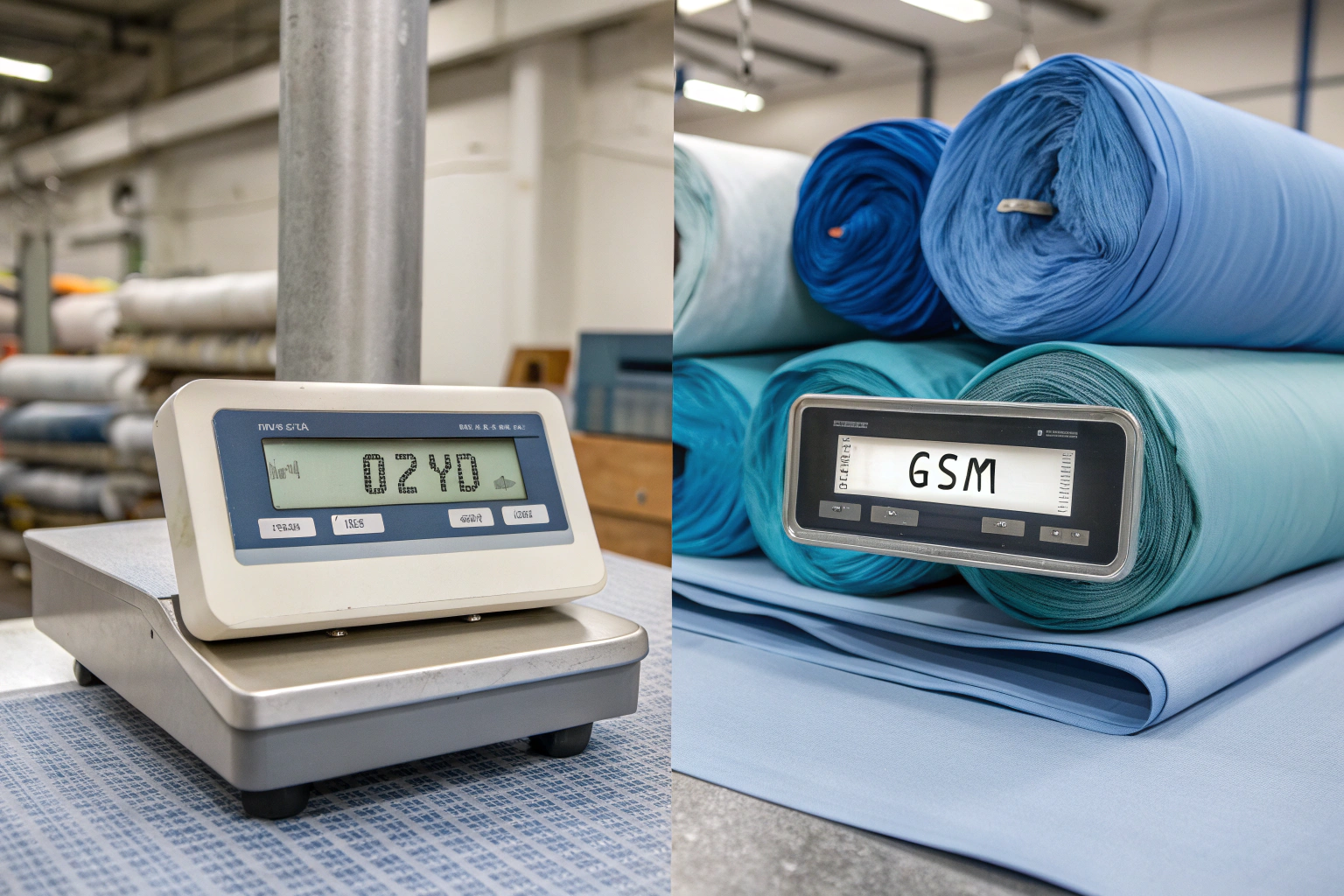
I still remember the email that made me realize how confusing fabric weight can be for buyers. A New York-based designer had specified 10 oz denim for her new collection. She found a supplier, ordered samples, loved the fabric, placed a bulk order for 5,000 yards. When the fabric arrived, it felt completely different from her samples. She checked the documentation: 10 oz, just as specified. The problem? Her sample was 10 oz per linear yard (a common misconception in denim), but her bulk order was specified as 10 oz per square yard (the correct industry standard). The fabric was nearly 30% lighter than she expected, and her jeans came out flimsy and wrong. That $30,000 mistake could have been avoided with one conversation about measurement systems.
Fabric weight is one of the most fundamental specifications in textile sourcing. It affects drape, durability, warmth, cost, and end-use suitability. But it's also one of the most commonly misunderstood specifications because two different measurement systems exist—ounces per square yard (oz/yd²) and grams per square meter (GSM)—and within those, there are variations in how "yard" is interpreted.
At Shanghai Fumao, we specify fabric weight for every order, every sample, every development project. We've seen every possible confusion play out, and we've learned how to prevent it. Let me walk you through what fabric weight actually means, how to specify it correctly, and how to ensure you get what you're expecting.
What Do oz/yd² and GSM Actually Measure?
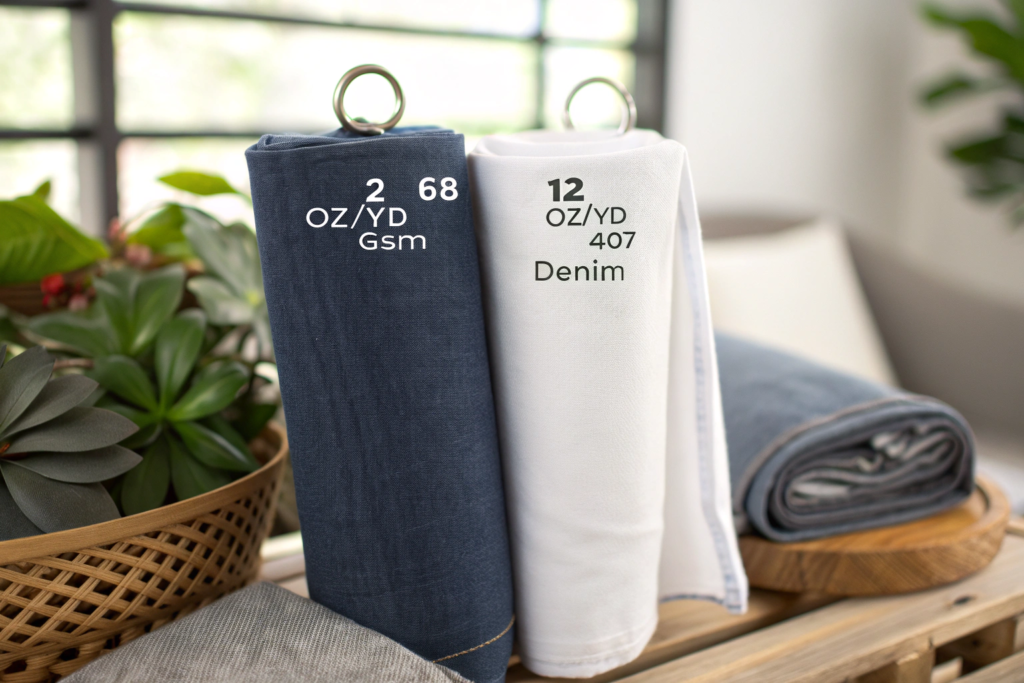
Both oz/yd² and GSM measure the same thing: the mass of a fabric sample of specific area. They're just different units. One square yard of fabric is 0.836 square meters. One ounce is 28.35 grams. So the conversion between systems is straightforward mathematically, but the practical implications matter.
Why do different regions prefer different measurement systems?
The oz/yd² system is primarily used in the United States and countries historically influenced by US textile trade. It's deeply embedded in American sourcing—denim is almost always specified in ounces, as are canvas, workwear fabrics, and many specialty textiles. US designers and manufacturers grew up thinking in ounces per square yard.
The GSM system (grams per square meter) is used everywhere else—Europe, Asia, Australia, most of South America. It's the international standard, aligned with the metric system used in global trade. Most technical specifications, test methods, and certifications use GSM because it's mathematically simpler and universally understood.
The practical problem arises when buyers and suppliers use different systems but assume they're talking about the same thing. A US buyer asking for "200 GSM" is clear. A Chinese supplier quoting "6 oz" is clear. But when the US buyer asks for "6 oz" and the Chinese supplier assumes ounces per square yard (correct), but the buyer meant ounces per linear yard (incorrect), confusion reigns.
For a UK brand sourcing for US distribution, we always confirm weight in both systems on every order. The spec sheet shows "Fabric weight: 200 GSM / 5.9 oz/yd²" so everyone is aligned. Dual specification prevents confusion.
How do you convert between oz/yd² and GSM?
The conversion is simple math, but accuracy matters:
GSM = oz/yd² × 33.906
oz/yd² = GSM ÷ 33.906
The number 33.906 comes from:
- 1 oz = 28.3495 grams
- 1 yd² = 0.836127 m²
- So oz/yd² to GSM = 28.3495 ÷ 0.836127 = 33.9057
Common reference points:
- 4 oz/yd² ≈ 136 GSM (light shirtings)
- 6 oz/yd² ≈ 203 GSM (medium-weight knits, light denim)
- 8 oz/yd² ≈ 271 GSM (heavy knits, light canvas)
- 10 oz/yd² ≈ 339 GSM (mid-weight denim, workwear)
- 12 oz/yd² ≈ 407 GSM (heavy denim)
- 14 oz/yd² ≈ 475 GSM (very heavy fabrics)
For a Canadian outerwear brand, we use a simple conversion chart in every quotation. The designer thinks in GSM (metric country), but their US manufacturing partner thinks in oz/yd². The chart keeps everyone aligned. Conversion tools prevent errors.
What's the difference between oz/linear yard and oz/square yard?
This is the hidden trap that catches even experienced buyers. Some fabrics, particularly denim and canvas, are sometimes specified in ounces per linear yard—the weight of one yard of fabric at its full width. This measurement depends on fabric width, so a 10 oz/linear yard fabric at 60" width is actually much heavier per square yard than a 10 oz/linear yard fabric at 45" width.
The math: oz/linear yard ÷ fabric width (in yards) = oz/square yard
For a 60" wide fabric (1.67 yards):
10 oz/linear yard ÷ 1.67 yards = about 6 oz/square yard
For a 45" wide fabric (1.25 yards):
10 oz/linear yard ÷ 1.25 yards = 8 oz/square yard
Same "10 oz" specification, completely different fabrics.
I had a Australian client in 2021 order "10 oz denim" for a jeans collection. They'd worked with denim before, so they assumed they knew what they were getting. Their previous supplier had used oz/linear yard at 60" width. Our standard specification is oz/square yard. When the fabric arrived, it felt heavier than expected—because it was. 10 oz/square yard is about 40% heavier than 10 oz/linear yard at 60" width. The jeans came out too stiff for their intended use. We replaced the fabric at our cost and now always clarify: "10 oz per square yard or per linear yard?" Width matters as much as weight.
How Does Fabric Weight Affect Performance and End Use?
Weight isn't just a number—it predicts how fabric will perform. Understanding the relationship between weight and properties helps you choose the right fabric for your application and troubleshoot problems when fabric doesn't perform as expected.
What weight ranges are appropriate for different garment types?
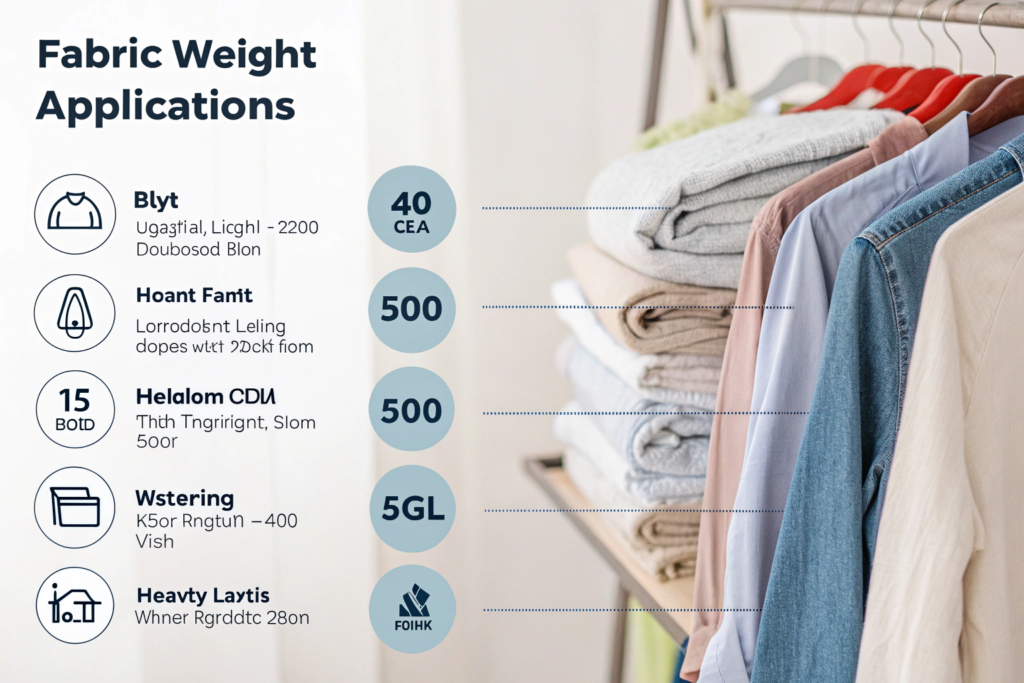
General guidelines by end use (GSM / oz/yd²):
Blouses, shirts, lightweight dresses: 80-150 GSM / 2.4-4.4 oz
Fabric must be fluid and drapable. Heavier weights would be too stiff.
T-shirts, polo shirts, lightweight knitwear: 150-200 GSM / 4.4-5.9 oz
Standard t-shirt weight. Below 150 feels flimsy; above 200 feels heavy for basic tees.
Dresses, skirts, lightweight pants: 180-250 GSM / 5.3-7.4 oz
Needs enough body to hang well without being stiff.
Sweaters, hoodies, sweatshirts: 250-350 GSM / 7.4-10.3 oz
Fleece and sweater knits at this weight provide warmth without bulk.
Jackets, workwear, heavy pants: 300-450 GSM / 8.8-13.3 oz
Must be durable enough for abrasion resistance while allowing movement.
Denim (light): 8-10 oz (240-300 GSM) for shirts, light jeans
Denim (medium): 10-13 oz (300-385 GSM) for standard jeans
Denim (heavy): 14 oz+ (415+ GSM) for workwear, fashion
Outerwear, coats, upholstery: 400+ GSM / 11.8+ oz
Heavy fabrics for maximum durability and warmth.
For a French fashion brand developing a year-round collection, we specified different weights for different seasons: 180 GSM for spring dresses, 240 GSM for autumn dresses, 320 GSM for winter jackets. The same patterns, same fabrics, just different weights—creating a cohesive collection with appropriate seasonal variation. Weight seasonalization is smart design.
How does weight correlate with durability?
Generally, heavier fabrics are more durable—but it's not a straight line. A 400 GSM fabric of poor construction (loose weave, low-quality yarn) might wear out faster than a 300 GSM fabric of excellent construction (tight weave, high-quality yarn).
Key factors that interact with weight:
- Fiber type: Nylon is stronger than cotton at the same weight
- Yarn quality: Long-staple fibers create stronger yarns than short-staple
- Weave density: Threads per inch matters as much as weight
- Finish: Some finishes add durability without adding weight
For a US workwear client, we developed a 280 GSM fabric that out-performed their previous 340 GSM fabric because we used high-tenacity polyester yarns and a tighter weave construction. The fabric was lighter (more comfortable) but stronger (more durable). Weight isn't the only durability factor.
What's the relationship between weight and warmth?
In insulation, weight correlates with warmth—but fabric structure matters enormously. A 200 GSM fleece can be warmer than a 300 GSM woven because the fleece's loft traps more air. The key is "thermal resistance" (clo value), not just weight.
For thermal applications:
- Fleece, sweater knits: Lofty structures trap air, providing warmth at lower weights
- Woven fabrics: Dense structures block wind but require more weight for insulation
- Multi-layer constructions: Combine lightweight outer with insulating inner for warmth without bulk
For a Swedish outdoor brand, we developed a 180 GSM fleece that matched the warmth of their previous 250 GSM fleece because we used a different knit structure with higher loft. The fabric was lighter, packed smaller, and sold at a premium. Structure can beat weight for warmth.
How Do You Specify Fabric Weight Correctly?
Clear specification prevents the kind of expensive mistakes my New York client experienced. Here's how to specify weight so there's no ambiguity.
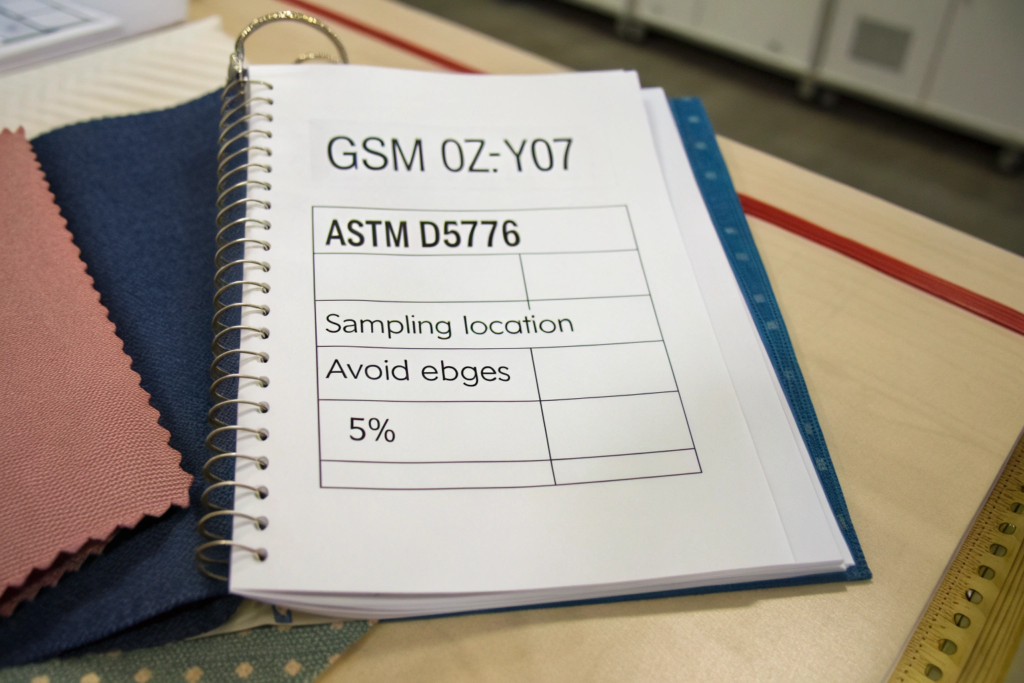
What information should be in a weight specification?
Complete weight specification includes:
Target weight: Both GSM and oz/yd², clearly labeled
Tolerance: Acceptable range (typically ±5% for most fabrics, tighter for critical applications)
Test method: ASTM D3776, ISO 3801, or equivalent
Conditioning: Fabrics must be tested in standard atmospheric conditions (70°F, 65% RH) because moisture affects weight
Sampling location: Specify that samples should be taken from middle of fabric, not edges (edges can be different)
For a German automotive client (very tight tolerances), we specify weight as "200 GSM ±3%, tested per ISO 3801, conditioned 24 hours at 20°C/65% RH, samples taken minimum 1 meter from fabric edge." This level of detail prevents disputes. Precision eliminates ambiguity.
How do you measure fabric weight accurately?
Weight measurement seems simple—cut a sample, weigh it—but accuracy requires attention:
-
Condition the fabric: Let it rest in standard atmosphere for minimum 24 hours. Moisture content affects weight significantly.
-
Cut accurately: Use a precise die cutter (typically 100 cm²) or measure and cut exactly. Small errors in area create proportionally larger errors in calculated weight.
-
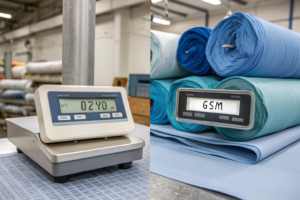
Weigh precisely: Use a calibrated scale accurate to 0.01g. We use Mettler Toledo balances calibrated monthly.
-
Calculate: Weight (g) × 100 = GSM (for 100 cm² sample). Or use conversion factors for other sample sizes.
-
Average multiple samples: Test at least 3-5 samples from different areas and average.
For quality control, we test every production roll and record the results. If a roll measures outside tolerance, it's flagged for investigation. Accurate measurement requires disciplined process.
What tolerances are reasonable?
Acceptable weight variation depends on fabric type and end use:
Knits: ±5-7% typical due to stretch and relaxation variation
Wovens: ±3-5% typical for quality production
Premium/technical fabrics: ±2-3% possible but costs more
Commodity fabrics: ±10% sometimes accepted (but risky)
For a Zara supplier, we maintain ±3% on all wovens and ±5% on all knits. This meets their quality standards without excessive cost. For a Lululemon supplier, we maintain ±2% on key styles—tighter control requires more testing and occasional rejection, but their price point supports it. Tolerance should match price and end use.
What Common Mistakes Do Buyers Make with Fabric Weight?
Learning from others' mistakes is cheaper than making your own. Here are the most common weight specification errors we see.
Mistake #1: Specifying weight by feel, not measurement
"Give me something similar to this sample" is the most common request we hear. But hand feel is subjective and influenced by finish, fiber, and construction—not just weight. A 180 GSM fabric with a soft finish can feel heavier than a 200 GSM fabric with a crisp finish.
Always specify weight numerically, not descriptively. If you're working from a physical sample, have it tested for weight and specify that number. Don't rely on "it feels about the same."
For a Portuguese client who sent us a "reference sample," we tested it at 215 GSM. They'd assumed it was 180 GSM based on feel. Specifying 180 would have produced a completely different fabric. Test don't guess.
Mistake #2: Forgetting that finishing affects final weight
Fabric weight changes during finishing. Dyeing, shrinking, compacting, brushing—all affect final weight. The weight specified should be "finished weight," not "greige weight" (weight before finishing). Greige weight can be 10-20% higher than finished weight depending on processes.
Always confirm: "Is this weight before or after finishing?" For sample development, request finished weight specifications. For bulk orders, specify finished weight with acceptable tolerance.
A Danish client once ordered fabric based on greige weight samples, assuming finishing wouldn't change it much. The finished fabric came in 15% lighter than expected—too light for their application. We adjusted the greige fabric to compensate, but the timeline stretched. Finished weight is what matters.
Mistake #3: Confusing weight with thickness
Weight and thickness are related but not the same. A dense, compact fabric can be heavier than a thick, lofty fabric of the same thickness. For example:
- Dense cotton twill: 300 GSM, 0.5mm thick
- Lofty fleece: 250 GSM, 2.0mm thick
If warmth or bulk is your goal, specify thickness (in mm) as well as weight. If durability or hand feel is your goal, weight is more relevant.
For a Canadian blanket client, we specify both weight (GSM) and thickness (mm) because their customers expect a certain "loft" feeling. Weight alone wouldn't capture that. Multiple specifications capture complete properties.
The fabric weight specification seems simple, but the details matter enormously. The difference between 10 oz/linear yard and 10 oz/square yard can destroy a collection. The difference between greige weight and finished weight can break a budget. The difference between 180 GSM and 200 GSM can change a garment's entire character.
At Shanghai Fumao, we treat weight specification as a conversation, not just a number. We confirm units. We confirm finished vs. greige. We confirm tolerances. We provide test reports. We make sure that what you imagine is what you get.
Conclusion
Understanding and specifying fabric weight correctly requires clarity about measurement systems, awareness of common pitfalls, and attention to detail in specification. Ounces per square yard (oz/yd²) and grams per square meter (GSM) measure the same property but require conversion. Ounces per linear yard is a different measurement entirely, dependent on fabric width. Weight ranges correlate with end-use suitability but interact with fiber, construction, and finish. Accurate specification includes target weight, tolerance, test method, and conditioning requirements.
The cost of weight confusion is measured in ruined garments, missed seasons, and damaged supplier relationships. The investment in clear specification is just a few minutes of attention.
If you're sourcing fabric and want to ensure your weight specifications are clear and actionable, I invite you to reach out to us at Shanghai Fumao. We work with clients across measurement systems and applications, translating between US and international standards, confirming specifications before production, and providing test documentation with every shipment. Contact our Business Director, Elaine, directly at elaine@fumaoclothing.com. Tell her about your project and your weight requirements. She'll connect you with our technical team, and we'll help you specify fabrics that perform exactly as you expect.
Because the right weight isn't just a number—it's the foundation of everything your garment will become.