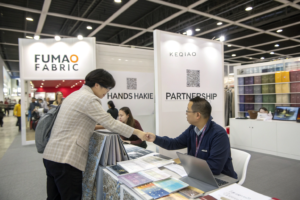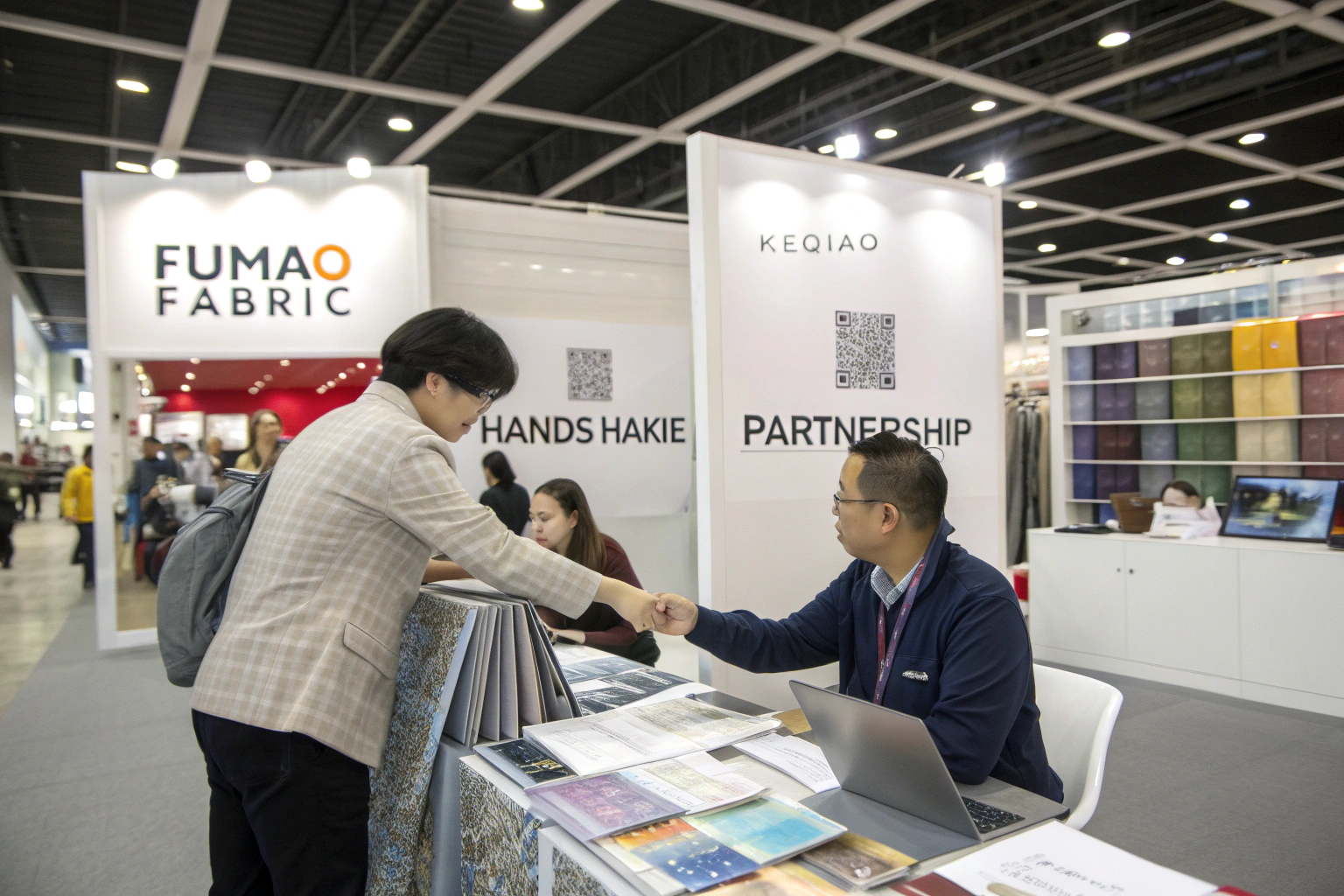
I remember the exact moment I understood the difference between a trader and a factory. I was standing in the Magic Show in Las Vegas, years ago, working a booth for a trading company I was with at the time. A buyer walked up—a sharp guy named Ron, about your age, confident. He picked up a swatch of linen, rubbed it between his fingers, and asked the question that changes everything: "Is this your mill? Can I see the dye house audit?" The sales rep next to me, a smooth talker, launched into a story about "exclusive partnerships" and "proprietary sourcing." Ron smiled, put the swatch down, and walked away. He knew he was talking to a middleman.
That stuck with me. Now, sitting here in my office at Shanghai Fumao in Keqiao, surrounded by the actual hum of looms and the steam from the dye house down the road, I understand why buyers like Ron make that transition. Trade shows are a fantastic starting point. They're the industry's meet-and-greet. You see a thousand fabrics in two days. You collect business cards that smell like coffee and ambition. But they are also a Wall. A wall built of showroom pricing, curated samples, and sales scripts. Behind that wall is the real supply chain—the gritty, efficient, and sometimes messy world of direct factory production. Moving from the trade show floor to the factory floor is the single most profitable shift you can make as a professional fabric buyer. But it requires a new set of skills. You stop being a "shopper" and start being a "partner."
Let me walk you through the exact path from the carpeted aisles of a convention center to the concrete floor of a Chinese mill. I'll tell you what changes in pricing, what changes in quality control, and what changes in the relationship. Because when you cut out the middleman, you don't just save money. You gain control.
What Are the Hidden Costs of Sourcing Through Trade Show Middlemen?
Let's be honest about the economics of the trade show circuit. Those booths at Première Vision Paris or Texworld New York are not free. The flights, the hotels, the shipping of 50-pound swatch books, the elaborate booth displays—someone is paying for all of that. And it's not the trading company's shareholders out of the goodness of their hearts. It's you. It's baked into the Price Per Yard.
When you buy from a trade show vendor who doesn't own a factory, you're paying for Sourcing as a Service. That service has value, don't get me wrong. They curate the collection. They speak English fluently. They handle the initial communication. But you are paying a Premium for that convenience. The industry average markup for a trading company over direct factory ex-works pricing is 15% to 35% .
But the price per yard is just the visible tip of the iceberg. The deeper, more dangerous costs are hidden in the Supply Chain Opacity. You don't know where the greige goods came from. You don't know which dye house is being used. When there's a problem—a shade issue, a late shipment—the trader is stuck in the middle, relaying messages. They can't fix the machine tension. They can't prioritize your order on the stenter frame. They can only ask nicely. And asking nicely doesn't get fabric on a boat any faster.
How Much Markup Is Typical for Fabric Sourcing Agents?
I'm going to pull back the curtain on the numbers here. At Shanghai Fumao, we are a Factory-Direct operation. We own the looms, we control the dye house partnerships, we run the QC. Our pricing reflects the Actual Cost of Manufacturing + Reasonable Margin.
Let's compare a real scenario: 5,000 meters of Custom Dyed Cotton Spandex Jersey (180 GSM).
| Cost Component | Factory Direct (Shanghai Fumao) | Trade Show Trader |
|---|---|---|
| Yarn Cost (Greige) | $1.80 / yd | $1.80 / yd |
| Dyeing & Finishing | $0.80 / yd | $0.80 / yd |
| Factory Margin | $0.40 / yd | $0.40 / yd |
| Trader Markup | $0.00 | $0.75 - $1.20 / yd |
| FOB Price per Yard | $3.00 / yd | $3.75 - $4.20 / yd |
| Total Order Cost | $15,000 | $18,750 - $21,000 |
That's a difference of $3,750 to $6,000 on a single moderate-sized order. That's the cost of the trade show booth, the New York office rent, and the middleman's commission. For a small brand, that $6,000 is the profit margin for the entire season. For a large brand, that's a six-figure annual savings.
And here's the kicker: The fabric coming out of the dye house is Exactly the Same. It's the same machine, same dyes, same water. You're just paying a different invoice address. I've seen this firsthand when we've taken over production for brands that were previously sourcing through traders. The fabric spec doesn't change. The price drops 20%. The lead time often drops too, because there's one less person in the email chain. For a deeper dive into the financial structure, this is a good analysis: understanding the cost breakdown of textile sourcing and the role of intermediaries. And for a practical comparison, this guide to calculating the true cost of fabric from a trading company vs a mill is very clear.
Why Does Direct Factory Access Improve Problem Resolution?
(Here's where I get a little passionate.) This is the reason I left the trading world and went all-in on factory ownership at Shanghai Fumao. When you have a problem with fabric, you don't need a Translator. You need a Decision Maker.
Imagine this scenario: It's a Friday afternoon. Your cutting room in Los Angeles just discovered that 20% of the rolls in your shipment have a Barre Defect (horizontal streak). You email your contact.
- The Trader Scenario: The trader reads your email Monday morning Shanghai time. They forward it to their contact at the mill. The mill manager is in a meeting. He replies Tuesday afternoon. "We will check the retained sample." Wednesday morning, the trader emails you: "The mill says the fabric was within tolerance." You're now in a three-way argument with someone who has no authority to authorize a credit. It takes 2 weeks to get a 10% discount.
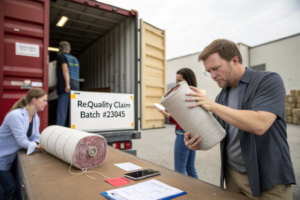
- The Factory Direct Scenario (Shanghai Fumao): You email Elaine. I walk over to the QC department. I pull the Retained Sample from that specific dye lot (we keep a cutting of every batch). I put it on the light table. I see the barre. I call the dye house manager on his cell phone. "Mr. Wang, Batch #F23045. Barre issue. We need to credit the client 15% for the affected rolls." He grumbles, looks at his own records, and says, "Okay, done. I'll adjust the next invoice." The whole thing takes 4 Hours.
That speed of resolution is not about being nicer. It's about Proximity to Power. When you're dealing with a factory, the person you're talking to can walk 50 feet and touch the machine that made the mistake. They have the authority to write off the loss because it's their loss. A trader has to beg the factory to eat the loss, and the factory has no incentive to say yes because the trader is just one of 50 clients.
I had a US outdoor brand client who had a water repellency (DWR) finish fail on a shipment of nylon from a trader. It took 6 months to resolve. They switched to us. Six months later, a similar finish issue cropped up on a new development. We caught it in our CNAS lab before shipping. We re-treated the fabric. It cost us $800 in chemicals. The client never even knew there was a potential problem. That's the difference. This is a great resource on the operational side: how factory-direct relationships streamline quality control and claims in textile manufacturing. And for a case study perspective, this analysis of supply chain visibility and its impact on dispute resolution is insightful.
How to Identify a True Manufacturer vs a Trading Company?
So you're convinced. You want to go direct. But here's the trap: The trade show floor is full of Trading Companies Disguised as Factories. They use words like "Our Mill" and "Our Production Base." They have glossy brochures with photos of looms (probably stock photos). How do you, sitting in an office in Chicago, verify that the person emailing you actually controls the means of production?
You need to become an amateur detective. You need to look for the Tells. And the biggest tell in 2026 is the Business License Scope. In China, every company has a registered Business Scope with the government. It's public information. It says exactly what they are legally allowed to do. A trading company's scope says: "Wholesale, Retail, Import/Export of Textiles." A manufacturer's scope says: "Manufacturing, Processing, Dyeing, Weaving of Textiles."
That's the legal truth. But there are practical tells, too. The volume of communication, the specificity of technical answers, and the ability to provide Vertical Proof (photos of your specific fabric on their specific machines).
What Does a Factory's Business License Reveal About Operations?
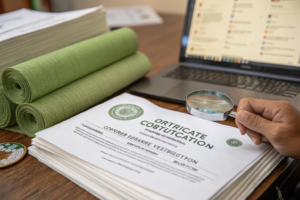
This is the single most powerful tool you have, and 95% of buyers never use it. When you're serious about a supplier, ask for a copy of their Business License . It's a standard document. They should have a scanned copy. If they refuse to share it, that's a massive red flag.
How to Read a Chinese Business License for Textiles (The Shanghai Fumao Cheat Sheet):
- Unified Social Credit Code: This is like a Social Security Number for the company. You can enter this code into free online databases to verify the company is real and active.
- Legal Representative: This is the person who goes to jail if there's fraud. It matters.
- Registered Capital: This gives you a sense of their financial skin in the game. A factory with ¥50,000,000 capital has a lot more to lose than a trader with ¥1,000,000 capital.
- Business Scope (The "Tell"): Look for these specific Chinese characters:
- Manufacturing - Must have this.
- Processing - Good sign.
- Dyeing/Printing - Excellent sign if they claim to own a dye house.
- Knitting or Weaving - Specific to their claimed capability.
If the scope only says Sales or Wholesale or Import/Export, they are Legally a Trader. They may be a very good trader with close factory ties, but they are not a factory. You cannot hold them to the same standard of operational control.
I had a client who was about to place a $50,000 order with a "Mill" they met at a show. They sent me the name. I looked up the license. The registered address was a small office on the 15th floor of a commercial building in downtown Shanghai. No factory. No looms. Just a desk and a phone. They were a trader with a good website. The client redirected the order to Shanghai Fumao and saved $8,000. This is a detailed guide: how to verify a Chinese manufacturer's business license and scope for textile production. And this is a practical checklist for distinguishing between a factory and a trading company in China.
Why Do Factory Visits or Video Tours Matter for Verification?
In the post-Covid world, you don't necessarily have to fly to China to verify a factory (though you should, eventually). You can do a Live Video Tour. And there is a right way and a wrong way to do this.
The Wrong Way: The supplier sends you a pre-recorded, edited, glossy video with background music showing clean floors and smiling workers. That's a Commercial. It tells you nothing.
The Right Way (The Shanghai Fumao Protocol):
- Schedule a Live Call: Use Zoom, WeChat, or WhatsApp.
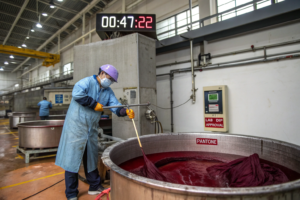
- Ask for a Specific Tour Path: Don't let them just show you the "nice" corner. Say: "Start at the raw materials warehouse. Show me the yarn inventory. Now walk me to the dye house floor. Show me the control panel of the active machine. Now walk to the inspection table. Show me a roll with a defect sticker."
- Look for the Details:
- The Floor: Is it wet? (Dye houses are wet).
- The Noise: Is it loud? (Looms are deafening).
- The Smell: (Okay, you can't smell over video, but you can ask: "Does it smell like vinegar or chemicals?" The answer should be "Yes" if they are finishing fabric).
- Ask to See a Current Job Ticket: Say: "Show me a production ticket on a machine right now." Read the date, the client name, the PO number. This proves they are running real production, not just a showroom.
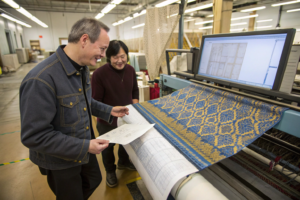
I do these tours for new Shanghai Fumao clients all the time. I walk them from the yarn storage (where I show them the cones labeled "Supima Cotton" and "Tencel"), through the weaving shed (where I have to shout over the looms), to the inspection room (where I show them our CNAS lab equipment). It takes 30 minutes. It builds more trust than 30 emails. This is a practical guide to conducting a remote factory audit: how to perform a live video inspection of a textile factory in China. And this article on key questions to ask during a virtual factory tour to verify manufacturing capability is very useful.
How to Negotiate Better Payment Terms with a Factory?
You've found the factory. You've verified they're real. Now comes the conversation that determines your cash flow for the next three months: Payment Terms. This is where many buyers, used to the rigid 30/70 terms of a trade show vendor, get nervous. They assume factory terms are even stricter.
Actually, the opposite is often true. A factory has More Flexibility than a trader. Why? Because a trader has to pay the factory Upfront or at Shipment. They are out the cash. They need your money fast to stay liquid. A factory, on the other hand, has Inventory and Production Capacity. They can be more creative with credit and scheduling because they hold the physical assets.
The key to negotiating better terms with a factory is to understand their Cash Flow Cycle. They need money to buy yarn. After that, their costs are mainly labor and utilities (which are paid monthly). If you can cover the yarn cost upfront, they can be very flexible on the labor cost.
What Are Standard T/T Payment Structures for Factory Direct Orders?
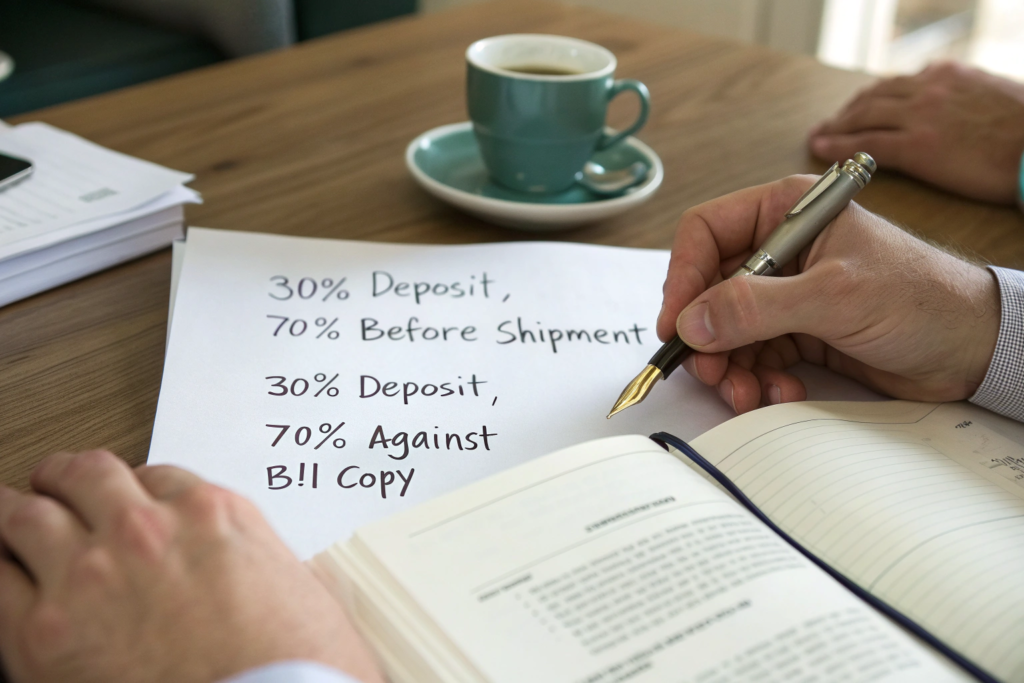
The standard starting point for a new factory relationship is T/T 30/70 (30% deposit to start, 70% balance before shipment or against B/L Copy). But let's be specific about the "70%" part because there's a huge difference.
- 70% Before Shipment: "Fabric is ready in our warehouse. Pay us, and we'll release it to the forwarder."
- 70% Against Copy of B/L: "Fabric is on the vessel. Here is the Bill of Lading copy. Pay us within 5 days."
At Shanghai Fumao, for established clients with a good track record, we almost always do 70% Against B/L Copy. It's the industry gold standard for balancing risk. You get proof the goods are on the water before you release the final payment.
But for Large Orders (over $100,000) or Repeat Clients, we can get even more flexible. We offer Letter of Credit (L/C) at Sight or even Open Account (O/A) Net 30/60 after a year of solid payment history.
Negotiation Leverage Points for Better Terms:
- Forecast Commitment: "Instead of one order of 5,000m, I'll give you a 6-month forecast for 30,000m in three tranches." This guarantees the factory's loom utilization. They'll offer better payment terms in exchange for the Volume Commitment.
- Seasonal Timing: "I'll place this bulk order for November production." (Off-peak season). Factories are hungry for work in Nov/Dec. They will accept Smaller Deposits (e.g., 20%) or Longer Credit to keep the machines running.
- Raw Material Offset: "I'll pay for the yarn directly. You just charge me for weaving and finishing." This removes the factory's biggest upfront cost. You can often negotiate a Lower Weaving Fee and Delayed Payment for the labor portion.
I recently worked with a US home textile brand on their first large order with us. They were nervous about a 30% deposit on a $120,000 order ($36,000). We looked at their forecast. We saw they would re-order this linen blend three more times. We agreed to a 20% Deposit on the first order, with a commitment to standard 30/70 on the subsequent three orders. It built trust and smoothed their cash flow. This is a great resource for understanding the landscape: understanding T/T payment terms and negotiating with Chinese textile suppliers. And for a legal perspective, this guide to international sales contracts and payment methods for apparel is helpful.
Why Is Open Account Credit a Sign of a Mature Partnership?
Open Account (O/A) is the Holy Grail of sourcing. It means the factory ships you the fabric, you receive it, you inspect it, and you pay 30, 60, or 90 days later. It's how business is done domestically in the US. It's rare internationally, but it's the ultimate sign of trust and financial stability.
What O/A Terms Signal:
- Financial Health: The factory has enough cash reserves to operate for 60-90 days without your payment. They are not living "hand-to-mouth" on deposits. This is a Green Flag.
- Quality Confidence: They are confident you won't find a reason to deduct from the invoice. They know their quality is solid.
- Strategic Partnership: They view you as a Long-Term Asset, not a one-time transaction. They are willing to act as your bank for two months to keep your business.
We extend O/A Net 60 terms to a select group of Shanghai Fumao clients who have done over $500,000 in business with us and have never missed a payment. For them, it transforms their working capital. They can receive the fabric, cut it, sew it, sell the garments to stores, and Collect Receivables before they even pay us for the raw material. That's a powerful financial advantage.
If a factory offers you O/A terms after a solid track record, take it seriously. It means you've graduated from "buyer" to "partner." You have a seat at the table. This is a financial deep dive: how open account payment terms work in international trade and the risks for suppliers. And this article discusses building strategic supplier relationships and negotiating extended payment terms.
How to Build a Long-Term Quality Assurance System with a Mill?
You've cut out the middleman. You've got the factory pricing and the flexible terms. Now you have to manage the Quality yourself. When you bought from a trader, they were supposed to be your "eyes and ears" on the ground. Without them, you need to build your own system. But here's the secret: A good factory wants you to do this. We want you to have clear specs. We want you to have a QC checklist. It makes our job easier and eliminates arguments.
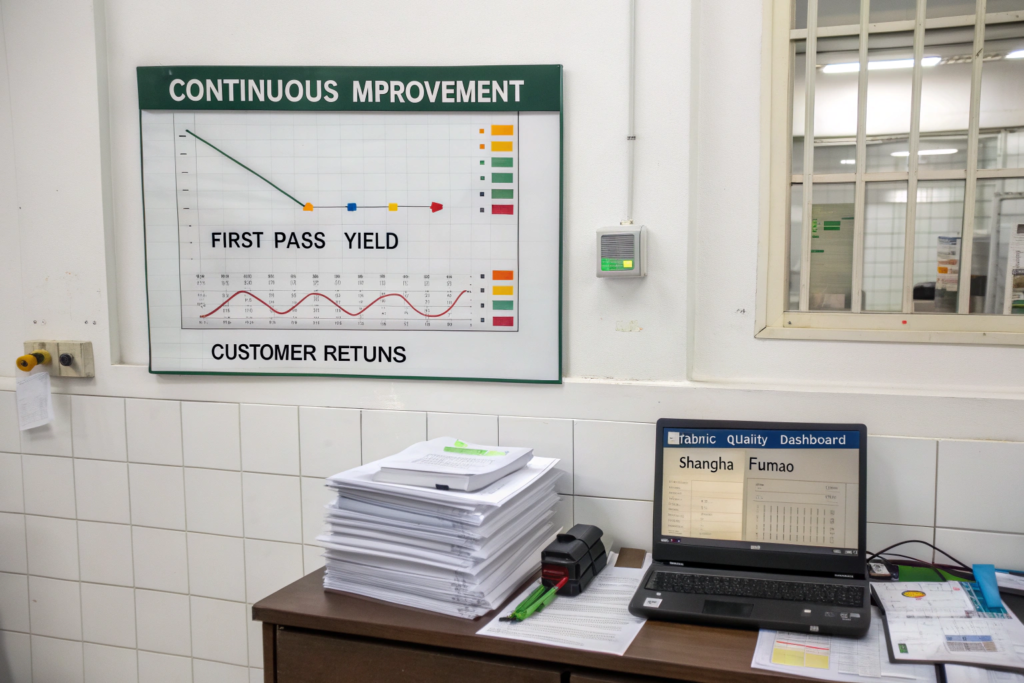
A long-term QA system with a mill is not about catching them in a lie. It's about Continuous Alignment. It's about creating a shared language around defects, tolerances, and standards. The two pillars of this system are Internal Lab Data (like our CNAS reports) and Third-Party Verification (like SGS inspections). You need to understand how to use both.
How to Use CNAS Lab Reports as a Third-Party Reference?
I talk about our CNAS-accredited lab at Shanghai Fumao a lot. And some buyers might think, "Well, of course, you trust your own lab." And you're right to be skeptical. That's why CNAS Accreditation is the key. CNAS means the lab is audited by the Chinese government to ISO 17025 international standards. It's the exact same standard that SGS and Intertek labs follow.
The Value of a CNAS Report to You, the Buyer:
- Legal Weight: If there is a dispute about fiber content (e.g., you claim it's 95% Cotton / 5% Cashmere and it tests as 100% Cotton), a CNAS report is Admissible in Court and in Alibaba Trade Arbitration. It's not just "our word." It's a certified document.
- Cost Savings: We run the test in-house. It costs us $20 in technician time. If you send that same fabric to SGS in the US for an AATCC 20 Fiber Analysis, it costs you $250 and takes a week. By accepting our CNAS report, you save that money on every shipment.
- Root Cause Analysis: If the shrinkage test shows 7% instead of 5%, we don't just say "Oops." We take that CNAS data to the finishing department. We look at the Overfeed Percentage on the stenter frame. We adjust the machine settings. The next batch is 5%. That closed-loop feedback doesn't happen with a trader.
I encourage my clients to Spot Check our CNAS results. Send one roll out of every five shipments to SGS in the US. If our CNAS numbers consistently match the SGS numbers (and they do), then you can trust the system. It's a "Trust but Verify" model. This is the official source for the standard: ISO 17025 general requirements for the competence of testing and calibration laboratories. And for the specific Chinese context, this explainer on CNAS accreditation and its equivalence to international lab standards is useful.
What Should Be Included in an Annual Factory Audit Checklist?
You don't need to audit the factory every month. But an Annual Audit is a smart practice for any brand doing over $100k a year with a mill. It keeps everyone sharp. It shows the factory you're serious.
Here is the Shanghai Fumao Client Audit Checklist that I actually encourage my clients to use. I'd rather they see the real thing than rely on a marketing brochure.
Section 1: Social Compliance (The "No Headlines" Check)
- Fire Exits: Clear and unlocked? (Yes/No)
- Worker Age Verification: HR records reviewed? (Yes/No)
- Wages: Overtime paid at legal rate? (Yes/No)
- Bathrooms: Clean and stocked? (Yes/No - This tells you more about management than any spreadsheet).
Section 2: Technical Capability (The "Can They Do It" Check)
- Lab Equipment: Spectrophotometer calibrated? Lightbox with D65? (Yes/No)
- Inspection Equipment: Fabric inspection machines with backlighting? (Yes/No)
- Maintenance Logs: Are the looms and stenters serviced regularly? (Yes/No)
Section 3: Process Control (The "Repeatability" Check)
- Dye Lot Retains: Does the factory keep a swatch of every batch for 12 months? (Yes/No - Non-negotiable for us.)
- Color Continuity: Is there a documented system for shade sorting and lot numbering? (Yes/No)
- Inline Inspection: Do they inspect greige fabric before dyeing? (Yes/No - This prevents wasting dye on bad fabric.)
I had a client who audited three potential mills in Keqiao. They used this checklist. They told me later, "Elaine, your bathrooms were the cleanest. We figured if you care about the toilets, you care about the yarn tension." They weren't wrong. Attention to detail is holistic. This is a comprehensive guide to the process: how to conduct a textile factory audit for quality and social compliance. And for a more focused look at quality systems, this ISO 9001 checklist adapted for textile manufacturing provides a solid framework.
Conclusion
Transitioning from trade shows to direct factory partnerships is the single most impactful evolution a fabric buyer can make. It's the difference between renting a seat at the table and owning the table. You move from paying a premium for convenience to earning a discount through commitment. You move from hoping a middleman solves your problems to knowing the factory manager has the authority and the incentive to make it right, right now.
This path requires more work upfront. You have to verify licenses, decode business scopes, and conduct video tours. You have to learn the rhythm of T/T payments and the value of a CNAS report. But the reward is a supply chain that is not only more profitable but more Resilient. You're not just a customer number in a trader's database. You're a partner whose success is tied to the hum of the looms.
At Shanghai Fumao, we've built our entire business model around this direct partnership approach. We open our doors (virtually and physically). We share our licenses, our lab data, and our production floor. We want partners, not just POs. If you're ready to stop paying the middleman markup and start building a real relationship with the people who actually make your fabric, let's talk. Reach out to our Business Director, Elaine, at elaine@fumaoclothing.com. Let's see if we're a good fit for the long haul.