Sourcing custom logo wear is tough. Sourcing certified sustainable custom wear from China can feel like navigating a maze blindfolded. I’ve seen too many brands get burned by vague promises that fall apart at the first audit. The pain points are real: inconsistent quality hidden behind a logo, missed deadlines that ruin launch plans, and the terrifying risk of a failed compliance check that recalls your entire line. But here’s the truth—it doesn’t have to be this way. With the right roadmap and partner, sourcing OCS-certified custom apparel from China becomes your most powerful competitive edge.
The key is to treat certification not as an afterthought, but as the core framework of your sourcing strategy. Successfully sourcing OCS (Organic Content Standard) certified custom logo wear from China requires a three-phase approach: identifying and vetting truly compliant factories, meticulously planning and integrating certification into every production step, and implementing rigorous in-process quality control that goes beyond basic checks. It’s a process built on documentation, transparency, and partnership.
Forget the old way of just emailing a logo and hoping for the best. This guide will walk you through the actionable steps, from your initial search to final shipment, ensuring your branded apparel meets the ethical and quality standards your brand promises. Let’s build a sourcing process that is as reliable as the logo on the garment.
Why Choose OCS Certification for Your Custom Branded Apparel?
You’re investing in custom wear to build your brand identity. Why undermine that investment with materials you can’t fully trust? OCS certification transforms your custom order from a simple manufacturing job into a verifiable asset. It answers the growing “prove it” demand from consumers, B2B clients, and even your own team. In a market flooded with green claims, the OCS label is your independent, third-party verification that the organic content in your custom t-shirts, hoodies, or uniforms is real and traceable.
For custom wear, this is especially powerful. It allows you to tell a complete story: “Our team uniforms are not just branded; they are responsibly made from field to finish.” This elevates your brand’s perceived value, supports premium pricing, and mitigates the risk of sourcing scandals that can attach to your logo. When you partner with a vertically-integrated expert like Shanghai Fumao, you’re not just ordering clothes—you’re activating a certified supply chain.
How does OCS certification add value beyond the logo?
The value extends far beyond a marketing tag. First, it introduces supply chain discipline. Factories that maintain OCS certification are typically better managed overall. They keep proper records, understand international standards, and are accustomed to audits. This discipline spills over into every aspect of your order, leading to better communication, more accurate timelines, and higher consistency.
Second, it future-proofs your investment. Regulations around sustainability claims are tightening globally, especially in the EU with new directives. Having OCS documentation in place protects you against future compliance issues. It also makes you a more attractive partner for large corporations or institutions with strict vendor codes of conduct. I recall a 2023 project for a UK-based fintech startup needing branded organic cotton sweatshirts for a client conference. Their enterprise clients required proof of sustainable sourcing for gifted apparel. Our OCS-certified pipeline allowed us to provide full transaction certificates (TCs) with the shipment, which directly helped them secure a larger contract. The logo wear became a business development tool.
What are the common pitfalls in sourcing certified custom wear?
The pitfalls are numerous, but three stand out:
- The “Certificate-Laundering” Factory: Some factories claim certification but only hold it for a small portion of their operations or fabric stock. They might source certified fabric but mix it with conventional during cutting, voiding the claim. The pitfall is not verifying the scope of the certificate and asking for a Transaction Certificate (TC) for your specific order, which tracks the certified material’s flow.
- The Decoration Dilemma: OCS tracks the organic material. But what about the thread used for embroidery, the ink for printing, or the trim? If these components contain uncertified materials, they can compromise the final product’s certification claim. You must ensure your supplier has a plan for sourcing compliant trims and decoration materials for sustainable apparel.
- Timeline Underestimation: Certified production isn’t slower, but it is less flexible. You can’t easily substitute fabric at the last minute if there’s a shortage. Planning is critical. You must align your custom order timeline with the factory’s certified fabric procurement cycle. Rushing this process is the fastest way to failure.
How to Find and Vet a Reliable OCS-Certified Manufacturer?
Finding a supplier on Alibaba who checks the “Organic” box is easy. Finding a true partner who can shepherd your custom OCS order from concept to delivery is the real challenge. Your vetting process must move beyond price sheets and into forensic verification of capability and integrity. The goal is to find a supplier whose certification is a reflection of their overall operational excellence, not just a sales brochure bullet point.
The most reliable manufacturers for this niche are often not the largest generic garment factories, but specialized partners with strong upstream fabric connections or vertical control. Your search should prioritize transparency and a willingness to educate you on the process—a sign they understand it deeply themselves.

What documents must you request before placing an order?
Before discussing your logo, demand these documents. Treat missing or vague documents as a major red flag.
- Valid OCS Certificate: Request the factory’s current OCS certificate issued by an accredited body (Control Union, Ecocert, SGS, etc.). Check the scope—does it cover “processing” and “trading”? Check the validity dates. A screenshot is not enough; ask for the PDF.
- Sample Transaction Certificate (TC): Ask to see a redacted TC from a previous order. This proves they understand how to issue the final, batch-specific document you will need. If they can’t provide one, they likely haven’t completed a full certified shipment.
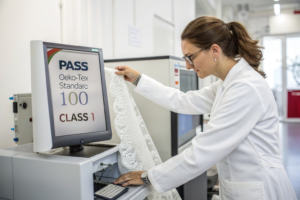
- Compliance Certificates for Inputs: Request OEKO-TEX Standard 100 or GOTS certificates for the dyes and chemicals used, and evidence for the certification status of threads/trims. This shows attention to the entire production ecosystem.
- Social Audit Reports (Optional but Recommended): While not part of OCS, factories that invest in SMETA or BSCI audits generally have stronger management systems, which correlate with better quality control for your custom order.
How to assess a factory's true custom production capability?
Certification is one thing; executing your specific vision is another. You need to assess their custom craft. Here’s how:
- Request Physical “Blank” Samples: Ask for swatches of their in-stock OCS-certified fabrics (e.g., 200gsm jersey, 300gsm fleece). Feel the quality, check the consistency. This is the canvas for your logo.
- Ask for a Capability Portfolio: Demand photos/videos of previous custom work—close-ups of embroidery on similar fabrics, prints, labels, and packaging. Look for precision and finish.
- Probe Their Development Process: Ask specific questions: “What is your process for creating an embroidery logo file from our vector art?” “How do you manage color matching for prints on organic cotton?” “Can we have a pre-production sample (PP sample) with all decorations before bulk?” Their answers reveal depth of experience.
- Visit or Do a Virtual Audit: If possible, visit. If not, insist on a live video walkthrough of the factory floor, focusing on the cutting, sewing, and decoration sections. Look for organization, cleanliness, and the quality of work-in-progress.
We once had a client from Australia in late 2023 who was sourcing custom OCS-certified baby bodysuits. They shortlisted three suppliers. Two sent glossy brochures. We sent them a dossier containing our OCS certificate, TC samples, swatches of five different certified interlock fabrics, a video of our embroidery machines running, and a breakdown of our PP sample procedure. They chose us not on price, but on demonstrated capability and transparency. Their order of 5,000 pieces shipped with zero quality disputes.
Navigating the Production Process: From Logo to Lab-Tested Shipment
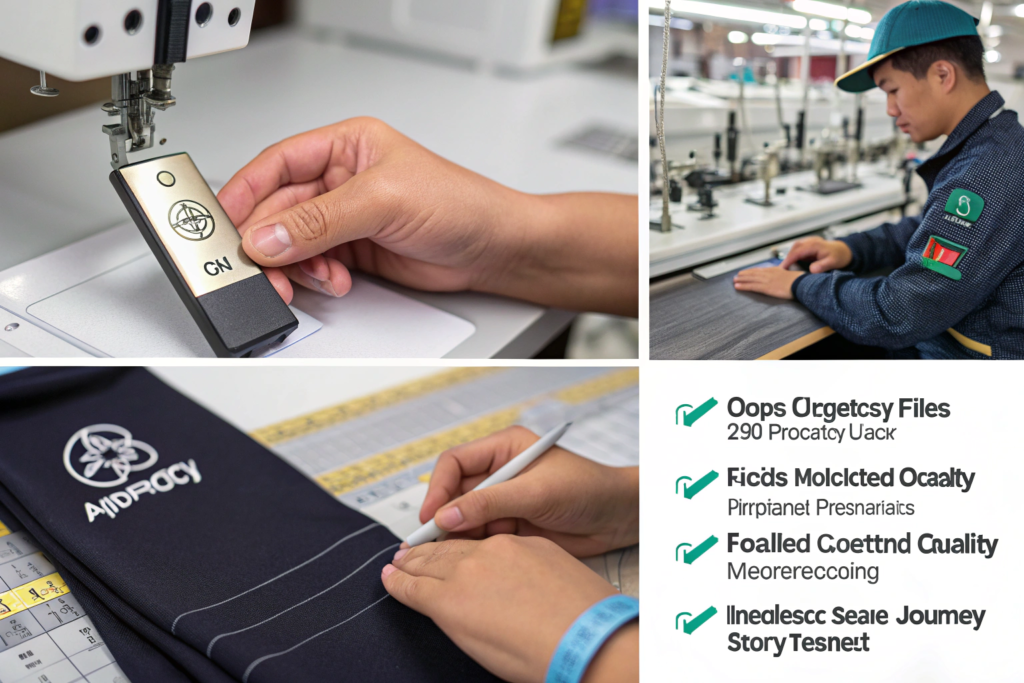
This is where planning meets execution. A successful custom OCS order is a symphony of coordinated steps, where your design files, the certified materials, and the factory’s schedule must align perfectly. The biggest mistake is treating this like a standard order. You need a project management mindset, with clear milestones and checks at every stage. The factory should act as your guide, but you must be an informed participant.
Think of it in three core stages: Pre-Production (where everything is decided), Production (where everything is made), and Verification (where everything is confirmed). A breakdown in any stage can delay your shipment or compromise certification.
What are the critical steps in the pre-production phase?
This phase sets the foundation. Rushing it guarantees problems.
- Tech Pack & Artwork Finalization: Provide a detailed tech pack. For your logo artwork, supply vector files (AI, EPS). Discuss decoration technique: embroidery (thread type, stitch density), printing (DTG, screen print), or woven labels. Get written confirmation on the technique and its compliance.
- Fabric Lockdown & Testing: Confirm the exact OCS-certified fabric to be used (supplier, composition, weight). The factory should provide a fabric test report (for shrinkage, colorfastness) from an accredited lab like our in-house CNAS lab. Approve this.
- Proto Sample & PP Sample: First, a proto sample in a similar fabric to check fit and design. Once approved, a Pre-Production (PP) Sample must be made using the actual OCS fabric and actual decoration method. This sample is your binding quality standard. Approve it physically, noting any adjustments.
- Lead Time & Payment Schedule Agreement: Build in buffer time. Agree on a clear schedule for deposit, progress payment, and balance. Confirm the production timeline accounts for fabric procurement, sampling, bulk production, and independent inspection.
How is quality control integrated during bulk production?
QC isn’t a final inspection; it’s a continuous process. For custom logo wear, it’s hyper-focused on consistency.
- In-Line QC: The factory should have checkers on the sewing line and at the decoration station. They are looking for stitching defects, logo placement accuracy, and embroidery/print quality in real-time. Ask for photos or videos during this phase.
- Mid-Production Inspection (DUPRO): When 20-30% of the order is completed, an inspector (yours or a third-party) should visit to check pieces from multiple lines. This catches systemic issues early—like a misaligned embroidery hoop or inconsistent print color—before the entire batch is wrong.
- Final Random Inspection (FRI): Once 100% is packed, an AQL (Acceptable Quality Level) inspection is performed on a random sample of cartons. This checks for workmanship, labeling, packaging, and, crucially, compares the final goods to your approved PP sample. This is non-negotiable. We integrate this seamlessly for our clients; our professional QC team treats every order as if it were our own brand.
A key moment is checking the logo application. Is every logo centered? Is the thread color correct? Is the backing clean? For a Swiss corporate client in early 2024 ordering custom OCS polo shirts, we implemented a 100% logo check before packaging. While it added a small cost, it ensured zero defects reached the client, protecting their high-end brand image. Their feedback was simple: “The logos were perfect on every single shirt.”
Managing Logistics, Costs, and Building a Long-Term Partnership
Getting the perfect garments off the production line is only half the battle. Getting them to your door, on budget, and ready for the next order is where strategic sourcing proves its worth. This phase is about optimizing the total cost of ownership, not just chasing the lowest FOB price. It’s where a true partner adds immense value, navigating the complexities of certified goods logistics and helping you plan for the future.
Remember, your goal shouldn’t be a one-time transaction. It should be to build a supplier relationship that gets better, faster, and more efficient with each order. This is how you achieve true scalability and brand consistency.

How to accurately calculate the total landed cost?
The FOB price is just the start. For OCS custom wear, your true cost includes several often-overlooked items:
| Cost Component | Description | Why It's Important for OCS Orders |
|---|---|---|
| Fabric Premium | Extra cost of OCS vs. conventional fabric. | Core cost driver. Understand this breakdown. |
| Testing & Certification Fees | Cost for fabric tests, garment tests, and the Transaction Certificate (TC). | Essential for compliance. Not optional. |
| Decoration Setup | Cost for creating embroidery digitization or print screens. | One-time cost per logo design. |
| Sampling Cost | Cost for proto and PP samples. | Vital investment to avoid bulk mistakes. |
| QC Inspection Fee | Cost for DUPRO or FRI by a third-party. | Risk mitigation. Highly recommended. |
| Shipping & Logistics | Sea/air freight, customs clearance, duties (like U.S. tariffs). | Organic content does not affect tariff rates. |
| Insurance | Covers goods in transit. | Protect your investment. |
Pro Tip: Always ask for an itemized quotation. A good partner like Shanghai Fumao will provide this transparency. For instance, we helped a Los Angeles-based streetwear brand in 2023 model their landed cost for custom hoodies. By showing them how our integrated supply chain reduced intermediate markups and shipping handoffs, we delivered a 12% lower total landed cost than their previous fragmented sourcing model, even with the OCS premium.
What are the best practices for long-term supplier collaboration?
Turn your supplier into an extension of your team.
- Share Your Vision: Don’t just send PO#234. Explain your brand, your target customer, your growth plans. This helps them anticipate your needs.
- Be a Good Client: Pay on time, provide clear artwork and instructions, and consolidate feedback. Efficiency is a two-way street.
- Plan Seasonally Together: After a successful order, discuss your next season’s needs. Early engagement allows them to reserve fabric capacity and plan production slots, especially around peak periods. This is how you avoid the 2-week timeline additions during March-May or August-October.
- Invest in Continuous Improvement: Share customer feedback from your market. Ask for their input on new fabric innovations or more efficient decoration techniques. Explore strategies for reducing lead times in apparel sourcing from Asia together. This collaborative approach builds mutual loyalty.
Conclusion
Sourcing OCS-certified custom logo wear from China is a detailed, disciplined process, but it is far from an impossible one. It shifts the paradigm from finding the cheapest maker to partnering with the most capable, transparent, and compliant producer. The reward is a product that carries not just your logo, but the weight of verified responsibility—a powerful combination in today’s market. You gain control over quality, solidify your brand’s integrity, and build a supply chain asset that fuels growth.
The journey begins with choosing a partner who sees beyond the single order. At Shanghai Fumao, we’ve built our business on this very principle. From our own weaving of certified fabrics to our controlled decoration and inspection processes, we provide the end-to-end reliability that custom brands need. If you’re ready to move from uncertain sourcing to confident partnership, let’s discuss your specific custom wear project. Reach out to our Business Director, Elaine, who specializes in guiding brands through this exact process. Start the conversation at elaine@fumaoclothing.com. Let’s create something exceptional, together.