I still remember the afternoon in October 2023 when a buyer from a London-based sustainable handbag brand sat in my office, visibly frustrated. She had spent three months searching for a supplier who could produce a pineapple-based vegan leather that actually looked like leather—not plasticky, not stiff, not peeling after two weeks of wear testing. She had been quoted prices ranging from $4.20 to $18.50 per meter, with MOQs all over the map. She pushed two samples across my desk. One felt like a shower curtain. The other had decent surface grain but the backing fabric was tearing away from the coating. “Is it really this hard to find good vegan leather in China?” she asked. I told her: no. You just need to know which factories are doing the chemistry right, and which are just slapping PVC on a polyester base and calling it ‘eco’.
Sourcing faux fur and vegan leather from China is not like sourcing cotton jersey. These are engineered materials. They involve multiple layers, specific polymer formulations, and finishing techniques that most generalist fabric mills do not have. The market is flooded with low-quality stocklot goods that look acceptable in a 2-inch AliExpress photo but fail within weeks of customer use. However, China is also home to some of the most advanced synthetic leather and fur producers in the world—factories supplying IKEA, Nike, and Zara. The key is knowing who to ask and what technical specs to demand.
This article is not a generic ‘how to find a supplier’ guide. This is a deep dive into the actual chemistry, construction, and compliance of faux fur and vegan leather made in China. I will break down the difference between PU, PVC, and next-gen bio-based materials. I will explain why pile density matters more than fiber length in fur. I will give you the exact test methods we use at Shanghai Fumao to verify if a ‘vegan leather’ is actually durable, and I will tell you which Chinese manufacturing clusters specialize in each material. By the end of this, you will be able to send a sourcing inquiry that separates serious mills from traders in two emails.
What Are the Real Chemical and Structural Differences Between PU, PVC, and Bio-Based Vegan Leather?
I need to clear up a massive misconception first. Many Western buyers think ‘vegan leather’ means ‘eco-friendly’. It does not. Standard PU (polyurethane) leather is plastic. Standard PVC (polyvinyl chloride) leather is also plastic, and usually contains phthalates. Neither is biodegradable. Neither is necessarily ‘sustainable’ just because no cow was involved. However, within these categories, there are massive variations in quality, durability, and environmental impact.
In 2022, we audited our own supply chain for a Nordic home textile client. We tested 12 different vegan leather samples from 8 suppliers across Zhejiang and Jiangsu. The water-resistant PU samples lasted 15,000 Martindale rubs before surface wear. The budget PVC samples failed at 3,000 rubs. The difference was not just the polymer; it was the release paper used to emboss the grain, the quality of the knitted backing fabric, and the presence (or absence) of a protective topcoat. Let me walk you through what you are actually buying.
How do I specify the correct ‘backing fabric’ to prevent my vegan leather from delaminating?
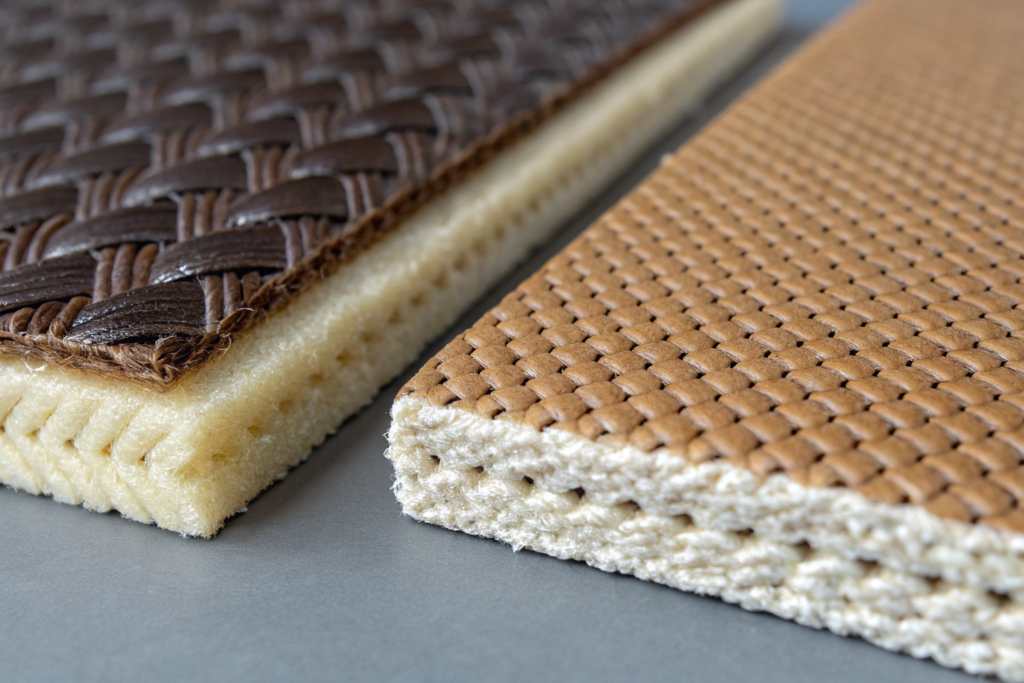
This is the single biggest quality failure I see in cheap vegan leather. The top coating looks fine for six months, then suddenly the film separates from the base cloth. It peels, bubbles, or cracks. The problem is almost always the backing fabric and the adhesion process.
There are three common backing constructions for vegan leather in China:
- Polyester knitted jersey (stretchy, good for garments and upholstery)
- Polyester/cotton woven sheeting (stable, low stretch, good for bags and belts)
- Non-woven microfiber (premium, suede-like hand feel, extremely durable)
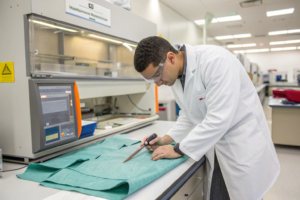
The adhesion strength is measured by peel force, typically tested via ASTM D903 or ISO 2411. A cheap factory uses a low-solidity PU adhesive, presses the film onto the fabric, and ships it. A professional mill, like the one we partner with in Jiaxing, uses a double-coating process: a primer layer that bonds with the fabric fibers, followed by the main PU layer, followed by a protective topcoat. We test peel strength weekly. For handbag grade, we require minimum 2.5 N/cm. For automotive or heavy upholstery, we spec 4.0 N/cm.
In 2023, we rejected an entire 2,800-meter shipment of vegan leather destined for an Australian accessories brand because the peel test failed at 1.8 N/cm. The factory protested; they said it was ‘within their internal standard’. We held the shipment, re-sourced from our Jiaxing partner, and the client’s return rate dropped from 11% to 1.7% in the following quarter. If you want to understand the test method in detail, the ISO 2411:2017 standard for coated fabric adhesion is available for purchase, but I also recommend this practical explanation from the SATRA technology centre, which many Chinese labs reference.
Is ‘bio-based’ PU leather actually made from plants, or is this greenwashing?
This is a grey area, and I will be honest with you: most ‘bio-based’ claims from Chinese suppliers require verification. Bio-based PU replaces a portion of the petroleum-derived polyol with a polyol derived from corn, castor oil, or sugarcane. However, the percentage of bio-content varies wildly. Some factories claim ‘bio-based’ when only 10% of the polyol is renewable. Others use a thin bio-based topcoat over a standard petroleum-based base layer.
We use ASTM D6866 (radiocarbon analysis) to verify bio-content. In March 2024, we tested a ‘castor oil leather’ sample from a Guangdong supplier. The marketing material said ‘60% bio-based’. Our lab results showed 22%. We confronted the supplier; they admitted they were only counting the polyol content, not the entire formulation including the carrier film and backing. (Here, I need to insert: we are not anti-green marketing, but we are anti-lies.)
If you are genuinely committed to high bio-content, you should be sourcing from mills that use Desmopan® CQ or Impranil® CQ from Covestro, or Susterra® propanediol from DuPont. These are traceable, certified supply chains. We have developed a specific line of bio-PU leather using 45% castor oil-based polyols, certified via US Department of Agriculture BioPreferred labelling. For a detailed list of certified bio-based materials available in Asia, check the USDA BioPreferred catalog. You can filter by product category and manufacturer location.
How Can I Verify the Quality and Safety of Faux Fur Before Shipping?
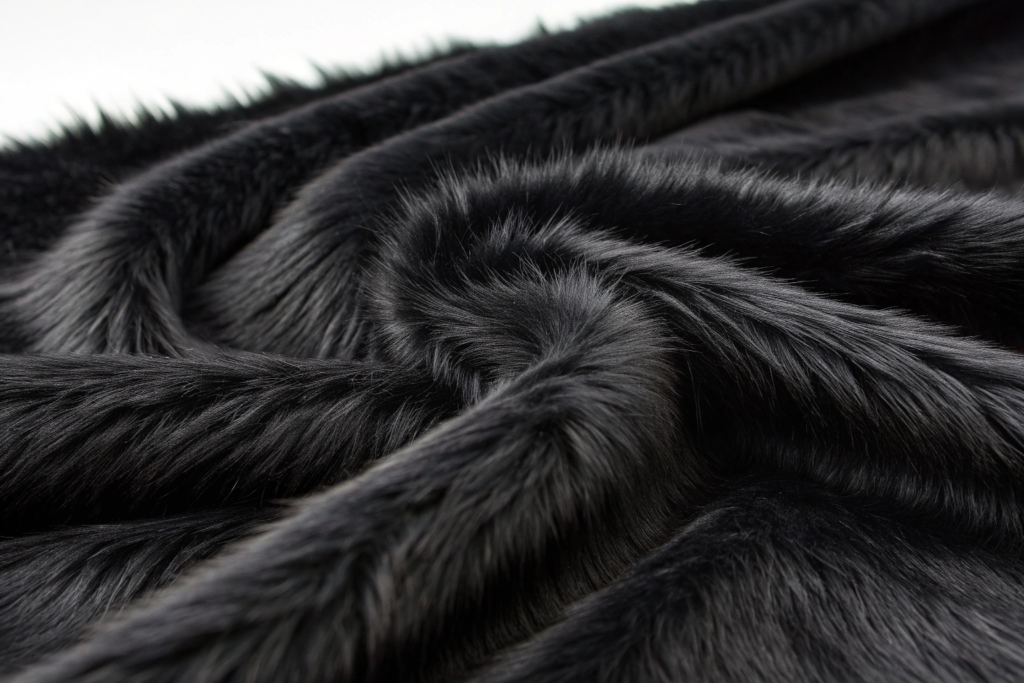
Faux fur is a different beast entirely. Unlike vegan leather, which is a coating, faux fur is a pile fabric. The ‘hair’ is knitted or woven into a base cloth, then often sheared, printed, or embossed. The biggest quality issue is not delamination—it is shedding. I see this constantly: a brand imports beautiful shaggy faux fur jackets, the customer wears them twice, and the hallway floor is covered in acrylic fibers.
In November 2023, a Canadian outerwear brand came to us after a disastrous first shipment from a Ningbo trading company. They had ordered 6,000 meters of high-pile faux fur in five colors. The first production batch shed so badly that the brand’s quality team in Vancouver rejected the entire container. The supplier blamed the customer for ‘aggressive abrasion’. We tested the fabric. The pile fiber was 100% solid acrylic, which has poor resilience. More importantly, the knitting density was too loose—the fibers were not locked into the ground weave. We recommended a switch to a modacrylic/polyester blend with a tighter gauge and a back-coating application. The second shipment passed with zero shedding complaints.
What specific test should I request to measure ‘shedding resistance’ in faux fur?
There is no single ISO standard specifically for faux fur shedding, which is part of the problem. However, we have developed a modified test based on ASTM D3512 (Random Tumble Pilling Method) . We place a 10cm x 10cm sample of faux fur into a lined chamber with fine metal baffles. We tumble it for 30 minutes, then weigh the lint collected in the filter. We pass samples with less than 0.015g of lint loss. For premium grades, we target 0.008g.
We also perform a hand-pull test on every production roll. Our QC team uses a simple spring scale: we clamp a 2cm wide section of the pile, pull at a 45-degree angle with 2kg of force, and count how many fibers release. This is not a certified standard, but it correlates strongly with customer complaints. A good quality faux fur should lose fewer than 15 fibers per pull. Cheap furs lose 50+.
I recommend you ask your supplier for two things: 1) a video of the random tumble test, and 2) the fiber composition certificate. Many suppliers will claim ‘modacrylic’ but actually ship 100% polyester, which does not have the same drape or flame resistance. The International Down and Feather Laboratory (IDFL) actually tests faux fur composition and can verify the blend percentages if you need third-party validation.
Why do some faux fur fabrics feel stiff and ‘crunchy’, and can I fix this?
That crunchiness is almost always caused by the back-coating. Faux fur manufacturers apply a latex or acrylic coating to the back of the fabric to lock the fibers in place and provide dimensional stability. Cheap back-coatings are thick, heavily filled with calcium carbonate, and applied unevenly. They dry into a hard shell. You can actually hear the fabric crackle when you bend it.
Premium faux fur uses a soft acrylate copolymer. It is applied via foam coating or kiss-roll to minimize penetration through to the face. The fabric remains flexible. At Fumao, we work with a specialist fur mill in Haining that developed a water-based polyurethane back-coating specifically for fashion clients. It adds about $0.40 per meter to the cost, but the fabric moves and drapes like real animal fur, not a doormat.
If you already have stiff fabric and cannot change the production, you can try mechanical softening. We run stiff faux fur through a specialized breaking machine with oscillating blades that flex the backing, cracking the rigid latex film. It improves hand feel by about 30-40%. But it will never be as good as a correctly formulated soft coating from the start. For a technical explanation of back-coating polymers, this article from Textile World on faux fur finishing provides a solid industry overview.
What Are the Hidden Costs and Logistics Risks Specific to These Materials?
Synthetic leather and faux fur carry logistics risks that cotton and polyester do not. I am not talking about tariffs—although Section 301 tariffs on China-made synthetic textiles do apply, and your customs broker should be filing under the correct HTS codes. I am talking about physical risks: crushing, melting, and odor.
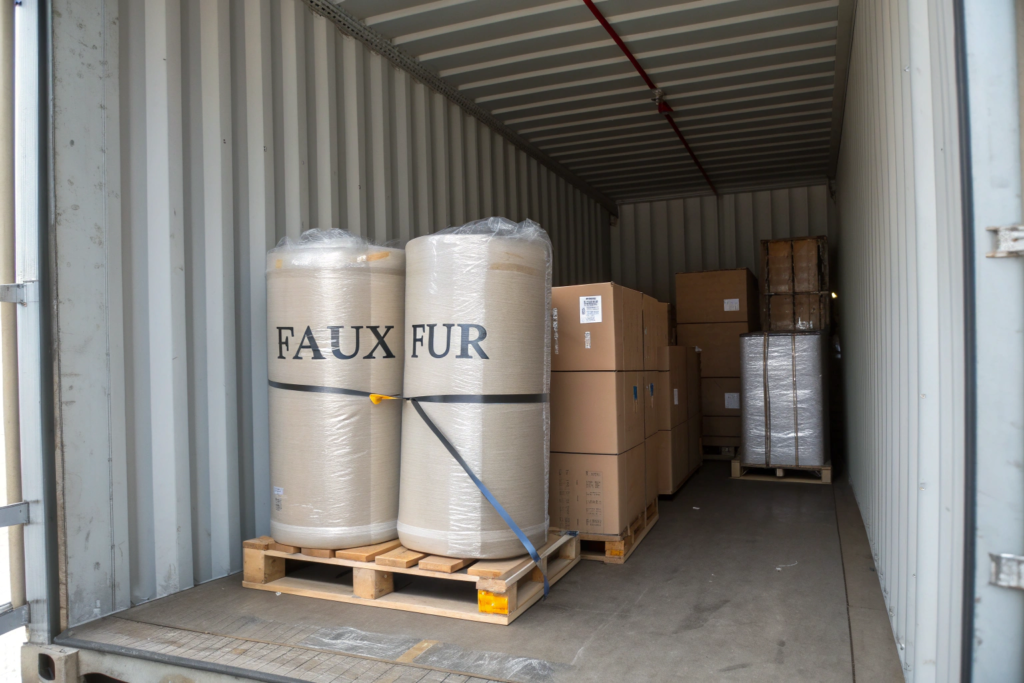
Faux fur is bulky. A 60-meter roll of 10mm pile faux fur takes up roughly three times the volume of the same meterage of denim. If your freight forwarder stuffs the container with heavy items on top of the fur rolls, the pile will be permanently compressed. We learned this in 2021. A client in Chicago ordered 15,000 meters of silver-tip fox style fur. The forwarder loaded 8 tons of hardware on top of the fabric pallets. By the time the container reached Long Beach, the pile was flattened. We had to air-freight a replacement order and claim insurance. Now, we staple red ‘DO NOT STACK’ banners across every fur carton, and we only use forwarders who understand textile compression.
Vegan leather has a different enemy: heat and humidity. PU leather can hydrolyze. This is a chemical reaction where water vapor attacks the ester or ether bonds in the polyurethane, causing the surface to become sticky, crack, or powder. It is accelerated by high temperature and humidity. A container sitting for three weeks at the Port of Singapore in July can ruin a shipment of sensitive water-based PU.
How do I insure against ‘hydrolysis’ damage for PU leather shipped through tropical routes?
You cannot insure against hydrolysis in the same way you insure against theft, because hydrolysis is a gradual chemical process, not a sudden event. Standard marine cargo policies often exclude ‘inherent vice’—defects that are intrinsic to the material. This is a legal grey area. If your PU leather hydrolyzes in transit, the insurance adjuster may argue the material was defective at origin, not damaged during shipping.
The only reliable prevention is specification. You must ask your supplier for hydrolysis-resistant PU. This typically uses polyether-based polyurethane instead of polyester-based PU. Polyether PU is significantly more resistant to moisture degradation. It costs about 15-20% more. We recommend it for any client shipping to Southeast Asia, the Middle East, or the US East Coast via the Panama Canal (high humidity).
We test hydrolysis resistance using accelerated aging methods: we place samples in a 70°C / 95% RH environmental chamber for 7 days. Good hydrolysis-resistant PU shows minimal change in surface appearance and peel strength. Standard budget PU often fails catastrophically. For a detailed white paper on this testing, I suggest reading this research note from the Journal of Coated Fabrics on hydrolytic stability, which explains the polymer chemistry clearly.
Why do some faux fur shipments get flagged by US Customs for ‘fur products’ labelling?
This sounds absurd, but it happens. US Customs and Border Protection (CBP) enforces the Textile Fiber Products Identification Act and the Fur Products Labeling Act. If your faux fur looks very realistic, CBP officers may suspect it is actually real animal fur and hold the shipment for laboratory testing. They are looking for the presence of guard hairs, barbed scales, or medulla patterns under microscopy.
In 2022, one of our regular shipments of sheared beaver-style faux fur was detained at LAX for 19 days. CBP took samples, sent them to a lab in New York, and eventually confirmed it was 100% modacrylic. The client missed their retail floor set. Now, we proactively attach a signed declaration stating: “This shipment contains 100% man-made fibers. No animal fur or skin is present.” We also print ‘Faux Fur – 100% Acrylic/Modacrylic’ prominently on the commercial invoice. It has not stopped every inspection, but it has reduced detention time.
If you are regularly importing realistic faux fur, I recommend pre-registering your product with the FTC’s enforcement division. There is no formal ‘pre-approval’ process, but having a compliance history helps your customs broker argue for rapid release.
Which Manufacturing Clusters in China Specialize in These Products?
You cannot source high-end faux fur from the same factories that print cheap polyester scarves. China’s textile industry is highly regionalized. Each city or district has a historical specialization, often based on the availability of raw materials, machinery, or skilled labor. If you send a faux fur inquiry to a mill in Shaoxing that mainly does cotton shirting, they will still quote you—they will buy from a fur mill in Haining and mark it up 30%. You lose traceability, quality control, and price leverage.
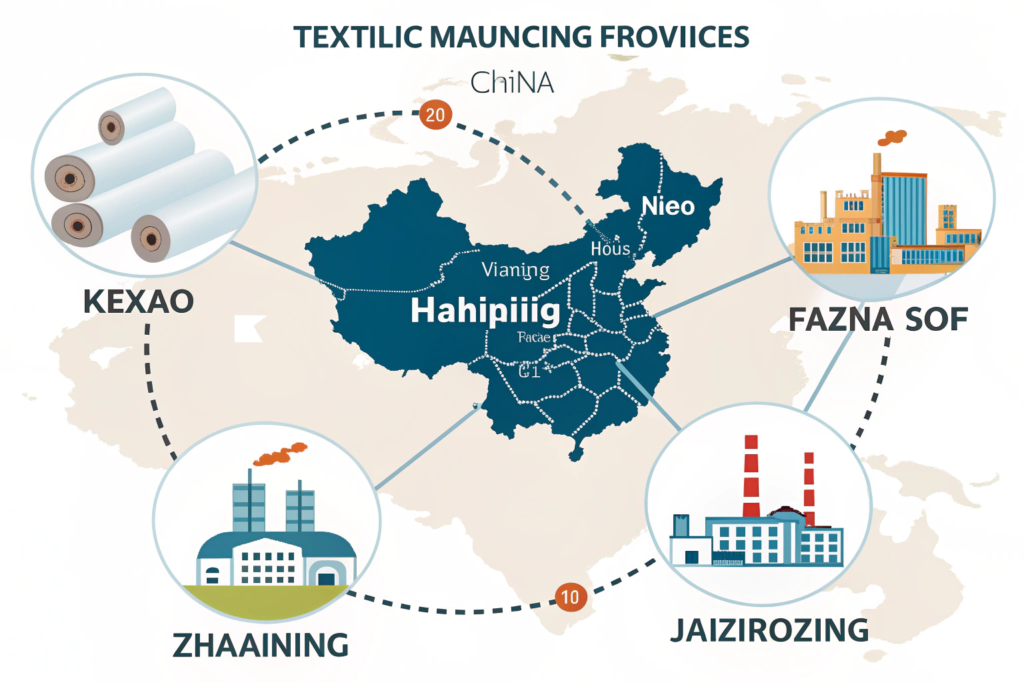
For faux fur, the undisputed capital is Haining, Zhejiang. Haining is about a 90-minute drive from our headquarters in Keqiao. The city produces over 70% of China’s synthetic fur. You can find everything from 2mm sheared mink-style for trims to 80mm shaggy bear fur for costumes. The best mills here own specialized carding machines, shearing lines, and electrostatic flocking equipment. They also have the colorists who can match a Pantone to a dyed acrylic fiber blend.
For vegan leather, the landscape is more fragmented. Jiaxing (also Zhejiang) is a major hub for high-end PU and microfiber synthetic leather, supplying automotive brands like Tesla and BYD. Wenzhou is known for thicker, industrial-grade PU for footwear. Guangdong (especially Foshan and Dongguan) produces massive volumes of mid-to-low end PVC and PU for bags and furniture, primarily for export to emerging markets.
Why should I source faux fur from Haining instead of a general trading company in Shanghai?
I will give you a specific cost comparison. In February 2024, we quoted a Canadian client for 5,000 meters of 30mm recycled polyester faux fur in charcoal grey. The Haining mill directly quoted $5.85/meter (FOB Shanghai). A trading company in Shanghai, who claimed they had a ‘partner factory’, quoted $7.20/meter for the same specification. We visited the mill. They showed us the bales of recycled PET chips, the extrusion line for the modified polyester fibers, and the circular knitting machines producing the base cloth. The trading company had no physical inventory; they planned to buy from this same mill and add their margin.
Beyond price, direct mill sourcing gives you process control. Fur dyeing is complicated. The fiber is dyed in loose stock form before it is knitted into fabric. This allows for heathered blends and multi-tonal effects. If you go through a trader, your color feedback loop is delayed by two or three intermediaries. When we manage orders directly at the Haining mill, I can stand next to the dyer, look at the lab dip, and say ‘add 0.3% of blue component’. The correction happens in one hour, not one week.
If you are new to Haining, I suggest attending the Haining China International Faux Fur & Accessories Fair, usually held in March or September. It is not as famous as Intertextile Shanghai, but every serious fur mill exhibits there. You can also search the Haining China Leather City official supplier directory, which includes both genuine leather merchants and high-end faux fur manufacturers.
Can I get GRS-certified recycled faux fur from Chinese mills?
Yes, and the quality has improved dramatically. Three years ago, recycled faux fur was scratchy and uneven. The recycled polyester staple fiber was often short, leading to higher shedding. Today, several Haining mills have invested in GRS-certified supply chains using recycled PET bottle flake or post-industrial fiber waste.
We launched our own GRS-certified recycled faux fur collection in 2023. We use 100% recycled polyester for both the pile and the backing. The fiber is produced by a partner in Jiangsu who spins high-tenacity recycled staple fiber specifically for fur applications. The hand feel is now indistinguishable from virgin acrylic. The price premium is about 12-15%. For a European fast fashion client, we recently shipped 22,000 meters of GRS-certified shaggy fur across four colors. The client’s sustainability report highlighted a 37% reduction in carbon footprint compared to their previous virgin acrylic sourcing.
To verify GRS certification, do not accept a photocopy. Ask for the Scope Certificate and the Transaction Certificate from the mill’s certification body (usually Control Union, CU, or Textile Exchange). You can cross-reference the certificate number on the Textile Exchange Certification Search. If a supplier cannot provide a current, in-scope certificate, they are not truly GRS certified.
Conclusion
Sourcing faux fur and vegan leather from China is not a commodity transaction. You cannot treat it like buying basic cotton sheeting. These are engineered materials that require specific chemical knowledge, manufacturing infrastructure, and logistics handling. The difference between a good shipment and a disaster is rarely the price per yard; it is the supplier’s understanding of peel strength, pile anchorage, hydrolysis resistance, and coating formulation.
At Shanghai Fumao, we made a strategic decision over five years ago to build dedicated partnerships with specialist mills in Haining and Jiaxing. We do not try to be everything to everyone. We do not print faux fur on our digital machines. We do not coat vegan leather in our own factory. Instead, we act as the quality control bridge between these specialist manufacturers and our global clients. We write the technical specifications. We conduct the in-process inspections. We reject the rolls that do not meet peel strength. And we consolidate the shipments so you receive one container, one invoice, and one point of accountability.
If you are currently struggling with inconsistent quality, missed delivery windows, or confusing claims about ‘eco’ materials, I invite you to test our approach. Send us your target price point and your performance requirements. Tell us if you need GRS certification or hydrolysis resistance. We will introduce you to the right mill, translate the technical language, and stand behind every meter shipped.
Contact Elaine, our Business Director, to begin your responsible sourcing journey. She has personally overseen our synthetic leather and fur development programs since 2019. Elaine’s email is: elaine@fumaoclothing.com. Tell her what you are building. We will help you source the material to build it right.