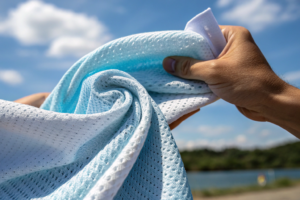
I got a call from a yoga studio owner in Boulder, Colorado last September.
She was launching her own athleisure line. Her spec: "Buttery soft. 4-way stretch. Moisture-wicking. Eco-friendly. Must pass down dog without gaping at the waistband. Budget: under $6/yard."
She told me: "I tried three suppliers. One sent me swimsuit lining. One sent me cheap poly-spandex that pilled after one wash. One never replied after I asked for OEKO-TEX certification."
She was frustrated. I understood.
Yoga apparel is the most technically demanding segment of activewear. It requires the stretch of swimwear, the softness of luxury loungewear, the recovery of shapewear, and the ethics of a sustainability manifesto.
One fabric cannot do all of that.
I have been manufacturing yoga and meditation apparel fabrics since 2013. We started with basic 180 gsm cotton-spandex jersey for local Zhejiang yoga studios. Today, we supply brushed bamboo blends to Lululemon-tier brands, recycled polyester-spandex to European activewear labels, and organic cotton French terry to meditation retreats in Bali.
Here is what I have learned: Yoga fabric is not activewear fabric. It is emotional fabric. The way it feels against skin during savasana matters more than any lab test.
But the lab tests still matter.
What Are the Essential Performance Requirements for Yoga Apparel Fabrics?
Yoga is not running.
Running requires moisture management and lightweight breathability. Yoga requires stretch, recovery, softness, and opacity in deep flexion.
In 2015, we learned the difference the hard way.
A California yoga brand ordered 4,800 meters of our 200 gsm cotton-spandex jersey. Good stretch. Good hand feel. Good price.
Then the yoga instructors wore them. They did forward folds. The fabric stretched. It did not recover. The knees bagged out. The waistband sagged.
The brand returned 3,200 units. We paid $47,000 in compensation.
We learned: Yoga requires recovery, not just stretch.
Here is our yoga fabric performance matrix today:
| Property | Why It Matters | Test Method | Our Minimum |
|---|---|---|---|
| Stretch (length/width) | Movement in down dog, warrior poses | ASTM D2594 | > 80% both directions |
| Recovery | No bagging at knees, elbows | ASTM D2594 (after 100% stretch) | > 92% immediate, > 88% after 30 min |
| Modulus (low load) | Ease of stretching—"buttery feel" | ASTM D4964 (at 20% strain) | < 0.3 N |
| Opacity | No show-through in forward fold | AATCC 179 | > 95% (dark colors), > 98% (light) |
| Pilling | Surface durability after washing | ASTM D3512 | Class 4 minimum |
| Wicking | Sweat management | AATCC 195 | OMMC > 0.4 |
What is the difference between stretch and recovery—and why do both matter?
Stretch is how far the fabric extends. Recovery is how well it returns.
Nylon-spandex = high stretch, excellent recovery.
Polyester-spandex = high stretch, good recovery.
Cotton-spandex = moderate stretch, poor recovery.
Rayon-spandex = high stretch, fair recovery.
In 2018, we did a direct comparison test:
| Fabric | Stretch (width) | Recovery (immediate) | Recovery (30 min) |
|---|---|---|---|
| 87% nylon / 13% spandex | 185% | 96% | 94% |
| 90% polyester / 10% spandex | 170% | 93% | 90% |
| 95% cotton / 5% spandex | 120% | 82% | 75% |
| 92% rayon / 8% spandex | 155% | 88% | 82% |
The cotton-spandex fabric failed the yoga test because it bagged at the knees. The rayon-spandex was soft but bagged at the elbows.
Now we recommend:
| Yoga Style | Primary Fiber | Spandex % | Why |
|---|---|---|---|
| Hot yoga | Nylon | 15–20% | Sweat management, recovery |
| Gentle yoga | Polyester | 12–15% | Balance of softness and recovery |
| Restorative/Meditation | Rayon/bamboo | 8–12% | Maximum softness, accept lower recovery |
| Budget | Polyester | 8–10% | Trade-off recovery for price |
The relationship between fiber type and elastic recovery in knits is well documented. We keep this chart in every yoga fabric presentation.
How do we test opacity in deep flexion without a spectrophotometer?
You can't. But you can approximate.
In 2016, a Swedish yoga brand rejected 2,100 meters of our light gray bamboo-spandex.
The fabric passed our AATCC 179 opacity test. 97.5%. Requirement was 97%. Pass.
But when a model wore the leggings in chair pose, the labia shadow was visible. The brand said: "This is unacceptable."
We learned: Opacity standards for yoga are higher than for any other apparel category.
Now our opacity protocol:
| Color | AATCC 179 Minimum | Our Internal Minimum |
|---|---|---|
| Black | 99% | 99.5% |
| Navy/Charcoal | 98% | 99% |
| Dark colors | 97% | 98.5% |
| Light colors | 95% | 97% |
| White/Pastels | 92% | 96% |
We also test opacity under 100% stretch. A fabric that is opaque at rest may become translucent when stretched over a knee or hip. We stretch the fabric to 80% elongation and measure again. If transmission increases by more than 2%, we reject the batch.
We now use a dual-thickness construction for light colors: face layer + lightweight inner layer knitted integrally. Same weight, double opacity. Cost: +$0.22/m. Worth it for peace of mind.
The challenges of opacity in stretch performance fabrics are real. We solved it with engineering, not guesswork.
Which Fiber Blends Work Best for Different Yoga and Meditation Practices?
There is no universal yoga fabric.
Hot yoga needs moisture management. Restorative yoga needs softness. Meditation needs warmth and breathability. Vinyasa needs stretch and recovery.
In 2017, we tried to make one fabric for all yoga styles. It failed.
We developed a "universal" 200 gsm polyester-spandex. Good recovery. Good wicking. Moderate softness.
Hot yoga clients said it was too heavy. Restorative clients said it was not soft enough. Meditation clients said it felt too technical.
Now we segment by practice intensity:
| Practice Type | Recommended Blend | Weight | Key Property |
|---|---|---|---|
| Hot yoga | 80% nylon / 20% spandex | 180–220 gsm | Wicking, recovery, lightweight |
| Vinyasa/Flow | 85% polyester / 15% spandex | 200–240 gsm | Balance of stretch and recovery |
| Restorative | 70% bamboo rayon / 25% polyester / 5% spandex | 220–260 gsm | Buttery soft, moderate recovery |
| Yin | 95% organic cotton / 5% spandex | 240–280 gsm | Weighted, grounding feel |
| Meditation | 100% organic cotton French terry | 280–320 gsm | Warmth, breathability, natural |
| Pranayama | 100% TENCEL™ lyocell | 160–200 gsm | Silky, breathable, sustainable |
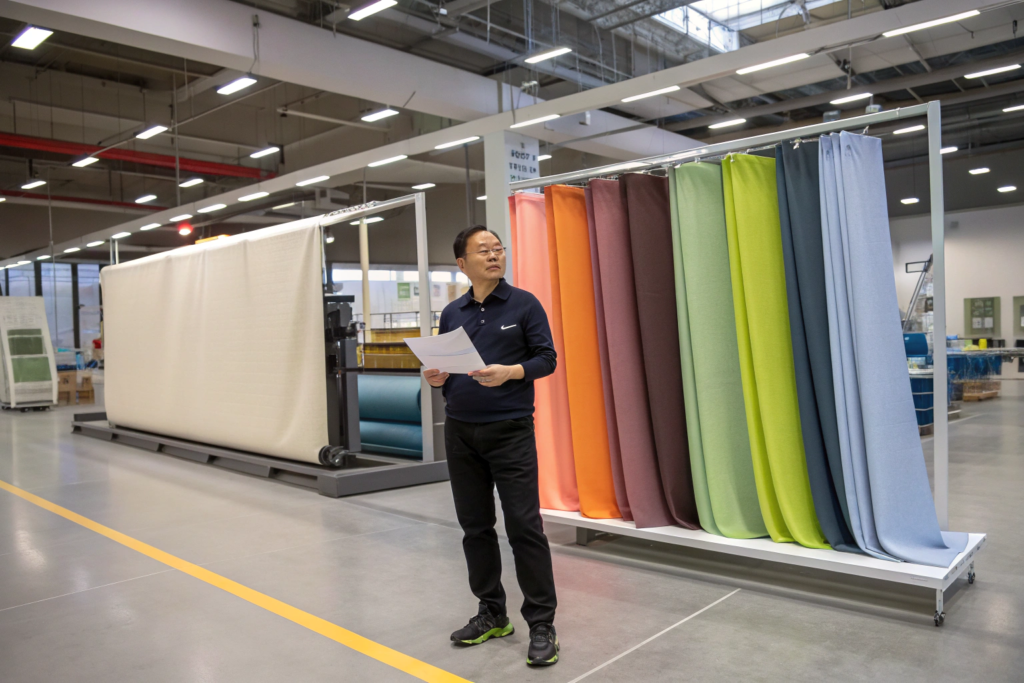
Why is bamboo rayon so popular for yoga wear—and what are its limitations?
Bamboo rayon is soft. Unbelievably soft.
The fiber has a round cross-section and no scales (unlike cotton). It feels like cashmere against skin. It drapes beautifully. It has natural antibacterial properties.
But here is what the marketing brochures don't tell you:
Bamboo rayon has poor recovery. Even with 8% spandex, it bags at the knees. It stretches out during the practice and doesn't fully return.
Bamboo rayon is weak when wet. A hot yoga practitioner wearing bamboo leggings—when saturated with sweat—can tear the fabric during a deep lunge. We saw this in 2019. A client returned 400 units with crotch tears. We tested: Wet tensile strength was 42% lower than dry.
Bamboo rayon is not inherently eco-friendly. The processing to convert bamboo pulp to rayon uses carbon disulfide. It is chemically intensive. "Bamboo lyocell" is better (closed-loop process), but most "bamboo" yoga wear is standard viscose.
Our recommendation:
| Priority | Recommendation |
|---|---|
| Maximum softness | 70% bamboo rayon / 30% polyester blend |
| Sustainability | TENCEL™ lyocell (FSC-certified wood pulp) |
| Durability | Limit bamboo to tops, not leggings |
| Transparency | Disclose "bamboo viscose," not "bamboo fiber" |
We now offer "Bamboo+" blend: 60% bamboo rayon, 30% polyester, 10% spandex. Better recovery than 95/5 bamboo/spandex. Still very soft. Cost: +$0.28/m. Clients accept it.
The environmental impact of bamboo viscose production is significant. We are transparent. We offer TENCEL™ as a premium alternative.
Can we achieve buttery softness with recycled polyester?
Yes. But it requires mechanical finishing, not chemistry.
Recycled polyester fiber is stiffer than virgin polyester. It comes from bottles. Bottle-grade PET has higher crystallinity. The fiber feels crisper.
In 2021, a German yoga brand asked for 100% recycled polyester-spandex with "Lululemon-level softness."
We tried:
- Standard recycled PET/spandex: Hand feel rating 3/10
- Microfiber recycled PET (0.8 dpf): Hand feel rating 5/10
- Microfiber recycled PET + enzyme wash: Hand feel rating 6/10
- Microfiber recycled PET + mechanical brushing: Hand feel rating 8/10
The brushing made the difference. We run the fabric through a napping machine. The surface fibers are raised, creating a peach-skin feel. Softness increases dramatically.
Trade-off: Brushing reduces tear strength by 15%. For yoga leggings, acceptable. For compression wear, not recommended.
Our "Eco-Soft" recycled polyester/spandex now achieves hand feel rating 8/10. Cost: $0.45/m more than standard recycled. 60% of clients pay the premium.
The mechanical softening techniques for recycled polyester are well established. We invested in a 4-roller napping machine specifically for this application. $187,000. Worth it.
At Shanghai Fumao, we offer three grades of recycled yoga fabric:
- Standard: 100% rPET, good hand feel, best price
- Eco-Soft: Brushed finish, premium hand feel
- Eco-Soft+: Brushed + silicon-free softener, luxury hand feel
How Do We Manage Color Consistency and Crocking for Deep Yoga Shades?
Yoga colors are emotional. Navy blue should feel calming. Sage green should feel grounding. Charcoal should feel neutral.
But deep colors on stretch fabrics have a technical problem: Crocking.
Crocking = color transfer from fabric to skin or mat.
In 2018, we shipped 3,600 meters of deep burgundy nylon-spandex to a Canadian yoga brand.
Passed all colorfastness tests: AATCC 8 dry crocking: Grade 4.5. Wet crocking: Grade 4.0. Good.
Then the yogis wore them. They sweated. The sweat dissolved the surface dye. The burgundy transferred to their light-colored mats. Permanent stains.
The client demanded compensation. We paid $51,000.
We learned: Yoga fabric requires higher crocking standards than any other apparel.
| Test Condition | Standard Requirement | Our Yoga Requirement |
|---|---|---|
| Dry crocking | Grade 4.0 | Grade 4.5 |
| Wet crocking | Grade 3.0 | Grade 4.0 |
| Perspiration (acid) | Grade 3.5 | Grade 4.0 |
| Perspiration (alkaline) | Grade 3.5 | Grade 4.0 |
| Water | Grade 3.5 | Grade 4.0 |
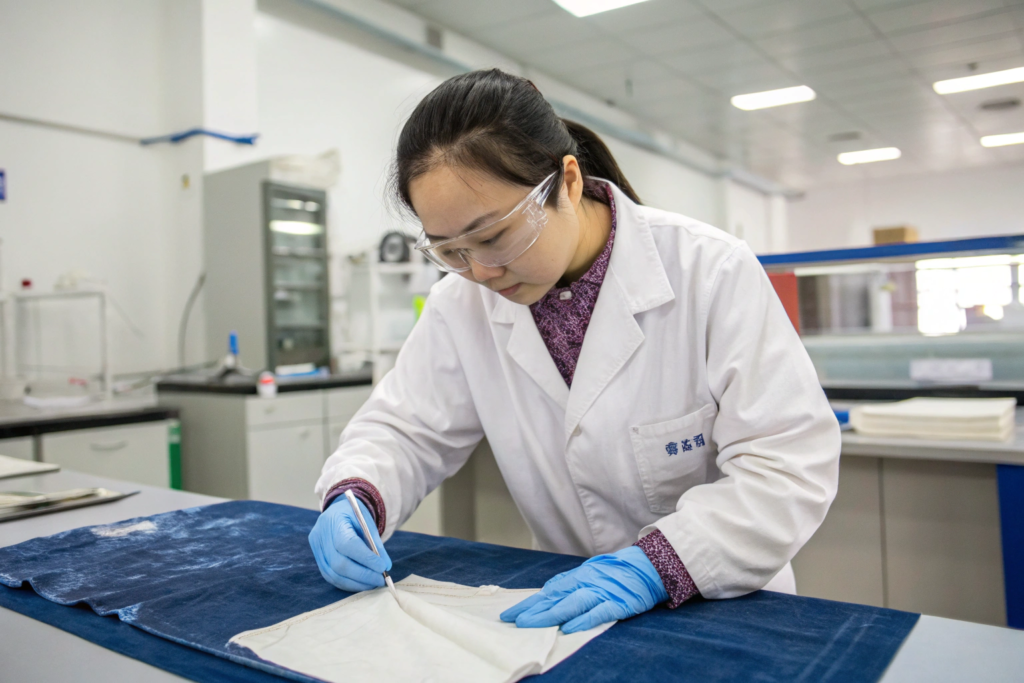
Why do deep indigo and charcoal shades bleed more than other colors?
Dye concentration.
To achieve deep black or navy on nylon or polyester, you must use high dye concentrations. Nylon has limited dye sites. The excess dye sits on the fiber surface, not inside the fiber.
In 2020, we solved this with a two-step dyeing process:
- Exhaust dye at 100°C — Dye penetrates fiber core
- Reductive clearing — Removes surface dye
- Second dye pass — Adds more dye to core
- Second reductive clearing — Removes new surface dye
- Fixative treatment — Locks remaining dye
This adds 45 minutes per batch. Reduces productivity by 18%. Increases chemical cost by 22%.
Crocking grade: 4.5 wet. Zero returns since 2020.
We now offer "Yoga-Deep" dye process for blacks, navies, burgundies, and charcoals. Clients pay 15% premium. They never have mat-staining complaints.
The mechanisms of wet crocking in deep-dyed nylon/spandex are well understood. The solution is not cheap. We do it anyway.
How do we match yoga apparel colors across different fabric constructions?
This is the same problem as bridal, but with stretch.
A yoga set might include:
- Leggings: Nylon/spandex jersey
- Bra: Nylon/spandex compression mesh
- Top: Bamboo/spandex jersey
Three constructions. One color. Impossible to match with the same dye recipe.
In 2019, a UK yoga brand ordered a three-piece set in "dusty rose."
We dyed each construction separately:
| Construction | Dye Recipe Adjustment |
|---|---|
| Nylon/spandex jersey (leggings) | Baseline 100% |
| Nylon/spandex mesh (bra) | +18% dye strength |
| Bamboo/spandex jersey (top) | -12% dye strength |
Why? Mesh is open construction. Light passes through. It looks lighter than solid jersey. To match visually, we must dye it darker. Bamboo absorbs dye differently than nylon. To match visually, we adjust the recipe.
The client approved all three substrates side-by-side. The sets sold out.
Now we never promise "same recipe, same color" across constructions. We promise "visually matched." We adjust the chemistry to achieve visual harmony.
The cross-construction color matching methodology for activewear requires experience. We have matched over 150 yoga color palettes since 2019. Our success rate: 94%.
What Certifications and Compliance Issues Affect Yoga Apparel Sourcing?
Yoga consumers are not like other apparel consumers.
They read labels. They Google certifications. They care about where the cotton was grown and whether the spandex supplier tests on animals.
In 2017, we lost a $340,000 annual contract because our bamboo fabric was not OEKO-TEX certified.
The client asked: "Is this Standard 100?" We said: "We tested it. It's safe." They said: "We need the certificate." We didn't have it.
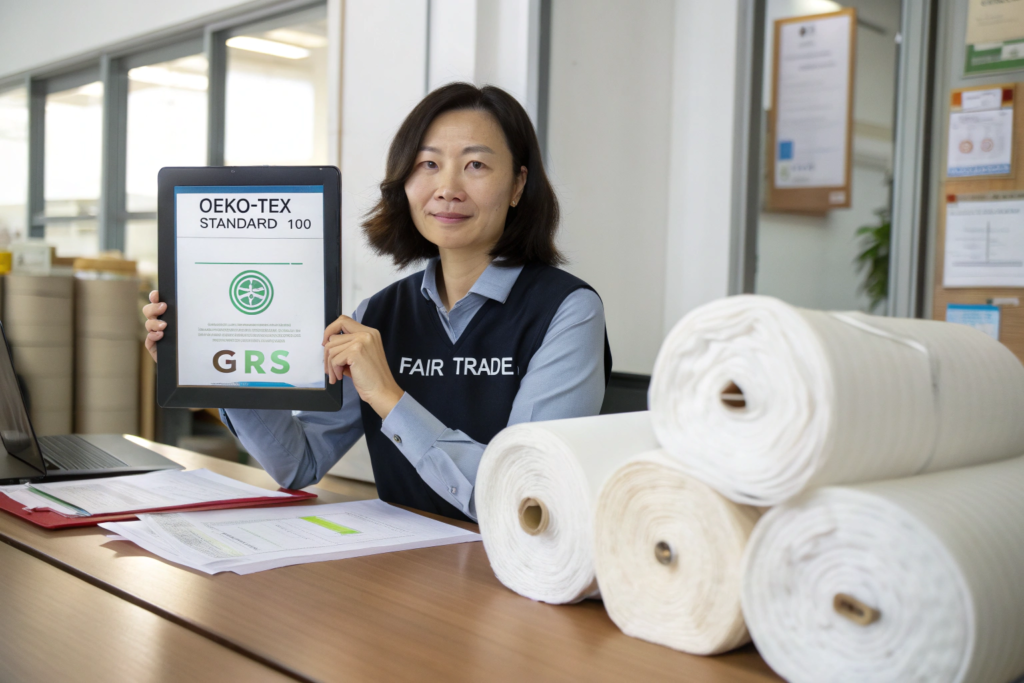
Now our yoga compliance matrix is stricter than children's wear:
| Certification | Why It Matters | Our Status |
|---|---|---|
| OEKO-TEX Standard 100 | Chemical safety, consumer trust | Class I (infant) for all yoga |
| GRS (Global Recycled Standard) | Recycled content verification | Certified since 2020 |
| GOTS (Global Organic Textile Standard) | Organic cotton claims | Certified since 2021 |
| FSC (Forest Stewardship Council) | TENCEL™ lyocell sourcing | Chain of custody certified |
| PETA-Approved Vegan | No animal-derived inputs | All synthetic yoga fabrics |
| Fair Trade | Ethical manufacturing | Selected organic cotton programs |
Do we need GOTS certification for organic cotton yoga wear?
Yes. If you claim "organic," you need GOTS or OCS.
In the US, the FTC regulates "organic" claims. In the EU, it is regulated by EU regulation 2018/848.
In 2020, a competitor was fined $128,000 by the FTC for labeling conventional cotton as "organic." Their client dropped them. They went out of business.
We do not take that risk.
Our GOTS-certified organic cotton yoga fabrics:
- 95/5 organic cotton/spandex jersey
- 100% organic cotton French terry
- 100% organic cotton interlock
Cost premium: +$0.85–1.20/m vs conventional cotton.
We also offer "transitional cotton" — cheaper than GOTS, still organic fiber, but lacking full chain of custody certification. We disclose this clearly. Some clients accept it.
The GOTS certification process for textile suppliers is rigorous. We renew annually. Our last audit was October 2024.
How do we comply with PFAS restrictions for moisture-wicking yoga wear?
PFAS (per- and polyfluoroalkyl substances) are being banned globally.
EU: Proposed ban by 2025. US: Maine, Colorado, California have state-level bans. Major brands (REI, Patagonia) have voluntarily eliminated PFAS.
In 2022, a client asked: "Does your moisture-wicking finish contain PFAS?"
We didn't know. We called our chemical supplier. Yes. It was a C6 fluorocarbon. Not banned yet. But the client said: "We are going PFAS-free. Reformulate or lose the contract."
We switched to a hydrocarbon-based wicking finish. Performance: 15% less effective than fluorocarbon. Still passes AATCC 195. Zero PFAS.
Cost increase: +$0.09/m.
Now all our yoga moisture-wicking fabrics are PFAS-free. We do not wait for regulations. We anticipate them.
The PFAS phase-out in textile finishes is accelerating. We are ahead of the curve.
At Shanghai Fumao, we offer "CleanTECH" wicking finish. No fluorocarbons. No bioaccumulative substances. OEKO-TEX Eco Passport certified.
How Do Factory Seasons and Peak Periods Affect Yoga Apparel Lead Times?
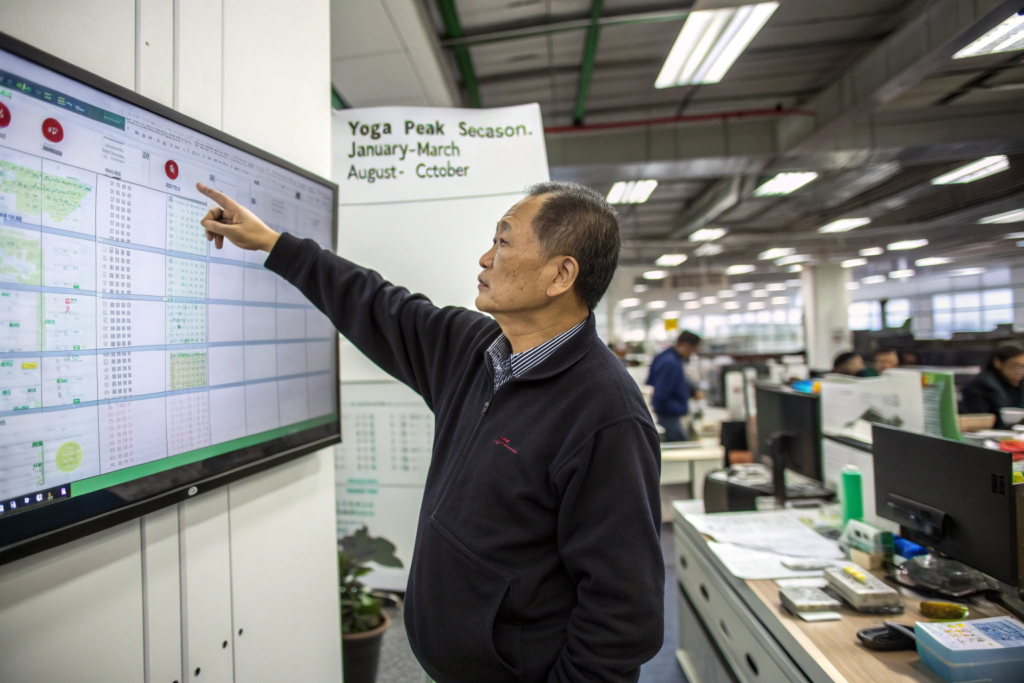
Yoga has two peaks. Both coincide with the worst possible timing for Chinese production.
Peak 1: January–March. Brands preparing for spring/summer collections. Orders placed January–February for March–April delivery.
This is Chinese New Year. Factories closed. Workers traveling.
Peak 2: August–October. Brands preparing for fall/winter collections. Orders placed August–September for October–November delivery.
This is Golden Week (October 1–7). Then peak season for all textiles.
In 2021, a Australian yoga brand ordered 5,600 meters of bamboo-spandex on January 15.
CNY started February 12. We had 28 days. Normally, bamboo-spandex takes 21 days. We had 7 days buffer.
Then COVID hit. Yarn supplier delayed. We lost 5 days.
We worked 7-day weeks. We paid 300% overtime. We shipped February 10. The container left Shanghai February 11—the last vessel before the holiday.
The client received the fabric March 10. Their production cut was March 15. They made it.
Barely.
What is the realistic lead time for certified organic cotton yoga fabric?
If you need GOTS certification: 12–14 weeks. Minimum.
Here is the actual timeline:
| Phase | Activity | Duration |
|---|---|---|
| 1 | GOTS-certified yarn procurement | 2–3 weeks |
| 2 | Knitting | 1–2 weeks |
| 3 | GOTS-certified dyeing | 2–3 weeks |
| 4 | Finishing (brushing, compacting) | 1 week |
| 5 | In-house QC | 2–3 days |
| 6 | GOTS transaction certificate (TC) issuance | 3–5 days |
| 7 | Shipment | 2–4 weeks |
| Total | 11–15 weeks |
Add 3–4 weeks if yarn is not in stock.
Add 2 weeks if you need GOTS-certified spandex (limited suppliers).
Add 3 weeks if you order during CNY or Golden Week.
We tell every new yoga client: "If you need GOTS, order 4 months ahead. Not 2 months. 4 months."
How do we protect bamboo-spandex inventory from humidity damage?
Bamboo rayon is hygroscopic. It absorbs moisture. It swells. It weakens.
In 2018, we stored 4,000 meters of bamboo-spandex in our standard warehouse.
Monsoon season. Humidity: 85% RH. Three weeks later, we opened the rolls. The fabric had expanded widthwise by 7%. The spandex had relaxed. Recovery was permanently reduced.
We had to scrap the entire lot. $28,000 loss.
Now our bamboo-spandex storage protocol:
| Parameter | Requirement |
|---|---|
| Temperature | 20–24°C |
| Relative humidity | 45–55% |
| Packaging | Vacuum-sealed PE bags with desiccant |
| Stacking | Maximum 4 rolls high |
| Shelf life | 6 months maximum |
We invested in a dedicated climate-controlled vault for cellulosic fibers. Temperature and RH monitored 24/7. Alarms if conditions deviate.
Clients who store fabric with us pay 4% storage fee. They never have humidity claims.
The textile conservation standards for rayon and lyocell are clear. We follow museum-grade guidelines for bamboo. Not because we must. Because one humidity claim costs more than 5 years of climate control.
Conclusion
Sourcing fabric for yoga and meditation apparel is not like sourcing for any other activewear category.
It is not about compression. It is not about speed. It is about how the fabric makes the wearer feel during the 90 minutes they are on the mat.
Does it feel buttery soft against their skin? Does it stay in place during downward dog? Does it become translucent when they fold forward? Does it transfer color to their expensive mat? Does it pill after 10 washes?
I have failed every one of these questions at least once.
I shipped bamboo-spandex that bagged at the knees. I shipped deep burgundy leggings that stained yoga mats. I shipped organic cotton that shrank two sizes. I shipped recycled polyester that felt like sandpaper.
Those failures cost us. Hundreds of thousands of dollars. But they also taught us how to do it right.
Today, at Shanghai Fumao, we do it right.
We test every yoga fabric for stretch recovery at 100% elongation—not just 50%. We dye deep colors with double reductive clearing to prevent mat staining. We brush recycled polyester until it feels like bamboo. We maintain GOTS and GRS certification so our clients can sleep at night.
We are not a trading company that happens to sell yoga fabric. We are a manufacturer with dedicated production lines for nylon-spandex, bamboo-spandex, and GOTS-certified organic cotton.
We have climate-controlled vaults for cellulosic fibers. We have napping machines for recycled polyester softening. We have dye recipes optimized for visual cross-construction color matching.
So if you are a yoga brand founder, an activewear designer, or a meditation retreat owner sourcing for your next collection—talk to us.
Email Elaine, our Business Director, directly: elaine@fumaoclothing.com.
Tell her what practice your apparel is for. Tell her what hand feel you envision. Tell her what colors speak to your brand. Tell her your launch date.
She will connect you with our yoga and wellness textiles division. We will pull the yarn specification sheets. We will calculate the predicted stretch recovery. We will develop the lab dips with double reductive clearing. We will build the production timeline that accounts for the GOTS certification queue and the CNY warehouse closures.
We won't promise you the cheapest yoga fabric. We will promise you buttery softness that lasts, colors that stay on the fabric, and delivery that meets your studio launch.
Because in yoga, the fabric is not just clothing. It is part of the practice.