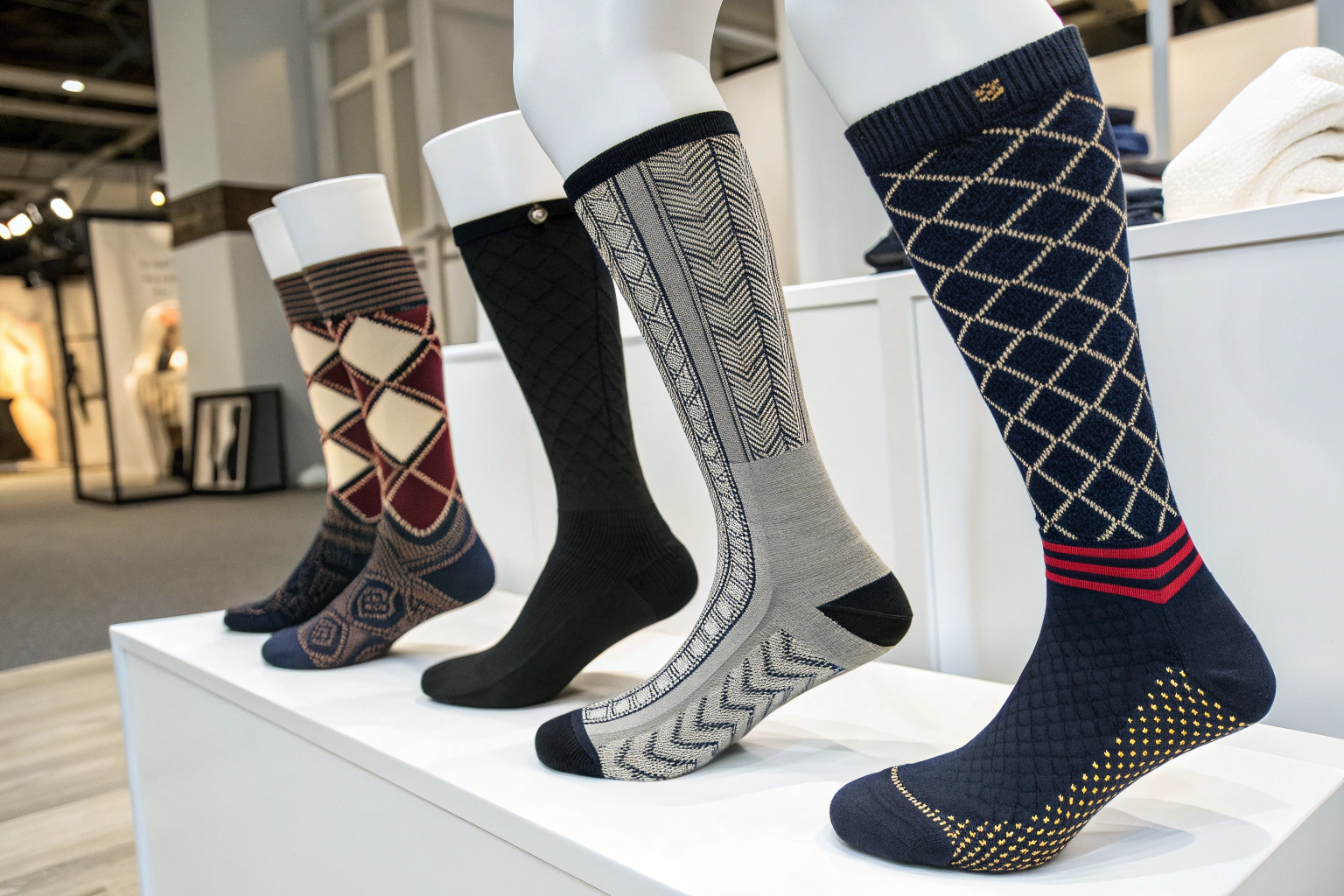
I'll never forget the call from a Swedish sock brand founder in 2021. She'd spent six months developing what she thought was the perfect athletic sock—great yarn, comfortable fit, beautiful colors. Then she received her first bulk shipment and discovered that every single sock had a slight variation in heel placement. Some were comfortable, some pulled uncomfortably, some just looked wrong. Her supplier kept saying "it's normal variation." It's not normal when it destroys your brand's reputation. She came to us desperate for consistency, and we had to explain that sock manufacturing is a completely different world from regular apparel production—with its own machines, its own quality rules, its own sourcing challenges.
Socks and hosiery seem simple. They're small, right? How hard can it be? The truth is that socks are one of the most technically demanding apparel categories. They need to stretch without losing shape, wick moisture without feeling wet, cushion without bulk, and fit perfectly despite being worn by feet of infinite variation. And they need to do all this while surviving hundreds of machine washings and thousands of steps.
At Shanghai Fumao, we've supplied sock and hosiery yarns and fabrics to clients across 20+ countries—from athletic brands requiring compression properties to luxury houses needing ultrafine gauge silk stockings. The sourcing considerations are unique, and getting them right separates successful sock lines from returns nightmares.
What Makes Sock and Hosiery Fabric Different from Other Knits?
Sock knitting is its own universe. The machines are different, the yarn requirements are different, and the performance demands are unlike anything in regular apparel. Understanding these differences prevents the kind of disaster my Swedish client experienced.
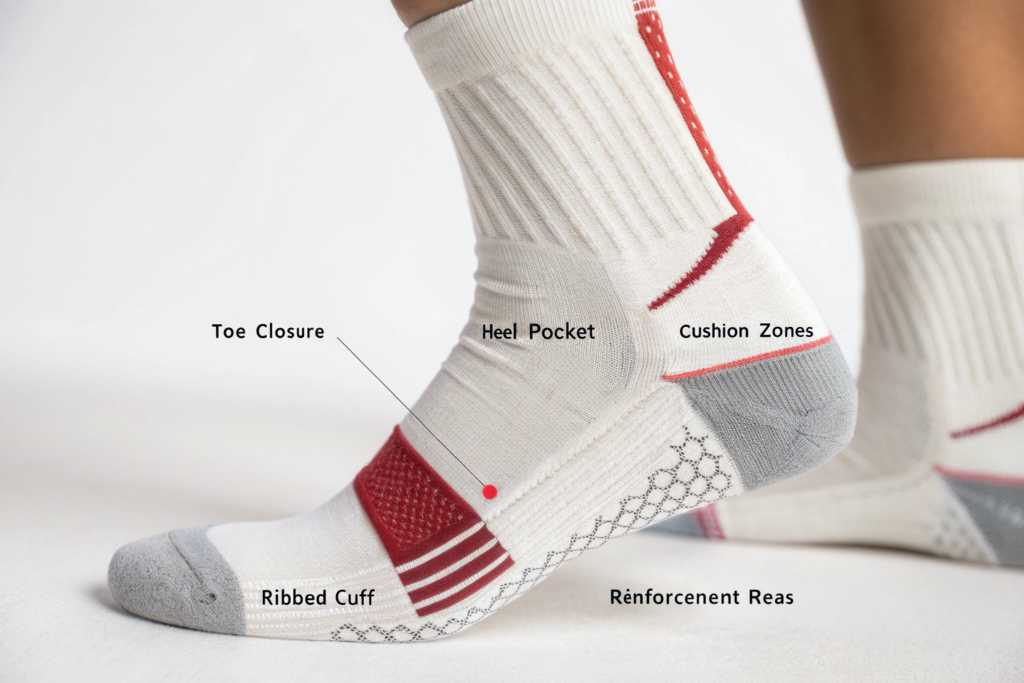
Why are socks knitted on specialized machines rather than regular knitting equipment?
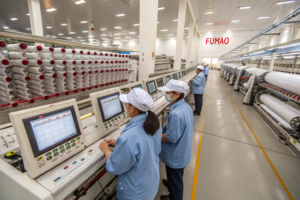
Regular knitting machines—even circular knits—produce flat fabric that's then cut and sewn. Sock machines are completely different. They're small-diameter circular knits (typically 3-5 inches in diameter) that knit a complete tube shaped specifically for a foot. They can create different structures in different parts of the same sock—cushion loops in the foot, tighter knitting in the ankle, ribbed cuff at the top—all in one continuous process.
The machine creates a "heel pocket" by knitting back and forth on part of the needles while the rest remain idle—something regular circular machines can't do. This heel formation is critical for fit. If the heel isn't positioned correctly, the sock twists, bunches, and causes blisters.
Sock machines also handle "terry" knitting—creating loops on the inside surface for cushioning. The length of these loops determines cushion thickness. Athletic socks might have 3-5mm loops; dress socks have minimal or no loops. The machine can selectively create loops only where needed—heel and toe areas—while keeping the instep flat for better shoe fit.
For a US hiking sock brand in 2022, we specified different loop heights across the sock: 5mm in heel and toe for maximum cushion, 3mm along the foot for moderate protection, and flat knit on the instep to reduce bulk inside boots. The machine programming required precision, but the resulting sock outperformed their previous version significantly. Specialized machines enable specialized performance.
What fiber properties matter most for sock performance?
Sock fibers face demands that regular apparel doesn't. They're compressed under body weight, rubbed against shoes, exposed to moisture and bacteria, and washed frequently. Fiber selection directly determines performance.
Nylon is the workhorse of sock manufacturing. Almost all socks contain significant nylon (typically 15-30%) because nylon provides strength, abrasion resistance, and shape recovery. Without nylon, socks would stretch out and never return to shape. The nylon is usually wrapped around an elastic core or plied with other fibers.
Polyester is common in athletic socks for its moisture-wicking properties. Polyester doesn't absorb water, so it moves moisture away from skin. However, pure polyester can be less comfortable than natural blends, so it's often combined with cotton or wool.
Cotton provides comfort and softness but has limitations. Cotton absorbs moisture (which can lead to blisters), has poor recovery (socks sag), and wears faster than synthetics. Cotton socks typically need 15-25% nylon to maintain shape and durability.
Merino wool is premium for performance socks. Wool naturally manages moisture, resists odor, and regulates temperature. But wool is expensive and requires careful blending with nylon for durability. High-end hiking socks might be 60% merino, 40% nylon.
Spandex/elastane (2-5%) provides the stretch and recovery that keeps socks from sliding down. Without spandex, sock cuffs would relax and droop within hours of wear.
For a Danish cycling sock brand in 2023, we developed a custom blend: 65% merino wool, 32% nylon, 3% spandex. The wool provided temperature regulation for all-day rides, nylon added durability where cleats rubbed, spandex kept socks in position. Lab testing showed 4x the abrasion resistance of their previous all-wool socks. Blending optimizes competing requirements.
How does sock sizing work when feet vary so much?
Sock sizing is its own science. Unlike garments that fit based on measurements, socks fit based on stretch and recovery. A sock might fit US men's sizes 6-12 because the knit structure can stretch to accommodate different foot lengths while still providing adequate compression and hold.
The key specification is "leg length" and "foot length" in the relaxed state, combined with stretch percentage. A sock with 8" relaxed foot length and 50% stretch can fit up to 12" feet. The stretch comes from:
- Fiber content (spandex percentage)
- Knit structure (ribs stretch more than plain knit)
- Yarn tension during knitting
For consistent fit across production runs, we control all three factors precisely. If spandex content varies by even 1%, stretch changes. If knitting tension drifts, stretch changes. If yarn diameter varies, stretch changes.
A German medical compression sock client requires stretch testing on every production batch. We use a Instron tensile tester to measure force at specific elongations, ensuring that socks provide consistent compression levels. Variation under 5% is acceptable; beyond that, we reject and adjust. Precision matters when socks affect health.
What Technical Specifications Should You Provide for Sock Production?
Sock sourcing requires specific technical information that regular apparel buyers might not know to provide. The more detail you give upfront, the closer the first sample will match your vision.
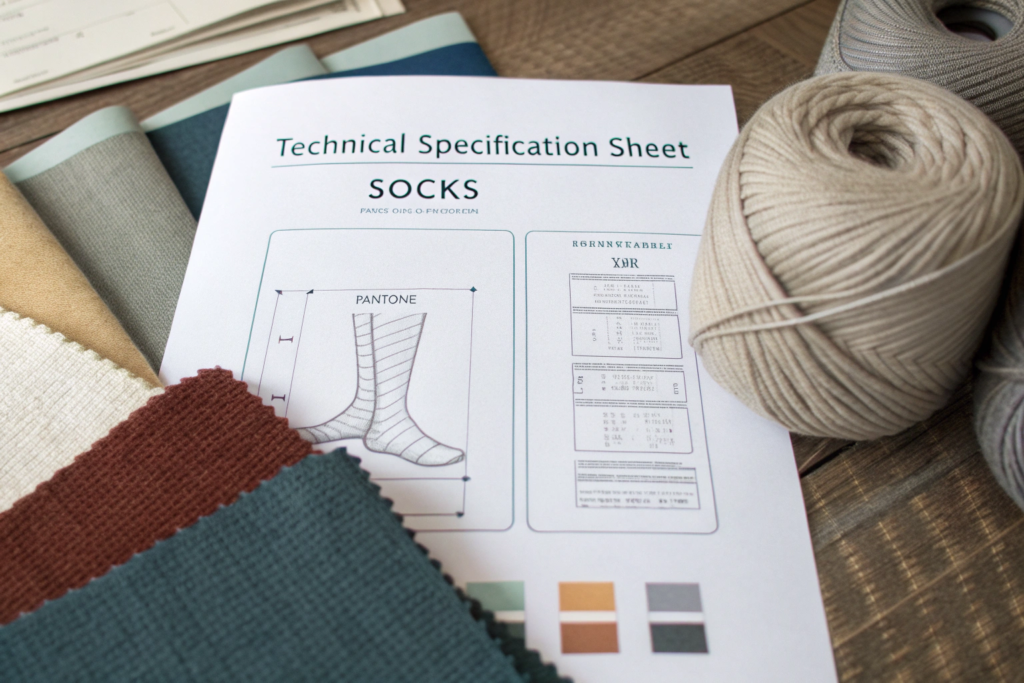
What measurements must be specified for custom socks?
Sock specifications go far beyond "small, medium, large." For proper production, provide:
Total length: From toe to cuff top, relaxed and stretched
Leg length: From heel to cuff top
Foot length: From heel to toe
Cuff height: From ankle to cuff top (for crew, quarter, no-show styles)
Heel placement: Distance from toe to heel pocket start
Toe shape: Rounded, tapered, anatomical left/right
Recovery rate: How much the sock returns after stretching (critical for fit)
For a Canadian running sock brand in 2022, their initial specification included only foot length ranges. Their first samples fit poorly because heel placement wasn't specified—the heel pocket ended up too far back, causing bunching. We re-specified with heel placement distance, and the revised samples fit perfectly. Measurement detail prevents fit failures.
How do you specify cushion zones and knit structures?
Modern socks aren't uniform—they have different structures in different zones. Your specification should map these zones clearly:
Cushion zones: Where terry loops should be placed (full foot, heel/toe only, forefoot only)
Cushion height: Loop length in mm for each zone
Reinforcement zones: Extra yarns or tighter knitting in high-wear areas
Ventilation zones: Mesh structures for breathability
Compression zones: Tighter knitting for support
Pattern areas: Where color or stitch patterns change
Provide a diagram with zones clearly marked. Words alone lead to misinterpretation.
For a UK football (soccer) sock client, we developed a specification with seven distinct zones: reinforced heel with extra-heavy terry, reinforced toe with medium terry, arch support with graduated compression, instep ventilation mesh, calf graduated compression, front of ankle flex zone (reduced compression), and top cuff with non-slip ribbing. The diagram made production possible. Zoned construction requires zoned specification.
What yarn count and ply specifications matter?
Sock yarns are specified differently than regular apparel yarns. Key parameters:
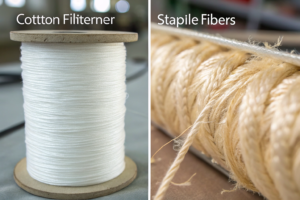
Yarn count: Thickness of individual yarns (measured in denier for synthetics, Ne for cotton)
Number of plies: How many individual yarns are twisted together (2-ply, 3-ply, etc.)
Twist level: How tightly twisted (affects durability and hand feel)
Core-spun construction: For elastic yarns, the percentage and type of core
Higher ply counts generally mean more durable socks but also thicker, warmer fabric. Athletic socks might use 2-ply yarns for balance of durability and comfort. Heavy hiking socks might use 3-ply for maximum cushion and wear life.
For a US military contractor supplying boot socks, we specified 3-ply yarns with 15% nylon wrap over spandex core. The construction survived 200 miles of rucking in testing—double the requirement. Lower ply options had failed at 120 miles. Ply count directly affects durability.
How Do Quality and Consistency Challenges Differ for Socks?
Sock quality issues are often different from regular apparel issues—and harder to catch without specialized knowledge. Understanding what can go wrong helps you specify inspections that actually matter.
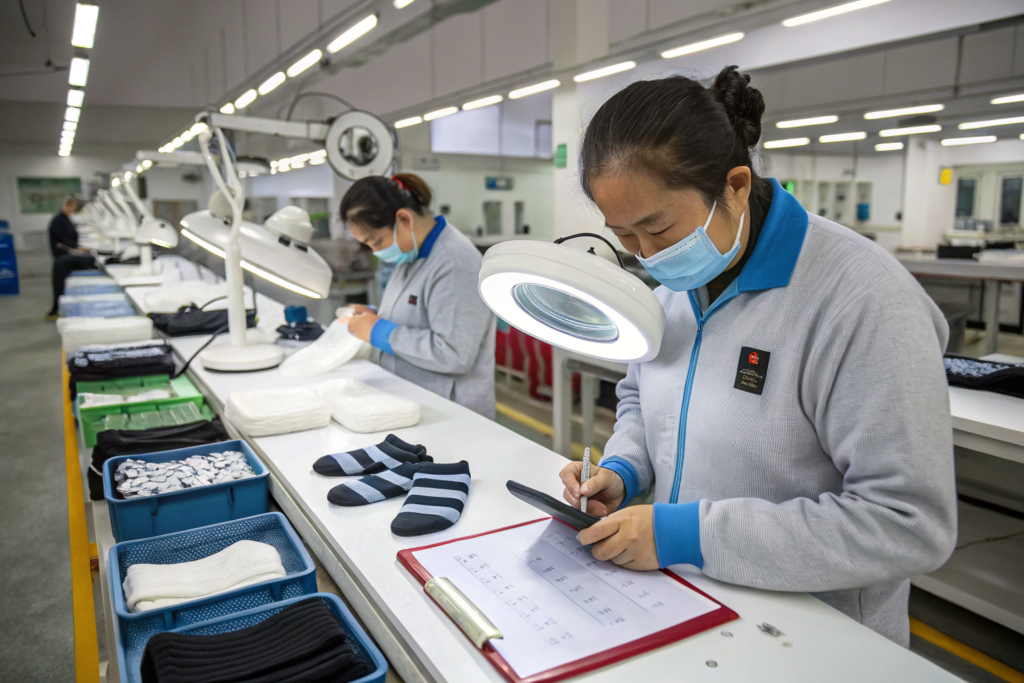
What are the most common defects in sock production?
From years of sock production, here are the defects we see most often:
Needle lines: Vertical stripes caused by damaged or improperly set needles. One bad needle creates a line through every sock from that machine position.
Yarn banding: Horizontal color variations when yarn packages change during production. Even "same dye lot" yarn can vary slightly between packages.
Size variation: Socks from the same production run that measure differently. Usually caused by tension variations during knitting.
Poor toe closing: The toe seam should be flat and comfortable. Poor closing creates irritating ridges that customers hate.
Heel pocket misplacement: The heel doesn't align with actual wearer's heel, causing twisting and bunching.
Spandex relaxation: If spandex isn't properly heat-set, socks lose shape after first wash.
For a French fashion sock client in 2023, we rejected an entire production batch due to subtle needle lines visible only under certain lighting. The client hadn't noticed in sample approval, but we caught it during final inspection. We replaced the needles, re-knitted the order, and delivered two weeks late but perfect. The client's customers never saw the defect. Inspection catches what sampling misses.
How do you test sock durability and performance?
Sock testing requires specialized methods beyond regular textile tests:
Abrasion resistance: Modified Martindale tests with higher pressure to simulate shoe friction. Socks typically need 20,000-50,000 cycles depending on intended use.
Elastic recovery: Measure sock length before stretching, stretch to specified elongation, hold, release, measure recovery. Poor recovery means sagging socks.
Compression testing: For compression socks, measure pressure at ankle, calf, and specified points using specialized test equipment.
Seam strength: Toe closure seams must withstand significant stress. Test by pulling seam to failure.
Colorfastness: Sweat and rubbing tests are critical because socks contact skin directly and rub against shoes.
A Swiss hiking sock client requires 50,000 abrasion cycles for their premium line—double the industry standard. We test every production batch and provide certificates. When one batch tested at 47,000 cycles (still excellent but below their spec), we offered to downgrade or re-produce. They accepted the batch for a different product line and waited for re-production. Testing ensures performance claims are valid.
What quality control points matter most in sock manufacturing?
Effective sock QC requires checks at multiple stages:
Yarn incoming: Test yarn count, twist, strength, and color before production starts. Bad yarn makes bad socks regardless of knitting quality.
Machine setup: Verify machine settings match specifications for each style. Document settings for traceability.
First-piece inspection: First sock from each machine position inspected 100% for all specifications.
In-process sampling: Random socks pulled throughout production, measured, and inspected.
Final inspection: Every sock? Usually not—statistical sampling is standard. But for premium clients, we can inspect 100%.
Packaging verification: Ensure pairs are correctly matched, labeled, and packaged.
For a Japanese sock brand with extremely high standards, we implemented video inspection for every sock. Each sock passes through an imaging station that compares it to a master image, flagging any variations in size, color, or structure. The system costs more but catches issues human inspectors sometimes miss. Automated inspection elevates consistency.
How Do Sock Sourcing Timelines and MOQs Compare to Apparel?
Sock production has its own rhythm. Understanding timelines and minimums helps you plan effectively and avoid surprises.
What are typical minimum order quantities for custom socks?
Sock MOQs are generally lower than for cut-and-sew apparel because sock machines produce individual pieces directly. Typical ranges:
Sample development: 1-5 pairs per style for approval
Small production: 200-500 pairs per style per color (for basic styles)
Efficient production: 1,000-3,000 pairs per style for best pricing
Full-scale production: 5,000+ pairs per style for maximum efficiency
The MOQ is often per "machine setup"—each style, size, and color combination requires setup time. A production run with 5 colors and 4 sizes (20 combinations) might have minimum 100 pairs per combination, total 2,000 pairs. Running fewer than 100 pairs per combination is possible but inefficient—setup cost per pair becomes very high.
For a US startup launching their first sock line, we produced 300 pairs per style across 4 styles—1,200 total pairs. The per-pair cost was higher than larger runs would have been, but the total investment was manageable for a test launch. As they've grown, their per-pair costs have dropped 35% with larger quantities. Start small, scale with demand.
How long does sock sampling and production take?
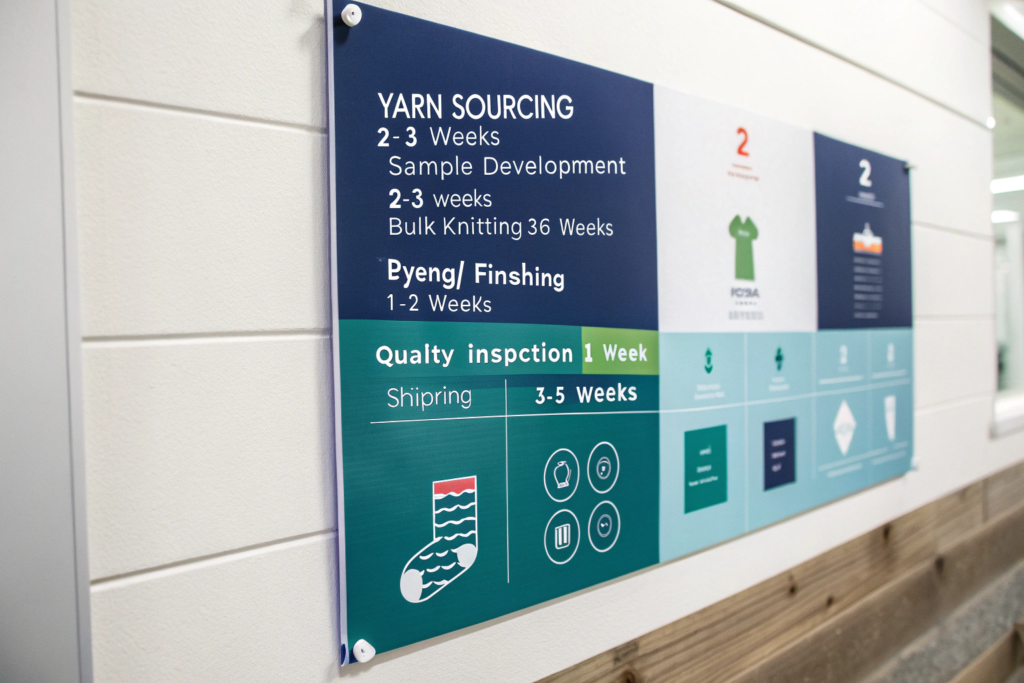
Sock development timelines are generally shorter than for woven or cut-and-sew apparel because there's less pattern work and sewing. Typical timeline:
Weeks 1-2: Specification finalization and yarn sourcing
Weeks 3-4: Sample knitting (2-3 rounds typical)
Weeks 5-6: Sample approval and adjustments
Weeks 7-10: Bulk yarn ordering and preparation
Weeks 11-14: Bulk knitting production
Weeks 15-16: Finishing (boarding, packaging)
Weeks 17-20: Shipping (sea freight)
Total: 4-5 months from initial inquiry to delivery for a first order. Repeat orders can be faster—3-4 months—because specifications are established and yarn sources identified.
For a Canadian sock brand needing rapid replenishment, we hold greige (undyed) sock blanks in inventory. When they need more inventory, we dye to their current color specifications and ship within 6-8 weeks. This system cuts 6-8 weeks off their normal timeline. Inventory strategies can accelerate delivery.
What shipping and logistics considerations are unique to socks?
Socks are small and lightweight, which creates both advantages and challenges:
Volume vs. weight: Socks are light but bulky. A 40-foot container holds far fewer pairs than its weight capacity allows. For large orders, we optimize packaging to maximize container utilization.
Duty classification: Socks have specific HS codes that affect tariff rates. Classification must be accurate—miscounting can lead to customs delays and penalties.
Packaging options: Socks can be shipped flat, rolled, paired, banded, bagged, or boxed. Each option affects shipping volume and cost. For some clients, we ship in bulk for them to package locally; for others, we deliver retail-ready packaging.
Seasonality: Sock demand varies by season—heavy socks in fall/winter, light socks in spring/summer. Timing shipments to match retail seasons requires careful planning.
A UK sock client ships by air for replenishment orders (2 weeks) and sea for seasonal stock (6 weeks). The air freight costs 4x more but allows them to respond to bestseller trends without holding excessive inventory. Logistics strategy should match sales velocity.
Sock sourcing is its own specialty within the textile industry. The machines are different, the specifications are different, the quality considerations are different, and the suppliers who excel at socks aren't necessarily the same ones who excel at apparel. Working with specialists matters.
Conclusion
Sourcing fabric for custom socks and hosiery requires understanding a specialized manufacturing world. Socks are knitted on small-diameter circular machines that can create heel pockets, cushion zones, and different structures in a single continuous process. Fiber selection—typically blends of nylon, polyester, cotton, wool, and spandex—determines performance. Specifications must include detailed measurements, cushion zone mapping, and yarn parameters. Quality control must catch needle lines, size variations, and heel placement issues that regular apparel inspection might miss. Timelines and minimums differ from cut-and-sew production.
The brands that succeed in socks understand these nuances. They work with suppliers who specialize in socks, not just general textile producers. They invest in proper specifications and testing. They plan for the unique logistics of small, lightweight products.
If you're developing custom socks and want to get them right the first time, I invite you to reach out to us at Shanghai Fumao. We've supplied sock yarns and finished socks to clients across athletic, fashion, medical, and promotional markets. We understand the machines, the materials, and the quality standards that separate great socks from disappointing ones. Contact our Business Director, Elaine, directly at elaine@fumaoclothing.com. Tell her about your sock vision—athletic, fashion, compression, or custom—and she'll connect you with our hosiery specialists. We'll help you develop socks that fit, perform, and last.
Because your customers' feet deserve better than "close enough." They deserve socks designed for how they actually live.