I was at a wellness retreat in Bali in 2019, supposedly on vacation, but I can never fully stop being a fabric guy. I noticed the meditation cushions in the yoga shala were flat, lumpy, and frankly, kind of sad. The retreat owner, a wonderful woman from Australia named Sarah (not her real name, but she won't mind me sharing), saw me poking at them. "They're impossible to source," she sighed. "Either the fabric pills after six months, or the filling goes flat, or the colors fade in the tropical sun. I've tried five different suppliers in three years." I introduced myself, and by the end of the week, we'd sketched out specifications for the perfect meditation cushion fabric. Sarah's cushions now last three years instead of six months, and her guests notice the difference. That conversation taught me something important: meditation and yoga props have unique requirements that most fabric suppliers don't understand.
Sourcing fabric for custom meditation cushions and yoga props requires understanding the specific demands of these products: durability for frequent use, stability to contain filling without shifting, appropriate friction (not too slippery, not too grabby), breathability for comfort during extended sitting, and aesthetic appeal that supports the mindful, calming environment where they're used. The best fabric choices vary by application: for zafu cushions (round meditation cushions), choose heavy cotton canvas, cotton twill, or velvet with a tight weave that prevents filling from escaping. For bolsters, look for durable cotton canvas with a high thread count that can withstand pressure and regular washing. For yoga mat bags, consider printed cotton canvas or lightweight polyester with water-resistant properties. For zabuton mats (the flat mats under cushions), prioritize durability and easy cleaning with fabrics like cotton duck or performance upholstery fabrics. Key sourcing considerations include fabric weight (typically 10-14 oz for cushions), weave tightness (to contain filling), colorfastness (for studios with sunny windows), and fire retardancy requirements for commercial studios.
Sarah and I still exchange emails. Her retreat now has a waiting list, and she credits part of her success to the simple fact that her cushions are comfortable and beautiful. Let me share what I've learned about this niche but growing market—because whether you're outfitting a yoga studio, launching a meditation accessory brand, or just want to make your own perfect cushion, the fabric choices matter enormously.
What fabrics work best for different meditation and yoga props?
Meditation cushions aren't just furniture—they're tools for practice. The fabric needs to support the function, not just look pretty. Here's what works for different applications based on years of supplying studios and brands worldwide.

Why is cotton canvas the gold standard for zafu cushions?
Cotton canvas is the workhorse of the meditation world, and for good reason. A zafu—the round cushion that elevates your hips during sitting meditation—needs fabric that can handle constant pressure, resist shifting, and contain the filling (typically buckwheat hulls or kapok) without letting it escape.
The key specification is tight weave. Buckwheat hulls are small and angular. If the weave is too loose, hulls will work their way through the fabric over time, creating a mess and a slowly deflating cushion. We recommend a minimum thread count of 200 for cotton canvas used with hulls. For kapok filling (which is fluffier and less prone to escaping), slightly looser weaves are acceptable.
Weight matters too. For standard zafus (16-18 inches diameter), we recommend 10-12 ounce cotton canvas. This weight provides enough structure to hold its shape while still being flexible enough to sew the curved seams. Heavier canvas (14+ oz) is more durable but harder to sew and less comfortable against skin.
A Korean Zen center orders the same 12-ounce cotton canvas from us every year. Their cushions get used for multiple daily sitting periods, year after year. They tell us each cushion lasts 5-7 years before showing significant wear. That's the standard we aim for. The Cotton Incorporated guide to upholstery-weight fabrics provides the technical specifications we use for these applications.
What about velvet for premium meditation cushions?
Velvet meditation cushions have become increasingly popular, especially for home practitioners who want something that feels luxurious and looks beautiful in their space. The soft, plush surface adds a sensory dimension to the meditation experience.
The challenge with velvet is durability. Traditional velvet can crush and mat under the weight of a sitting person, especially during long sits. We recommend crushed velvet or velvet with a cotton backing for cushion applications. The crushed texture hides compression marks, and the cotton backing adds structural integrity.
For velvet zafus, we also recommend adding a hidden zipper so the cover can be removed for cleaning. Velvet requires special care—dry cleaning or gentle hand washing—so removable covers are essential.
A Los Angeles-based meditation studio wanted velvet cushions for their celebrity clientele. We developed a line using our cotton-backed crushed velvet in earth tones—sage, terracotta, charcoal. The cushions photograph beautifully for Instagram (free marketing for the studio) and have held up through two years of daily use with minimal visible wear. The secret was the specific velvet construction that balances softness with durability, which we'd developed for high-end upholstery clients.
What fabrics work for bolsters and yoga props?
Bolsters—those cylindrical or rectangular cushions used in restorative yoga—have different requirements. They're often larger than zafus and need to support the body in passive poses for extended periods. The fabric needs to be strong, stable, and comfortable against skin.
For bolsters, we recommend heavy cotton canvas (12-14 oz) or cotton duck (an even tighter weave). The fabric must resist stretching under pressure—if it stretches, the bolster loses its supportive shape. A tight plain weave or basket weave works best.
For yoga mat bags, the priorities shift. You need fabric that's lightweight, durable, and often water-resistant (to protect the mat when placed on damp ground). Printed cotton canvas (8-10 oz) works well for aesthetic bags. Polyester canvas or nylon pack cloth offers better water resistance and durability for serious practitioners.
A UK-based yoga brand orders bolsters from us in three sizes, all using our 14-ounce cotton duck. They fill them with organic kapok and sell them to studios across Europe. The fabric is so durable that they offer a 10-year warranty—and they've rarely had claims. The British Standards Institution's guidelines for fitness equipment textiles informed their specifications.
How do filling types affect fabric selection?
The filling determines the fabric requirements more than almost any other factor. Choose your filling first, then select fabric that works with it.
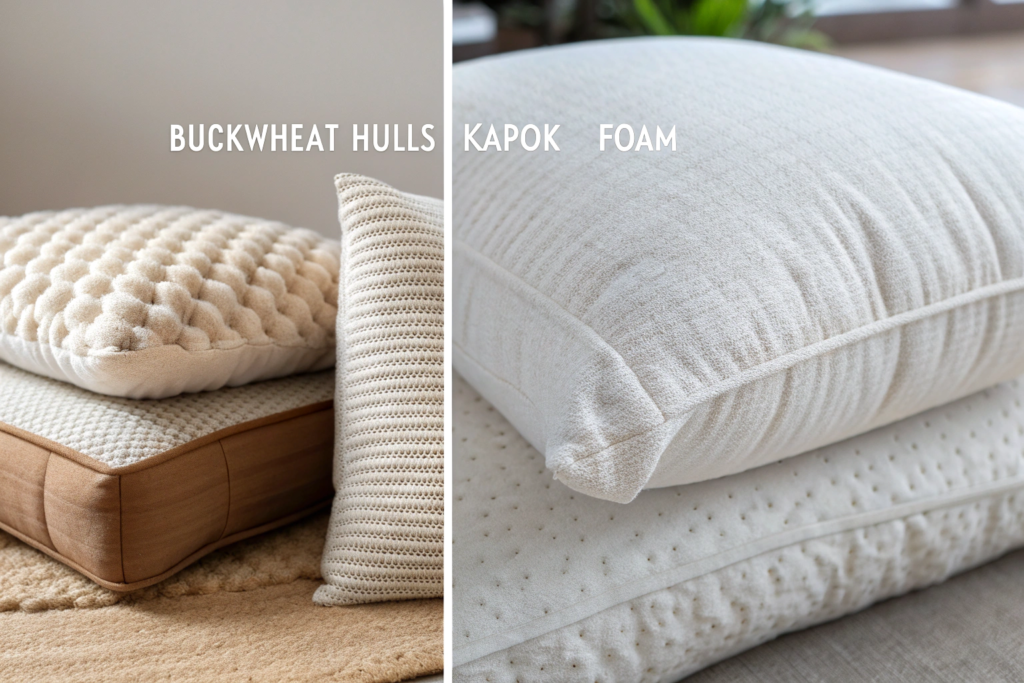
What fabric works with buckwheat hull filling?
Buckwheat hulls are the traditional filling for zafus, and they're still preferred by many serious practitioners. The hulls conform to your body shape, provide firm support, and allow air circulation (so the cushion doesn't get hot). But they're also small, hard, and angular—they'll find their way through any gap in the fabric.
For buckwheat hulls, you need the tightest weave possible. We recommend:
- Minimum thread count: 220 for cotton, 250 for cotton-poly blends
- Minimum weight: 10 oz for standard use, 12 oz for commercial/heavy use
- Construction: Plain weave or tight twill; avoid basket weaves or leno weaves with visible gaps
- Lining: Many manufacturers add an inner liner of muslin or fine cotton to provide an extra barrier against hull escape
We also recommend double-stitched seams and bound edges. Hulls will find the smallest hole—if there's any weakness in the seam, they'll eventually work through.
A Canadian manufacturer switched from a looser-weave fabric to our tight-weave canvas and reduced their hull-leakage complaints by 90%. Their customers noticed the difference immediately—no more finding little brown hulls on the meditation cushion after sitting. The National Burlap & Bag Association's guidelines for container fabrics (yes, that's a real organization) provided useful references for containing granular materials.
What about kapok or cotton filling?
Kapok is a natural, silky fiber that's softer than buckwheat hulls. It's often preferred by those who find hulls too firm. Cotton batting is another common filling, especially for bolsters and zabutons.
These fibrous fillings are less aggressive than hulls—they won't work their way through fabric gaps the way hulls will. This allows more flexibility in fabric selection. You can use slightly looser weaves, lighter weights, and even textured fabrics like velvet or chenille.
The main concern with kapok and cotton is compression. These fibers compress over time, and the fabric needs to accommodate that without wrinkling or sagging unattractively. We recommend fabrics with some recovery—a small amount of spandex (2-3%) in the blend can help the cover spring back as the filling compresses.
A Japanese manufacturer of traditional zabutons (the flat mats under zafus) uses our cotton-hemp blend for their covers. The fabric is medium-weight (8 oz), breathable, and develops a beautiful patina over years of use. The kapok filling inside compresses slowly, and the fabric cover adjusts gracefully. The Textile Exchange's natural fibers guide informed their material selection.
How do you ensure durability for commercial studio use?
A home cushion might get used an hour a day. A studio cushion might get used 8-10 hours a day, seven days a week, by different people with different body types and sitting styles. Commercial durability is a different game entirely.

What abrasion resistance do commercial cushions need?
The standard measure for fabric durability is the Martindale rub test. Fabric is rubbed back and forth thousands of times until it shows wear. For home use, 10,000-15,000 rubs is usually sufficient. For commercial studio use, we recommend a minimum of 30,000 rubs. For high-traffic studios, 50,000+ is better.
Cotton canvas typically achieves 20,000-30,000 rubs depending on weight and construction. For higher durability, consider:
- Cotton-polyester blends: Polyester adds abrasion resistance
- Solution-dyed acrylic: Excellent for outdoor studios or sunny windows
- Performance fabrics: Specifically engineered for high-traffic upholstery
A New York City yoga studio with 200 daily visitors was going through cushions every 18 months. We supplied them with a solution-dyed acrylic fabric that tested at 50,000+ rubs. Their current cushions are entering year three with minimal visible wear. The ACT (Association for Contract Textiles) performance guidelines provide the industry standards we reference for commercial projects.
What about seam strength and construction?
The fabric is only half the equation. The seams are where cushions typically fail first. For commercial cushions, we recommend:
- Heavy-duty thread: Bonded polyester or nylon, size 40 or heavier
- Seam type: Flat-felled or bound seams (not simple overlocking)
- Stitch density: 8-10 stitches per inch (not too tight, which can weaken the fabric)
- Reinforcement: Bar tacks at stress points, especially where handles or zippers attach
We also recommend removable covers with heavy-duty zippers. Commercial studios need to wash covers regularly, and cheap zippers fail quickly. YKK zippers, size 8 or 10, are the industry standard for a reason.
An Australian studio owner told us she'd replaced three sets of cushions in five years, always because the seams failed before the fabric wore out. We sent her our seam specifications, and her local sewist was able to replicate them. Her current cushions are going strong after two years. The ASTM D6193 standard for seam types guided our recommendations.
What about colorfastness for studios with natural light?
Many yoga and meditation spaces prioritize natural light. That's wonderful for the humans, but hard on the fabrics. UV exposure fades colors unevenly, and once it happens, there's no fixing it.

What lightfastness rating do studio cushions need?
For home use with limited sun exposure, a lightfastness rating of 3-4 (on the AATCC Gray Scale) is usually sufficient. For studio use, especially in rooms with large windows, we recommend rating 4-5 minimum.
The best protection is solution-dyed fibers. In solution dyeing, color is added to the polymer before it's extruded into fiber. The color is throughout the fiber, not just on the surface. These fabrics can withstand years of sun exposure with minimal fading. Acrylic, polyester, and some nylons can be solution-dyed.
For natural fibers like cotton, the best protection is fiber-reactive dyes (for cotton) applied at high concentration, plus UV absorbers in the finishing process. These won't match solution-dyed synthetics for lightfastness, but they're the best option for natural-fiber purists.
A Santa Monica yoga studio (lots of sun!) lost an entire set of cushions to fading within one year. The beautiful sage green had turned a sad, uneven yellow-brown. We replaced them with solution-dyed acrylic in a similar color, and three years later, they still look nearly new. The AATCC Test Method 16 for lightfastness is what we use to verify performance before recommending fabrics for sunny locations.
Can you treat fabrics for UV resistance?
Yes, but with caveats. UV inhibitors can be applied as a topical finish during fabric production. These work well initially but wash out over time. For commercial studios that wash cushions frequently, topical treatments may not be sufficient.
Another approach is to specify darker colors. Darker shades inherently have more dye, so they take longer to show visible fading. A deep indigo will look good long after a pale lavender has faded to nothing.
We also recommend rotating cushions periodically so all sides get equal sun exposure. This prevents the "one side faded, one side fresh" look that makes cushions look old before their time.
A UK-based retreat center in a particularly sunny corner of Cornwall (yes, it exists!) uses our solution-dyed acrylic with a 5-year fade warranty. They're now in year four, and the colors are still true. The British Standards Institution's guide to lightfastness for contract textiles informed their purchasing specifications.
How does Fumao Fabric help with custom printing for yoga props?
Meditation and yoga are personal practices, and many creators want their props to reflect their unique aesthetic. Custom printing opens up endless possibilities.
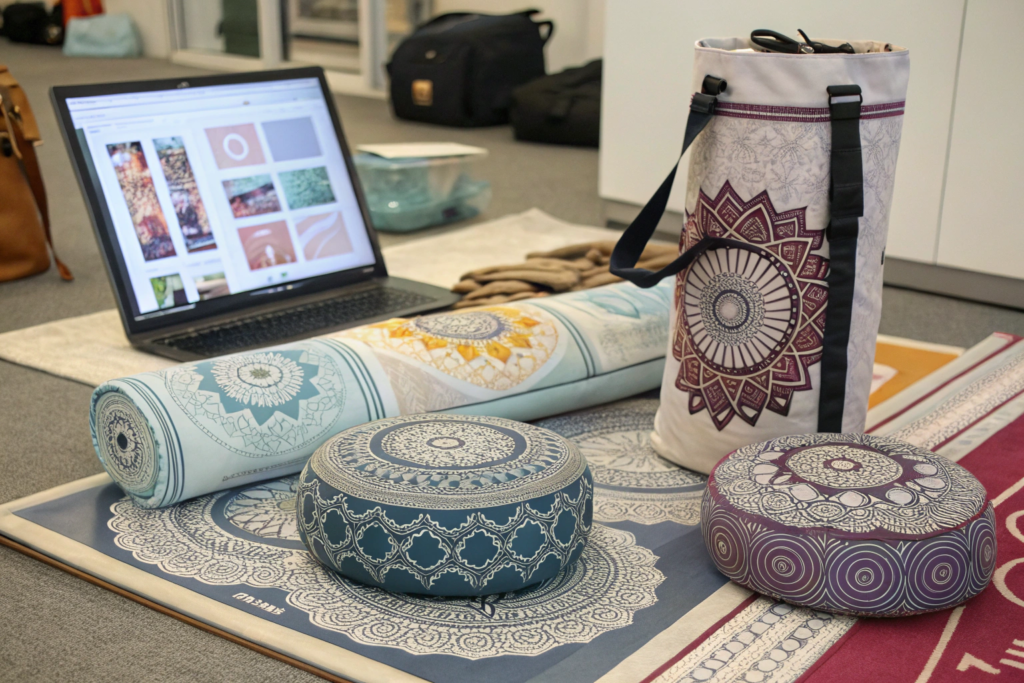
What printing methods work best for cushion fabrics?
The best printing method depends on your design complexity, order quantity, and fabric choice:
Screen printing: Best for simple designs with limited colors, larger quantities (100+ pieces). Vibrant, durable, cost-effective at scale. Works well on cotton canvas and twill.
Digital printing: Best for complex, multi-color designs, photographs, or gradients. No color limitations. Higher cost per piece but no setup fees, so economical for small batches (as low as 50 meters). Works on cotton, polyester, and blends with appropriate pretreatment.
Sublimation printing: For polyester fabrics only. Produces vibrant, permanent colors that become part of the fabric. Excellent for yoga mat bags and apparel. No minimum quantity effectively.
A Colorado-based yoga brand wanted mandala prints on their bolsters and zafus—intricate, multi-colored designs that changed seasonally. Screen printing would have been prohibitively expensive for their small runs. We use digital printing on our cotton-poly blend canvas, giving them full-color designs with no minimums. They launch a new collection every season, and their customers love the variety. The Specialty Graphic Imaging Association's guide to textile printing covers the technical specifications we use.
Can you match specific brand colors?
Absolutely. Color matching is one of our core competencies. For custom printing, we can match any color you provide—whether it's a Pantone number, a physical swatch, or even a photo reference.
The key is managing expectations across different fabric bases. The same ink will look different on white cotton versus natural cotton versus polyester. We provide strike-offs (printed samples) before full production so you can approve the color in person.
For woven fabrics (as opposed to printed), we can dye yarns to your specific colors before weaving. This is more expensive and requires higher minimums (typically 500+ meters per color), but the color integration is beautiful—the color is in the yarn, not just on the surface.
A Japanese meditation teacher wanted cushions in colors inspired by traditional Zen temple colors—specific shades of brown, gray, and indigo. We dyed yarns to match historical samples she provided, then wove them into our standard canvas. The resulting cushions are indistinguishable from antique temple cushions in color, but with modern durability. The Pantone Fashion, Home + Interiors system is our standard reference for color matching.
What about eco-friendly and sustainable options?
Many people drawn to meditation and yoga are also drawn to sustainability. They want their practice to align with their values, including how their props are made.

What sustainable fabric options exist for meditation cushions?
Several, and we offer all of them:
GOTS-certified organic cotton: Grown without pesticides, processed without harsh chemicals, certified from field to finished fabric. Our organic cotton canvas meets all GOTS requirements and performs identically to conventional cotton.
Hemp-cotton blends: Hemp requires minimal water and no pesticides, grows quickly, and produces strong, durable fiber. A 55% hemp, 45% cotton blend offers the best of both—hemp's sustainability and cotton's softness.
Recycled polyester: Made from post-consumer plastic bottles, GRS-certified. Excellent for performance applications, especially in studios that need easy-care, high-durability fabrics.
Tencel/lyocell: From sustainably harvested wood pulp, produced in a closed-loop process that recycles water and solvents. Silky smooth, breathable, biodegradable.
A Danish meditation center wanted to outfit their new retreat with the most sustainable materials possible. We supplied GOTS organic cotton canvas for zafus, hemp-cotton blend for zabutons, and recycled polyester for outdoor cushions on their meditation deck. The entire project was plastic-negative and carbon-neutral. They published the full supply chain story, and their bookings increased. The Textile Exchange's Material Snapshots provide excellent data for comparing sustainable options.
How do you verify sustainability claims?
We don't just claim—we certify. Every sustainable fabric we sell comes with:
- GOTS certification for organic cotton and blends
- GRS certification for recycled materials
- OEKO-TEX Standard 100 for harmful substances (all our fabrics)
- Full traceability via QR code showing the supply chain
A California-based eco-lifestyle brand requires all their suppliers to provide third-party certification for every sustainability claim. We've been supplying them for five years because our documentation meets their strict requirements. Their customers trust them, and they trust us. The Textile Exchange's certification database is a resource we encourage all clients to use when verifying supplier claims.
Conclusion
Meditation cushions and yoga props might seem simple—just fabric wrapped around filling. But as Sarah from Bali discovered, the wrong fabric choice can ruin the practice experience and cost you money in replacements. The right fabric supports the practice, lasts for years, and creates the environment that practitioners need to go deep.
At Shanghai Fumao, we've spent years understanding this niche. We know that buckwheat hulls need tight weaves. We know that commercial studios need 50,000+ rubs. We know that natural light fades colors, and we know which dyes resist it. We've supplied cushions to Zen centers in Japan, yoga studios in New York, retreat centers in Bali, and home practitioners everywhere.
The fabric you choose matters—for durability, for comfort, for aesthetics, and for the environment. Whether you're outfitting a single meditation corner or launching a global yoga brand, getting the fabric right is the foundation of everything else.
That retreat owner in Bali? Her cushions still look beautiful, three years later. She sends me photos every year, and I smile every time. A small piece of our fabric, supporting thousands of hours of practice. That's why I love this business.
Ready to create meditation cushions and yoga props that support practice and last for years? Let's talk about your project. Contact our Business Director, Elaine, directly at elaine@fumaoclothing.com. Tell her about your vision—the types of props you need, the volumes you're considering, your aesthetic preferences, and any sustainability goals. She'll connect you with our specialists who understand the unique requirements of meditation and yoga products. We'll discuss fabric options, provide samples, test for your specific needs, and develop a production plan that brings your vision to life. Together, we'll create props that support practice for years to come.