I was at a gaming convention in Shanghai last year, just walking the floor and people-watching. A young guy walked past me with the most incredible dice bag I'd ever seen—deep purple velvet with silver embroidery of a dragon curling around the base, and little tassels on the drawstrings. I stopped him. "Where did you get that?" I asked. He grinned. "My girlfriend made it for me. She's starting a little Etsy shop." I gave him my card. Three months later, that girlfriend—her name is Mei, and she's now a regular client—came to our office with a sketchbook full of designs. "I can't find anyone who will do small batches with good quality," she said. "Everyone wants 500 pieces minimum. I need 50, maybe 100. And I need them to look amazing."
Sourcing fabric for custom dice bags and gaming accessories requires a different approach than sourcing for apparel. You need fabrics that combine durability (to protect sharp-edged dice), aesthetic appeal (to reflect gaming themes), and workability (for cutting, sewing, and embellishment). The best options include velvet and crushed velvet for a premium look, cotton canvas and twill for durability and printability, faux suede and microfiber for softness, and novelty prints featuring fantasy, sci-fi, or gaming motifs. Key sourcing considerations include minimum order quantities (look for suppliers offering low minimums or deadstock), fabric width and weight (lighter weights are easier to sew for small items), and embellishment capabilities (embroidery, screen printing, or heat transfer). Working with a full-service supplier like Fumao Fabric, who can handle fabric sourcing, custom printing, and even assist with cut-and-sew partners, transforms the process from frustrating to feasible.
Mei's Etsy shop now has over 5,000 sales, and she's expanded into custom playmats, card holders, and accessory pouches. She still orders from us, but now it's 500 pieces at a time, not 50. Her story is just one of dozens I could tell you about creators, small business owners, and even established gaming companies who've figured out how to source fabric for this growing niche. Let me walk you through what actually works, based on real orders and real challenges we've solved in our Keqiao facility.
What fabrics work best for dice bags and gaming accessories?
The gaming accessory market has exploded over the last decade. It's not just about function anymore—it's about identity, about showing your gaming personality through your gear. The fabric you choose sends a message about who you are as a player.

Why is velvet the premium choice for dice bags?
Velvet is the undisputed king of dice bag fabrics. Here's why: it looks and feels luxurious, it's surprisingly durable, and it protects dice beautifully. The dense pile of velvet creates a soft cushion that prevents sharp-edged dice from damaging each other. I've seen velvet bags from the 1990s that still look great—the fabric holds up remarkably well.
But not all velvet is created equal. For dice bags, we recommend cotton velvet or polyester velvet with a cotton backing. Pure polyester velvet can be too slippery—the drawstrings don't grip well. Cotton-rich velvet gives you that soft hand feel while still holding its shape. Crushed velvet is another excellent option; the textured surface hides wear and adds visual interest.
A German gaming company came to us in 2022 wanting velvet bags for their limited-edition dice sets. They needed deep, saturated colors—royal purple, blood red, forest green—that matched their branding. We ran samples in eight different velvet qualities before landing on a cotton-poly blend with a dense pile that took dye beautifully. The bags retailed for €35 each and sold out in two days. If you're exploring velvet specifications for small goods, this textile sourcing forum has discussions from buyers who've been through the process.
When should you choose canvas or twill over velvet?
Canvas and twill are your workhorses. They're durable, affordable, and take printing and embroidery exceptionally well. If you're making bags for conventions, for giveaways, or for players who throw their gear in backpacks, canvas is your friend.
The key with canvas is weight. For dice bags, you want medium-weight canvas—around 7-10 ounces per square yard. Too light, and the bag won't stand up; too heavy, and it's difficult to sew the curved bottom and drawstring channel. Twill is similar but has a diagonal weave that gives it a subtle texture. Both fabrics are widely available in organic cotton versions if sustainability is important to your brand.
A US-based gaming subscription box service orders thousands of screen-printed canvas bags from us every year. Each box includes a limited-edition bag with artwork from the featured game. They've used our 8-ounce organic cotton canvas for five years running because it prints consistently, sews efficiently, and holds up through whatever adventures their subscribers put it through. The key to their success has been working with printers who understand fabric tension and ink absorption, which we helped them find through our network.
What about faux leather and other specialty materials?
Faux leather creates a completely different aesthetic—more RPG rulebook, more dark fantasy, more "serious gamer." It's excellent for high-end accessories, especially when combined with metallic foil stamping or embossing. The challenge with faux leather is sewing. It doesn't stretch, it can stick to machine feet, and it shows needle holes permanently.
We recommend polyurethane (PU) faux leather with a knitted backing for dice bags. The knit backing gives it some flexibility and makes sewing easier. Thickness matters too—aim for 0.8mm to 1.2mm. Thinner than that, and it feels flimsy; thicker, and it's hard to turn the bag right-side out after sewing.
A French artisan who makes custom leather-bound gaming journals came to us for faux leather in colors she couldn't find locally. We supplied her with burgundy, forest green, and charcoal grey PU leather in 1.0mm thickness. She embosses them with gold foil game titles and sells them for €80-120 each. She's now one of our most consistent small-batch clients. The PU leather specifications and care guide from the Materials Research Society helped us educate her on proper storage and cleaning for her customers.
How do minimum order quantities affect small gaming accessory brands?
This is the number one obstacle for small gaming accessory creators. You go to a fabric supplier, and they want you to order 3,000 meters. You need 50 meters. It's a fundamental mismatch. But there are ways around it.
What are the realistic minimums for custom fabric orders?
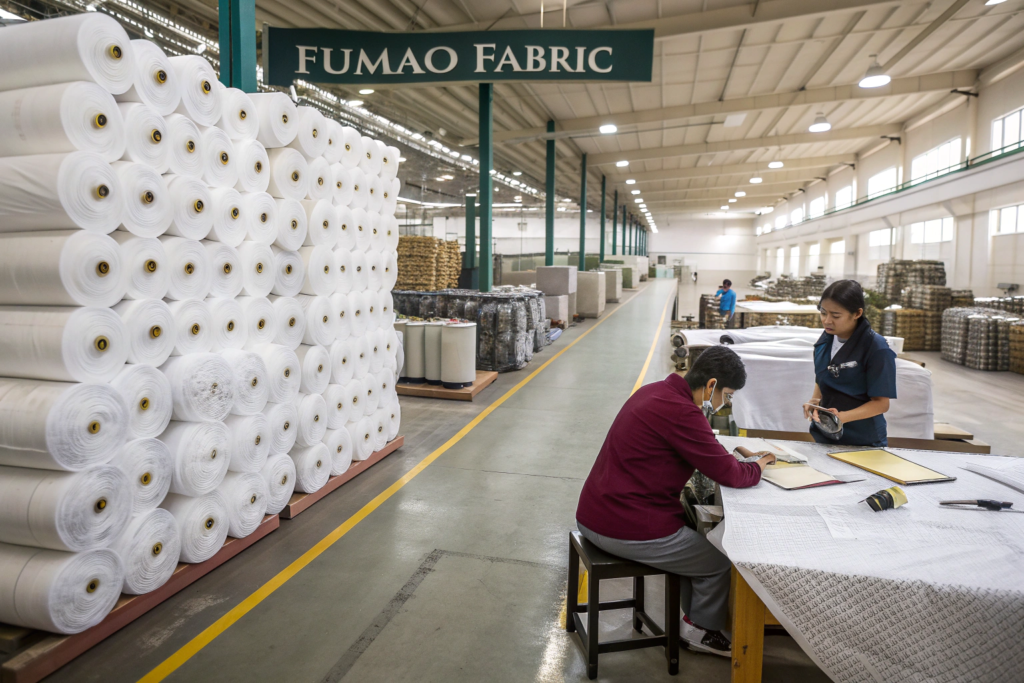
Let me be straight with you. If you want custom-woven fabric with your own yarn colors and construction, you're looking at 5,000-10,000 meters minimum. That's the reality of the weaving industry—setting up a loom is expensive, and mills need to run enough meters to justify the setup time.
But most gaming accessory creators don't need custom-woven fabric. You need custom-printed fabric, or you need small quantities of existing fabrics. That's where we come in. For existing fabrics we stock—velvets, canvases, faux leathers—we can sell as little as 50 meters. Sometimes less, depending on the fabric and our current inventory. For custom digital printing, our minimum is 100 meters per design, and we can combine multiple small designs into one production run to keep costs down.
Mei, the Etsy seller I mentioned, started with 50-meter orders of our velvet in five colors. That gave her enough fabric for about 200 bags per color—a full year's inventory when she was just starting. As she grew, her order sizes grew with us. We've never asked her to order more than she's ready for. This flexibility is why small creators should seek suppliers who understand the maker economy.
How can deadstock and overrun fabrics help small creators?
Deadstock—fabric that mills produced for other clients that was never used—is a goldmine for small creators. You get unique fabrics at discounted prices, often with no minimums. The downside is consistency. Once it's gone, it's gone. You can't reorder the same color.
We maintain a deadstock list that we share with our small-batch clients. When a major fashion brand cancels an order, we end up with 500 meters of amazing fabric that needs a home. We offer it to our gaming and accessory clients first. One of our regulars built an entire brand around "limited edition" dice bags made from deadstock designer fabrics. She sells them as collectibles, and her customers love that each batch is unique.
A Canadian creator bought 300 meters of a stunning jacquard velvet from us—leftover from a high-end fashion line. She made 600 dice bags and sold out in three months at $45 each. She's asked us repeatedly for more, but it's gone. That scarcity actually drives demand for her next find. If you're interested in finding deadstock fabrics, this sustainable fashion marketplace lists sources we sometimes work with.
What embellishment options work best for gaming accessories?
The fabric is just the beginning. What makes a dice bag truly yours is the embellishment—the logo, the artwork, the personal touch. Here's what works for different fabrics and scales of production.
Is embroidery worth the cost for small batches?
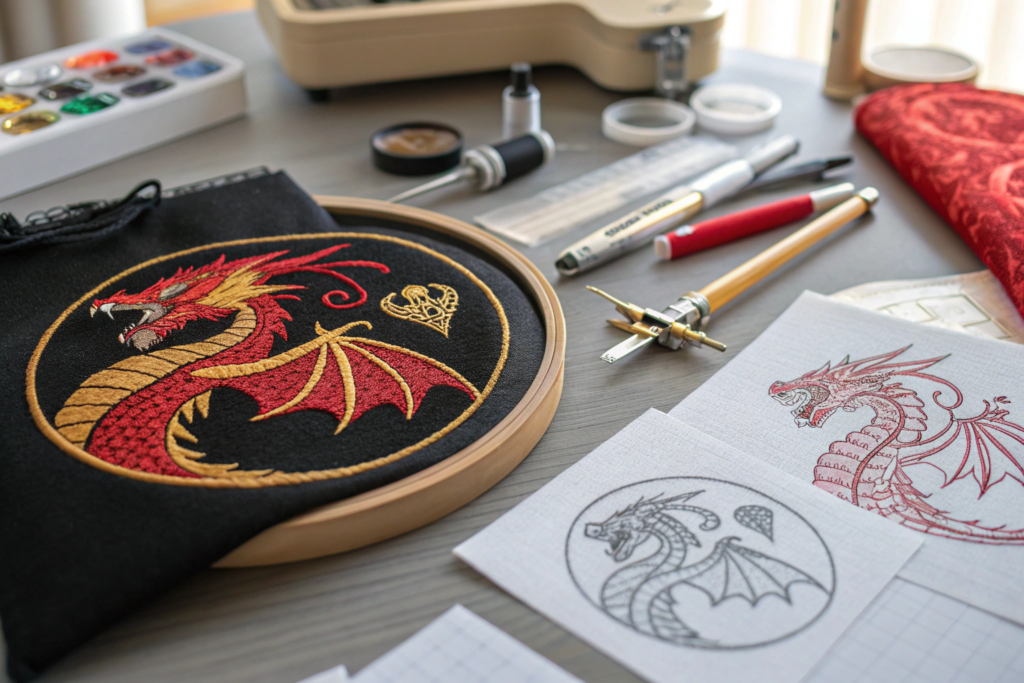
Embroidery looks premium because it is premium. It's durable, professional, and adds perceived value. For velvet and canvas bags, embroidery is excellent. The stitches sink into velvet beautifully, creating a dimensional effect. On canvas, embroidery stands proud and feels substantial.
The cost challenge is setup. Each embroidery design requires digitizing—converting the artwork into stitch instructions for the machine. That's a one-time cost of $50-150 depending on complexity. Then per-piece embroidery adds $2-5 depending on stitch count and size. For small batches of 50-100 pieces, that's manageable. For batches under 25, the setup cost per piece becomes high.
A UK gaming club ordered 30 embroidered bags from us for their tournament prizes. They wanted their club crest in gold and silver thread on burgundy velvet. The embroidery cost more than the bag itself, but these were trophies, not merchandise. The winners treasure them. We worked with an embroidery digitizing service that specializes in small runs, keeping their setup costs reasonable.
How does screen printing compare to heat transfer for fabric accessories?
Screen printing is the classic choice for canvas and cotton fabrics. It's durable, vibrant, and cost-effective once you're past the setup. The downside is minimums—most screen printers want to run at least 50-100 pieces to make setup worthwhile. For canvas dice bags, screen printing is perfect. The ink bonds with the fibers and lasts for years.
Heat transfer vinyl (HTV) or sublimation works better for smaller batches and for fabrics that can't be screen printed. Faux leather, for example, doesn't take screen printing well—the ink sits on top and cracks. HTV adheres beautifully. For polyester fabrics, sublimation printing gives you full-color, photographic images that become part of the fabric itself.
An Australian creator came to us wanting full-color fantasy artwork on polyester dice bags. We suggested sublimation printing. She sent us her artwork, we printed it onto transfer paper, and then heat-pressed it onto the finished bags. The results were stunning—vibrant, detailed, and permanent. She started with 25 bags for a Kickstarter campaign, and when it funded at 500%, we helped her scale to 300 bags for her backers. The sublimation printing guide from the Specialty Graphic Imaging Association covers the technical requirements we use for these projects.
How do I choose the right fabric weight and construction for my accessory?
Fabric weight isn't just a number—it's the difference between a bag that stands up proudly and one that slumps pathetically, between a playmat that lies flat and one that curls at the edges.

What fabric weight works best for dice bags?
For dice bags, the sweet spot is 7-10 ounces per square yard (240-340 grams per square meter). At this weight, the fabric has enough body to hold the bag's shape when empty, but it's still flexible enough to sew easily and gather nicely at the drawstring.
Lighter fabrics—4-6 ounces—work for lining or for very small bags, but they won't stand up on their own. Heavier fabrics—11 ounces and up—can be used, but you'll need stronger sewing machines and heavier thread. They also add weight to the final product, which matters if you're selling online and paying for shipping.
A client from Brazil ordered velvet from us for dice bags but specified a heavy weight—12 ounces. The bags were gorgeous but stiff, and the drawstring channel was difficult to sew. She switched to 8 ounces for her next order and was much happier. The lesson: heavier isn't always better. This fabric weight conversion chart from the Textile Institute helps our international clients specify exactly what they need.
How does fabric construction affect playmats and larger accessories?
Playmats require different thinking. They need to lie flat, resist curling, and provide a smooth surface for cards and dice. For playmats, we recommend fleece-backed fabrics or fabrics with some stability. A common construction is printed polyester face bonded to a non-slip rubber or foam backing—similar to mouse pad material.
For fabric-only playmats (washable, rollable), look for medium-weight canvas or twill with a tight weave. The tight weave prevents cards from snagging and provides a smooth surface. Some players prefer a slight texture—enough to keep cards from sliding, not enough to interfere with gameplay.
A US-based game publisher came to us for playmats for their new card game. They wanted something affordable enough to include in the game box but nice enough that players would use them. We developed a 100% polyester microfiber fabric with a printed game board design. The fabric is soft, washable, and prints with incredible detail. They've ordered over 50,000 units across three print runs. The key was finding a printer who could maintain color consistency across multiple batches, which we manage through our quality control systems.
How does Fumao Fabric help small creators navigate the sourcing process?
We've built our business on serving everyone from massive fashion houses to solo creators working from their kitchen tables. The needs are different, but the commitment to quality and communication is the same.

Can you help with prototypes and samples before full production?
Absolutely. In fact, we insist on it. For dice bags and gaming accessories, the sample phase is where you work out the kinks. We can provide fabric samples for $5-10 per swatch, including shipping. For made-up samples—actual bags sewn from your chosen fabric—we charge our cost plus a small handling fee, usually $50-100 depending on complexity.
The sample process typically takes 2-3 weeks. We'll make 3-5 prototypes with different fabric weights or embellishment options so you can compare them side by side. A Swedish creator went through four sample rounds with us before finalizing her design. Each round taught us something new—the first was too stiff, the second too floppy, the third had the wrong drawstring length, the fourth was perfect. She now sells that design in three colors and has expanded to matching playmats.
We document everything during sampling. Photos, measurements, notes on sewing challenges. This sampling checklist from the Council of Fashion Designers of America covers the process we follow with all new clients.
What's the typical timeline from order to delivery for small batches?
For stocked fabrics with standard embellishments, figure 4-6 weeks from order to shipment. That breaks down to:
- Week 1: Order confirmation, fabric cutting, embellishment setup
- Week 2-3: Production (printing, embroidery, etc.)
- Week 4: Quality control, packing
- Week 5-6: Shipping (assuming ocean freight to US/Europe)
For custom fabrics or complex embellishments, add 2-4 weeks. For air freight, subtract 2-3 weeks but add significantly to cost.
Seasonal factors matter. Chinese New Year shuts everything down for 3-4 weeks, so plan accordingly. Our slower periods (June-July, November-December) actually offer advantages—we can often turn orders faster because we're less busy.
A Canadian creator learned this the hard way when she placed her first order in January without asking about Chinese New Year. We explained the situation, helped her prioritize a small air shipment for her immediate needs, and produced the bulk order after the holiday. She now plans her launches around our production calendar. Shanghai Fumao provides all clients with a production calendar showing holiday closures and peak seasons so you can plan effectively.
What about sustainability in gaming accessories?
Gamers care about the planet too. We're seeing increasing demand for sustainable options in gaming accessories, especially from younger players and European markets.
What sustainable fabric options exist for dice bags?
Several, and we offer all of them:
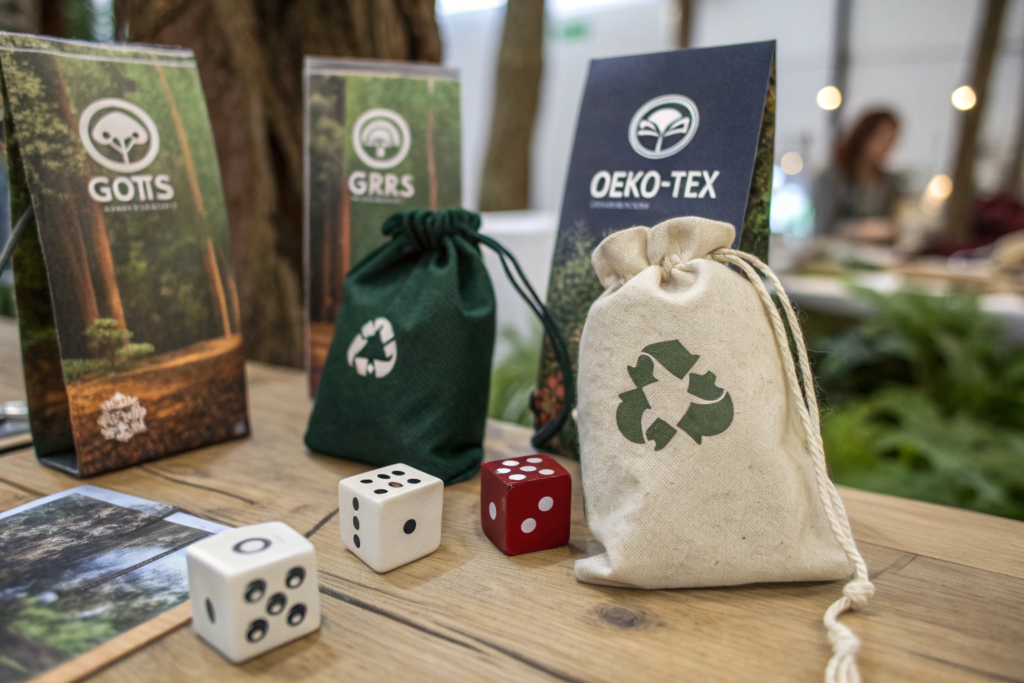
- Organic cotton canvas: GOTS-certified, grown without pesticides, perfect for printing and embroidery
- Recycled polyester velvet: Made from post-consumer bottles, soft and luxurious, available in rich colors
- Tencel/lyocell blends: From sustainably harvested wood pulp, biodegradable, with a silky hand
- Deadstock fabrics: Already produced, no new resources needed, unique and limited
A Dutch gaming cafe chain ordered 500 organic cotton canvas bags from us for their membership program. They screen-printed their logo with water-based inks and gave them to annual members. The bags are durable enough for daily use, and the sustainability story aligns with their cafe's values. They've reordered twice.
The cost premium for sustainable options varies. Organic cotton adds 20-30% to fabric cost. Recycled polyester is often comparable to virgin. Deadstock can actually be cheaper. We help clients understand the trade-offs between different sustainable certifications so they can make informed choices based on their budget and values.
How can I communicate sustainability to my gaming customers?
Be specific, not vague. Don't just say "eco-friendly." Say "made from 100% organic cotton certified by GOTS" or "fabric sourced from recycled plastic bottles, verified by GRS." Gamers appreciate details—they're used to reading rulebooks and understanding complex systems.
We provide all our sustainable fabric clients with:
- Certification documentation
- QR codes that link to traceability information
- Suggested language for product descriptions
- Images of the supply chain (farms, recycling facilities, our factory)
A UK-based dice maker includes a small card with every bag showing the bag's "sustainability story"—where the fabric came from, how much water was saved, what certifications apply. Their customers photograph these cards and share them on social media. It's free marketing and builds trust.
We've found that transparency about sustainability resonates with the gaming community, who value authenticity and are quick to call out greenwashing. Our approach is to provide verifiable facts and let the products speak for themselves.
Conclusion
Sourcing fabric for custom dice bags and gaming accessories doesn't have to be frustrating. Yes, the industry is built around large orders and long lead times. Yes, the options can be overwhelming. But with the right partner, you can navigate these challenges and create accessories that gamers will love and treasure.
At Shanghai Fumao, we've spent over 20 years building relationships with mills, perfecting our quality control, and learning to serve clients of all sizes. We've helped solo creators launch successful Etsy shops. We've helped established gaming companies scale their accessory lines. We've worked with velvet, canvas, faux leather, and everything in between. We know which fabrics sew well, which take embroidery best, and which will survive years of gaming sessions.
The key is starting with a clear vision, being realistic about timelines and costs, and working with a partner who understands your needs. Whether you're making 50 bags for a Kickstarter campaign or 5,000 for a retail launch, the fundamentals are the same: choose the right fabric, embellish it beautifully, and deliver quality that makes your customers proud.
Mei, the Etsy seller who started with 50 velvet bags? She just placed her largest order yet—2,000 units across six designs. She's opened a small studio and hired two seamstresses. She still calls me when she has questions about new fabrics or embellishment techniques. That's the relationship we build with every client, regardless of size.
Ready to bring your gaming accessories to life? Let's make it happen. Contact our Business Director, Elaine, directly at elaine@fumaoclothing.com. Tell her about your designs, your target quantity, and your timeline. She'll connect you with our small-batch specialists who can discuss fabric options, provide samples, and develop a production plan that fits your budget and schedule. Whether you're a solo creator or an established brand, we're here to help you create accessories that gamers will love.