You’ve been burned before. You approved a sample. It felt great. The color was perfect. You placed a bulk order. When the fabric arrived, something was off. The handfeel was different. The color was slightly off. The width varied from roll to roll.
What happened? The sample didn’t represent the bulk production.
I’ve seen this happen hundreds of times. Sometimes it’s the supplier’s fault. They made the sample with care and then cut corners on the bulk. Sometimes it’s the buyer’s fault. They didn’t specify the right requirements. They assumed the sample would automatically represent the bulk.
At Shanghai Fumao, we’ve spent 20 years learning how to make samples that actually represent bulk production. And we’ve learned that the process starts with the buyer. How you request the sample determines what you get.
Let me walk you through exactly how to request fabric samples that will give you confidence in your bulk order. I’ll cover the information you need to provide, the questions you need to ask, the tests you need to run, and the documentation you need to collect.
What Information Must You Provide with Your Sample Request?
The biggest mistake buyers make is assuming the supplier knows what they want. You send a photo of a fabric and say, “Send me a sample of this.” The supplier sends something close. You approve it. Then the bulk is different.
The supplier wasn’t trying to trick you. They just didn’t have enough information. They made assumptions. Those assumptions were wrong.
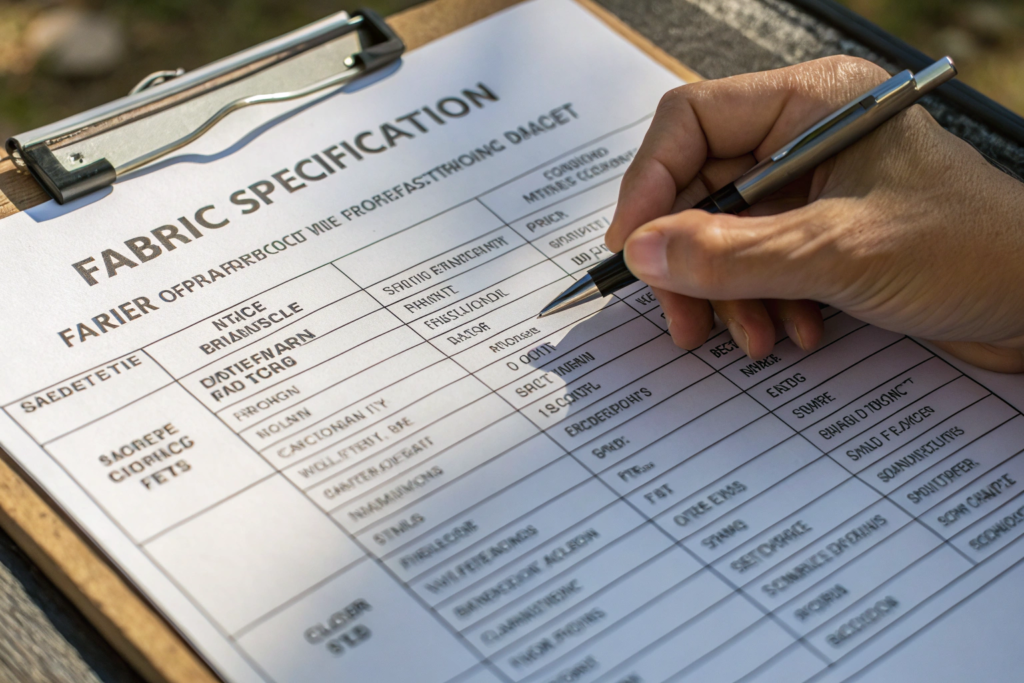
What Specifications Should You Include?
Here’s the minimum information you need to provide for a knitted or woven fabric sample request. Without these, you’re guessing.
| Specification | Why It Matters | Example |
|---|---|---|
| Fiber composition | Different fibers behave differently. A 95/5 cotton-spandex jersey is different from 100% cotton. | 100% combed cotton, 95% cotton/5% spandex |
| Weight (GSM) | Weight affects drape, opacity, and feel. A 150gsm tee is different from 200gsm. | 180gsm +/- 5% |
| Construction | Knit or woven? Single jersey, rib, interlock? Plain weave, twill, satin? | Single jersey, 24 gauge |
| Width | Finished width after finishing. Affects cutting yield. | 60 inches finished |
| Color | Pantone number or physical standard. “Red” is not enough. | Pantone 19-1664 TPX |
| Finishing | Softener? Anti-pilling? Wicking? Water repellent? | Standard softener only |
In 2023, a client from the US sent us a photo of a fabric and asked for a sample. He didn’t provide any specifications. We sent him our closest match—a 180gsm organic cotton jersey. He approved it. When the bulk arrived, he said, “This feels different from the sample.” We checked. The sample was 180gsm. The bulk was 180gsm. But he had assumed the sample was 200gsm based on a different fabric he had used before. The problem wasn’t our quality. It was his lack of specifications.
Now we require every sample request to include a full spec sheet. If a client can’t provide specs, we work with them to develop them. It takes more time upfront. But it saves problems later.
Should You Request a “Stock Sample” or a “Production Sample”?
This is a critical distinction that many buyers don’t understand.
A stock sample is a piece of fabric we already have in our warehouse. It was produced from a previous order or as a development piece. It represents what we can do. But it may not be exactly what you’ll get in bulk, because bulk will be produced from a new batch of yarn, a new dye lot.
A production sample is made specifically for your order, using the same yarn, the same dyeing process, the same finishing that will be used for bulk. This is the gold standard. But it takes longer and costs more.
If you’re ordering a stock fabric that we run regularly, a stock sample is fine. The bulk will be very close because we run the same spec repeatedly.
If you’re ordering a custom fabric, you need a production sample. It’s the only way to verify that the production process will deliver what you want.
A client from Germany learned this in 2022. He ordered a custom jacquard. He approved a stock sample that was close to his desired pattern. The bulk production used a different loom setup. The pattern came out slightly different. He was unhappy. Now he always requests a production sample for custom orders. It adds 2 weeks and a few hundred dollars. But it eliminates the risk.
How Many Sample Options Should You Request?
Don’t request just one sample. Request options. Ask for different weights, different finishes, different color variations.
The sample cost is small compared to the cost of a bad bulk order. Spend a little more upfront to explore the options. You might find that a slightly different fabric works better for your garment.
In 2023, a client from Australia requested samples of three different weights of organic cotton jersey—160gsm, 180gsm, and 200gsm. She also requested two different softener levels. She tested all six options with her pattern maker. She chose the 180gsm with the lighter softener. She placed a 10,000-yard order. She told me, “The sample cost was $200. It saved me from ordering the wrong weight. That’s the best $200 I’ve spent.”
What Questions Should You Ask the Supplier About the Sample?
The sample itself tells you part of the story. But the supplier’s answers to your questions tell you the rest. You need to ask about how the sample was made, because that determines whether the bulk will match.

How Was the Sample Produced?
Ask specifically: Was this sample made on production equipment or on sample equipment?
Sample knitting machines and sample dyeing equipment are different from production machines. They’re smaller. They’re more precise. A sample made on sample equipment might look perfect, but the production run on large equipment might have variations.
A good supplier will be honest about this. At Shanghai Fumao, we tell our clients exactly how each sample was produced. For standard fabrics, we use production equipment. For complex custom fabrics, we sometimes use sample equipment for the initial sample, then run a production sample once the specs are locked.
In 2022, a client from Canada asked for a sample of a complex rib knit. We produced it on a sample machine. He approved it. When we ran bulk on a production machine, the rib was slightly tighter. We caught it during our pre-production run. We told the client. He adjusted his pattern. The bulk order was fine. But if we hadn’t told him, he would have been surprised.
Ask the question. A supplier who avoids answering is hiding something.
What Yarn Batch Was Used for the Sample?
For custom fabrics, ask what yarn batch was used for the sample. Then ask if the bulk will use the same yarn batch or a different one.
Yarn can vary between batches. Different lots of the same yarn specification can have slight differences in color, thickness, or strength. A good supplier will test the bulk yarn against the sample yarn.
At Shanghai Fumao, we keep a retained sample of every yarn batch we use. When we run bulk, we compare the new yarn to the retained sample. If there’s a difference, we tell the client before production starts.
What Dyeing and Finishing Parameters Were Used?
For colored or finished fabrics, ask for the dyeing and finishing parameters. Temperature. Time. Chemical concentrations.
A sample might be dyed with extra care—longer dye cycles, more precise temperature control. Bulk production might use shorter cycles to save time. The color could shift.
Ask your supplier to document the parameters. Then ask if the bulk will use the same parameters. A quality supplier will say yes. A supplier who says “close enough” is a risk.
How Should You Test the Sample to Predict Bulk Performance?
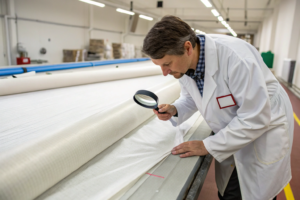
Looking at a sample and feeling it is not enough. You need to test it. The tests you run on the sample will predict how the bulk will perform. If the sample fails a test, the bulk will fail too. Better to fail a small sample than a large bulk order.
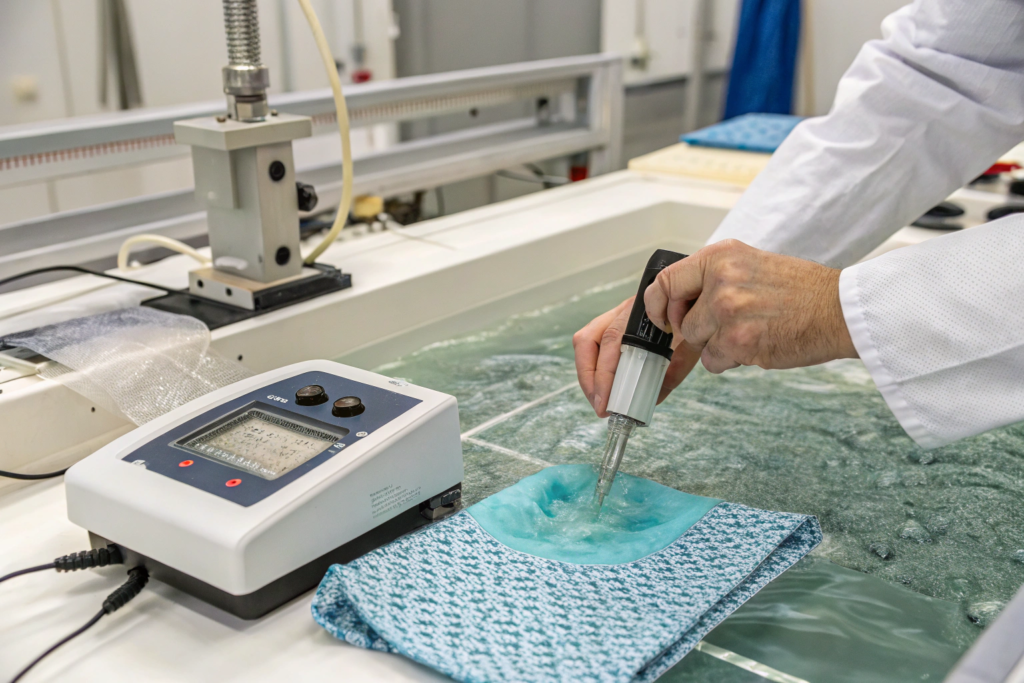
What Tests Should You Run on the Sample?
Here are the tests we recommend for every knitted or woven fabric sample:
Shrinkage Test
Cut a 12x12 inch piece. Measure it. Wash it according to the care label instructions. Dry it. Measure again. The shrinkage percentage tells you how the fabric will behave in production and in the customer’s home.
For most cotton knits, acceptable shrinkage is under 5%. For high-quality basics, under 3%. If your sample shrinks 8%, the bulk will too.
Pilling Test (Martindale)
This test rubs the fabric in a circle for a set number of cycles. After 2,000 cycles, look at the surface. How many pills? A rating of 3 or higher (on a 1-5 scale) is acceptable for most applications.
If your sample pills badly, your garments will look old after a few wears.
Colorfastness Tests
Wash a piece with a white multifiber fabric. Does the color bleed onto the white? Rub a wet white cloth on the fabric. Does the color transfer? Both tests should score 4 or higher on the grey scale.
For dark colors, especially reds and blacks, test twice. These colors are most likely to bleed.
Tensile Strength and Tear Strength
Pull the fabric until it breaks. How much force does it take? A weak fabric will tear during cutting and sewing, causing production delays and waste.
Weight and Width
Weigh a square meter of the sample. Measure the width. Are they within your specifications? If the sample is 180gsm but you need 200gsm, the bulk won’t magically be heavier.
In 2023, a client from the UK requested a sample of what we said was a 220gsm French terry. He didn’t test it. He trusted our spec. He placed a 5,000-yard order. When the bulk arrived, his factory measured it at 205gsm. He was unhappy. We checked our records. The sample was 220gsm. The bulk was 220gsm. But his measurement method was different. If he had tested the sample with his method, he would have seen the discrepancy and we could have aligned our measurement standards.
Test the sample with your own methods. Don’t assume.
Should You Pay for Third-Party Testing?
For critical orders, yes. A third-party lab like SGS or Intertek provides an unbiased assessment. They’ll test according to international standards. They’ll give you a report you can trust.
The cost is usually a few hundred dollars. That’s cheap insurance against a bad bulk order.
A client from the US requires third-party testing on every sample before she places a bulk order. She told me, “I’ve been burned too many times. Now I pay for the test. If the sample passes, I order. If it fails, I find another supplier. The test cost is nothing compared to the cost of redoing a collection.”
What Tests Can Your Supplier Run In-House?
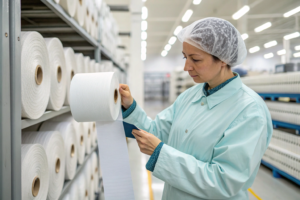
Ask your supplier what tests they can run in-house. A quality supplier will have a lab. They’ll test their own samples. They’ll share the results with you.
At Shanghai Fumao, we have a CNAS-accredited lab. We test every sample before we send it. We share the test report with the client. That way, you know what you’re getting before you approve.
If a supplier can’t run basic tests, be careful. They’re not controlling their quality. And if they’re not controlling it on samples, they’re definitely not controlling it on bulk.
How Do You Document Sample Approval for Bulk Consistency?
You’ve tested the sample. You’re happy with it. Now you need to lock it in. Without proper documentation, the sample approval is just a memory. And memories fade.
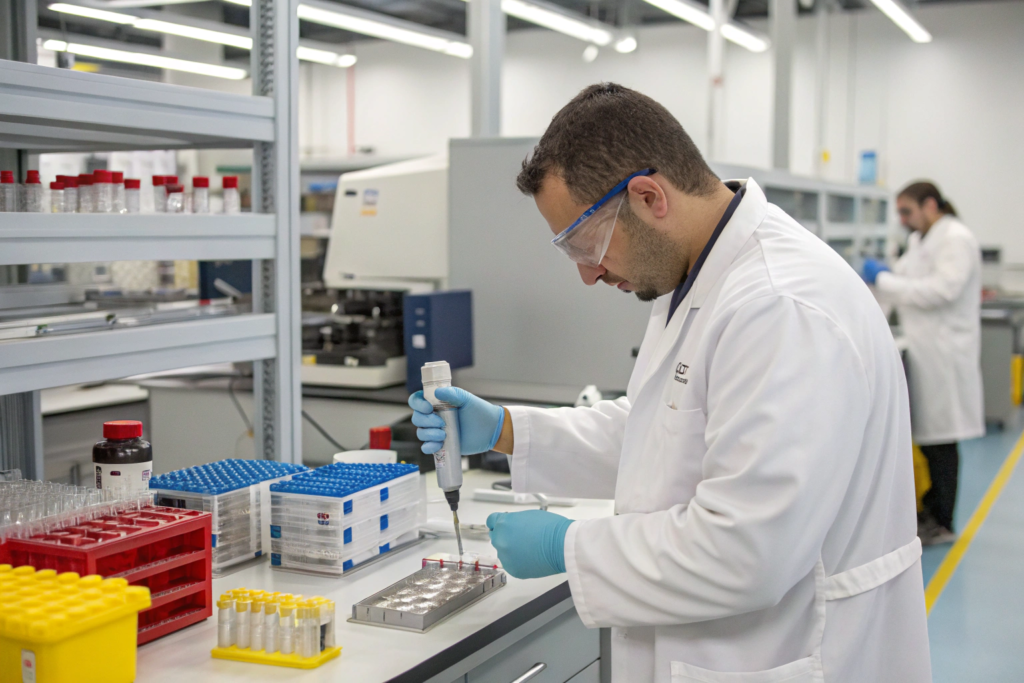
What Is a “Golden Sample” and Why Do You Need One?
A golden sample is a physical piece of the approved sample that both you and the supplier keep. It becomes the reference for bulk production.
When the bulk is produced, the supplier compares it to the golden sample. If the bulk matches the golden sample, it’s approved. If it doesn’t, it’s rejected.
At Shanghai Fumao, we keep a golden sample for every custom order. It’s sealed in a bag with the date, the client name, the order number, and the specifications. It’s stored in a controlled environment. When we run bulk, we pull the golden sample and compare.
A client from Sweden told me, “My previous supplier lost my golden sample. The bulk came in, and they had nothing to compare it to. They said it looked right. It didn’t. Now I send two golden samples. One for the supplier. One for me. And I require a photo of the bulk next to the golden sample before shipping.”
That’s a good practice. Ask for a photo of the bulk fabric next to the golden sample. If the colors match in the photo, they’ll match in person.
What Should Be in Your Sample Approval Document?
Your sample approval document should include:
- Date of approval
- Sample identification number
- Fabric specifications (fiber, weight, width, construction)
- Color standard (Pantone number or physical standard)
- Finishing details
- Test results (shrinkage, pilling, colorfastness)
- Signatures from both buyer and supplier
This document is your contract for quality. If the bulk doesn’t match the approved sample, you have recourse.
How Do You Handle Color Approvals Separately?
Color is often approved separately from construction. You might approve a lab dip before the fabric is even knitted.
For color approvals, ask for a lab dip on the actual fabric that will be used for bulk. A lab dip on a different fabric might look the same, but the dye uptake could be different.
Also ask for the spectrophotometer reading. A delta E of less than 1.0 is a good match. If the supplier is matching visually, ask for a photo of the lab dip under standardized lighting.
In 2022, a client from France approved a lab dip based on a photo. The bulk color was different. The lighting in the photo had been warm, making the color look different. Now she requires a physical lab dip shipped to her. It takes an extra week. But the color matches every time.
Conclusion
Requesting a fabric sample that actually represents bulk production is not complicated. But it requires discipline. You need to provide detailed specifications. You need to ask the right questions. You need to run the right tests. You need to document the approval.
Most buyers skip some of these steps. They’re in a hurry. They assume the supplier will figure it out. They hope for the best. And then they’re surprised when the bulk doesn’t match the sample.
At Shanghai Fumao, we help our clients do it right. We provide spec sheets. We document our sample production methods. We run tests and share results. We keep golden samples. We compare bulk to sample before shipping. We do everything we can to ensure that what you approve is what you get.
But we need your help. The more information you provide upfront, the better the sample. The more questions you ask, the fewer surprises. The more testing you do, the more confidence you have.
If you’re ready to request a sample the right way, I want you to reach out to our Business Director, Elaine, at elaine@fumaoclothing.com. Tell her what you’re making. Send her your specifications. She’ll walk you through our sample process. She’ll answer your questions. She’ll send you a sample that you can trust.
Don’t guess. Don’t hope. Test. Document. Approve. Then order with confidence.