You've spent months—and a significant budget—developing a revolutionary fabric: a unique jacquard pattern inspired by ancient art, a proprietary blend that changes color with body temperature, or a seamless knit construction that eliminates side seams. You send your precious tech packs and samples to a potential supplier for quoting. Weeks later, you see your exact design being advertised by a competitor at half the price. This nightmare scenario isn't just paranoia; it's a tangible risk in the global textile industry where copying is often easier than innovating. Your custom fabric is more than material; it's your competitive edge, and losing control of it can be catastrophic.
So, how can you protect your intellectual property when developing custom fabrics? True protection is not a single legal document, but a layered strategy combining legal safeguards, strategic sourcing practices, and meticulous process control. It involves using Non-Disclosure Agreements (NDAs) correctly, registering design rights where possible, carefully structuring your tech packs, and choosing partners whose business model values long-term collaboration over short-term copying. You must build a fortress, not just lock a single door.
Protecting IP in China and other manufacturing hubs is challenging but entirely possible with the right approach. It requires moving from a naive "trust-based" model to a professional "verify and control" model. The goal isn't to eliminate all risk—that's impossible—but to make copying more difficult, less profitable, and legally dangerous for anyone who tries. Let's build your IP defense plan, step by step.
What Legal Tools and Registrations Are Available?
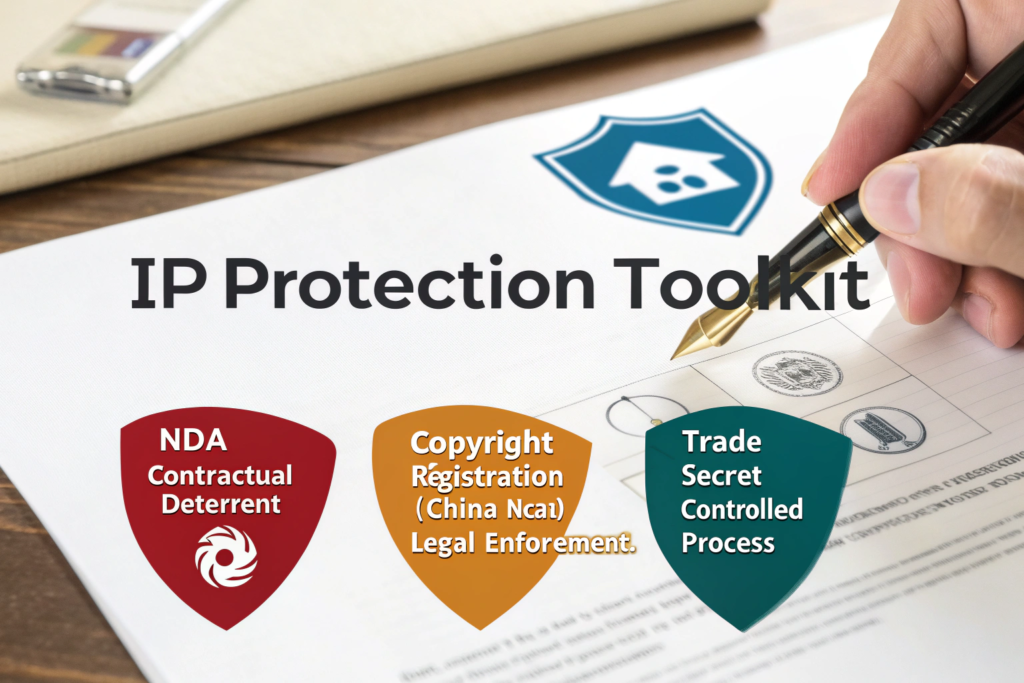
Before you disclose a single sketch, you need to understand the legal tools at your disposal. Intellectual Property for textiles can be fragmented across copyright (for artistic prints), design patents (for ornamental patterns), and trade secrets (for proprietary processes or blends). Relying on a single method is like having a lock on your front door but leaving the windows open. The most effective strategy uses a combination tailored to the type of IP you've created.
In many jurisdictions, including the EU and US, you automatically hold copyright to an original artistic work (like a print design) the moment it's fixed in a tangible medium. However, enforcing that right requires registration in some countries, like China. Knowing where and how to register is half the battle.
Are Non-Disclosure Agreements (NDAs) Effective in China?
The short answer is yes, but their power is often misunderstood. An NDA is a crucial first step—it legally defines your confidential information and creates a contractual obligation for the supplier to keep it secret. However, its real value is as a deterrent and a tool for legal recourse after a breach has occurred. To make an NDA meaningful:
- Make it Specific and Mutual: It should clearly list what is confidential (e.g., tech packs, CAD files, samples, cost breakdowns). A mutual NDA (binding both parties) is often more readily accepted.
- Ensure it's Signed by the Right Entity: The NDA must be with the actual factory that will produce the fabric, not just a trading company middleman. Get the factory's official company chop (stamp).
- Governing Law and Jurisdiction: Stipulate that disputes will be resolved in a court you can realistically access (e.g., Hong Kong, Singapore, or your home country). A clause stating disputes will be settled in Chinese court under Chinese law is standard, but having a neutral venue can be advantageous.
We had a client, a UK print studio, who only used an NDA with a Hong Kong trading agent. When their print showed up elsewhere, they had no legal recourse against the mainland factory. Now, we facilitate direct NDA signing between our clients and our partner mills, ensuring a clear chain of responsibility. Understanding the practical enforcement of NDAs in Asian manufacturing is critical.
Should You Register Copyrights or Design Patents?
This depends on what you've created.
- Copyright Registration (for Prints & Patterns): In China, copyright is not automatically enforced for non-artistic industrial designs. You must register your 2D artwork/pattern with the China National Copyright Administration (NCA). This gives you a strong, enforceable certificate. The process takes 2-3 months and is relatively inexpensive. It's the single most important step for protecting graphic prints.
- Design Patent (for 3D Ornamental Designs): If your fabric has a unique, non-functional 3D texture or construction (e.g., a specific raised jacquard structure), you can file for a design patent. This is more expensive and time-consuming (12-18 months) but offers stronger protection against lookalikes.
- Trade Secret (for Processes & Blends): Your proprietary dye recipe, fiber blend ratio, or finishing process can be protected as a trade secret. This requires you to prove you took reasonable steps to keep it secret—hence the importance of NDAs and controlled disclosure.
A French luxury brand we work with registers the copyright for every major seasonal print in both the EU and China. In 2022, they successfully had a Chinese e-commerce listing taken down by presenting their NCA certificate to the platform. The take-down was swift because they had the locally recognized documentation. Learning about copyright registration for textile designs in key markets is a non-negotiable business expense for design-led brands.
How to Structure Your Tech Pack for Maximum Security?
Your tech pack is the DNA of your fabric. It's also the single most valuable document you share, containing all the information needed to replicate it. Therefore, you must design your tech pack to be both a precise manufacturing guide and a security-conscious document. The goal is to provide enough information for your chosen partner to produce the fabric perfectly, while withholding the "secret sauce" or making it incomplete for anyone else.
Think of it as giving a chef a recipe but keeping the exact source of a rare spice or a specific stirring technique a secret. A well-structured tech pack balances transparency for production with opacity for IP protection.
What Information Should You Withhold or Obfuscate?
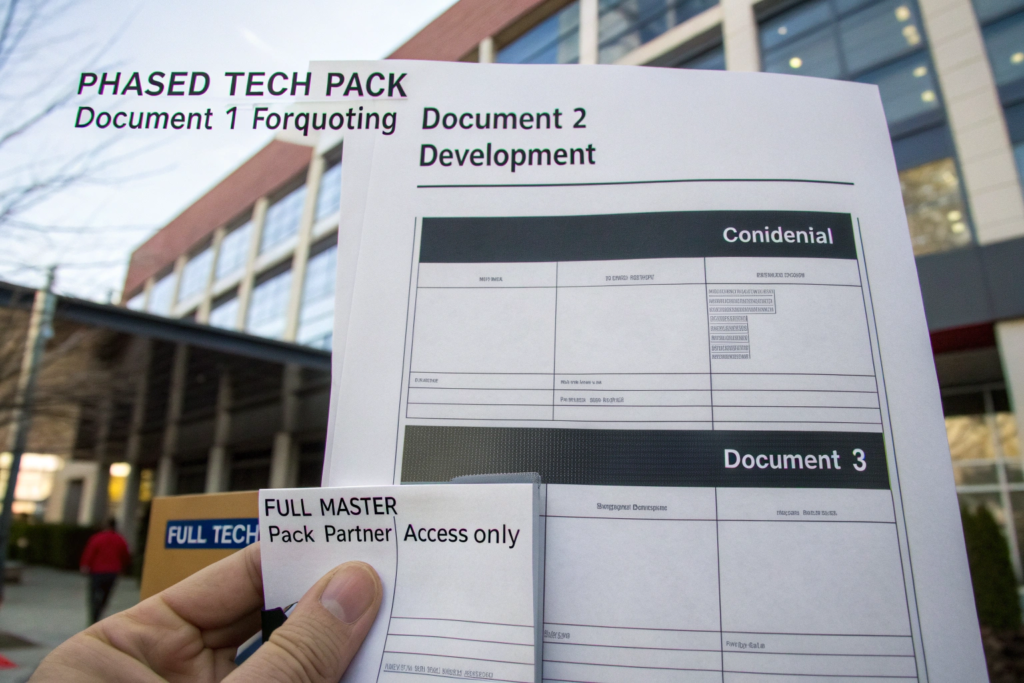
Never send your "master file" with all details upfront. Instead, use a phased disclosure approach:
- Initial Sourcing/Quoting Phase: Send a "Reduced Specification Sheet." This includes visual references (low-res images of the pattern or texture), general hand feel description, target weight (GSM), and basic composition (e.g., "wool blend"), but not the exact blend percentages, yarn suppliers, or detailed construction drafts.
- After Partner Selection & NDA: For development, provide more detail but consider:
- Blend Ratios: You can provide these to the chosen mill but ask them to source the yarns. Don't disclose your direct yarn supplier contacts.
- Construction Details: For weaves, you might provide a visual diagram but not the full digital loom file (.EP). For knits, specify gauge and structure without the full programming.
- Dye Formulas & Finishes: These are the crown jewels. A trustworthy mill will develop these for you. The final, optimized formula should be kept as a trade secret between you and that mill.
A Los Angeles-based performance brand developed a cooling fabric using a phase-change material (PCM) capsule technology. In their tech pack for development with our partner mill, they specified the required cooling effect and provided the PCM capsules directly, but the method of embedding them into the fiber matrix was developed collaboratively and kept as a joint secret. This is a prime example of safeguarding proprietary textile technology during co-development.
How Can Digital Watermarking and Controlled Samples Help?
Technology adds another layer of control.
- Digital Watermarking: Embed a subtle, invisible digital code into the CAD files of your prints. If the design is copied, the watermark can prove origin. Some platforms now scan for these.
- Controlled Sampling: When you receive strike-offs or lab dips, number them and keep a record. If a copycat factory produces your design, a matching sample number can be evidence of a leak from a specific source.
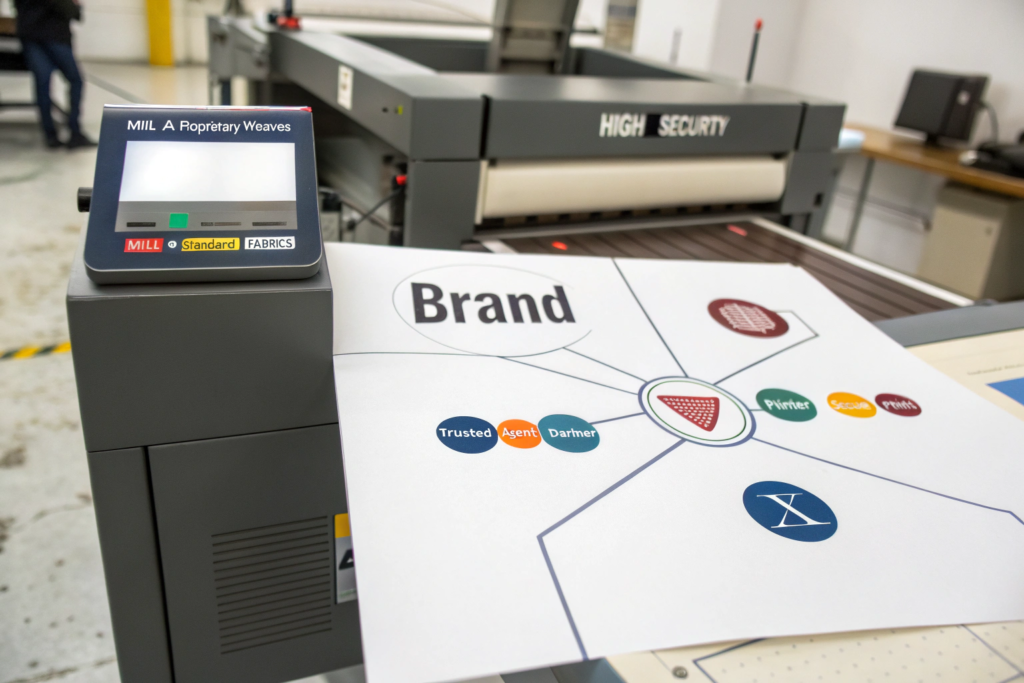
More strategically, work with a vertically integrated supplier or a trusted agent who controls the chain. When you partner with a company like Shanghai Fumao, we act as your firewall. Your full tech pack is shared with us under NDA. We then manage the communication with sub-suppliers (weavers, dyers, printers), disclosing only the necessary information to each. The dyer never sees the full weave draft; the weaver never gets the dye formula. This compartmentalization is a powerful, practical form of protection.
What Are the Strategic Sourcing Practices for IP Safety?
Your choice of partner is your most important IP protection decision. A supplier with their own R&D capabilities and a reputation to protect is far less likely to steal your idea than a generic factory competing solely on price. You need to look for partners who see you as a collaborator in value creation, not just a one-time order.
Conduct due diligence not just on capacity and quality, but on business ethics and client portfolio. Ask for references from other international brands they've done custom development for. A factory that proudly produces for well-known brands has more to lose from an IP scandal than they could gain from copying a small startup.
How to Vet a Supplier for IP Integrity?
Go beyond certificates. Ask direct questions:
- "What is your process for handling client-confidential designs?" A good answer will mention secure servers, limited access, and NDAs with their own staff.
- "Can you provide examples of successful long-term custom development partnerships?" Look for case studies, not just generic statements.
- "Do you have an in-house R&D team?" A supplier that invests in their own innovation is more likely to respect yours. They understand the cost and effort involved.
- "What measures do you take to prevent cross-contamination of designs between clients?" This is about physical and digital file management on their factory floor.
Visit if possible, even virtually. A factory tour can reveal if samples and tech packs are left openly on desks or are stored securely. In 2023, a Danish brand used a video audit we facilitated. They were impressed that our sampling lab required badge access and that work-in-progress samples were in locked cabinets. This tangible evidence built immediate trust. Resources on conducting ethical audits of overseas manufacturers often include IP management questions.
Why is Diversification and Relationship Building Key?
Don't put all your eggs—or all your secret formulas—in one basket.
- Compartmentalize Production: Use one highly trusted mill for your most critical, proprietary fabric development. For more standard items, you can use other suppliers. This limits exposure.
- Build a True Partnership: Pay fairly, be loyal, and communicate openly. A factory that sees a long-term, profitable future with you is your strongest ally against IP theft. They will protect your secrets to protect the relationship.
- Use an On-the-Ground Agent: A reputable local agent (like us) acts as your eyes, ears, and enforcer. We have the language skills, cultural understanding, and legal connections to monitor production and address issues swiftly. We have intervened in situations where a sub-contractor was suspected of running extra shifts for the gray market, immediately moving production to a more secure facility.
An Australian swimwear brand keeps their signature digital print files only on our secure server. The printing is done at a mill we exclusively manage for them. The cut-and-sew factory only receives pre-printed fabric, never the digital files. This supply chain segmentation is a textbook strategy for managing IP risk in segmented apparel production.
How to Monitor and Enforce Your Rights Post-Development?
Protection doesn't end when your bulk order ships. You must actively monitor the market for infringements and be prepared to enforce your rights. In today's digital world, copycats can appear on global marketplaces like Amazon, AliExpress, or Instagram within weeks. A proactive monitoring and enforcement plan is your final line of defense.
Enforcement in international markets is daunting, but not impossible. It requires a combination of digital tools, local legal resources, and the willingness to act decisively. Sometimes, a single, well-documented cease-and-desist letter from a local lawyer is enough to stop a small-scale infringer.
What Tools Can Help Detect Infringements?
- Reverse Image Search: Use Google Lens, TinEye, or Alibaba's image search regularly to see if photos of your products or fabrics appear elsewhere.
- Marketplace Monitoring: Set up alerts for key product names, design descriptions, or even your own brand name on sites like 1688.com (China's domestic B2B platform), AliExpress, and Amazon.
- Specialized IP Firms: In China, there are law firms and agencies that specialize in IP monitoring and enforcement. For a retainer, they will scan markets and send takedown notices on your behalf.
A client discovered their unique heat-transfer floral print on dresses being sold on a US fast-fashion website. Using the date-stamped copyright registration certificate and purchase records from their own production, their lawyer sent a Digital Millennium Copyright Act (DMCA) takedown notice to the website's host. The listing was removed within 48 hours. This is the power of having your legal paperwork in order for enforcing design rights against online copycats.
What Steps Can You Take if You Find a Copy?
- Gather Evidence: Screenshots, purchase receipts of the infringing product, links. Document everything.
- Trace the Source: Can you link it back to a specific factory or region? Does the copy match a specific sample round you sent out?
- Engage Local Counsel: In the country where the infringement is happening. They understand the local legal system and can send the most effective cease-and-desist letters.
- Platform Takedowns: For online sales, use the platform's own IP complaint system (e.g., Amazon Brand Registry, Alibaba IP Protection Platform). These can be very effective.
- Leverage Your Supplier Relationship: If the copy is traced to a region where your supplier operates, a serious partner will investigate internally. They have a vested interest in rooting out bad actors within their network.
Remember, the cost of enforcement is a business decision. For a major, damaging infringement, legal action may be warranted. For a small, obscure copy, a takedown notice may suffice. The key is to have the option and to show that you are vigilant and willing to act.
Conclusion
Protecting your intellectual property in custom fabric development is an active, multi-layered discipline that blends legal strategy, process design, and relationship management. There is no single silver bullet, but a synergistic system of registered rights, controlled disclosure, strategic partnering, and vigilant enforcement. By moving from a passive to a proactive stance, you transform your IP from a vulnerable secret into a defensible, valuable business asset.
The journey requires diligence, investment, and choosing partners who align with your values. It's about building a ecosystem where innovation can thrive securely. In the complex global textile landscape, your IP protection plan is as critical as your design itself.
If you are developing custom fabrics and need a partner who understands and prioritizes IP protection, we are structured to be your secure bridge to manufacturing. At Shanghai Fumao, we implement stringent confidentiality protocols, facilitate proper legal agreements, and manage a compartmentalized supply chain to safeguard your innovations. Let's discuss how we can help you bring your most valuable ideas to market with confidence. Contact our Business Director, Elaine, at elaine@fumaoclothing.com to start a secure and collaborative partnership.