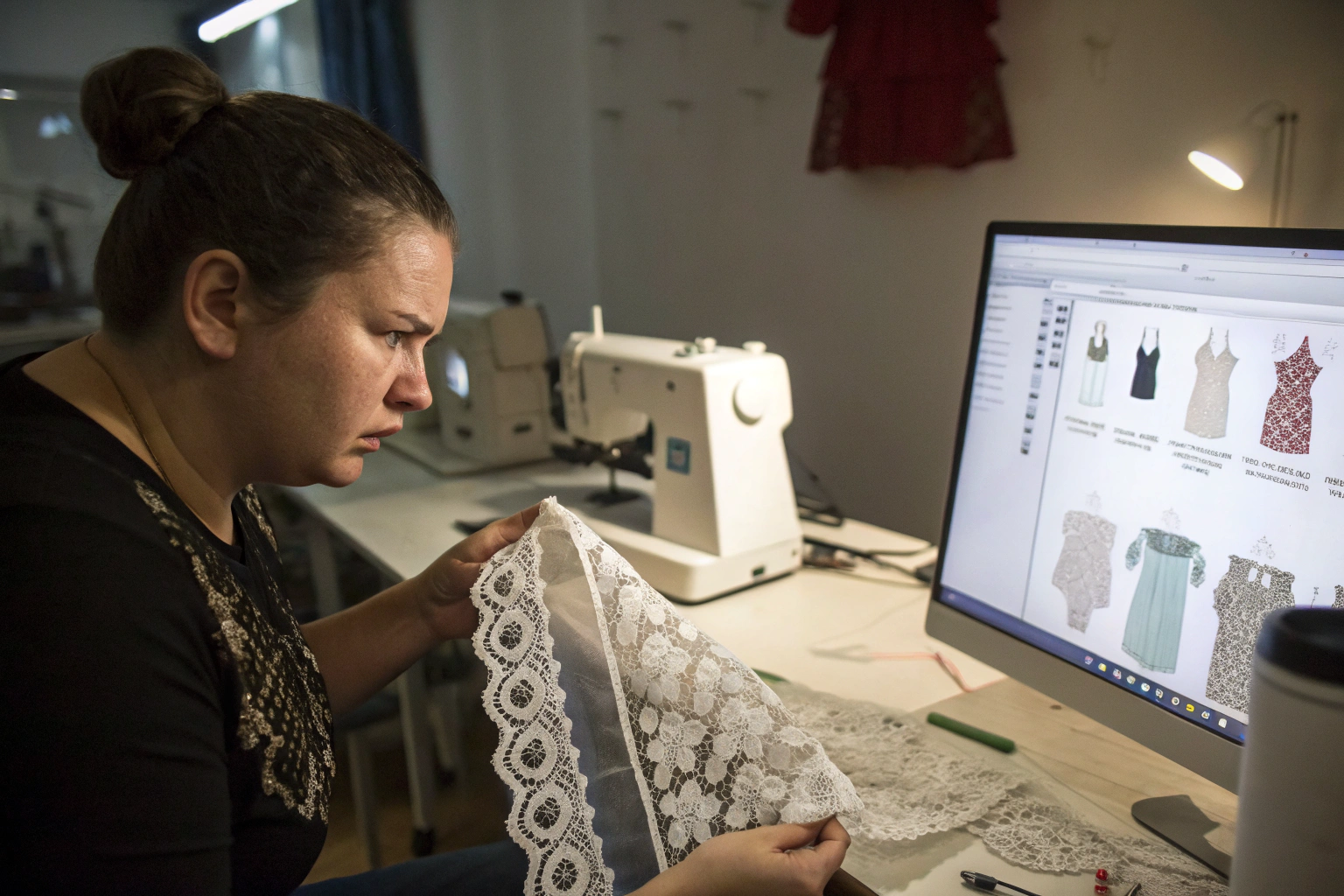
You’ve spent months, maybe years, developing a unique lace pattern. It’s the cornerstone of your brand’s identity. You finally find a manufacturer, send over your tech packs, and launch your collection. Then, six months later, you see your exact lace design—or a painfully obvious copy—on a fast-fashion website at a fraction of your price. Your heart sinks. This isn’t just about lost sales; it’s about your creative soul being commoditized. The problem is stark: the global supply chain is a leaky sieve for intellectual property (IP), and lace designs, sitting at the intersection of art and industrial product, are notoriously vulnerable.
Protection isn’t about finding a single magic legal bullet. It’s about building a multi-layered defense system that combines legal strategy, technical safeguards, and rigorous partner management. You must operate on the assumption that your design will be copied and put barriers in place that make it difficult, risky, and ultimately less profitable for others to do so. The goal is to create enough friction that copycats move on to easier targets.
At Shanghai Fumao, we’ve been on both sides of this table. We’ve had clients whose designs were stolen, and we’ve implemented systems to protect our own proprietary lace developments. The reality in manufacturing hubs like Keqiao is complex, but actionable strategies exist. Let me guide you through the practical steps to shield your lace designs, from the drawing board to the factory floor.
What Legal Protections Are Available for Lace Patterns?
First, understand your legal tools. Lace designs often fall into a grey area between copyright (protecting artistic works) and design patents (protecting ornamental designs of functional items). The most effective approach uses both, plus contractual muscle. Relying on a single method is like locking your front door but leaving the windows wide open.
Think of it as a legal ecosystem. Copyright is broad but can have enforcement gaps for functional aspects. Design patents are strong but expensive and slow. Trademarks protect your brand identity associated with the design. Your Non-Disclosure Agreement (NDA) and supply contract are your immediate, on-the-ground enforcement tools. You need all of them working together.
Copyright vs. Design Patent: Which is Stronger for Lace?
This is the core question. They protect different things in different ways.
| Protection Type | What it Covers | Pros | Cons | Best For |
|---|---|---|---|---|
| Copyright | The original 2D artistic expression of the pattern itself. | Automatic upon creation (in many jurisdictions), inexpensive, lasts a long time (life + 70 yrs). | Can be weak against "inspired by" copies if only small elements are taken. Vague on 3D application to fabric. Enforcement can be complex internationally. | The pattern artwork on paper/screen. The specific artistic arrangement of florals, geometries, etc. |
| Design Patent | The ornamental, non-functional design of the lace as applied to an article of manufacture (e.g., fabric, garment). | Very strong protection. Covers the overall look. Infringement is easier to prove if the "ordinary observer" would confuse the two. | Expensive ($2k-$5k+ per design), slow (12-24 months to grant), must be novel and non-obvious. Limited term (15 years in US). | A truly novel, signature lace that is a key brand identifier and has a long commercial life. |
The Strategic Move: Use copyright as your baseline, automatic protection for all designs. For your flagship, iconic lace patterns—the ones that define your brand—invest in a design patent. A European luxury brand we collaborate with patents every major jacquard and lace innovation; it’s a core part of their IP budget.
For foundational knowledge, the U.S. Copyright Office's guide on fabric designs is essential reading. To understand the patent process, the World Intellectual Property Organization (WIPO) resources on industrial designs provide an international perspective.
The Critical Role of Non-Disclosure Agreements (NDAs)
Your NDA is your first line of contractual defense. It must be signed before you disclose any design details.
- Key Clauses for Lace: It must clearly define "Confidential Information" to include tech packs, CAD files, weave/knit specifications, and sample swatches. It should prohibit reverse engineering and restrict the supplier from using your design for any other client. Crucially, it must have a jurisdiction clause stating disputes will be resolved in a court favorable to IP holders (e.g., your home country or a recognized commercial court).
- Reality Check: In China, a well-drafted, Chinese-language NDA is more enforceable than an English one. We provide bilingual NDAs to our clients at Shanghai Fumao because we understand local legal nuance. Enforcing it is still hard, but its presence deters casual misconduct and gives you a clear cause of action.
How to Secure Your Supply Chain from Design Leaks?
The law sets the rules, but security is about controlling the flow of information. Your design is most vulnerable inside the factory that produces it. A holistic security protocol treats your design files like trade secrets and limits access at every stage.
The "Need-to-Know" Principle in Tech Pack Sharing
Never send your full, detailed tech pack to a salesperson. Break it into segments.
- For Quotation: Send a redacted tech pack with blurred or missing critical details (e.g., exact yarn density, proprietary finish formula, full repeat dimensions). Include a low-resolution, watermarked image of the lace.
- For Approved Partner Only: After NDA signing and vetting, release the full tech pack through a secure portal (not email). Services like Dropbox Business or Tresorit allow you to control access and track downloads.
- Physical Sample Control: Mark all physical samples with a unique, hidden code (e.g., a UV-ink dot or a specific thread color in the selvedge). This allows you to trace any leaked sample back to the specific batch you sent to a particular factory. We implemented this for a client whose lace was leaked; the hidden code in the copied fabric traced it directly to a specific dyeing mill sub-contractor, leading to immediate termination.
Can You Use Split Manufacturing to Protect Your Design?
Yes. This is a powerful, though logistically complex, strategy. Don't let a single factory have the complete "recipe."
- How it Works: Separate the production stages. Use Factory A only for weaving or knitting the base lace ground (a generic, non-proprietary net). Then, send the base fabric to Factory B for the proprietary embroidery, printing, or specialty finishing. Factory B never sees how the base was made, and Factory A never sees the final design application.
- Example: A client created a unique burn-out lace by having one mill produce a standard polyester-cotton blend fabric, then sending it to a specialized chemical etching facility (our partner) that used their proprietary acid formula to create the pattern. Neither party had the full capability to replicate the end product alone.
- The Trade-off: This increases coordination complexity, logistics cost, and lead time. It’s reserved for your most valuable, high-margin designs.
What Technical Markers and Defenses Can Be Built into the Lace?
This is where you move from paperwork to physical engineering. Building identifiable, hard-to-remove features into the fabric itself serves two purposes: it acts as a deterrent, and it provides forensic evidence for legal action.
Embedding Hidden Signatures: From Selvedge Codes to Spectral Fingerprints
Modern technology offers sophisticated tagging options.
- Digital Yarn Integration: Companies like Applied DNA Sciences create molecular tags that can be embedded in yarns. These tags are invisible, survive washing and finishing, and can be detected with a scanner to verify authenticity. This is the gold standard for high-value fabrics.
- Unique Selvedge Design: Weave your logo, a QR code, or a unique alphanumeric code directly into the selvedge of the lace. This is visible but requires the copier to invest in customizing their looms, raising the barrier.
- Intentional "Errors" (Easter Eggs): Build a tiny, deliberate flaw into the pattern repeat—a specific stitch color change, a one-millimeter shift in a line every 50cm. Document this flaw meticulously. If you find it in a competitor's fabric, it’s near-irrefutable proof of copying your digital file, not just "inspiration."
- Proprietary Fiber Blends: Develop a custom fiber blend ratio (e.g., 67% polyester, 28% rayon, 5% lyocell) that is not commercially standard. A lab test can identify this unique composition as a fingerprint. We helped a brand develop a signature thermal-regulating lace with a specific phase-change material percentage; the blend itself became a protectable trade secret.
The Deterrent Value of Publicly Filed IP
While not a technical marker in the fabric, publicly registering your copyrights and patents is a powerful deterrent. Many copycats search these databases. Seeing that your design is patented in key markets (US, EU, Japan) makes them think twice. It also allows customs authorities in those regions to seize counterfeit goods at the border. Make sure your manufacturer knows your designs are patented—mention it in your contract.
How to Vet and Manage Manufacturing Partners for IP Safety?
Your partner choice is your biggest risk factor—and your greatest defense. A trustworthy factory with its own reputation to protect is your best ally. The vetting process must go beyond capacity and price audits to include a deep dive into their IP management culture.

Conducting an IP Security Audit on Potential Factories
Your site visit should include these questions:
- Physical Security: Do they control access to sample rooms and design offices? Is there signage about confidentiality?
- Digital Security: Do designers and technicians use password-protected computers? Is file server access logged?
- Process Security: What is their procedure for handling client samples and tech packs? Do they have a documented sample return/destruction policy?
- Employee Training: Are staff trained on IP confidentiality? Are there clear employment contract clauses about IP created for clients?
- Reputation & References: Ask for references from other brands known for proprietary designs. Search for past legal disputes involving IP.
A client once rejected a otherwise perfect factory because we saw a competitor’s confidential sample openly displayed in the sales office. That was a huge red flag about their culture of discretion.
Building a Partnership, Not Just a Transaction
Long-term relationships are inherently more secure. When a factory views you as a strategic partner for growth, not a one-time order, their incentive to protect your IP aligns with theirs.
- Fair Pricing: Don’t grind them to the last penny. A factory operating on razor-thin margins has more incentive to sell your design on the side to make up for lost profit.
- Volume Commitment: Offering forecasted, repeat business gives them stability and a reason to safeguard the golden goose.
- Joint Development: Frame it as collaboration. "We’re developing this exclusive lace with you. If it succeeds, you’ll be the sole producer for the next 3 seasons." This creates shared ownership of success. At Shanghai Fumao, our most secure partnerships are with clients who treat us as an extension of their R&D team.
Conclusion
Protecting lace designs from infringement is a continuous, proactive campaign, not a one-time legal filing. It requires a layered strategy: securing robust legal rights (copyrights and key design patents), implementing strict information control protocols within your supply chain, engineering identifiable markers into the fabric itself, and, most critically, partnering with manufacturers who value and enforce IP security as much as you do.
The goal is not to create an impenetrable fortress—an determined, well-funded copier will eventually find a way. The goal is to raise the cost, risk, and time required for copying to a point where it’s no longer a viable business model for the vast majority of potential infringers. You make protecting your design easier than stealing it.
If you are developing proprietary lace and need a manufacturing partner with a demonstrable commitment to IP security and transparent processes, let’s talk. At Shanghai Fumao, we have built our reputation on being a safe haven for innovative design, with structured NDA processes, secure data handling, and a track record of trusted partnerships. To discuss your specific lace project under a secure NDA, contact our Business Director, Elaine, at elaine@fumaoclothing.com. Let’s build something beautiful—and keep it yours.