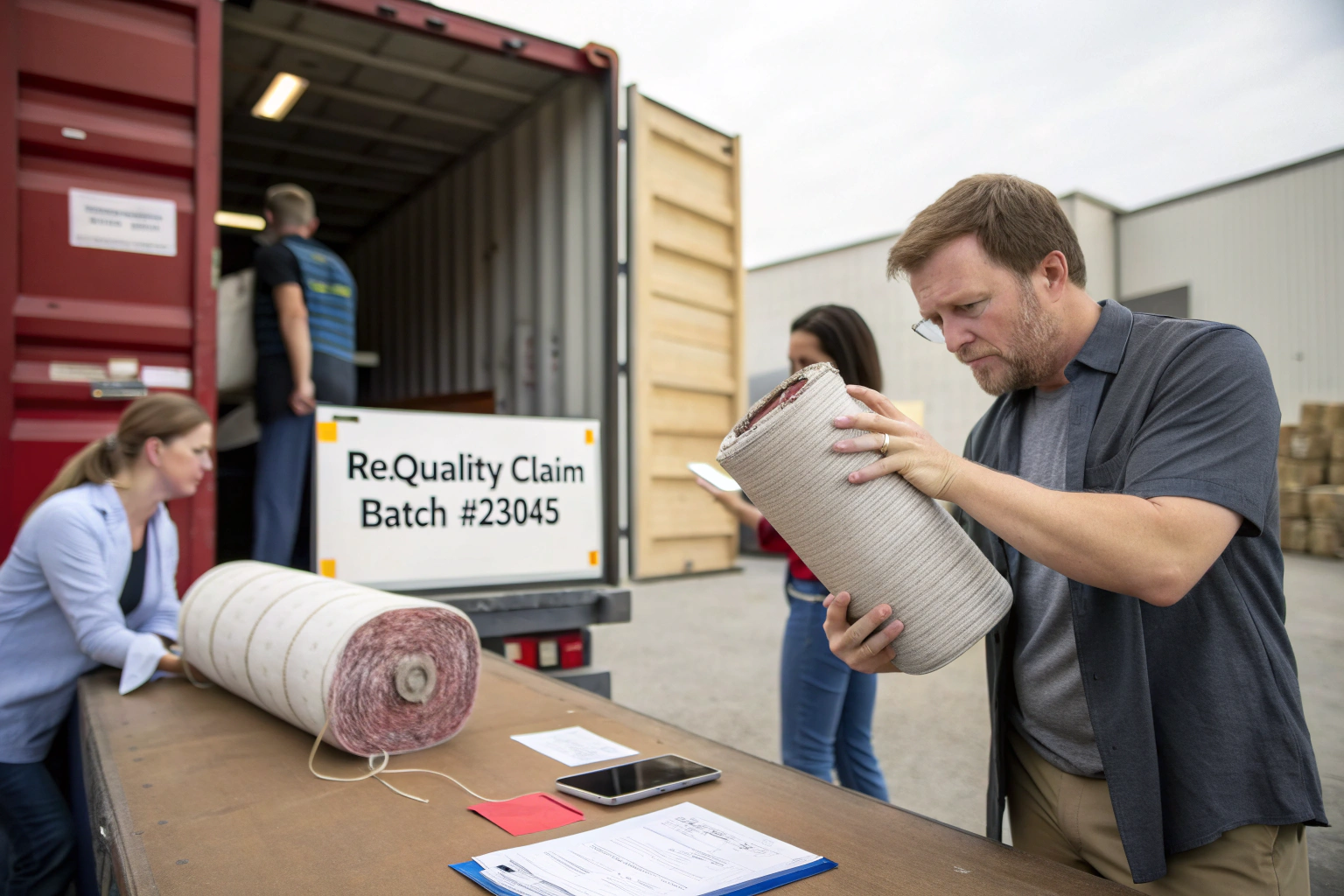
Let's not sugarcoat this. That moment when you slice open the plastic wrap on a new shipment of fabric and your heart sinks? I know it. You've been tracking this container for 28 days. You scheduled cutting. Your sewing team is waiting. And then you see it. A shade band running through the roll. A width variation that kills your marker efficiency. A hand feel that's stiffer than cardboard instead of the soft drape you paid for. You feel sick. You feel angry. You feel like you just threw away ten grand. But what happens in the next 48 hours determines whether this is a total loss or a recoverable situation. Screaming into the phone at your supplier in China usually just makes them shut down. Ghosting the invoice doesn't solve the fabric sitting on your floor.
I'm writing this from the other side of the fence. I run Shanghai Fumao, a textile mill and trading company in Keqiao. I've been the guy receiving that angry email. And I've also been the guy helping a client fix a mess created by another factory. Over 20 years, I've learned that "substandard" is a subjective word unless you have data. And the only way to get a supplier to eat the cost of a bad dye lot or a flawed weave is to speak their language: Evidence, Costing, and Leverage. This isn't about being a jerk. It's about being a professional. Let's walk through the exact process I recommend to my US clients when the fabric that arrives doesn't match the fabric we promised (or that someone else promised). We'll cover how to freeze the situation, how to quantify the damage, and how to get your money back or get replacement goods without destroying the supply chain relationship you spent months building.
What Should You Do Immediately Upon Finding Fabric Defects?
Your first instinct will be to pick up the phone. Fight it. Don't call me yet. You need to get your evidence locked down first. In the first 24 hours after discovering a problem, you are in the Preservation Phase. You need to act like a detective securing a crime scene before the suspect knows you're onto them. If you start cutting into the fabric to "see how bad it is," you've just destroyed your leverage. The supplier will (rightly) claim you accepted the goods and altered their condition.
The most important thing to understand is the difference between a Patent Defect (visible upon opening) and a Latent Defect (hidden until washing or stretching). If it's a stain, a hole, or a clear shade variation, that's patent. You must document it in the roll form before cutting. If it's high shrinkage that only appears after you pre-wash a sample yard, that's latent. Different rules apply. Let's start with the immediate steps for patent defects.
How to Document Fabric Flaws for a Successful Claim?
This is where 90% of buyers fail. They send me an email that says: "The fabric is bad. It has lines in it." That's useless. I can't go to the dyeing factory with "It has lines." They'll laugh at me and blame the weaver. You need a Claim Package that leaves zero room for interpretation.
Here is the checklist I give my clients at Shanghai Fumao. It's the same standard we use internally for our QC team:
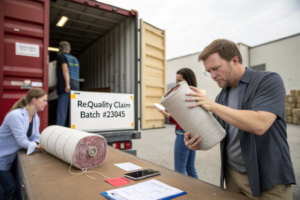
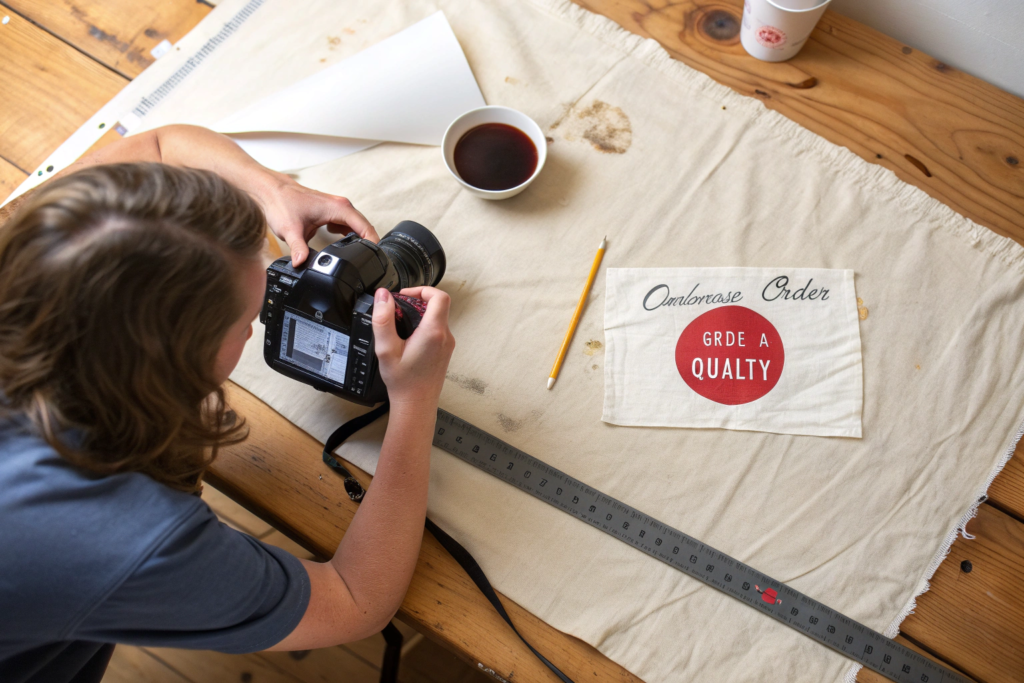
- The Wide Shot: Take a photo of the entire roll with the Shipping Label clearly visible. This proves the roll came from my specific shipment and not from leftover stock you had in the corner. I need to see the Article Number and Batch Number.
- The Scale Shot: Place a Ruler or Measuring Tape next to the defect. Is the oil stain 2 inches or 20 inches? Is the width 56 inches instead of 58 inches? Show me the numbers. No guesswork.
- The Macro Shot: Use your phone's zoom or a clip-on macro lens. If it's a broken yarn in a twill weave, I need to see the yarn ends poking out. If it's a coating delamination on nylon, I need to see the peeling layer.
- The Lightbox Shot: For color issues, do NOT photograph the fabric on a wooden table under warm warehouse lights. Take it to a window. Use natural daylight (or a D65 lightbox if you have one). Place the Approved Lab Dip right next to the bulk fabric. The camera might lie, but the relative difference between the two swatches in the same frame tells the truth.
I had a client in Los Angeles in 2024 who ordered 2,000 yards of black cotton/spandex jersey. He claimed it was "faded." He sent a blurry photo from his warehouse. It looked black to me. I asked for a photo with the approved swatch. When he sent that, I could clearly see the bulk fabric was a dark charcoal grey—about 10% lighter. That was actionable. I took that photo to the dye house. They ran a spectro test on their retained sample. It matched the lab dip. We tracked it back and realized the dye house had mistakenly substituted a cheaper reactive dye lot without telling us. We credited the client 15%. Without that side-by-side proof? He would have been stuck. To make your claim ironclad, you should follow the guidelines laid out in this resource on how to photograph fabric defects for a textile quality claim with a supplier. And for a deeper understanding of what constitutes a major vs minor flaw, check this industry standard classification of fabric defects in the 4-point system.
Why Should You Avoid Cutting Into the Fabric Immediately?
I'm going to be very clear about this because it's the number one reason claims get denied. Cutting equals Acceptance. Under the Uniform Commercial Code (UCC) in the US and standard international trade law (CISG), if you alter the goods in a way that prevents returning them in their original condition, you have legally "accepted" them. You can't accept a shipment and then demand a full refund.
Here is the smart play. Let's say you have 1,000 meters of linen with a weaving defect—maybe a "reed mark" that runs the length of every 10th inch.
- Bad Move: You tell the cutting room to "cut around it." You manage to salvage 700 meters. You throw away 300 meters. You then ask me for a 30% credit. I say: "Prove it was 30% waste. You cut it up. How do I know you didn't waste more due to poor pattern nesting?"
- Good Move: You stop cutting. You bring in a local third-party inspection service (like an SGS affiliate in LA). They inspect the rolls uncut and issue a report stating: "Based on 4-point system, the lot fails due to repeating warp defect. Estimated loss of usable width is 20%." You send me that report. We negotiate the credit before the knife touches the fabric.
If you must cut to meet a production deadline, do this:
- Isolate 5 Rolls: Do not open the whole shipment. Pick 5 random rolls from the shipment (photograph the labels first).
- Test Cut: Cut 2 layers from these 5 rolls. Measure the exact yardage wasted vs. good yardage obtained.
- Extrapolate: Use this 5-roll test as a Statistical Sample for the entire lot. This is much more defensible than cutting everything and sending me a pile of scraps.
(I have to say this: Our pre-shipment inspections at Shanghai Fumao are designed so this never happens. But if a shipment slips through, don't make my job of helping you harder by destroying the evidence.) You can find a clear legal explanation of this principle in this guide on how the right to reject non-conforming goods works under the Uniform Commercial Code. And for a practical logistics view, this blog explains why you shouldn't cut fabric before filing a claim with your freight forwarder or supplier.
How to Negotiate Compensation for Poor Quality Textiles?
Okay, you've documented the flaw. The supplier has acknowledged it (or at least stopped ignoring your emails). Now comes the hard part: The Ask. How much money back is fair? This is where you need to switch from "Frustrated Designer" to "Financial Analyst." You cannot just say, "Give me 50% off." That's arbitrary and unprofessional. You need to calculate the Actual Damages and the Salvage Value.
At Shanghai Fumao, we respect a buyer who comes to the table with a spreadsheet, not a sob story. We know fabric has flaws. Even with our CNAS lab and 4-point inspections, perfection is a goal, not a guarantee. The difference between a good supplier and a bad one is how they handle the math of the mistake. Let's break down the two most common negotiation paths: Discount for Keep vs. Full Return.

What Is a Fair Discount Percentage for Second Quality Goods?
This depends entirely on the End Use. A flaw in a $3/yd muslin for toiles is different from a flaw in a $15/yd silk charmeuse for bridal gowns. But generally, the industry standard for "off-goods" or "seconds" ranges from 15% to 40% discount, depending on defect severity.
Here is a table I use internally to assess claims when a US buyer wants to keep the fabric and just get a credit for the hassle. Use this as a benchmark for your negotiation:
| Defect Type | Impact on Use | Typical Fair Discount |
|---|---|---|
| Shade Off-Color (Delta E 1.5-2.0) | Can be used for linings, pockets, or separate dye lot if not mixed. | 10% - 15% |
| Width Variation (56" vs 58") | Reduces marker efficiency. You get fewer pieces per yard. | 3% - 5% (equal to % of lost width) |
| Spots/Stains (Random, 1-2 per 50 yds) | Labor cost to cut around. | Cost of Labor to Spot Clean + 5% Waste Allowance |
| Hand Feel Wrong (Stiff finish) | Can sometimes be fixed by washing. | Cost of Industrial Washing per yard |
| Major Repeat Defect (Barre, Stop Mark) | Fabric is unusable for large panels. Only small parts possible. | 40% - 50% (Essentially "Jobber" pricing) |
In 2023, we shipped a batch of rayon challis to a Canadian client. The print registration was slightly off—the white background bled under the floral pattern. It was subtle. The client had two options: Scrap it or use it. They chose to use it for a line of scarves (small pieces) instead of dresses (large pieces). We agreed on a 25% discount. Why? Because they salvaged the fabric but had to change their production plan. That 25% covered their extra cutting labor and the lower retail price they had to charge for the "imperfect" scarves. It was a win-win. We didn't have to pay for return shipping, and they got usable fabric at a cost that protected their margin. To get a sense of how this secondary market prices things, you can browse how jobbers price off-goods and second quality fabrics in the US textile market. And for a more formal definition of industry tolerance, review this textile tolerances standard for width, weight, and shade variations.
Should You Demand a Full Refund or a Replacement Shipment?
(Let me be real with you for a second.) A full refund plus return shipping is the Nuclear Option. It is almost never the right move unless the fabric is completely fraudulent (e.g., labeled 100% Cashmere but lab tests show 100% Acrylic).
Here is the hard truth about "Returns to China":
- Freight Cost: Shipping a container back to Shanghai costs roughly the same as shipping it to the US ($3,000 - $5,000). Who pays? If you paid FOB, it's your cost to return it. Most suppliers will never agree to pay return freight unless a court orders it.
- Customs Nightmare: Re-importing goods into China is a paperwork nightmare. We pay duty on our own fabric coming back in.
- Warehousing: The goods sit in a bonded warehouse for weeks accumulating storage fees.
Replacement Shipment is the Preferred Path. If the fabric is truly useless (e.g., the coating on your waterproof nylon is sticky and blocks the membrane), the logical solution is: We ship you new fabric on the next vessel. You keep or donate the bad fabric. We take the loss on the manufacturing cost; you don't take the loss on return freight.
Here's a real scenario: A sportswear brand in Oregon ordered 5,000 yards of our moisture-wicking polyester mesh. The knitting tension was wrong; the stretch recovery was 15% instead of 5% (it bagged out). They couldn't use it. We ran the lab test here on retained sample, confirmed the knitter error, and immediately put a Replacement Order into production at highest priority. The new fabric shipped air freight (we split the cost of the air freight upgrade 50/50). They received good fabric 10 days later. The bad fabric? They cut it into rags for their warehouse. It cost us $12,000 in new yarn and dyeing. But we kept a customer for life. That's the long game. If you are fighting a supplier on this, point them to this discussion on how to manage a supplier replacement order for defective goods in international trade.
How to Prevent Substandard Fabric Before It Leaves China?
I'm going to let you in on a secret that saves my clients thousands of dollars a year. The best negotiation is the one you never have to have. The best way to handle substandard fabric is to catch it while it's still in my warehouse in Keqiao, not while it's in yours in New Jersey. Once it's on the water, you've already lost the time. You can't replace it fast enough to meet your delivery windows to your own customers.
Prevention costs a fraction of cure. A pre-shipment inspection costs about $300 to $500 for a full day's work. That's less than the demurrage fee you'll pay if the container sits at the port while you argue about quality. Here are two methods—one high-tech and one old-school—that I actively encourage my clients to use before they release that 70% balance payment.
How Does Video Inspection Work for Remote Quality Checks?
Covid changed this industry in one good way: Everyone got comfortable with video calls. We now offer Live Video Inspection as a standard service at Shanghai Fumao. It's not a replacement for a third-party lab test, but it's a fantastic way to keep us honest and verify the visuals in real time.
Here's how it works with us:
- The Setup: We schedule a WeChat or Zoom call. My QC manager takes an iPad or phone with a gimbal stabilizer onto the floor of the packing warehouse.
- The Verification: You ask us to show you the Shipping Marks on the cartons live. You read them back to us. You confirm the destination is correct.
- The Random Pull: You say: "Open Carton #12." We open it. You say: "Pull the core of that roll." We pull back the plastic and show you the face of the fabric.
- The Measurement: You ask us to put a tape measure on the width. You watch us do it. No Photoshop tricks possible.
I had a client in Miami who was particularly nervous about a large run of linen/cotton blend for a hotel project. He couldn't fly to China. We did a 45-minute video inspection. He pointed out a slight slub inconsistency in the weaving that he wanted us to flag and remove. We found three rolls with that issue and pulled them from the shipment before it left. He was ecstatic. He paid the balance that same day. It gave him the confidence he needed. For a deeper look at the tools available for this, check out this guide on how to conduct a remote video inspection with a Chinese textile supplier for quality assurance. And for a tech-specific angle, this article discusses how to use real-time translation apps during video calls with Chinese factories.
Why Should You Request a Lab Dip Approval Before Bulk Dyeing?
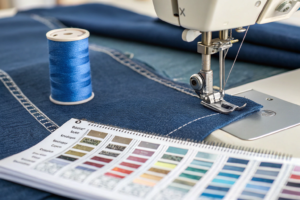
This is the single most important step in the entire color approval process. And yet, I'm shocked by how many buyers skip it to "save time." Never skip Lab Dip approval. The Lab Dip is a small swatch of fabric (usually 4x4 inches) dyed in the exact color formula intended for your bulk order. It's the Rosetta Stone for color.
The process is:
- You send Pantone reference or physical swatch.
- We dye 2-3 variations (Lighter, Darker, Greener, Redder).
- We ship these Lab Dips to you via DHL. (Cost: Usually $50-$100).
- You sign off on ONE dip and return it to us.
That signed-off Lab Dip becomes the Contractual Standard. When the bulk fabric is dyed, we run it through our spectrophotometer. The machine compares the bulk fabric to your approved Lab Dip. The machine doesn't lie. If the Delta E is > 1.2, we reject the batch at the dye house and re-dye it before it ever gets to the finishing plant.
I cannot tell you how many disputes we've avoided because I could pull out the signed, dated Lab Dip from the file and say, "Look, this is what you approved. The bulk matches this within a Delta E of 0.8. The issue is your lighting in your office, not the fabric." Conversely, if the bulk doesn't match the Lab Dip, the dye house eats the cost of stripping and re-dyeing, not you. It's your insurance policy against subjective color arguments. To get the terminology right in your POs, you should read this detailed explanation of what a lab dip is and why it's essential for color approval in textile manufacturing. And for the technical side, this is a good primer on how to evaluate a lab dip for color accuracy and metamerism.
How to Manage the Impact of Substandard Fabric on Production?
Alright. The negotiation is ongoing, or maybe you've accepted a discount. But the clock is ticking. You have a showroom deadline. You have e-commerce launch dates. The substandard fabric is sitting on your cutting table right now. You can't wait for a replacement container to sail from Shanghai. You have to Manage the Crisis. This is where the real skill of a production manager comes in. It's about triage. It's about deciding which parts of the roll are "Grade A" and which parts are "Filler."
At Shanghai Fumao, we understand this pressure. That's why we often help clients remotely troubleshoot how to cut around defects to maximize yield. We know the weaving pattern repeat better than anyone. We can tell you, "That defect repeats every 25 inches—shift your marker by 3 inches and you'll miss most of them." Let's talk about two immediate actions you can take on the cutting room floor.
Can You Salvage Shaded Fabric Through Sorting and Marking?
Shading is the most common issue in cellulosic fibers like Viscose, Modal, and Lyocell. The fabric comes off the dyeing machine in batches, and the end of the roll is slightly lighter or darker than the beginning. This is called Roll-to-Roll Shading or Edge-to-Center Shading.
Do not just cut it and sew it. You will end up with a dress where the left sleeve is a different shade than the right bodice. That's a guaranteed return from the customer.
Here is the Shade Sorting Protocol I train my clients on:
- Unroll and Fan: Unroll the first 2 yards of every single roll and lay them side by side on a large table under the same light source (North-facing window or D65 light).
- Group into Batches: Separate the rolls into Group A (On-Standard) , Group B (Slightly Darker) , and Group C (Slightly Lighter) . Sometimes you get a Group D (Redder Cast) .
- Assign to Panels:
- Group A: Use for the main body panels (Front, Back).
- Group B/C: Use for Separates (Collars, Cuffs, Pocket Flaps, Waistbands). Because these are broken up by seams, the eye cannot detect the shade difference compared to a large continuous panel.
I worked with a US denim brand in 2022 that had a massive issue with indigo shading on a Tencel blend. They were ready to reject the lot. We walked them through the sorting protocol over a Zoom call. They spent 4 hours sorting the rolls. Result? They used 95% of the fabric. They only scrapped 5% that were truly too far off. The extra labor cost in the cutting room was offset by the discount we provided. This technique is standard practice, and you can find more expert tips in this resource on how to manage and sort fabric rolls for shade variations in garment manufacturing. Also, understanding the root cause helps, so read up on why selvedge and roll shading occurs in indigo dyeing processes.
What Is the Best Way to Handle Width Variations in Cutting?
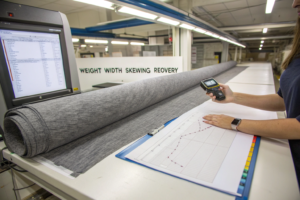
You ordered 58/60" usable width. The fabric arrives and it's actually 56/57". That missing 2 inches doesn't sound like much, but it changes the entire math of your Cutting Marker. A marker designed for 58" fabric might have pieces that simply don't fit on 56" fabric. You're forced to move pieces around, creating gaps, which increases your Fabric Consumption per Garment.
For example, if your planned consumption was 1.8 yards per dress, and the narrow width forces you to use 1.95 yards, that's an 8.3% increase in fabric cost! Plus the extra labor time to adjust the spread.
Here is the immediate fix:
- Re-Calculate the Marker Immediately. Do not let the spreader guess. They will just push the pieces closer and end up with "crowded" patterns that shift during cutting.
- Adjust the Spread Length. If you are cutting 50 plies high, a 2-inch width loss across a 10-foot table means you are losing significant square footage.
- Invoice the Supplier for the Waste. This is a Measurable Damage. The formula is simple:
(Actual Width / Ordered Width) - 1 = Percentage of Lost Efficiency- Example:
(56 / 58) - 1 = -3.4% - You are entitled to a credit of at least 3.4% of the fabric value, if not more, for the labor to re-marker.
We had a case with a Russian activewear client where our knitting machine tension was off due to a worn needle cylinder. The fabric came in 2cm narrower than spec. They sent us the marker efficiency report from their cutting room software (Gerber). The software showed the exact yardage waste. We credited them the exact cost of that extra fabric. No argument. Data wins. This is a great resource for understanding the technical side of how to adjust marker making and pattern nesting for narrower fabric widths. And for the math nerds, here's a deep dive into calculating fabric yield and consumption in garment production.
Conclusion
Dealing with substandard fabric is a gut punch, but it doesn't have to be a knockout blow. The key is to remove emotion and replace it with process. Start with ironclad documentation—photos with rulers, lightbox comparisons, and uncut evidence. Approach the negotiation not with demands for a free ride, but with a spreadsheet showing the actual financial impact: the cost of rework, the lost marker efficiency, or the salvage value of "seconds." And most importantly, build the preventative measures into your workflow so the next shipment never gets to this point. Demand the Lab Dip sign-off, consider a live video walkthrough, and always tie that final 70% balance payment to a clean inspection report.
Remember, a good supplier values the relationship more than a single batch of bad goods. At Shanghai Fumao, we stand behind our CNAS-tested quality, but we're also human. Machines break. Dye lots shift. What defines us is how we clean up the mess. If you're stuck with a shipment that isn't right and you're not getting straight answers, or if you want to switch to a partner who handles problems before they hit the loading dock, let's talk. You can reach our Business Director, Elaine, directly at elaine@fumaoclothing.com. She can help you navigate the current issue or set up the protocols to ensure your next order is smooth, on-shade, and on-spec.