Here's the hard truth you won't hear from most suppliers: ordering "organic" apparel in bulk is the highest-risk purchase you can make. The premium you pay—often 20-40%—is a magnet for fraud at every stage of a long, opaque supply chain. I've seen bulk orders where the fabric was organic but the dyehouse broke the chain, where labels were sewn on with non-compliant thread, where a middleman swapped certificates. The result? Ten thousand garments you can't sell as organic, a six-figure loss, and a brand reputation in ruins. Ensuring your bulk order is truly organic isn't about trust; it's about building an unbreakable system of verification that you control, from contract to delivery.
To ensure your bulk apparel order is truly organic, you must implement a multi-layered verification protocol that moves beyond supplier promises to forensic, document-based evidence. This requires pre-order due diligence on the factory's certification integrity, contractually binding traceability requirements, in-process mass balance audits, and post-production validation through testing and Transaction Certificate (TC) verification. You must act as both buyer and auditor.
Let's walk through the exact, actionable checklist we use internally to protect our clients and ourselves. This is how you sleep soundly after placing a 10,000-piece order.
Pre-Production: Due Diligence & Contractual Armor
The battle is won or lost before you sign the purchase order. This phase is about qualifying your supplier like a bank would vet a multi-million dollar loan. You're not just assessing their capability to sew; you're assessing their entire upstream supply chain and their mastery of organic certification logistics. Your purchase order terms must be your first line of legal defense.
Think of this as building a fortress. The walls are the contracts; the gates are the documentation checkpoints.
What specific documents must you collect before issuing a PO?
Demand a Pre-Production Compliance Dossier. Do not proceed without it.
- Factory's Organic Certificate (OCS or GOTS): Not just a screenshot. The full PDF. Verify the scope (must cover processing/trading), validity dates, and that the company name/address matches your supplier. Cross-check the certificate number on the certifier's website if they have a public database.
- Upstream Transaction Certificates (TCs): For your specific order, they must provide TCs from their fabric mill, and ideally from the spinner. This proves the organic material has been tracked to them. A TC is batch-specific. A generic mill certificate is useless.
- Mill and Dyehouse Certificates: The certificates of their direct fabric and dyeing suppliers. These facilities must also be certified.
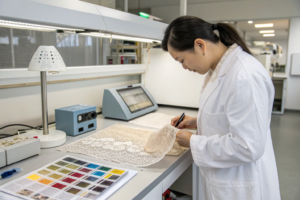
- Test Reports for the Bulk Fabric: Insist on recent, batch-specific test reports from an accredited lab (SGS, ITS, BV) for the exact fabric you'll use. Tests must include composition verification (to confirm it's 100% organic cotton, not a blend), colorfastness, and shrinkage.
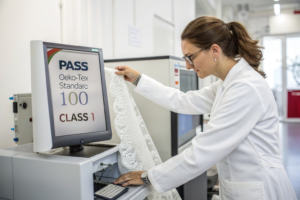
- Evidence of Compliant Inputs: Documentation for dyes (OEKO-TEX ECO PASSPORT or GOTS approval) and non-organic components (thread, labels) to show they meet basic safety standards.
A supplier who cannot assemble this dossier within a week is not capable of handling a truly organic bulk order. In 2023, a brand asked us for this dossier for a 15,000-unit order. We provided a 40-page digital pack. Their other shortlisted supplier sent a one-page OCS certificate and a blurry lab report. The choice was obvious.
How to structure your PO terms for maximum protection?
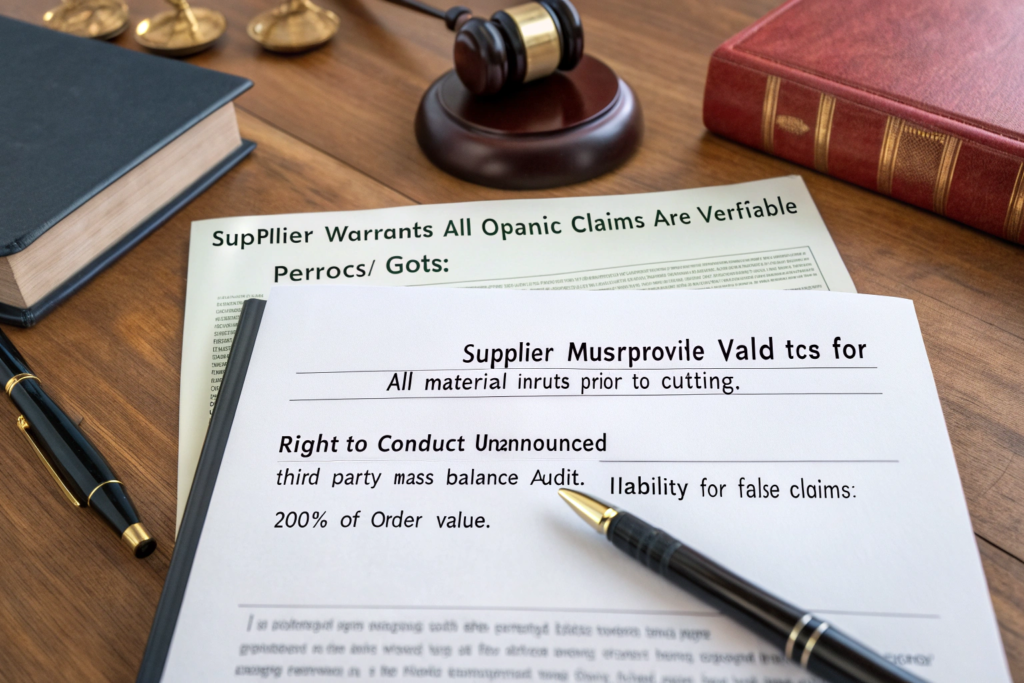
Your PO is a legal instrument. Include these clauses:
- Certification Warranty: "Supplier warrants that all goods delivered will conform to the [OCS/GOTS] standard and will be accompanied by a valid, batch-specific Transaction Certificate."
- Documentation as Condition of Payment: "Final payment is contingent upon receipt and buyer's approval of all required certification documents, including the final TC."
- Right to Audit: "Buyer or its designated third-party auditor reserves the right to conduct unannounced audits of the production facility and its upstream suppliers to verify compliance with organic standards."
- Liquidated Damages for Non-Compliance: "In the event of a material breach of organic certification warranties, supplier shall be liable for [e.g., 150%] of the order value, in addition to costs for recall and destruction."
This language shifts the risk and cost of fraud onto the supplier, where it belongs. It makes them financially accountable for their claims.
In-Production: The Mass Balance Audit & Real-Time Monitoring
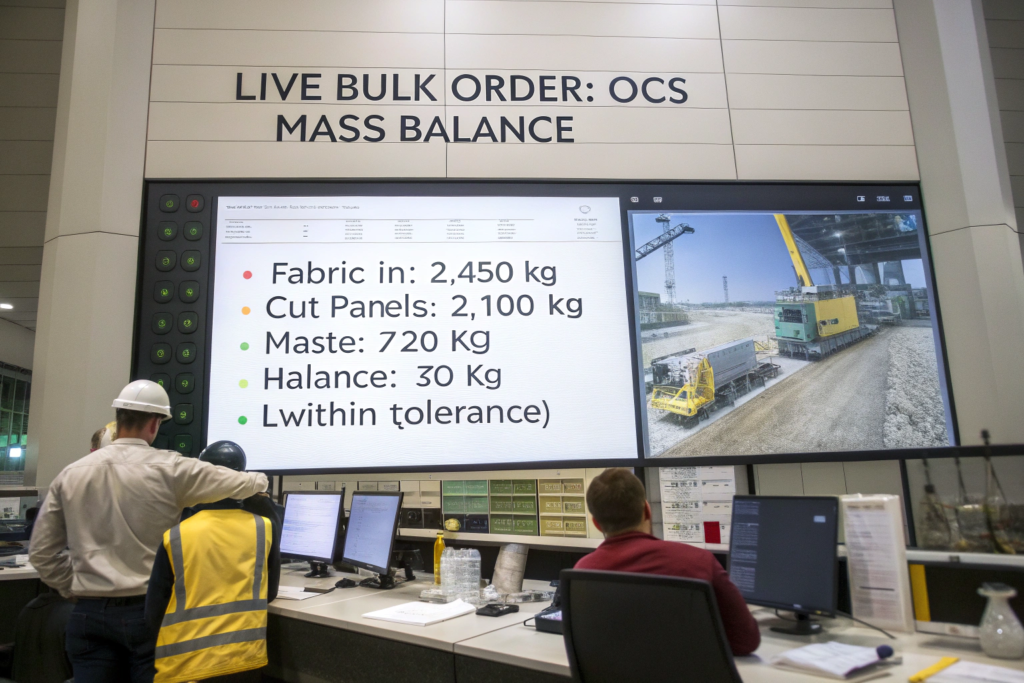
This is the most overlooked and critical phase. Certification isn't a switch flipped at the end; it's a continuous accounting process happening during production. The core mechanism is mass balance—the simple, powerful idea that the organic material going into the factory must equal the organic material coming out in finished goods, plus tracked waste.
You cannot outsource monitoring this. You must have eyes on the process, either directly or through a trusted third-party inspector.
How to conduct a mid-production mass balance audit?
Don't wait for the final report. When 20-30% of the order has been cut and is moving to sewing, dispatch your QC team or a third-party inspector (like SGS or QIMA) to conduct a DUPRO (During Production) Inspection with a focus on certification.
The inspector must:
- Verify Physical Inventory: Count/weigh the remaining OCS fabric rolls and check their lot numbers against the provided TCs.
- Track Cut Waste: Witness the weighing and recording of fabric off-cuts from the cutting tables. This is where material often "disappears."
- Review Production Records: Examine the factory's internal mass balance logs for your order. Are they being filled out daily? Do the numbers make sense?
- Check Segregation: Ensure OGS fabric and cut panels are stored separately from conventional materials.
Any significant discrepancy (e.g., 100kg of fabric unaccounted for) is a five-alarm fire. It means material is lost, wasted, or—worst case—was never organic to begin with. In early 2024, such an audit for a German client revealed a 5% discrepancy. The cause? The factory was using OCS cut panels as "fillers" on other lines. We halted production until the material was returned and procedures were corrected.
What are the critical in-line QC checks for organic integrity?
Beyond mass balance, your inspector should verify:
- Thread & Trim Compliance: Are they using the approved, documented thread and trims? A switch to cheaper, non-compliant thread is common and breaks the accurate composition claim.
- Label Accuracy: Check that the correct care/content labels are being sewn in. This is a 100% check. A mislabeled garment is unsellable as organic.
- Lot Traceability: Can a finished garment bundle be traced back to a specific fabric lot? This is usually done via bundle tickets.
This real-time monitoring turns you from a passive buyer into an active supply chain manager. It's the difference between discovering a problem when 10,000 pieces are finished versus when 2,000 are.
Post-Production: The Final Validation Before Shipment
The work isn't done when the last stitch is sewn. This is the final gate where you assemble all the evidence and validate it against the physical goods. The culmination of this phase is the final OCS Transaction Certificate (TC). If you've done the prior steps correctly, receiving this TC should be a formality, not a surprise.
Never authorize shipment or final payment until this phase is complete and all documents are in your hands, verified.
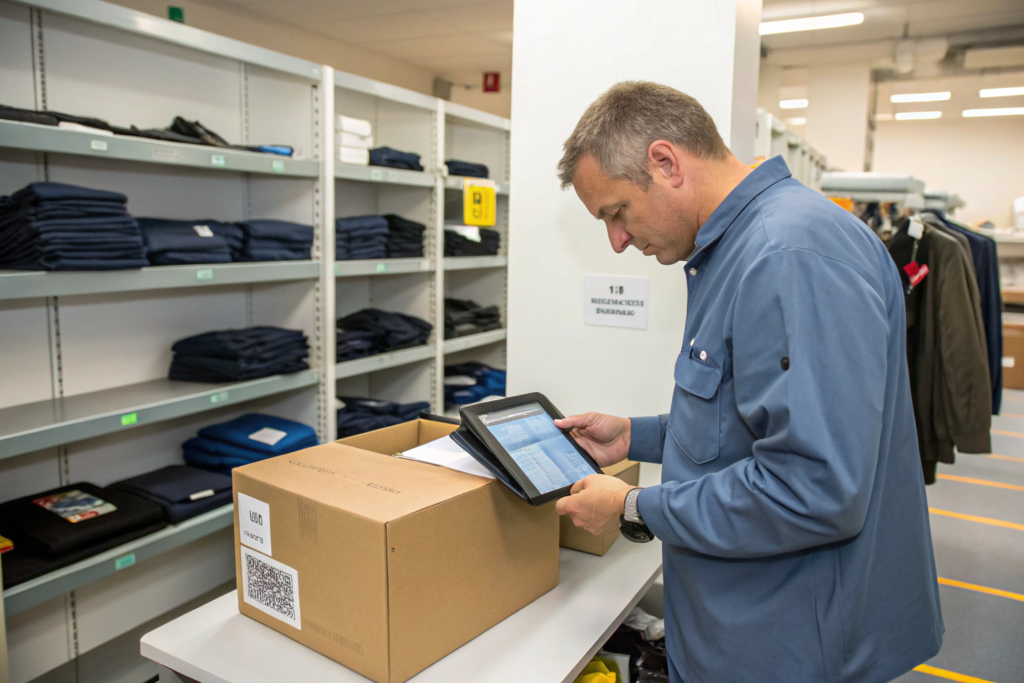
How to verify the final OCS Transaction Certificate?
When the factory sends you the draft final TC, scrutinize every field:
- Your Company Details: Are you listed correctly as the "Consignee" or "Receiver"?
- Product Description: Does it match your garment (e.g., "Women's Organic Cotton Jersey T-Shirt")?
- Quantity: Does it match your shipped quantity?
- Organic Content Percentage: Is it accurate based on your BOM? (e.g., "95% Organic Cotton, 5% Other Materials").
- Reference to Upstream TCs: It should reference the input TCs from the fabric supplier.
- Certifier's Signature/Stamp: It must be issued by a legitimate certifying body.
This TC is your legal proof of organic content. It's what you will show to retailers, customs, and consumers. Any error invalidates it. We had a case where a factory issued a TC with the wrong product HS code; it was caught in this review, preventing a customs delay.
Should you conduct independent composition testing?
Yes. Absolutely. For a bulk order, this is non-negotiable insurance. The cost is trivial compared to the order value.
- The Test: Request a composition test via Fourier-Transform Infrared Spectroscopy (FTIR) or similar. This scientifically verifies the material is cotton and can sometimes indicate if it's likely organic vs. conventional (though not definitively).
- The Gold Standard: For absolute certainty, a PCR (Polymerase Chain Reaction) test can detect genetic modification (GMO), which is prohibited in organic cotton. This is the most definitive proof.
- Process: Have your inspector randomly select sealed cartons from the shipment, pull garment samples, and send them directly to the lab (e.g., SGS, Eurofins) without the factory's involvement. Use a guide to textile testing for organic verification to select the right tests.
We advise all our bulk clients to do this. In a memorable 2023 case, a competitor's client ran a PCR test and found GMO cotton in their "organic" shipment. The test cost $500 but saved them from a $250,000 recall. That brand is now our client.
Building a Long-Term, Transparent Partnership
The ultimate assurance for your bulk organic orders isn't a checklist; it's a partnership with a supplier who views transparency as a core value, not a cost. After successfully navigating one bulk order with the above rigor, you should be working to streamline the process into a seamless, trusted workflow with that supplier.
The goal is to move from adversarial auditing to collaborative data sharing, where their systems are so open that your verification becomes a light-touch confirmation.
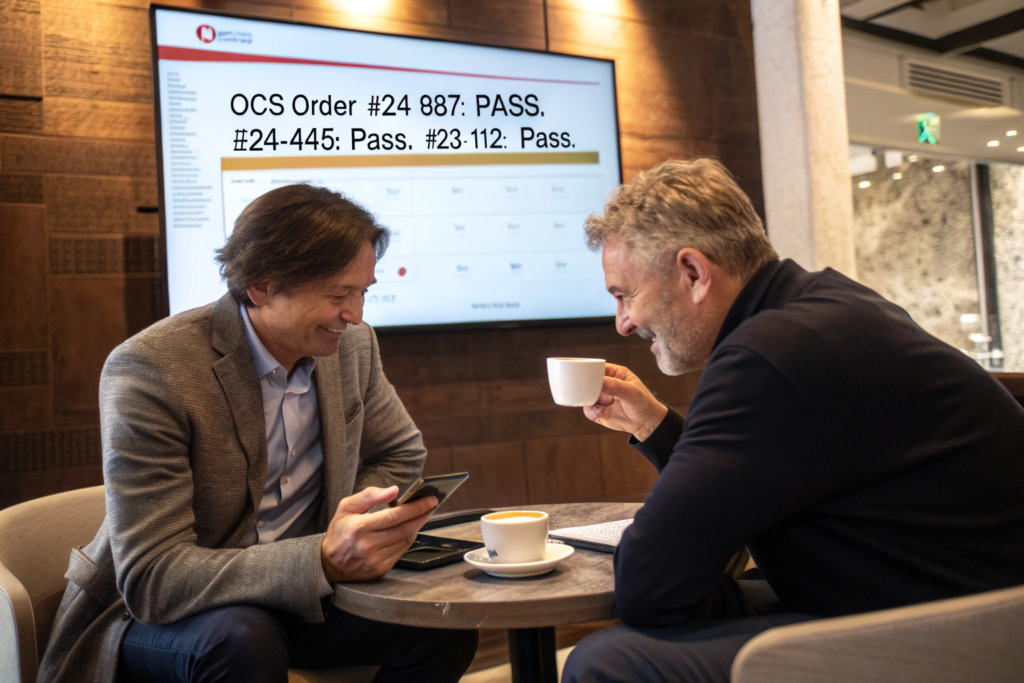
What are the signs of a truly transparent organic supplier?
They will proactively offer what you would otherwise have to fight for:
- Open-Book Policy: Willing to share the names and certificates of their upstream spinning and dyeing partners.
- Invitation to Audit: They encourage, not resist, your audits. They might even have live camera feeds in key production areas for client monitoring.
- Integrated Data Systems: They provide access to a client portal where you can see real-time order status, mass balance data, and document downloads.
- Collaborative Problem-Solving: When an issue arises (e.g., a dye lot variance), they immediately inform you and present solutions, rather than hiding it.
At Shanghai Fumao, we've built our model on this transparency. Our clients have direct access to our production planners and QC data. For us, the OCS system isn't a barrier to hide behind; it's a shared platform for building trust.
How does this approach reduce costs and lead times over time?
The initial investment in due diligence pays massive dividends:
- Reduced Inspection Costs: As trust builds, you may move from 100% third-party inspection to audit-based verification, cutting costs.
- Faster Turnaround: With established protocols and clear communication, sampling and approval cycles shorten dramatically.
- Lower Risk Premium: You avoid the catastrophic costs of a failed order, which effectively subsidizes all future orders.
- Strategic Value: Your reliable organic supply chain becomes a competitive asset, attracting investment and premium retail partnerships.
Conclusion
Ensuring your bulk apparel order is truly organic is a rigorous, multi-stage discipline that replaces blind faith with systematic verification. It requires you to be a detective before production, an auditor during production, and a forensic scientist after production. This process is not a cost—it is the essential investment that protects the premium value of your organic claim and, by extension, your brand's most valuable asset: its integrity.
For brands that are serious about organic, this level of diligence is the price of entry. The alternative is to gamble your money and reputation on a promise in a market where promises are broken every day.
If you are ready to execute a bulk organic order with a partner whose systems are designed for this level of scrutiny, let's talk. At Shanghai Fumao, our vertical integration and embedded OCS protocols are built to provide the transparency and evidence you need. Contact our Business Director, Elaine, to plan your next bulk order with certainty: elaine@fumaoclothing.com. Let's prove it, together.