You've approved that perfect lace sample. It’s beautiful, vibrant, and feels exactly right. Now comes the real challenge: making sure 10,000 meters of it look and perform exactly the same. If you've ever faced a bulk order where the lace faded, snagged, or shrank unpredictably, you know the nightmare. It’s not just about losing money; it’s about missing delivery dates and damaging brand reputation. The gap between a perfect sample and consistent bulk production is where most sourcing failures happen. But here’s the truth: with the right systems, this gap can be completely closed.
Ensuring durability and colorfastness in bulk lace production isn’t magic—it’s a rigorous, non-negotiable process of preventive engineering and relentless verification. It starts with selecting the right fiber and construction for the end use, continues with scientifically controlled dyeing and finishing, and is locked in with a multi-stage quality control protocol that leaves nothing to chance. At its core, it’s about moving from hoping the factory gets it right to knowing they can’t get it wrong, because every variable is managed.
Let’s be blunt: beautiful but fragile lace is a liability. Your customers expect garments to last. Achieving that in bulk requires a partner who treats the production line like a laboratory, where every step—from yarn to shipping carton—is a controlled experiment for consistency. This is the mindset that separates true manufacturers from simple traders.
Pillar 1: Engineering Durability from the Yarn Up
Durability isn’t something you add to lace; it’s something you build into it from the very first decision. Thinking that a delicate-looking lace can’t be strong is a common mistake. The reality is that durability is a function of fiber tenacity, yarn construction, and knit/weave density. A lace meant for a delicate bridal sleeve has different durability needs than one designed for a stretch athletic panel or a child’s dress. The key is to match the engineering to the application before you even request a sample.
This is where technical sourcing expertise pays off. You need a supplier who doesn’t just show you a catalog, but who asks: “How will this garment be worn, washed, and stressed?” At Shanghai Fumao, our R&D team’s first question is always about the end-use. This proactive approach prevents 80% of bulk production failures before they can even happen. We don’t just sell lace; we engineer solutions for real-world wear.
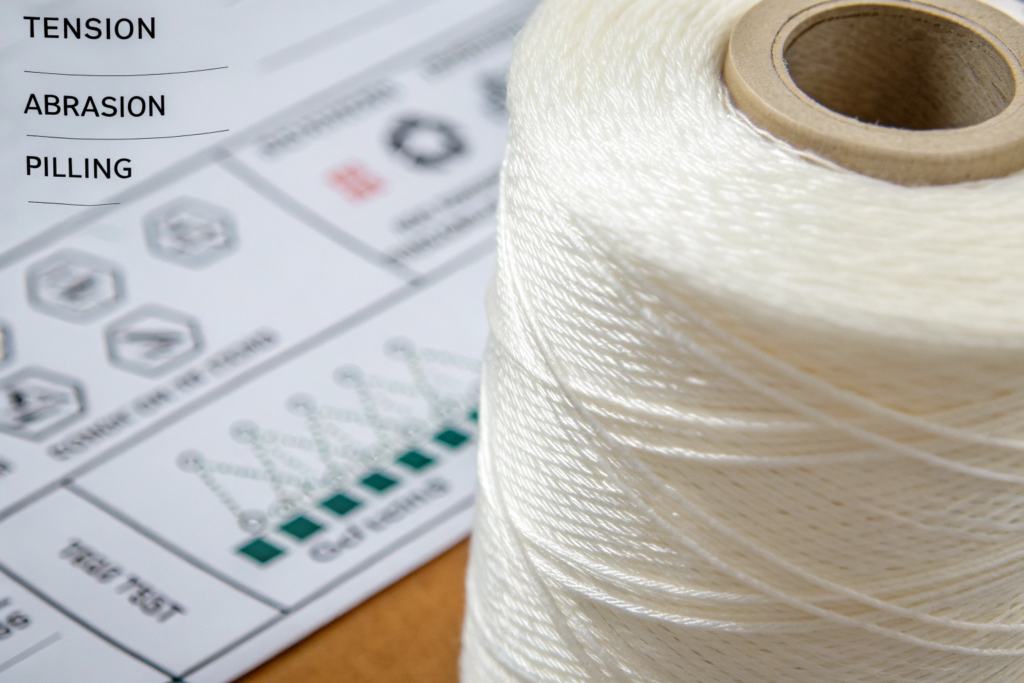
How Does Yarn Choice Dictate the Lifespan of Lace?
The yarn is the foundation. A lace made from a single, fine filament of polyester will have high tensile strength but may be prone to snagging. A staple cotton yarn gives a soft, matte look but may pill or break more easily under repeated stress. For durability, the trend is toward engineered and blended yarns:
- Core-Spun Yarns: An elastic core (like spandex/Lycra) wrapped with a natural or synthetic sheath. This provides recovery and prevents the lace from becoming permanently stretched out and saggy. Essential for any body-con or fitted garment.
- Multifilament vs. Monofilament: Multifilament yarns (many fine strands twisted together) are generally more durable and snag-resistant than monofilament (a single strand), which can act like a tiny razor if broken.
- High-Tenacity Variants: Specifying “high-tenacity” nylon or polyester can increase abrasion resistance by 30-50% compared to standard versions.
We had a hard lesson in 2023 with a client’s loungewear line. The sample used a beautiful, standard viscose yarn. In bulk, after three home washes, the lace cuffs on the robes began to fray and lose shape. The fix? We switched to a viscose-polyester core-spun yarn. The polyester core provided the needed strength, while the viscose sheath maintained the soft, luxurious hand-feel. The cost increased by 8%, but the return rate on the garment dropped to near zero. Understanding the engineered yarn guide for technical textiles provides a solid foundation for these conversations.
What's More Important for Snag Resistance: Fabric Construction or Finish?
It’s both, but construction is primary. You cannot finish a poorly constructed lace into being snag-proof. For snag resistance, the density and stability of the ground mesh (net) in the lace is critical. A loosely knitted hexagonal net will catch on anything. A tighter, more complex mesh structure (like a tulle or powernet base) provides a stable scaffold for the decorative pattern.
The finish is the secondary guardian. A light silicone-based softener can reduce surface friction, making it less likely for sharp objects to catch loops. For extreme cases, a very light resin application can “lock” the yarn intersections. However, over-application of resin can make lace stiff and brittle—the opposite of durable.
Here’s a real case from a US activewear brand last August. Their leggings had a lace overlay that was snagging during gym use. The construction was sound, but the net was just a basic hex. We solved it in two stages: First, we redesigned the lace to sit on a micro-powernet ground, which is incredibly resilient to lateral stress. Second, we applied a proprietary nano-scale lubricant finish. Post-change, the snag test results improved by over 70%. For niche applications, forums like Textile Engineering subreddits often have deep technical discussions on testing methods.
Pillar 2: Mastering the Science of Colorfastness
Color fading or bleeding is a silent killer of brand trust. Achieving colorfastness is a chemical and physical science, not an art. It hinges on three factors: dye selection, dyeing process control, and effective post-dyeing treatment. The goal is to create a chemical bond between the dye molecule and the fiber polymer so strong that water, sweat, friction, and light cannot break it.
Many bulk color failures happen because the sample was dyed in a small, carefully monitored lab pot, while bulk dyeing was rushed in a large vat with inconsistent temperature or pH control. The only way to prevent this is to treat the bulk dyeing recipe not as a suggestion, but as a legal contract, enforced by data from the factory floor. Our partner dyehouse is integrated with our QC system, and we get real-time pH and temperature logs for every batch—this is the level of transparency needed.

Why Do Some Colors (Like Reds and Blacks) Consistently Fail in Bulk?
Reds and blacks are notoriously difficult because of the chemistry involved. Vivid reds often require complex, multi-component dyes that are more sensitive to pH shifts. Jet blacks typically require a huge amount of dyestuff to achieve depth; if the dyeing cycle isn’t long enough or the temperature not high enough, the dye molecules don’t fully penetrate and bond, leading to surface dye that rubs off (crocking).
The solution is a combination of fiber-matched dyes and exhaustive washing. For a deep black on polyester lace, we specify high-energy disperse dyes and ensure the dyeing vat reaches and holds the exact “strike temperature” for the full cycle. After dyeing, a rigorous reduction clearing process is mandatory to scrub off any loose, superficial dye molecules. Skipping this to save time or water is the number one cause of poor crocking results.
We enforced this with a European fast-fashion client in March 2024. Their initial bulk order of black lace from another supplier failed the ISO 105-X12 rub test catastrophically. When they came to us, we provided a “colorfastness protocol” that included the specific dye class, reduction clearing parameters, and a third-party test report before shipment. The first 5,000-meter batch passed with a Grade 4-5 (excellent). The extra 48 hours of processing was non-negotiable. Resources like ASTM standard test methods for abrasion and crocking are the bible for setting these specs.
How Can I Guarantee Color Consistency Across Multiple Production Batches?
Guarantee is a strong word, but you can get to 99% certainty with a Digital Color Management System. This starts with your approved lab dip. That physical swatch must be measured with a spectrophotometer to create a digital color fingerprint—its unique values in a system like CIELAB. This digital standard, not the fading physical swatch, is what is sent to the dye house.
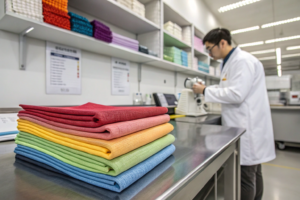
During bulk dyeing, the dyer pulls samples at intervals, measures them with the same spectrophotometer, and software tells them exactly which dye to add and in what quantity to “hit” the digital target. This removes human subjectivity from judging color. At Shanghai Fumao, we provide our clients with these digital color reports for every batch, showing the Delta E (ΔE) value—the numerical difference from the standard. A ΔE under 1.0 is usually visually imperceptible.
For a Canadian uniform company needing identical navy blue lace trim across a year of orders, this system was vital. We provided them with the digital color data upfront. Every subsequent batch was matched to that data, not a memory. They haven’t had a color mismatch complaint in 18 months. For smaller brands, understanding the practical guide to understanding Delta E and color tolerance is a great first step.
Pillar 3: The Non-Negotiable QC Protocol from Greige to Carton
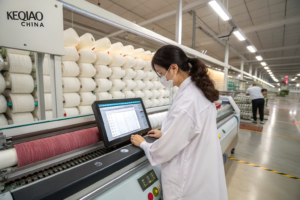
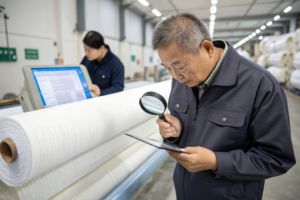
Quality control cannot be an afterthought or a single inspection at the end. It must be a series of checkpoints woven into the production timeline—a process called Inline Quality Control (IQL). This proactive approach catches defects when they happen, not after 10,000 meters are finished. The goal is to prevent errors, not just find them.
A robust QC protocol for lace must cover four stages: 1. Greige Goods Inspection (checking the undyed lace for knitting defects), 2. Post-Dyeing/Finishing Inspection (checking for color evenness, stains, and hand-feel), 3. Final Random Inspection (FRI) against your AQL standard, and 4. Pre-Shipment Verification of packaging and documentation. Missing any one stage is an invitation for disaster.
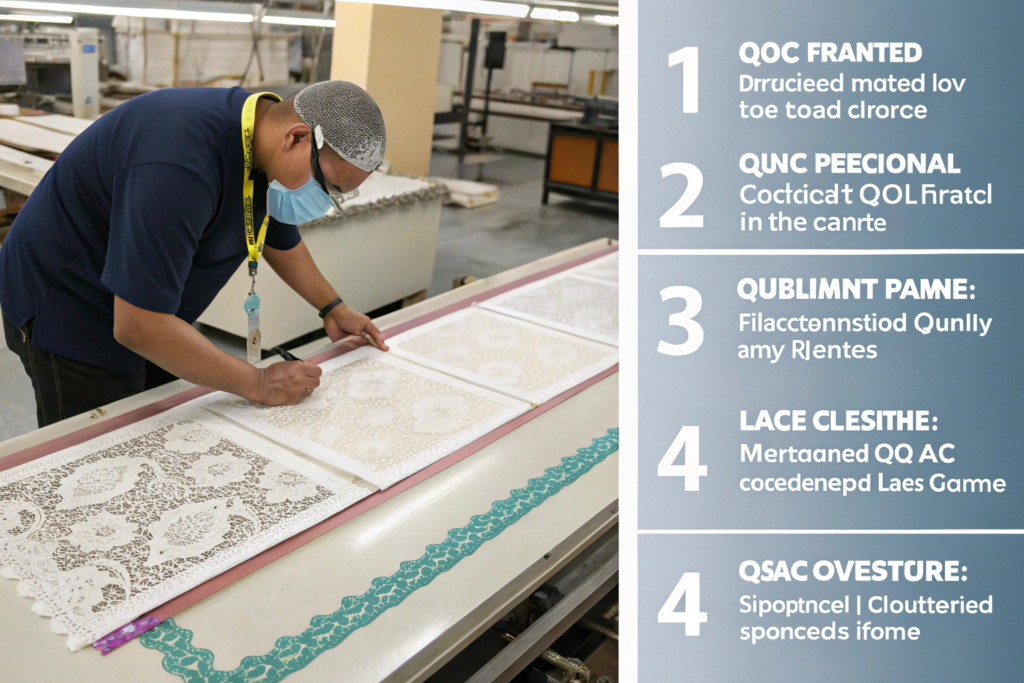
What Specific Defects Should My AQL Inspection Focus on for Lace?
Beyond common defects, lace has unique pitfalls. Your AQL inspector (or your supplier’s) must have a specific checklist for lace. We use a dedicated “Lace Defect Catalog” that includes:
- Broken or Missing Threads: In the pattern or the ground mesh.
- Pattern Distortion: Misaligned or deformed motifs due to incorrect machine tension.
- Holes/Runs: Especially in net grounds.
- Dyeing Defects: Barré (streaky color), side-to-center shading, spotting.
- Shrinkage/Width Variation: Measuring width and GSM at multiple points.
- Hand-Feel Inconsistency: Different softness or stiffness across the roll.
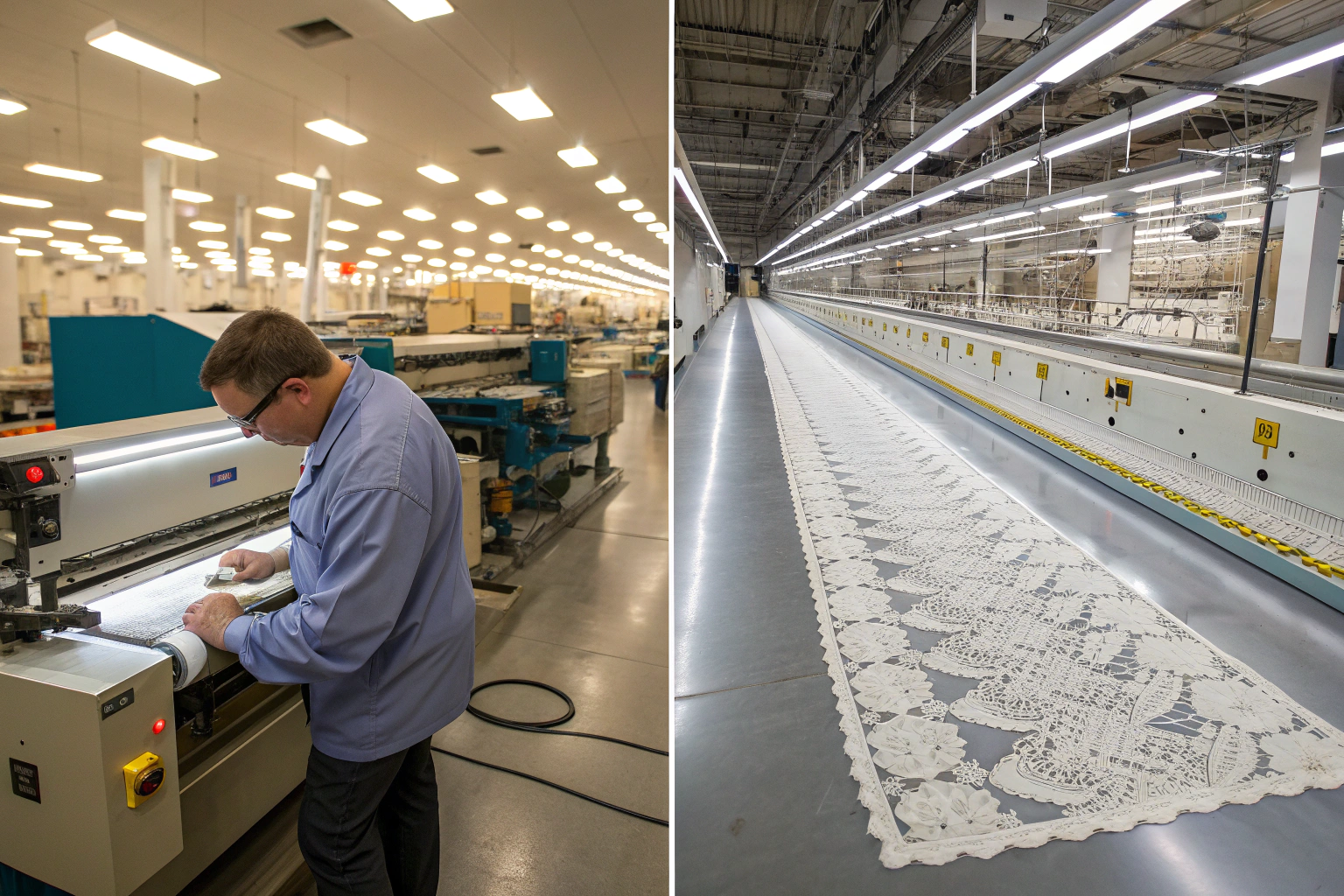
The inspection must be done on a light table to see tiny holes and on a flat surface under tension to check for distortion. In November 2023, for a Russian haute couture client, our QC team found a recurring, almost invisible “slub” (thick spot) in the yarn every 5 meters. It was a raw material issue from the spinner. Because we caught it at the greige goods stage, we rejected the entire 2,000-meter lot before it entered our expensive dyeing process, saving the client weeks of delay. A good reference for building your own checklist is the specialized guide to AQL for fabrics and trims.
How Do I Verify Physical Test Reports from My Supplier Aren't Fabricated?
Trust, but verify. The best practice is to split-test. When your supplier provides a test report from their lab (like our CNAS-accredited lab), you should randomly select a meter of fabric from the approved bulk and send it to an internationally recognized third-party lab like SGS, ITS, or Bureau Veritas for the same tests. You pay for this peace of mind.
The core tests for lace durability and colorfastness are:
- Durability: Martindale Abrasion (ASTM D4966), Tensile Strength (ASTM D5034), Seam Slippage.
- Colorfastness: Crocking (Dry & Wet, AATCC 8), Washing (AATCC 61), Light (AATCC 16), Perspiration (AATCC 15).
- Dimensional Stability: Washing Shrinkage (AATCC 135).
Make this split-testing a contractual requirement. For a long-term partner, you might reduce the frequency after a history of perfect alignment. A UK children’s wear brand we work with does this on the first bulk order of any new lace. Our reports and their SGS reports have had a 99% match rate for three years, which builds incredible trust. Understanding the scope and meaning of key colorfastness tests from an independent lab helps you know what to ask for.
Conclusion
Ensuring durability and colorfastness in bulk lace production isn't about finding a "good factory." It's about implementing and auditing a closed-loop system of engineering, process control, and verification. It requires a supplier that acts as the conductor of this entire orchestra, taking ownership from molecule to shipment.
The brands that suffer fewer returns, enjoy higher customer satisfaction, and build reputations for quality are those who invest in this systematic approach upfront. They understand that the few extra cents per meter spent on better yarn, controlled dyeing, and rigorous QC save dollars in avoided recalls and lost customer lifetime value.
If your current lace sourcing feels like a gamble with every bulk order, it’s time to change the game. At Shanghai Fumao, this system is our standard operating procedure. We don’t just supply lace; we deliver certified, consistent performance. Let us show you the data, the reports, and the process that can make bulk quality a certainty, not a concern. To engineer durability into your next collection, contact our Business Director, Elaine, at elaine@fumaoclothing.com.