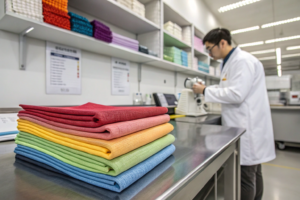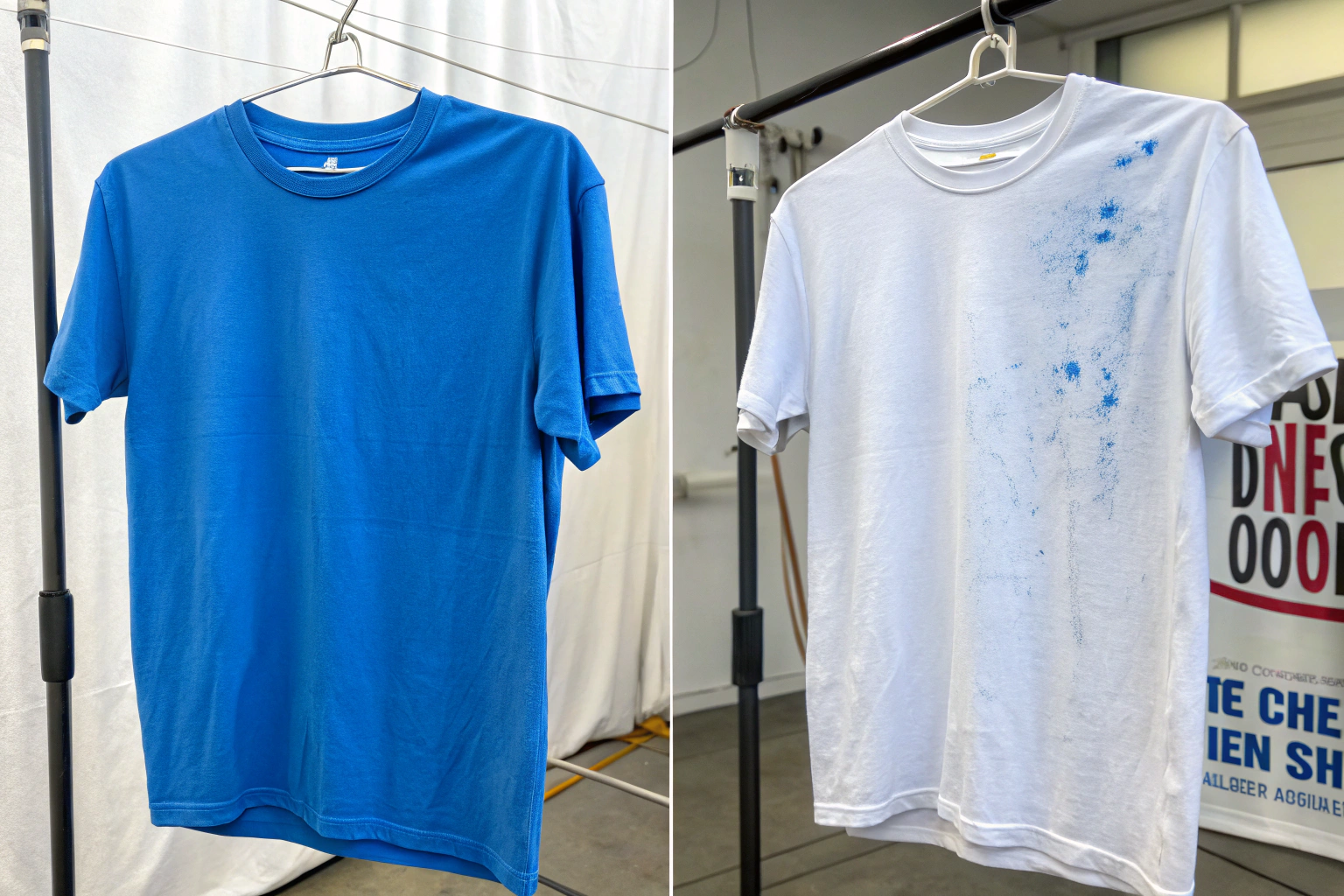
Here's the nightmare scenario: you receive 5,000 meters of beautiful royal blue jersey. Your factory cuts and sews it into perfect T-shirts. After the first customer wash, the color bleeds onto white logos, and the shirts now fit a child. Your brand reputation and margin are destroyed in one laundry cycle. This isn't a rare disaster; it's the direct result of failing to control colorfastness and shrinkage at the bulk fabric level. Hope is not a quality control method.
Ensuring these properties in bulk isn't about luck; it's about a systematic, scientific approach that starts at fiber selection and ends with verified test reports for every single production lot. At Shanghai Fumao Fabric, we treat color and dimensional stability as non-negotiable, measurable outputs of our process. You can't eyeball shrinkage or guess colorfastness. You must engineer it and then prove it with data. This is the core of reliable comprehensive fabric solutions.
The difference between a sample and bulk often comes down to process control. A sample can be carefully hand-dyed and finished. Bulk production runs through industrial machines where a 2°C temperature drift can change everything. I'll walk you through the exact control points that separate reputable suppliers from risky ones.
Why Do Color and Shrinkage Issues Only Appear in Bulk?
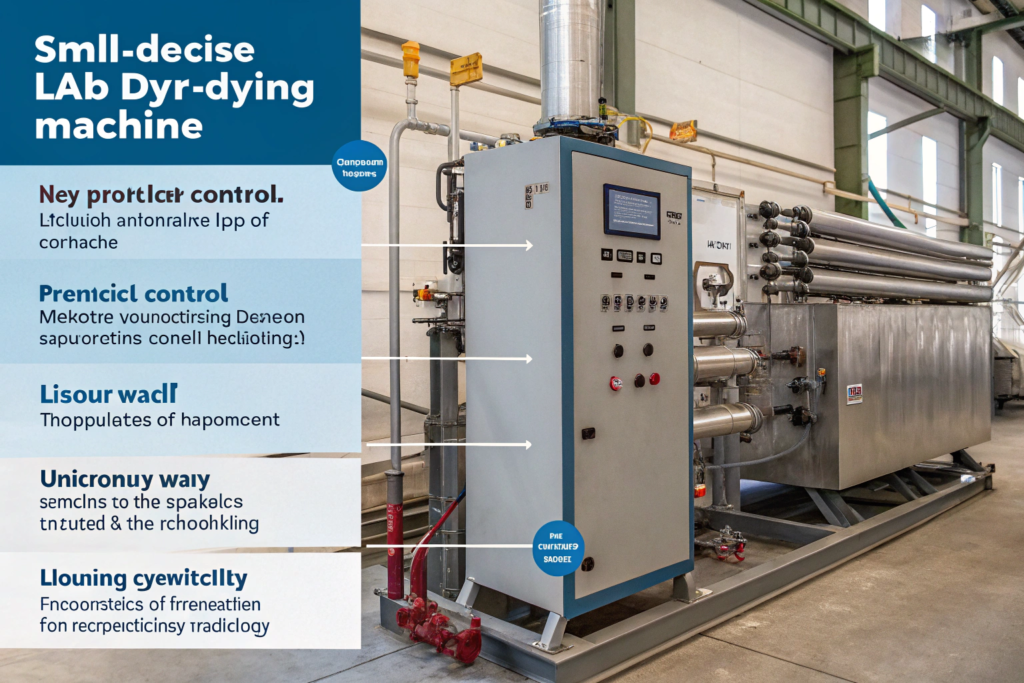
It's the classic bait-and-switch, but often not intentional. It's a scale problem. The sample you approved was likely produced in a 5-kg lab dyeing machine with meticulous attention. Bulk runs in a 500-kg machine where factors like water hardness, chemical distribution, and heat uniformity are magnified. If the supplier's process isn't standardized, the result is inconsistency.
The root causes are process drift and raw material variance. A different batch of cotton yarn, even from the same spinner, can have varying residual oils or moisture content, affecting dye uptake. A finishing machine running 5% faster than during sampling will apply less tension or heat, altering the final shrinkage. The goal is to eliminate these variables through specification and monitoring. Our end-to-end quality control system is designed to catch these drifts in real-time, not after the fact.
How does dyeing method impact bulk colorfastness?
The choice of dye and process is fundamental. For instance:
- Reactive Dyes (for Cotton/Cellulosics): Excellent colorfastness if the fixation and washing-off process is thorough. In bulk, incomplete washing leaves hydrolyzed dye in the fabric that bleeds in later washes.
- Disperse Dyes (for Polyester): Require high temperature and pressure. Inconsistent temperature in a large jet dyeing machine leads to uneven dye penetration and poor wash fastness.
- Acid Dyes (for Wool/Silk/Nylon): pH control is critical. A slight shift can change the shade and fastness.
We mandate a "soaping" or "washing-off" cycle after dyeing to remove unfixed dye. In 2023, for a German brand sourcing our organic cotton interlock, we implemented an extra ultrasonic washing stage for deep, saturated colors. Their post-wash colorfastness to washing (ISO 105-C06) improved from a grade 3 to a grade 4-5, effectively eliminating bleeding complaints. For a deep dive, the Society of Dyers and Colourists (SDC) offers resources on achieving consistent dyeing in bulk production.
What causes unpredictable shrinkage in bulk fabric?
Shrinkage is primarily caused by the relaxation of tension introduced during weaving, knitting, and finishing. The key is to pre-shrink the fabric consistently. The main industrial methods are:
- Compressive Shrinking (Sanforizing for wovens): Fabric is forced to shrink over a rubber belt.
- Heat Setting (for synthetics and knits): Fabric is held at a specific width and temperature to stabilize the fibers.
The problem in bulk? Inconsistent moisture content before shrinking, variable machine temperatures, or uneven feed tension. We use automated continuous sanforizers with real-time moisture sensors and infrared temperature controls. Every meter is processed under identical conditions. Furthermore, we don't just test a swatch; we test a full-width, 1-meter sample from the beginning, middle, and end of every production lot.
What Pre-Production Steps Lock in Your Standards?
You cannot control what you do not define. The single biggest mistake is approving a lab dip or a handfeel sample without attaching the technical performance criteria. That beautiful color swatch means nothing if it fades. Your pre-production phase is where you build the legal and technical framework for bulk success.
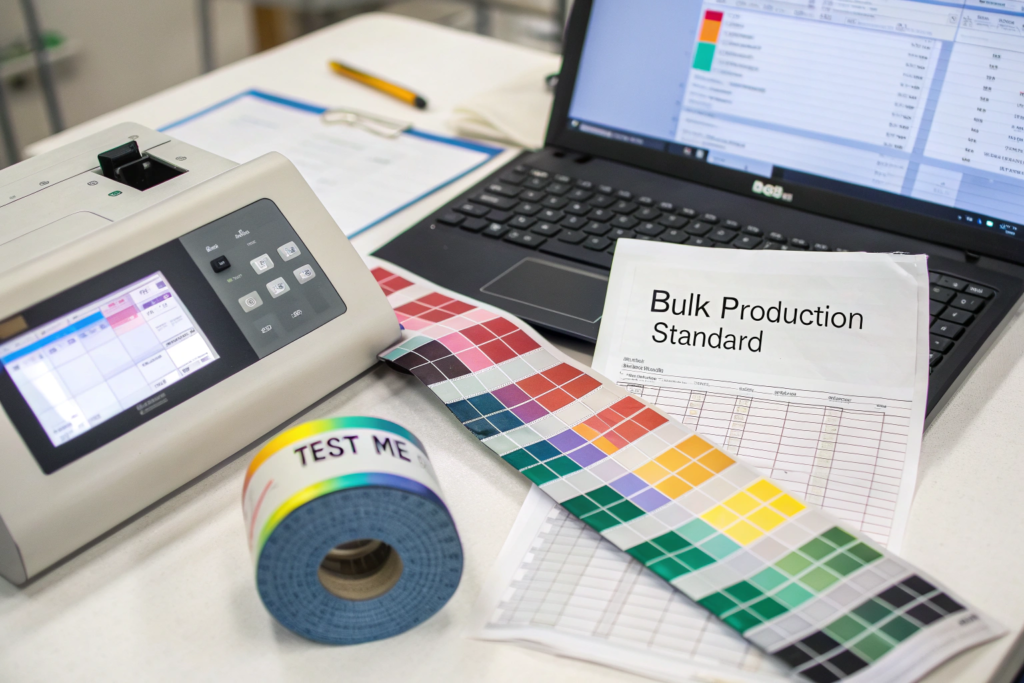
This phase involves three non-negotiable deliverables: 1) The Approved Lab Dip with a confirmed spectrophotometer reading (Delta-E value, usually <1.0 under D65 light), 2) The Signed-Off Bulk Production Standard (BPS) document, and 3) A Pre-Production (PP) Sample cut from the first few meters of bulk fabric. At Shanghai Fumao, we won't start bulk dyeing without a signed BPS. It protects both of us.
What must be included in a Bulk Production Standard (BPS) document?
This is your quality bible. It should specify:
- Color Tolerance: "Shade must be within Delta-E < 0.8 against approved lab dip under D65 illuminant."
- Colorfastness Requirements: e.g., "Wash Fastness: ISO 105-C06, Grade ≥ 4 for color change, ≥ 3-4 for staining. Rub Fastness (Dry/Wet): ISO 105-X12, Grade ≥ 4."
- Shrinkage Allowance: e.g., "Maximum shrinkage after 1x ISO 6330 5A wash: Warp -3%, Weft -3%."
- Testing Methodology: Specify the exact test standards (AATCC or ISO) to avoid disputes.
- Acceptable Quality Level (AQL): For visual defects (e.g., AQL 2.5 for major defects).
We provide a digital BPS template that clients can customize. For a Danish sportswear brand, this document included a requirement for "chlorine pool water resistance" for their swimwear fabric. By defining it upfront, we selected the right dye chemistry and finishes. The forum Techpacker discusses creating effective technical packages for manufacturers, which includes these specs.
Why is a Pre-Production (PP) sample critical?
The PP sample is your final safety check. It is fabric from the actual bulk dye lot, before the entire lot is finished. You must subject this 3-5 meter piece to your own washing and testing. Does it bleed? Does it shrink as predicted? This is your last chance to stop the bulk run if something is wrong. In our process, we hold the entire batch pending client approval of the PP sample test results. This step alone has saved our clients from countless disasters. (A real note from our floor: a client once saved a $80,000 order by catching a shrinkage variance in the PP sample we sent. We recalibrated the sanforizer and reproduced the lot perfectly).
What In-Process Controls Do Professional Mills Implement?
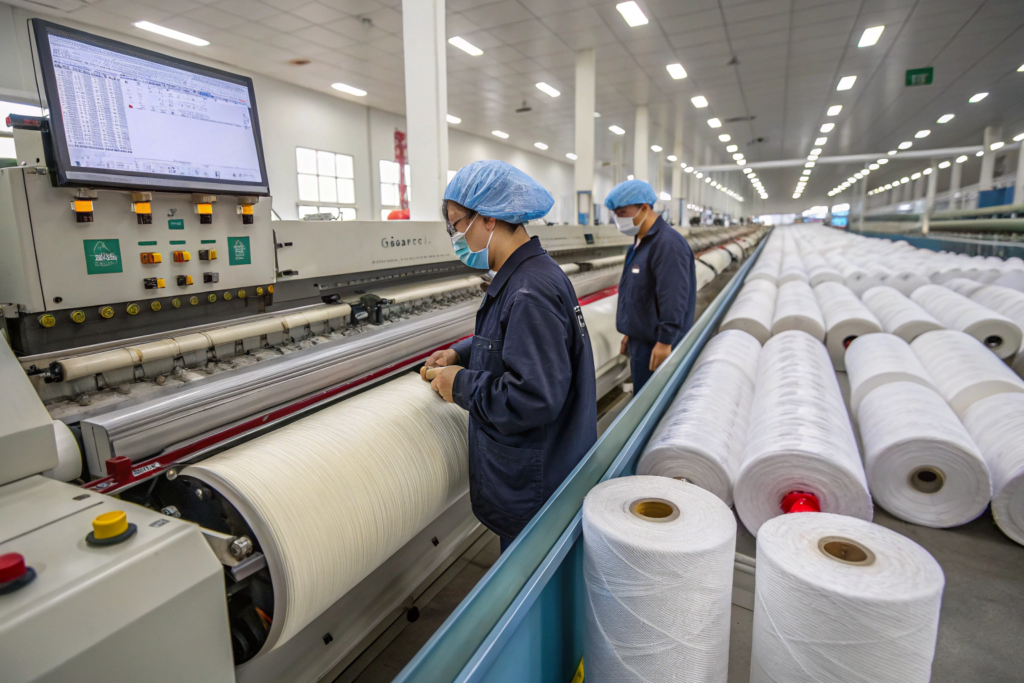
Bulk consistency is won or lost during the 72 hours of dyeing and finishing. This is where a supplier with vertical control and real-time monitoring separates itself. You need a partner who doesn't just operate machines, but actively controls them with data. It's the difference between driving a car and just being a passenger.
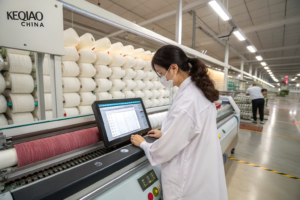
Key in-process controls include: Automated Dye Kitchen for precise chemical dosing, Real-time Temperature & pH Monitoring in the dye bath, On-line Color Measurement (spectrophotometers) scanning the fabric as it leaves the dye range, and Computerized Finishing Machines with preset formulas for shrinkage control. Our CNAS-certified lab isn't just for final testing; its technicians audit these in-process parameters hourly.
How does on-line color measurement work?
After the fabric exits the dyeing machine and is dried, it passes under a spectrophotometer that takes a reading every few meters. This data is plotted on a control chart showing the Delta-E variation across the entire lot. If the line drifts outside the preset tolerance (say, Delta-E 0.8), the machine operator is alerted to make a correction for the next lot. We provide this chart to clients as part of our transparency. For a US brand sourcing solid black polyester, this ensured there were no "reddish" or "greenish" black streaks in their 10,000-meter order. Understanding this technology is key; resources from Datacolor explain how on-line color control systems ensure batch-to-batch consistency.
What controls ensure consistent shrinkage during finishing?
For shrinkage, the finishing stage is everything. For knits, it's the heat-setting frame (tenter). For wovens, it's the sanforizer. Controls must include:
- Moisture Content Uniformity: Fabric must enter the machine at a consistent moisture level. We use pre-drying units to standardize this.
- Zone Temperature Control: The tenter or sanforizer has multiple heating zones. Each zone temperature must be locked to the BPS formula.
- Overfeed and Width Control: These mechanical settings physically determine how much the fabric is compressed or stretched.
We log all these parameters for every production lot. If a client ever has a query, we can pull the data log and see that, for example, "Lot #2345 was finished at 185°C with a 12% overfeed." This allows us to perfectly replicate or adjust. This data-driven approach is what defines a modern, professional mill.
What Post-Production Testing Validates Bulk Order Quality?
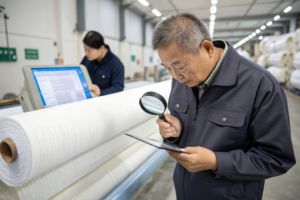
The final, non-negotiable step is independent verification. You must test the finished, packed fabric. This is not the supplier's in-house check; it's a formal, standardized test on samples taken from the bulk order, often performed by a third-party lab. This report is your certificate of compliance and your shield against downstream failure.
At a minimum, you need Lot Approval Testing. A representative sample from each unique dye lot (which can be 1,000-5,000 meters) must pass the tests outlined in your BPS. We advocate for and facilitate this at Shanghai Fumao. For key clients, we split each lot's fabric sample and send one part directly to an SGS or ITS lab, with the client CC'd on the report. This removes any doubt.
What is the correct sampling method for bulk testing?
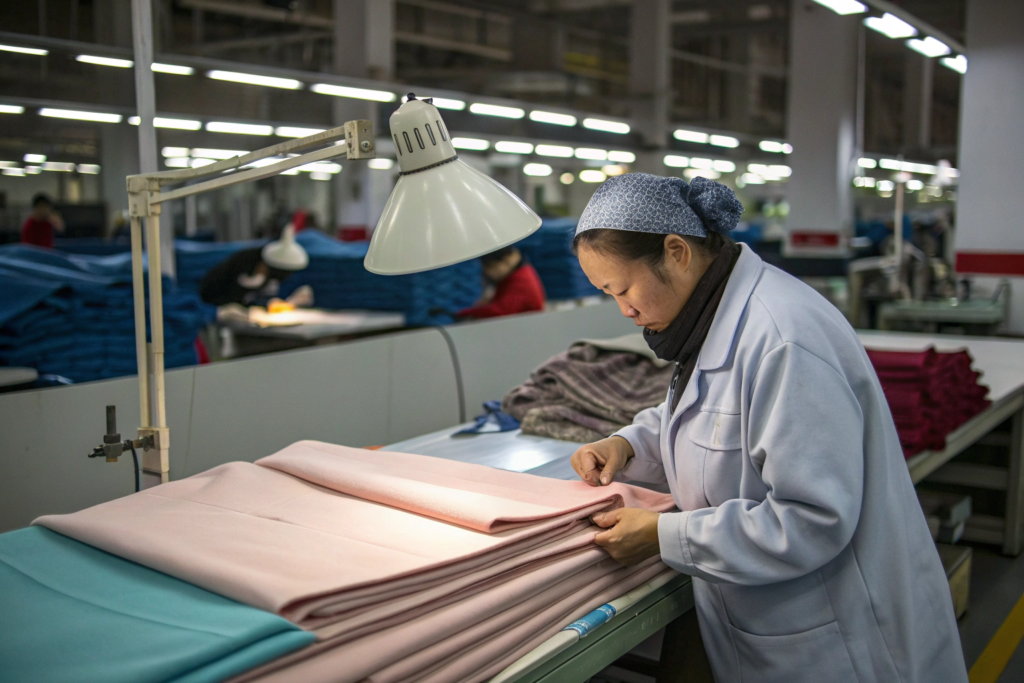
You cannot test from the beginning of the roll only. The correct protocol is "grab sampling" from multiple points. For a 20-roll lot, you would take a 1-meter full-width cut from:
- The beginning of Roll #1.
- The middle of Roll #10.
- The end of Roll #20.
These samples are combined, and test specimens are cut from this composite. This method accounts for potential variation across the entire production run. Failure to do this is a common loophole used by subpar suppliers.
How do you interpret a shrinkage and colorfastness test report?
Don't just glance at the "Pass/Fail." Analyze the numbers:
- Shrinkage Report: It will list % change in warp and weft directions. Your BPS says "max -3%." The report shows "-2.1%". That's a pass with a good safety margin. If it shows "-2.9%", it passed but is at the limit, indicating less process buffer.
- Colorfastness Report: It uses a grayscale rating from 1 (poor) to 5 (excellent). A "Grade 4" for color change means no perceptible fading. A "Grade 3" for staining means some dye transferred to the adjacent white fabric. You must check both values against your BPS.
In Q1 2024, a UK retailer's audit revealed their supplier's fabric passed shrinkage on a 30cm swatch test but failed on a full-meter test. The difference was relaxation time. We educated them on specifying the correct test method (ISO 5077). Now, they always specify "ISO 6330 5A wash followed by 4-hour flat drying before measurement." Precision matters. The SGS Global website is an authority on textile testing protocols and report interpretation.
Conclusion
Ensuring colorfastness and shrinkage control in bulk orders is a disciplined science, not a hopeful art. It requires a clear upfront definition of standards, a supplier with robust in-process controls, and a final validation through standardized testing. When this system is in place, the fabric that arrives at your factory is not a question mark but a verified component, ready for production.
The cost of skipping these steps is astronomical—far exceeding the price of thorough development and testing. It's a direct investment in your brand's integrity, customer satisfaction, and bottom-line profitability.
You don't need to become a textile chemist, but you do need a partner who acts like one. At Shanghai Fumao Fabric, our entire vertical operation—from our automated dye kitchens to our certified lab—is engineered to deliver this predictability, lot after lot. Let us provide you with the confidence that comes from data-backed quality. Contact our Business Director, Elaine, to establish a technical protocol for your next order: elaine@fumaoclothing.com.