Talking about compliance with overseas suppliers can feel like navigating a minefield. You know you need CMIA certification for fabric safety, but how do you bring it up without sounding accusatory or getting vague promises? Many buyers make the mistake of asking "Are you certified?" at the end of negotiations—only to discover the factory treats it as an optional extra. The truth is, how you discuss CMIA determines whether you get real protection or just paperwork.
This conversation should happen early and in specific terms. As a fabric supplier who works directly with hundreds of garment factories, I've seen both sides: brands who get burned by assumptions, and those who build bulletproof partnerships through clear dialogue. The difference comes down to asking the right questions in the right order. Let me show you the exact framework we use at Shanghai Fumao when clients ask us about certification—so you can apply it to your own supplier conversations.
What Questions Uncover a Supplier's Real CMIA Capability?
Start with discovery questions that reveal their process, not just their claims. Your goal isn't to catch them out, but to understand if certification is built into their system or tacked on as an afterthought.
First, ask about their experience with your specific fabric type: "For a [mention your fabric, e.g., polyester-spandex knit] like we're discussing, can you walk me through your last CMIA certification process—which lab you used, how long it took, and what the biggest challenge was?" This open-ended question forces specifics. A competent supplier will recall details immediately. Last month, when a Miami-based activewear brand asked us this about antibacterial polyester fabric, we pulled up the actual project timeline: "We used the Shanghai Testing Center, it took 22 working days, and the challenge was optimizing the antimicrobial finish to not affect pH levels. We solved it by adjusting the application sequence." That level of detail builds instant credibility.
Second, ask about their failure protocol: "What's your procedure when a pre-test fails—say, for formaldehyde exceedance? Who fixes it and how does that impact timelines?" This separates professionals from amateurs. A serious supplier will describe their corrective action process—like reformulating the finishing agent or adjusting curing temperatures—and have a contingency timeline. If they claim "we never fail," they're either lying or not testing properly. Every reputable supplier encounters occasional failures; what matters is how they handle them. This speaks directly to their technical expertise in textile chemical management.

How to Gauge Their Transparency on Costs?
Demand a Transparent Breakdown.
Ask: "Can you provide a separate line item for CMIA certification costs versus fabric costs? What exactly does that fee cover—is it just the lab fee, or does it include your management time and any reformulation work?" Many factories hide certification costs in the overall price, then try to skip it to boost margins. A transparent partner will separate it. At Shanghai Fumao, we typically quote certification as 3-8% of the fabric cost, depending on complexity, and we explain exactly what's included: sample preparation, lab coordination, documentation, and one round of corrective action if needed.
What Timing Questions Reveal Their Planning?
Ask About Their Critical Path Integration.
Pose this: "At what exact milestone in our timeline do you recommend we initiate CMIA testing? And what's your backup plan if results are delayed?" The correct answer should be: "Right after you approve the lab dip and handloom sample, before bulk fabric production begins." This shows they understand risk management. If they say "after production" or "during shipping," consider it a major red flag. Their answer should demonstrate how they integrate compliance into fashion production scheduling proactively.
Which Documents Prove Real Compliance vs. Paper Compliance?
Paperwork tells the real story. A supplier might claim certification, but the documents reveal whether it's valid for your specific order or just recycled from another project. Insist on seeing these before any deposit payment.
You must see the actual CMIA certificate with the official seal—not a test report, not a "factory certificate." Look for three key elements: 1) The unique certificate number, 2) The exact product description matching your fabric, and 3) The validity period (CMIA certificates are typically valid for 5 years for that specific product). In 2023, we helped a client audit a potential factory that presented a certificate for "100% cotton jersey"—but our client needed "95% cotton/5% spandex jersey." That missing 5% spandex meant the certificate was useless for their order. The factory was using generic documentation hoping nobody would check.
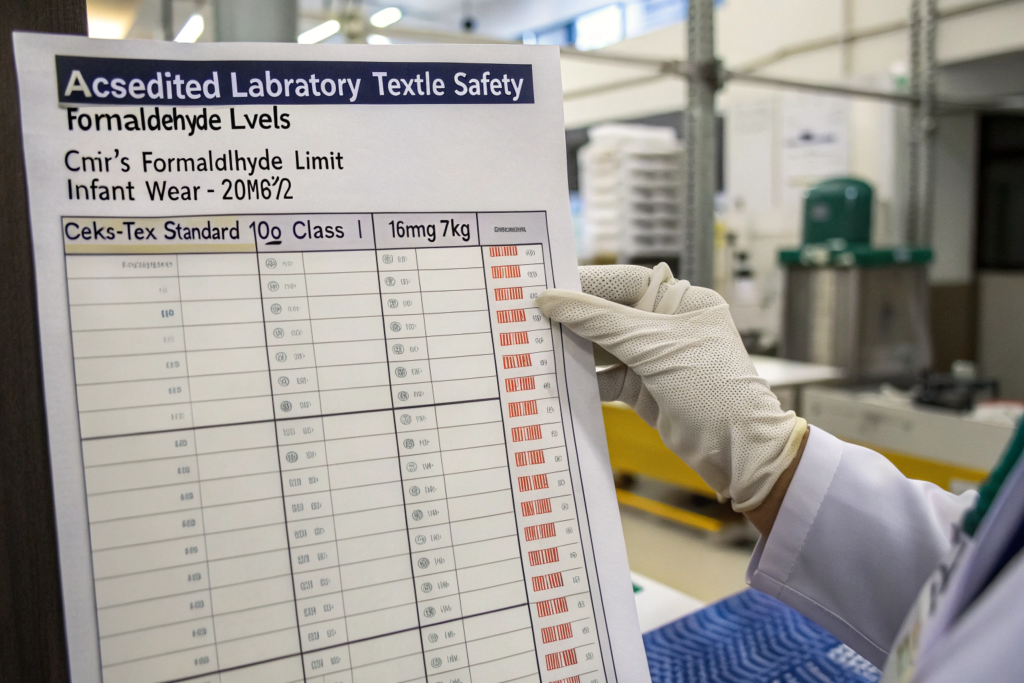
Additionally, request the complete test report from the accredited laboratory. This shows the actual numbers—not just "pass" or "fail." Compare these numbers against your market's requirements. For instance, CMIA's formaldehyde limit for Class A (infant wear) is ≤20mg/kg, while OEKO-TEX Standard 100 Class I is ≤16mg/kg. Understanding these key differences in global textile safety standards helps you assess if their certification meets your specific needs.
How to Verify Documents Aren't Fabricated?
Use Digital Verification Methods.
While not all Chinese certification bodies have public online verification, you can still verify authenticity. Ask: "Can you provide the lab's direct contact information so we can confirm the report? Can we include certificate verification as part of our third-party inspection?" A legitimate supplier will agree. Better yet, require that the certificate be issued to your company name as the applicant (or co-applicant), not just the supplier's name. This gives you direct legal standing and makes document falsification much harder.
What Contract Language Secures Your Rights?
Transform Promises into Obligations.
Your purchase contract must include language like: "Supplier warrants that all goods supplied under this PO comply with China Compulsory Certification (CMIA) requirements for . Valid CMIA certificate No. [__] and corresponding test reports shall be provided prior to shipment. Non-compliance constitutes material breach entailing full refund, return shipping costs, and compensation for consequential losses." This changes the dynamic completely. When we work with clients like Shanghai Fumao, we often help draft these clauses—because we want the obligations to be as clear to us as they are to you.
How to Respond When a Supplier Resists or Evades?
Not all resistance is equal. Some suppliers are uninformed but willing; others are deliberately opaque. Your response should match their attitude while protecting your interests.
If a supplier says, "All our fabrics are safe, we don't need certificates," respond with educated pushback: "I understand you believe in your quality, but our importers/retailers require documented proof. Without the CMIA certificate, our shipment could be held at customs for weeks. Can we run a trial certification on this first order to ensure smooth clearance?" This frames certification as business pragmatism, not distrust. If they remain resistant, ask: "Is there a cost concern? Would it help if we split the certification fee for this first order?" This tests whether it's really about money or about hiding something.
For persistently evasive suppliers, use the "three-level question" technique:
- "Do you have experience with CMIA?" (General)
- "Can you show me a certificate for a similar fabric you produced in the last 6 months?" (Specific)
- "Will you include certification as a contractual requirement in our PO?" (Action)
If they hesitate at level 3, it's time to seriously reconsider the partnership. The risk isn't just about this certificate—it's about their overall transparency on managing supply chain risks in fashion manufacturing.

When Is It Time to Walk Away?
Recognize the Point of No Return.
Walk away when you encounter: 1) Refusal to provide sample documentation, 2) Pressure to pay deposits before showing certificates, 3) Claims that certificates will come "later" after payment, or 4) Hostility to your questions. I recall a Canadian client who ignored these signs with a knitwear supplier last year. They paid a 50% deposit only to discover the factory had never actually certified their cashmere blend. The resulting delays cost them the entire holiday season. The lesson? No order is better than a disastrous order.
How to Find a Certified Supplier If Yours Won't Comply?
Consider Split Sourcing Strategies.
Say: "I appreciate your sewing expertise, but since CMIA certification is non-negotiable for us, we'll source the certified fabric separately and have it delivered to your factory for cutting and sewing. Would that workflow work for you?" Many garment factories will accept this—it reduces their responsibility and cost. This is actually how many savvy brands work with us at Shanghai Fumao. We supply the certified fabric directly to their chosen factory, with all documentation trail. This approach gives you direct control over the most critical—and risky—component.
How to Leverage CMIA Talks for Better Overall Terms?
The certification conversation is your gateway to negotiating better overall terms. A supplier who invests in proper certification is typically more professional across all operations—use this as leverage.
Once you've established their CMIA capability, connect it to other quality discussions: "Since we're ensuring fabric safety through CMIA, let's also agree on our AQL (Acceptable Quality Level) for garment inspection. For our price point, we require AQL 2.5 for major defects. Can you share your standard inspection report format?" This naturally expands the quality conversation. A supplier confident in their base materials is usually more willing to commit to higher finished product standards.
Also discuss repeat orders: "Once this fabric is certified, how do we ensure batch-to-batch consistency? Do you keep a certified reference sample and dye recipe on file?" Their answer reveals their systems for maintaining color consistency in apparel production. A professional supplier will describe their lab dip approval process and recipe management system. This forward-thinking discussion positions you as a strategic partner, not just a one-time customer.

How Does This Build Stronger Supplier Relationships?
From Transaction to Partnership.
By handling the CMIA discussion professionally, you demonstrate that you're a serious, knowledgeable buyer. This often earns you better service and priority treatment. Suppliers prefer clients who understand the complexities—it makes their job easier. At Shanghai Fumao, we consistently give better pricing and faster turnaround to clients who ask smart compliance questions upfront, because we know there will be fewer problems down the line. The relationship becomes predictable and profitable for both sides.
What's the Ultimate Business Advantage?
Risk Management as Competitive Edge.
Mastering these conversations does more than secure one certificate—it builds a supply chain resilience that becomes your competitive advantage. When competitors are dealing with rejected shipments or recalls, your products move smoothly to market. You gain the confidence to make stronger marketing claims, satisfy discerning retailers, and ultimately build a brand reputation for reliability. The few hours invested in these discussions pay dividends for seasons to come.
Conclusion
Discussing CMIA certification isn't a technical checkbox—it's a strategic business dialogue that reveals everything about a supplier's capabilities, transparency, and willingness to partner seriously. By asking specific process questions, demanding verifiable documentation, and using the conversation to negotiate broader quality terms, you transform compliance from a cost into an investment in supply chain security.
The most successful brands don't just ask for certificates—they understand what those certificates mean, how they're obtained, and what protections they provide. They choose partners who welcome these discussions, not those who resent them. Remember: your supplier's reaction to your CMIA questions tells you more about their reliability than any sales pitch ever could.
If your current supplier conversations aren't giving you confidence, perhaps it's time to talk with a partner for whom certification is fundamental, not optional. At Shanghai Fumao, we build CMIA compliance into every stage of our process because we believe our clients deserve complete transparency. Let's have that detailed conversation about your next project.
Ready to discuss certification with a supplier who has all the answers—and the documents to prove them? Contact our Business Director Elaine at elaine@fumaoclothing.com to start a conversation built on evidence, not just promises.