Let's be brutally honest. That "great price per meter" you negotiated can turn into a financial nightmare by the time the fabric lands at your factory. I've seen it happen too many times. A buyer focuses solely on the FOB price, only to get slammed with unexpected freight charges, port fees, customs duties, and inland delivery costs that blow their budget by 30% or more. The real cost isn't on the supplier's invoice; it's the Total Landed Cost—the complete price you pay to have usable fabric at your door. If you don't know how to calculate this, you're not sourcing fabric; you're just guessing.
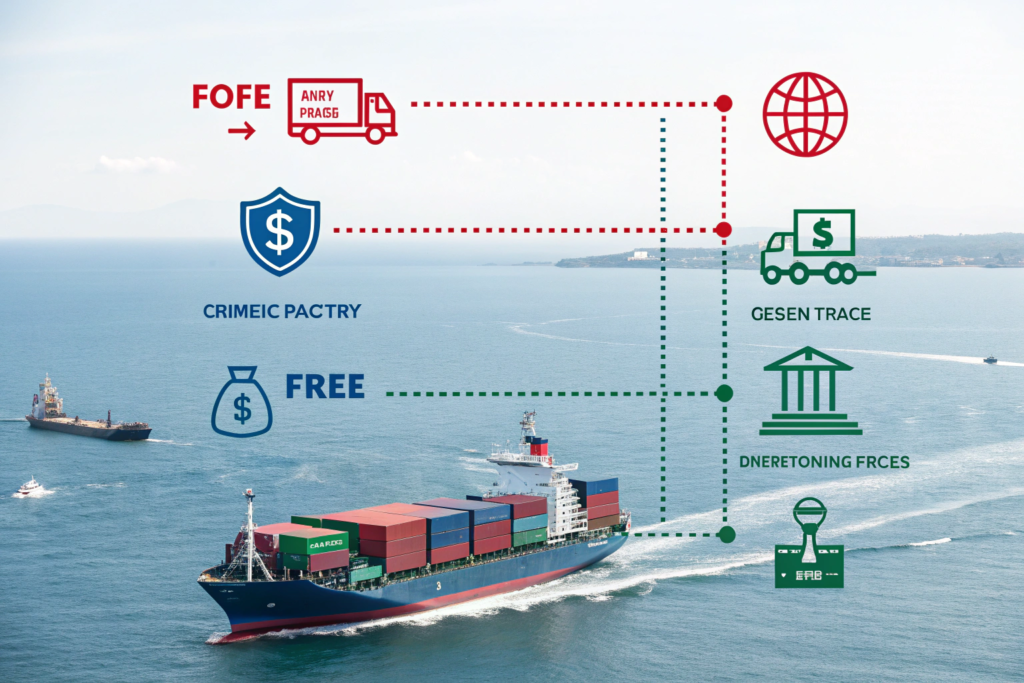
So, how do you calculate it? You build it up, layer by layer, starting with your Incoterm. Think of an Incoterm (FOB, CIF, DDP) as a roadmap that defines who pays for what and who bears the risk at each stage of the journey from the supplier's factory to you. Your total landed cost formula is: Product Cost + Logistics & Freight Costs + Insurance + Duties & Taxes + Inland & Handling Fees. The Incoterm you choose determines which of these costs are included in your supplier's quote and which ones you must add separately. Getting this wrong is the single biggest mistake importers make.
Why does this matter so much now? With volatile freight rates, complex tariffs (like the US Section 301 on Chinese goods), and supply chain uncertainty, a $0.10/meter miscalculation on a 50,000-meter order is a $5,000 hole in your profit. This isn't just accounting; it's survival. I'll walk you through each Incoterm, show you the hidden costs, and give you a real framework to get to your true number. No more surprises.
What Exactly Do FOB, CIF, and DDP Mean for Your Bottom Line?
These three-letter terms dictate your financial responsibility and risk. FOB (Free On Board) means your cost and risk start the moment the fabric crosses the ship's rail at the port of origin. You own it and are responsible for everything after that: main ocean freight, insurance, destination port charges, customs clearance, and final delivery. CIF (Cost, Insurance, and Freight) means the supplier covers the cost of the goods, insurance, and freight to your named destination port. Your risk still transfers at the origin port, but you pay for the freight upfront to the supplier. DDP (Delivered Duty Paid) is the full-service option. The supplier pays and manages everything to deliver the goods to your designated address, cleared through customs. You just wait for the truck to arrive.
The impact on your bottom line is about cash flow, control, and predictability. FOB gives you control to choose your own freight forwarder and potentially get better rates, but it requires you to manage the logistics chain and exposes you to cost volatility. CIF simplifies things but often includes a profit margin for the supplier on freight, and you lose control over the carrier choice. DDP offers the highest predictability—you get one all-in price—but it’s usually the most expensive because the supplier builds in a buffer for all risks and administrative work. For new importers, DDP feels safe, but as you scale, understanding FOB is crucial for cost optimization.
How Do You Build a Cost Model for an FOB Shipment?
This is where most of the hidden costs live. Your supplier's quote is just the starting point. Let’s build a real model for a 20-foot container (about 12,000-15,000 meters of mid-weight fabric) from Ningbo, China, to Los Angeles, USA.
- Product Cost: $30,000 (your negotiated FOB price).
- Ocean Freight: You must get a quote from your freight forwarder. Let's say: $1,800 (rates fluctuate wildly).
- Insurance: Typically 0.3% of the goods value (CIF value). For this, estimate: ~$100.
- Origin Port Charges (THC): Already included in your FOB price. Good.
- Destination Port Charges: This is a big one. Includes Terminal Handling Charge (THC), Pier Pass, etc. Estimate: $800 - $1,200.
- Customs Clearance Broker Fee: You cannot do this yourself. Budget: $300 - $500.
- Duties: This is critical. For woven cotton fabric (HS code 5208), the US duty is about 8.5%. Duty is calculated on the Customs Value, which is essentially your Product Cost + Insurance + Freight. So, duty = ($30,000 + $1,800 + $100) * 8.5% = $2,716.50.
- Inland Freight (Port to Your Warehouse): From LA port to a warehouse in, say, downtown LA: ~$400. If you're going to the Midwest, this can be $2,000+.
Quick Total Landed Cost Estimate:
$30,000 (Product) + $1,800 (Freight) + $100 (Insurance) + $1,000 (Avg. Dest. Port) + $400 (Broker) + $2,716.50 (Duty) + $400 (Inland) = $36,416.50.
See? Your $30,000 fabric just cost you $36,416.50. That's a 21.4% increase. For a detailed look at how to calculate landed cost with a free template, industry logistics platforms offer great resources. This is the reality of FOB. At Shanghai Fumao, we provide clients with a detailed pre-shipment cost breakdown that estimates these components, so there are no surprises.
What Are the Hidden Pitfalls in a CIF Quotation?
CIF seems simpler: "Price includes everything to my port." The pitfalls are in the lack of control and transparency.
- Freight Margin: Your supplier isn't a logistics expert. They use a forwarder and add a service fee, often 10-15%, on top of the actual freight cost. That $1,800 freight leg might cost you $2,100 in a CIF price.
- Insurance Coverage: They will procure insurance, but the coverage amount and terms might be minimal (e.g., 110% of CIF value, basic conditions). If you have a high-value shipment, you might need "All Risk" coverage, which they may not provide.
- Port of Destination Flexibility: You're locked into their chosen carrier and schedule. If there's a port congestion issue in Long Beach, you can't reroute to Oakland without major hassle and cost.
- Your Costs Don't End at the Port: A huge misconception! With CIF, your responsibility and costs begin as soon as the ship arrives at your port. You are still responsible for all the destination charges, customs clearance, duties, and inland freight from #5-8 in the FOB list above. Many buyers think CIF means "door-to-port," but it's not. It's "factory-to-port."
A real example: In Q3 2023, a Miami-based apparel brand took a CIF quote from another supplier. The quoted "all-in" price to Miami port was attractive. However, when the ship arrived, they were hit with unprecedented port demurrage fees due to congestion (a cost they owned under CIF), and their customs broker found the commercial invoice lacked proper detail, causing a delay and extra inspection fees. Their landed cost soared 18% above the CIF quote. They learned the hard way that understanding the nuanced differences between CIF and FOB responsibilities is non-negotiable.
How Do Tariffs and Duties Drastically Change Your Calculation?
This is the variable that can make or destroy your margin. Duties are not a flat tax; they are a complex matrix based on the fabric's Harmonized System (HS) code, its composition (e.g., 65% polyester, 35% cotton), its weight, and its construction (knit vs. woven). The country of origin (China vs. Vietnam) also plays a huge role due to trade agreements or punitive tariffs.
For US importers, the Section 301 tariffs on goods of Chinese origin are a massive factor. Many textiles and apparel items have an additional 7.5% to 25% tariff slapped on top of the normal duty rate. For example, knitted polyester fabric (HS 6006) might have a normal duty of 14%, plus a Section 301 tariff of 7.5%, resulting in a total duty burden of 21.5%. This must be in your landed cost model from day one.

How Do You Correctly Classify Fabric with HS Codes?
You cannot guess this. Getting it wrong leads to customs delays, penalties, and forced re-classification at a higher rate. The process:
- Know Your Material Precisely: You need the exact fiber composition percentages (by weight), the construction (woven plain weave, knitted pile, etc.), weight in g/m², and width. Your supplier must provide this.
- Use Official Resources: Start with the US International Trade Commission's (USITC) Harmonized Tariff Schedule online. It's searchable.
- Look at the Notes: Chapters 50-63 cover textiles. The section notes are critical. For example, a fabric with 52% cotton and 48% polyester is classified as a cotton fabric (majority by weight).
- When in Doubt, Get a Ruling: For large, recurring orders, you can apply for a Binding Ruling from U.S. Customs and Border Protection (CBP). This gives you legal certainty. For many of our clients at Shanghai Fumao, we provide a suggested HS code based on the fabric's technical specifications, but we always advise they confirm with their customs broker.
Let me give you a technical case: A client ordered a "performance twill" in 2022. It was 86% recycled polyester, 14% spandex, 280gsm. The instinct was to classify it under synthetic filament fabrics. However, due to its specific weight and the presence of spandex, the correct HS code (under 5903, coated fabrics) carried a lower duty rate. Correct classification saved them 3.5% in duties on a $70,000 shipment. That's $2,450 saved because we did the detailed spec work upfront.
What's the Real Cost Impact of Section 301 Tariffs on Chinese Fabrics?
It's massive and it directly incentivizes diversification. For a fabric with a 25% Section 301 tariff on top of, say, a 10% normal duty, your total duty is 35%. On a $50,000 shipment, that's $17,500 just in duties.
This is why many brands are exploring "China Plus One" sourcing. They might source the fabric from China for its quality and development speed but have it cut and sewn in Vietnam or Cambodia to change the "country of origin" for the final garment, which may have a lower or zero tariff into the US under trade agreements. However, the rules of origin are strict—usually requiring a "substantial transformation."
For fabrics you must import directly from China, the tariff is a non-negotiable cost. You must bake it into your costing and pricing. Some strategies include:
- Value Engineering: Working with your supplier to see if a slightly different composition (e.g., 51% wool / 49% polyester vs. 50/50) falls under a different, lower-tariff category.
- Bonded Warehouses: Importing large quantities and storing them in a bonded warehouse in the US. You only pay duties when the fabric is withdrawn for use, aiding cash flow.
Why is DDP Often the Most Expensive But Least Risky Option?
DDP is the "hassle-free" price. Your supplier quotes you a single number to get the fabric to your warehouse. They handle the freight forwarder, the customs broker, pay the duties on your behalf, and arrange the final truck. For you, it's simple: one cost, one point of contact. The risk of cost overruns, delays due to paperwork errors, and dealing with customs falls entirely on the supplier.
The expense comes from the risk premium. The supplier isn't just adding up the actual costs; they're adding a significant buffer because:
- They are on the hook for unpredictable costs (like sudden fuel surcharges, detention/demurrage fees if your truck is late at the destination port).
- They have to pre-pay duties and logistics costs, tying up their cash flow, which they pass on to you.
- They assume the administrative burden and liability for correct customs classification.
For small to medium-sized orders, or for businesses without a dedicated logistics team, the DDP premium can be worth every penny. It converts a variable, unpredictable cost into a fixed line item on your P&L. But you must verify the supplier's capability. Can they truly handle US customs? Do they have a reliable partner network? Ask for references.

When Does Choosing DDP Make the Most Financial Sense?
DDP makes sense when the value of your time and risk mitigation exceeds the premium cost. Consider it for:
- First-Time Imports: Eliminates the learning curve and fear of making a costly mistake.
- Small, High-Value Samples or Development Lots: The logistics complexity isn't worth your effort for a few hundred meters.
- Tight Deadline Projects: You need a supplier who controls the entire chain to guarantee a delivery date. They can't blame the forwarder or customs if they are responsible for it all.
- Complex or High-Tariff Items: If the duty classification is very complex, letting a supplier experienced in exporting that specific product handle it can prevent costly errors.
We had a client in Canada, a startup, order 3,000 meters of custom-printed jacquard in 2024. They chose DDP. Our all-in price was about 18% higher than an FOB equivalent. For them, it was perfect. They had no import experience, no broker relationship, and needed to focus on marketing. The fabric arrived at their studio in Toronto on the exact day we promised. They paid a premium for total predictability and peace of mind, which for their stage of business was the correct financial decision.
How Can You Verify and Negotiate a DDP Price?
Don't just accept the DDP number. Break it down. Ask your supplier for a detailed cost breakdown (they may be reluctant, but it's a sign of a good partner if they provide it). It should roughly outline:
- Ex-factory product cost.
- Estimated freight cost.
- Estimated insurance cost.
- Estimated destination port charges.
- Estimated customs duties and taxes.
- Estimated inland delivery cost.
- Their service/admin fee.
This allows you to:
- Check for Reasonableness: Compare the freight and duty estimates with your own research or a quick call to a forwarder.
- Negotiate: You might say, "I see your freight estimate is $2,500. I have a forwarder who can do it for $2,100. Can we use them, or can you match that rate?" A transparent supplier will work with you.
- Build Trust: Understanding the components shows you're a professional buyer and helps build a more collaborative relationship. A platform like Freightos's DDP explained guide can help you understand standard components to ask for.
What Are the Most Common Landed Cost Calculation Mistakes?
Even experienced buyers trip up. Here are the big ones:
Mistake 1: Forgetting Domestic Logistics. You budget for ocean freight but forget the final leg from your domestic port to your warehouse. This can be $500 or $5,000 depending on distance and access.
Mistake 2: Using the Wrong Value for Duty Calculation. Duties are on the CIF value (Cost + Insurance + Freight), not just the product cost. Using only the product cost under-calculates your duty by a wide margin.
Mistake 3: Ignoring Currency Fluctuation. If you're quoted in USD, you're safe. But if you're a European buyer and the supplier's costs are in RMB, a shift in the EUR/RMB exchange rate between order and payment can change your product cost by 3-5%.
Mistake 4: Not Planning for Peak Surcharges. Shipping during peak seasons (Aug-Oct) often incurs Peak Season Surcharges (PSS) of $500-$1500 per container. If your shipment lands during Chinese New Year closures, origin port labor shortages can cause delays and fees.
Mistake 5: Overlooking Payment Fees. Bank transfer fees (especially international SWIFT), letter of credit charges, or currency conversion fees from your bank can add up to 0.5-1% of the order value.

How Do You Create a Foolproof Landed Cost Checklist?
You need a system. Create a spreadsheet template you use for every single quotation. Here’s a basic structure:
| Cost Component | Responsible Party (FOB) | Estimated Cost | Actual Cost | Notes |
|---|---|---|---|---|
| 1. Product Cost | Supplier | [Quote] | ||
| 2. Origin Charges | Supplier (in FOB) | Included | THC, Documentation | |
| 3. Ocean/Air Freight | Buyer | [Get Quote] | ||
| 4. Insurance | Buyer | 0.3% of CIF Val | ||
| 5. Destination Port Charges | Buyer | [Get Quote] | THC, Pier Pass, etc. | |
| 6. Customs Broker Fee | Buyer | $400-$600 | ||
| 7. Duties & Taxes | Buyer | (1+3+4)*Duty Rate | Base: CIF Value | |
| 8. Inland Freight (Dest.) | Buyer | [Get Quote] | Port to Door | |
| 9. Other (Bank Fees, etc.) | Buyer | 0.5% of Order | ||
| TOTAL LANDED COST | SUM(1-9) |
Pro Tip: For the "Estimated Cost" column, build relationships with a reliable freight forwarder and customs broker. Send them the shipment details (origin, destination, volume, weight) to get real-time estimates. For duties, use the HTS lookup tool. This turns your estimate from a guess into a projection.
How Can a Supplier Help You Accurately Forecast These Costs?
A good supplier is a partner in your costing. At Shanghai Fumao, we don't just send an FOB price. For serious inquiries, we provide a Preliminary Landed Cost Analysis. This includes:
- The exact gross weight, net weight, and volume of the packed goods (critical for freight quotes).
- A detailed packing list simulation.
- A suggested HS code based on the fabric's tech specs.
- Recent freight rate benchmarks from Ningbo/Shenzhen to major ports.
- An outline of the documents we will provide (Commercial Invoice, Packing List, Certificate of Origin, potentially BL/AWB).
This allows you to plug accurate numbers into your checklist. For example, in March 2024, we worked with a Danish brand on a 40-foot container of linen blend. We provided the exact cubic volume (68 CBM) and weight (11,500 kg). They got precise freight quotes, and our spec sheet allowed their broker to pre-confirm the HS code and duty rate. Their final landed cost was within 2% of our joint forecast. That's how it should work.
Conclusion
Calculating total landed cost isn't a finance exercise—it's the core of profitable sourcing. The difference between FOB, CIF, and DDP isn't just about who pays; it's about who carries the risk, who has control, and ultimately, what your true cost of goods sold will be. By building a disciplined model that accounts for every layer—from the factory floor to your warehouse dock—you move from reactive budgeting to proactive financial management. You stop being surprised by costs and start planning for them.
The most successful brands we work with treat landed cost modeling as non-negotiable. They have their checklist, they ask the detailed questions, and they choose their Incoterm based on a clear understanding of their own capacity and risk tolerance. In today's volatile trade environment, this knowledge is your greatest shield against margin erosion.
If you're tired of unpredictable costs and want a fabric partner who brings transparency and expertise to your supply chain, let's connect. At Shanghai Fumao, we believe an informed customer is a successful customer. We provide the detailed data and support you need to forecast your landed costs with confidence. To discuss how we can bring predictability to your next fabric order, contact our Business Director, Elaine. She can guide you through the specifics of your project. Reach her at: elaine@fumaoclothing.com. Let's ensure your next "great price" is truly great, all the way to your door.