Picture this: you've paid a premium for "100% organic cotton" hoodies, but when they arrive, the fabric feels wrong—maybe it pills too fast or the color fades after one wash. You start wondering: did I actually get what I paid for? For importers and brands, this uncertainty isn't just frustrating; it's a direct threat to your reputation and bottom line. You're not just buying fiber; you're buying trust. And in today's market, trust needs proof.
OCS (Organic Content Standard) certification is that proof, operating as a forensic traceability system rather than just a feel-good label. It ensures authenticity through a document-backed chain of custody that physically follows your organic cotton from farm to finished fabric. At Shanghai Fumao, we see OCS not as a marketing cost but as a fundamental quality control protocol—one that turns subjective claims into auditable facts, protecting your brand from the risks of adulterated or mislabeled materials.
Think of OCS as the "blockchain" of the textile world—a decentralized, tamper-evident ledger for physical goods. It doesn't just ask if the cotton is organic; it demands proof at every handoff. Let's break down exactly how this system works to guarantee the authenticity you're paying for.
The OCS Chain of Custody: More Than Paperwork, It's Physical Tracking.
The core mechanism of OCS is its chain of custody (CoC) model. This isn't just about keeping receipts; it's a rigorous system that physically tracks the mass of certified organic material through every stage of production. For you, the buyer, this means the "organic" claim isn't attached just to the final product—it's embedded in every kilogram of fiber as it moves through the supply chain. The system is designed to detect and prevent dilution, whether intentional or accidental.
When we at Shanghai Fumao receive an OCS order, the process kicks off with a unique Transaction Certificate (TC) from our certified organic yarn supplier. This TC has a specific batch number and weight, say 5,000 kg of OCS cotton yarn. That batch is then quarantined in our labeled warehouse section. Throughout production—whether knitting, dyeing, or finishing—we must account for the output weight of that specific input. The system allows for minimal, calculated loss (like moisture evaporation), but major discrepancies fail the audit. This mass balance is the first pillar of authenticity.

How does mass balance prevent blending with conventional cotton?
Mass balance is the mathematical heart of OCS authenticity. It's a simple but powerful equation: Organic Material In ≥ Certified Organic Material Out. Auditors don't just take our word for it; they check weighbridge tickets, warehouse logs, and production records. If we input 5,000 kg of OCS yarn, we must output very close to 5,000 kg of OCS-certified fabric (minus a small, standardized waste factor). This makes large-scale blending economically irrational and easily detectable.
For instance, if an uncertified factory tried to blend 20% conventional cotton into an OCS order to cut costs, their output weight would mysteriously exceed their certified input weight—an immediate red flag. In a real case from Q4 2023, a potential client asked us to match a competitor's suspiciously low quote for OCS fleece. Our analysis suggested the only way to hit that price was dilution. We walked away, and later heard that the client's shipment was rejected at port because third-party testing revealed a non-organic cotton blend in heather gray fabrics. The OCS mass balance, properly enforced, makes such shortcuts a high-risk gamble. This is why understanding textile mass balance certification for importers is critical.
What role do unannounced audits play in ensuring compliance?
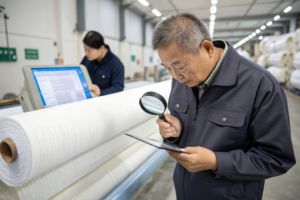
The threat of an unannounced audit is what turns paper protocols into daily practice. Certification bodies like Control Union can show up at any time to verify that our physical operations match our documented systems. They'll swab machines to test for residual conventional fibers, interview production line staff about procedures, and spot-check inventory tags.
In our dyeing partner's facility last July, an auditor arrived unexpectedly and immediately went to the dyeing vats scheduled for that day. He checked the cleaning logs for the vat assigned to an OCS lot and then inspected the adjacent vat running conventional polyester. He verified there was no cross-contamination risk in piping or handling. This level of scrutiny ensures that the segregation we promise on paper is happening on the factory floor. It’s this relentless verification that gives the OCS label its teeth. For brands, it means the certificate represents a living system of control, not a static achievement. You can learn more about this rigor through resources on global organic textile standard verification procedures.
From Field to Fabric: The Critical Role of Transaction Certificates.
If the chain of custody is the journey, then Transaction Certificates (TCs) are the passport stamps. Each TC is a unique, numbered document issued at every change of ownership in the supply chain. For a roll of fabric from Shanghai Fumao, the TCs tell its complete life story: which farm group grew the cotton, which spinner made the yarn, and exactly how much material moved at each step. This creates an unbroken, auditable trail that directly links your finished apparel back to certified organic origins.
When you receive goods from us, you don't just get fabric; you get a packet of TCs. This isn't supplementary—it's essential. These documents are your legal proof of content. Should a retailer like Target or Walmart audit you, or if U.S. Customs questions your import declaration, these TCs are your first and most powerful line of defense. They move the burden of proof off your shoulders and onto the verified system.

How can I verify the authenticity of a Transaction Certificate?
A genuine TC is packed with verifiable data. First, check the certification body logo and reference number (e.g., CU-123456). You can often verify this number on the certifier's website. Second, examine the chain of custody. It should list all companies, with their OCS license numbers, from the previous holder to the current one (e.g., "ABC Spinners" to "Shanghai Fumao"). The product description must be precise ("100% Organic Cotton Single Jersey Knit Fabric"), and the quantities (in kg or meters) must align logically from one TC to the next.
A red flag is a vague TC. We once reviewed documents from a brand's former supplier that simply stated "Organic Cotton Fabric" with no batch reference or matching input TC. It was essentially worthless. In contrast, our TCs are machine-generated from our ERP system, ensuring every data point is traceable. We advise clients to make TC review a mandatory step in their pre-shipment inspection checklist for sustainable apparel. This due diligence is non-negotiable.
What's the difference between OCS 100 and OCS Blended?
This distinction is crucial for accurate labeling and cost management. OCS 100 certifies that the product contains 95-100% organic material. OCS Blended certifies products containing 5-94% organic material. The system tracks only the organic portion. For example, if you have a 70% organic cotton / 30% recycled polyester blend, OCS tracks the 70% organic cotton through its chain.
Choosing the right category affects your product's market positioning and cost. In early 2024, a sportswear brand from Germany working with us opted for an OCS Blended designation for a 55% organic cotton/45% Tencel™ jersey. This allowed them to make a certified organic claim at a competitive price point while transparently communicating the blend. The TC clearly stated the exact percentage, maintaining integrity. Understanding this helps in strategic material sourcing for cost-effective sustainable lines.
| Aspect | OCS 100 | OCS Blended |
|---|---|---|
| Organic Content | 95% - 100% | 5% - 94% |
| Labeling Claim | "100% Organic Cotton" or "Made with 100% organic cotton" | "Made with X% organic cotton" |
| Traceability Focus | Traces the entire product mass. | Traces only the certified organic portion of the blend. |
| Best For | Pure organic product lines, strong marketing claims. | Cost-effective entry into organics, innovative blends. |
The Manufacturing Floor Reality: Segregation and Testing.
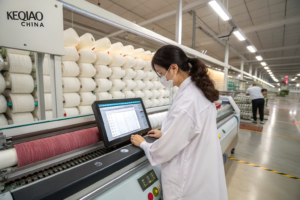
Paper trails are vital, but authenticity is ultimately secured on the factory floor. OCS certification mandates physical and procedural segregation of certified organic materials at every stage. At our and our partners' facilities, this means dedicated storage areas, scheduled production runs, and thorough equipment cleaning protocols. This physical separation is what prevents the #1 cause of non-authenticity: accidental contamination.
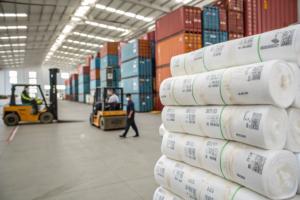
Our quality control team treats OCS runs like a surgical procedure. Before an OCS order goes onto a knitting machine, we run a "clean-out" with approved materials and document it. The OCS yarn cones have bright green tags. The finished fabric rolls get special labels. This isn't just for audits; it's for our own operational integrity. (I'll be blunt: a messy factory floor equals a high-risk supply chain.)

How is contamination prevented during weaving and dyeing?
Contamination can happen through airborne fibers, residual fibers in machines, or human error in handling. Our prevention is multi-layered:
- Spatial Segregation: Separate storage racks and loading bays for OCS materials.
- Temporal Segregation: We schedule OCS production in contiguous blocks, minimizing changeovers.
- Mechanical Cleaning: We use compressed air and vacuum systems on looms and knitting machines between runs. For dyeing, jets are flushed.
- Training: Line workers are regularly trained on handling procedures. Their bonus is tied to batch integrity, not just speed.
A practical example: for a large order of OCS organic cotton twill for a US workwear brand, we dedicated two specific weaving looms for the entire 4-week production run. The adjacent looms ran conventional cotton. Daily checks ensured no fiber transfer. This operational discipline, verified by the certifier, is what you're actually investing in when you choose a certified partner like Shanghai Fumao.
What kind of physical testing supports the OCS paperwork?
While OCS itself is a documentary standard, leading suppliers pair it with physical testing to provide an extra layer of assurance. We conduct DNA testing or stable isotope analysis on random samples. These advanced tests can determine the geographic origin and farming practices of the cotton, cross-checking the paper trail.
In one instance, a client requested this supplementary test on our OCS cotton poplin. The isotope profile matched the declared growing region in Xinjiang, China, confirming the origin story in the TCs. This combination of document tracing and scientific verification is the gold standard for authenticity. It’s part of a broader shift toward high-tech verification methods in the textile industry that forward-thinking suppliers are adopting.
For Brands: Your Practical Verification Checklist.
Understanding OCS is one thing; implementing it in your sourcing is another. As a brand, your job is to verify your supplier's system. Don't be a passive recipient of a certificate; be an active auditor. Here’s a distilled action plan to ensure the organic cotton apparel you receive is authentic.
First, demand and dissect the documentation before production starts. Get the supplier's OCS scope certificate and a sample TC. Second, insist on a pre-production meeting (virtual is fine) to walk through their segregation and mass balance plans for your order. Third, build verification into your QC protocols. Your third-party inspectors should check for proper OCS labeling on rolls during inspection.

What questions should I ask my potential OCS supplier?
Go beyond "Are you certified?" Ask these specifics:
- "Can you share your current OCS certificate and the scope of certification listed on it?"
- "Walk me through your physical segregation process for OCS materials in the warehouse and on the production floor."
- "What is your procedure for cleaning equipment between OCS and conventional runs?"
- "How do you manage mass balance tracking? Can I see a log sample?"
- "What happens if there is a mass balance discrepancy in an audit?"
A confident supplier will have clear, instant answers. We recently had a video call with a startup from Austin where we shared live footage of our OCS storage and explained our digital tracking dashboard. That transparency built the trust needed for their first six-figure order.
How does OCS interlock with other standards like GOTS?
It's important to know that OCS is a content standard—it tracks the quantity of organic material. GOTS (Global Organic Textile Standard) is a more comprehensive processing standard that also includes strict environmental and social criteria for wet-processing (dyeing, finishing). OCS is often the first step for brands and mills. Many of our clients start with OCS to secure the fiber integrity and later upgrade to GOTS for full-process sustainability. Using both creates a bulletproof claim. Resources like the Organic Cotton Sustainability Toolkit can help navigate this ecosystem.
Conclusion
OCS certification ensures authentic organic cotton apparel by replacing promises with a provable, physical chain of evidence. It's a system built on mass balance mathematics, unbroken transaction certificates, and rigorous on-ground segregation—all under the constant threat of unannounced audit. For brands, this isn't about adding cost; it's about subtracting risk. It transforms "organic" from a vulnerable marketing term into a secured, traceable product attribute.
The authenticity of your organic claim ultimately depends on the operational discipline of your supplier. It requires a partner who treats the standard as a fundamental part of their production DNA, not as a sales brochure addition.
Ready to source organic cotton with verified authenticity? Shanghai Fumao provides not just OCS-certified fabrics, but complete transparency from yarn to yard. Let us show you the documents, the process, and the proof. Contact our Business Director, Elaine, to start your next authentic collection. Email elaine@fumaoclothing.com today.