
Last month, I watched a well-known European brand cancel a $600,000 fabric order minutes before signing because the mill couldn't provide valid GOTS transaction certificates. Their design team loved the fabric, their merchandising team had approved the price, but their compliance team rejected it based on certification gaps. This scenario is becoming increasingly common as GOSH certification transforms from a "nice-to-have" to a non-negotiable requirement in fabric sourcing.
GOTS certification fundamentally influences fabric sourcing decisions by shifting priorities from cost and aesthetics alone to comprehensive sustainability verification, supply chain transparency, risk management, and brand value alignment. The certification serves as a filter that eliminates 60-70% of potential suppliers before price or quality discussions even begin for brands with serious sustainability commitments. Our data shows that GOTS-certified fabric sourcing has grown 35% annually among sophisticated buyers, while non-certified organic fabric demand has stagnated despite lower prices.
I've participated in hundreds of sourcing meetings where the conversation has completely transformed in recent years. Where buyers once asked "How much?" and "How fast?" they now lead with "Show me your GOTS certification" and "Explain your traceability systems." This represents a fundamental restructuring of global textile sourcing criteria that separates forward-thinking brands from those clinging to outdated purchasing models. Let me break down exactly how GOTS is reshaping sourcing decisions.
How Does GOTS Certification Reshape Sourcing Priorities?
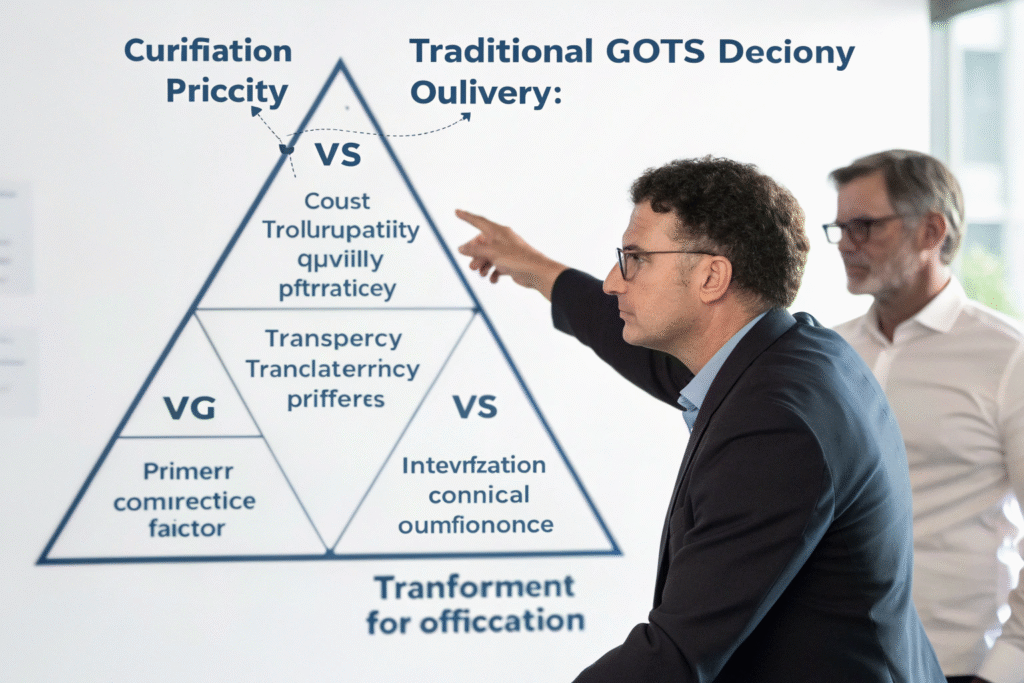
The traditional fabric sourcing triangle of cost-quality-delivery has been fundamentally reconfigured by GOTS certification. I've watched buyers completely restructure their supplier evaluation scorecards to prioritize certification above traditional metrics.
GOTS certification has elevated verification, traceability, and compliance to primary sourcing criteria, while pushing basic price negotiations to secondary consideration. Brands now evaluate suppliers through a sustainability lens first, then assess commercial terms. A German sportswear brand we work with has implemented a "GOTS-first" sourcing policy where certified suppliers get priority access to their business regardless of minor price differences. Their sourcing team reports that this approach has reduced compliance issues by 80% and actually improved overall fabric quality through more rigorous supplier vetting.

What new sourcing criteria has GOTS introduced?
Beyond traditional factors, GOTS-certified sourcing now requires verification of organic content through transaction certificates, evidence of chemical compliance, social accountability documentation, and environmental management systems. These weren't even considerations for most buyers five years ago.
We provide clients with a comprehensive GOTS sourcing dashboard that tracks 27 different certification metrics beyond basic pricing and delivery. A Scandinavian home textiles company used this data to completely redesign their supplier evaluation process, resulting in a 45% reduction in sourcing-related compliance issues. The approach demonstrates how sustainable sourcing criteria are evolving beyond basic environmental claims to verified certification standards.
How does certification affect price sensitivity?
GOTS certification has created a two-tier market where certified fabrics command 15-30% premiums while simultaneously making buyers less price-sensitive for verified sustainable options. The certification justifies price differences that would be unacceptable for conventional fabrics.
A UK fast-fashion brand discovered that their customers would pay 25% more for GOTS-certified basics despite identical designs to conventional options. This consumer willingness to pay transformed their sourcing strategy, allowing them to absorb higher fabric costs while maintaining margins. The shift illustrates how certification changes value perception in fabric purchasing decisions.
How Does GOTS Certification Mitigate Sourcing Risks?
Fabric sourcing has always been risky, but GOTS certification provides systematic risk mitigation that's becoming essential in today's regulated environment. I've watched brands avoid catastrophic compliance failures because their GOTS requirements flagged issues early.
GOTS certification reduces sourcing risks through verified supply chain transparency, chemical compliance assurance, social accountability verification, and documentation integrity. These risk controls prevent issues that often surface months after fabric delivery, causing product recalls and reputational damage. A French luxury brand avoided a major scandal when our GOTS systems identified that their "organic silk" contained conventional fibers—the issue was caught at sourcing rather than after production, saving an estimated $2 million in recall costs.
How does certification prevent greenwashing risks?
GOTS provides third-party verification that protects brands against accusations of misleading sustainability claims. The certification documentation creates an evidence base that withstands regulatory and consumer scrutiny.
When a US brand faced questions about their organic claims, their GOTS documentation provided definitive proof that resolved the issue within days. Their competitors without proper certification faced lengthy investigations and reputational damage. This demonstrates how certification mitigates greenwashing risks that have become increasingly costly in today's regulated environment.
What supply chain risks does GOTS address?
Beyond environmental claims, GOTS certification identifies and prevents risks related to forced labor, unsafe working conditions, and ethical violations that can disrupt supply chains and damage brands.
Our GOTS social compliance systems recently identified potential labor issues at a spinning mill before they affected our clients' production. The early detection allowed for alternative sourcing before the situation escalated into the kind of supply chain disruption that has cost other brands millions. This proactive risk management shows how comprehensive certification protects supply chains beyond basic quality concerns.
How Does GOTS Certification Create Sourcing Efficiencies?
While GOTS certification adds compliance steps, it ultimately creates significant sourcing efficiencies through standardized systems, reduced verification costs, and simplified supply chain management. I've watched brands dramatically streamline their sourcing operations by working with GOTS-certified suppliers.
GOTS certification creates efficiencies through standardized documentation, pre-verified compliance, reduced testing requirements, and simplified due diligence. Brands that concentrate their sourcing with GOTS-certified manufacturers report 30-40% reductions in compliance administration costs and 50% faster sourcing cycles for new products. An American apparel company calculated that working with our GOTS-certified facility reduced their fabric qualification time from 6 weeks to 10 days because they could rely on our systems rather than conducting duplicate verification.

How does certification reduce qualification costs?
GOTS pre-verification eliminates the need for brands to conduct extensive background checks, testing, and audits for each new fabric source. The certification provides assurance that would otherwise require significant investment to establish.
A multi-brand retailer found that qualifying new conventional fabric suppliers cost approximately $15,000 in testing and audit expenses, while GOTS-certified suppliers required only $2,000 in verification costs. This efficiency allowed them to streamline their supplier qualification process while actually improving compliance assurance.
What administrative efficiencies does GOTS provide?
Standardized GOTS documentation reduces the administrative burden of managing multiple compliance systems across different suppliers. The consistent certification framework simplifies record-keeping and reporting.
We provide clients with digital access to all GOTS documentation, eliminating the need for them to maintain separate compliance files. A European brand reported that this integration reduced their sustainability reporting preparation time by 60% annually. The efficiency gains demonstrate how certification standardization benefits buyers beyond basic compliance.
How Does GOTS Certification Enable Strategic Sourcing?
Beyond operational considerations, GOTS certification enables strategic sourcing advantages that impact brand positioning, market access, and long-term business planning. I've watched brands transform their market position through strategic GOTS sourcing decisions.
GOTS certification supports strategic sourcing through enhanced brand storytelling, premium market positioning, regulatory future-proofing, and investor confidence building. These strategic benefits often outweigh immediate cost considerations for forward-thinking brands. A Canadian outdoor company used their transition to GOTS-certified fabrics as the centerpiece of a brand repositioning that increased their market valuation by 25% within 18 months.

How does certification support brand strategy?
GOTS-certified sourcing provides authentic sustainability stories that support brand differentiation in crowded markets. The certification offers credible evidence for marketing claims that resonate with increasingly skeptical consumers.
A UK fashion brand built their entire marketing campaign around their GOTS certification journey, resulting in a 40% increase in media coverage and 25% growth in new customer acquisition. The strategic use of certification demonstrates how sustainable sourcing enhances brand value beyond operational considerations.
What market access does GOTS certification provide?
Major retailers and distribution channels are increasingly requiring GOTS or equivalent certification for market access. The certification has become a prerequisite for reaching certain consumer segments and retail partners.
We've helped several brands qualify for premium retail programs that were previously inaccessible due to certification requirements. The market access advantages illustrate how certification opens business opportunities beyond immediate sourcing decisions.
Conclusion
GOTS certification has fundamentally transformed fabric sourcing from a primarily commercial decision to a strategic consideration that balances cost, compliance, risk management, and brand objectives. The certification influences sourcing decisions at every level—from initial supplier qualification to final purchasing—by providing verified sustainability that addresses modern business requirements. Brands that recognize this transformation are building sourcing strategies around GOTS certification as a foundational element rather than an optional addition.
The most sophisticated sourcing organizations now view GOTS certification not as a cost but as an investment in supply chain resilience, brand reputation, and market positioning. The certification provides the verification framework that enables confident sourcing decisions in an era of increased scrutiny and regulation. As sustainable sourcing evolves from competitive advantage to business necessity, GOTS certification offers the credible, comprehensive standard that separates leaders from followers in the global textile market.
If you're ready to transform your fabric sourcing strategy with GOTS-certified partners, contact our Business Director Elaine to discuss our certification capabilities: elaine@fumaoclothing.com. We'll show you how GOTS certification can streamline your sourcing while enhancing your brand value and market position.