I remember the call from a New York-based fashion brand that still makes me cringe—not because it was our fault, but because it easily could have been. They'd ordered 15,000 meters of beautiful silk from a supplier in another country. When the container arrived, they found water damage throughout. Seawater had seeped through a container seal, soaking the bottom rolls. Mold was already growing. The entire shipment was a loss—$120,000 worth of fabric destroyed because someone skimped on packaging. The supplier refused responsibility, claiming "acts of God." The brand was left with nothing but legal bills and a season to cancel. That's when they came to us, and their first question was: "How do you make sure this never happens to your customers?"
Packaging might seem like the least glamorous part of fabric sourcing. It's easy to focus on fiber content, weave quality, color accuracy—all the things that make fabric beautiful. But all of that effort means nothing if the fabric arrives damaged. Water, crushing, snagging, shifting—a dozen things can destroy fabric between our factory door and your warehouse.
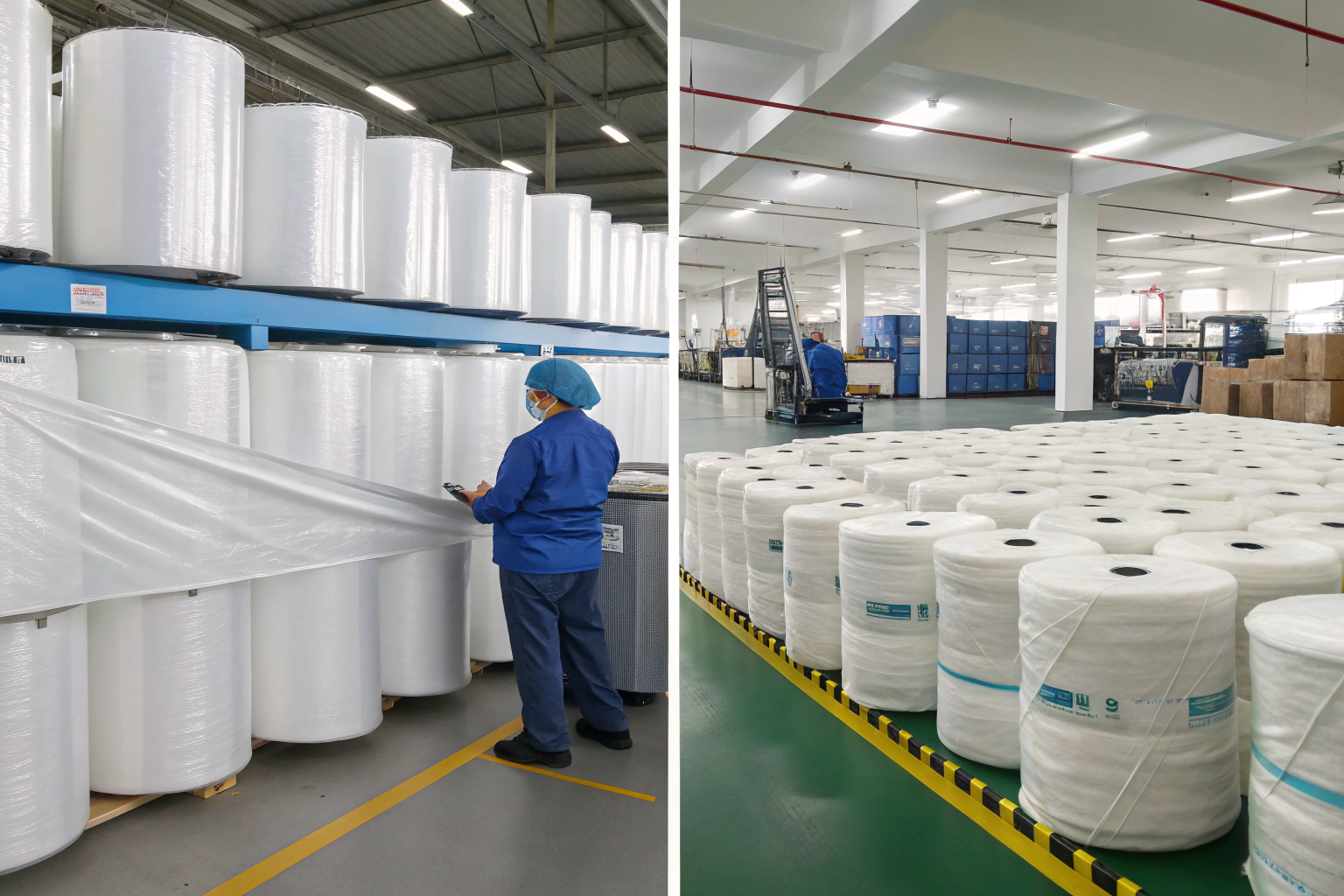
At Shanghai Fumao, we treat packaging as seriously as we treat weaving. Our on-site packaging operation isn't an afterthought—it's a carefully designed system that protects your investment every step of the way. We've learned through 20 years of shipping to 100+ countries exactly what can go wrong and how to prevent it. Let me walk you through how we ensure your fabric arrives exactly as it left our factory.
What Packaging Materials Protect Fabric During Transit?
The right materials make the difference between fabric that arrives pristine and fabric that arrives damaged. We don't cut corners here—the cost of quality materials is tiny compared to the cost of a damaged shipment.
Why is moisture protection critical for ocean freight?
Ocean freight is humid. Containers experience temperature swings that cause condensation. Seawater can splash container doors during loading. Rain can soak containers at ports. Moisture is the #1 threat to fabric in transit.
Our moisture protection system includes:
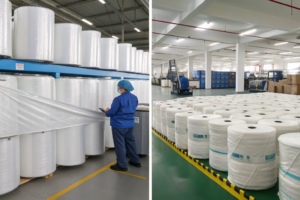
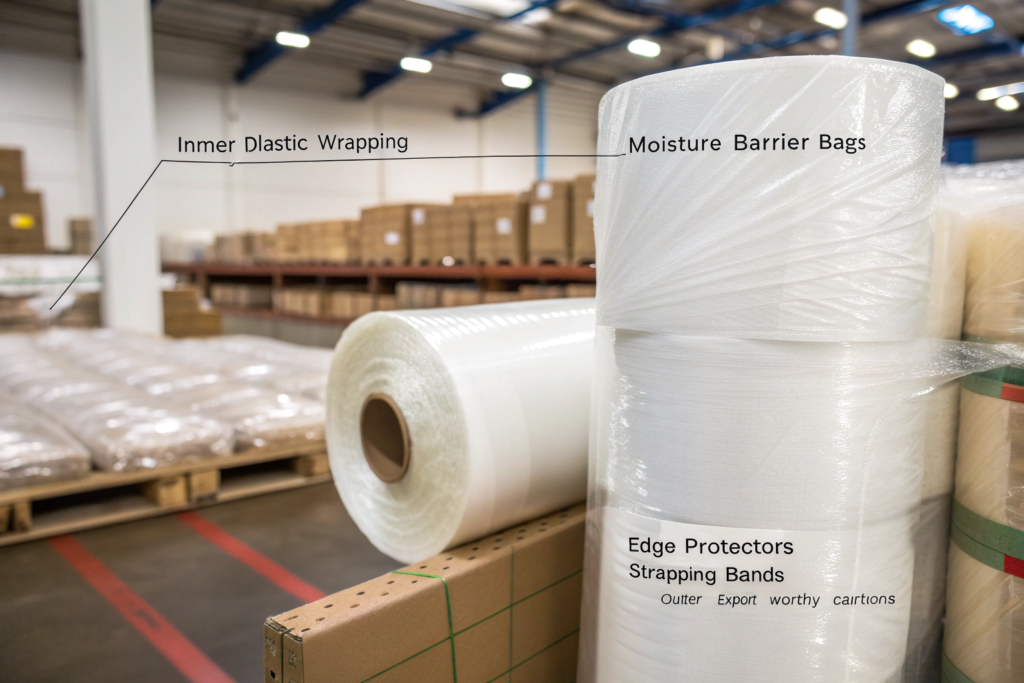
Inner plastic wrapping: Every roll is wrapped in polyethylene film before anything else. This creates the primary moisture barrier. We use 50-80 micron film—thicker than standard—because thin film tears easily.
Desiccant packets: For moisture-sensitive fabrics (silk, wool, anything that can mold), we add silica gel desiccant packets inside the wrapping. These absorb any residual moisture in the air trapped with the fabric.
Container moisture control: For high-value shipments, we specify container desiccant strips or bags that absorb condensation during the voyage. These hang inside the container, protecting the entire load.
Ventilation consideration: Some containers have ventilation openings; we ensure these are properly sealed or managed based on destination climate.
For a Norwegian wool client (high-value, moisture-sensitive), we triple-wrap each roll: first in acid-free tissue, then polyethylene, then a second polyethylene layer with desiccant between. Their fabric arrives in perfect condition despite weeks at sea and cold-to-warm temperature transitions. Moisture protection is non-negotiable for ocean freight.
How do we prevent physical damage from crushing and shifting?
Fabric rolls are heavy—a standard roll can weigh 30-50 kg, sometimes more. During transit, they shift, roll, and crush against each other. Our protection system addresses this:
Edge protectors: Cardboard or plastic corners placed on roll ends prevent strapping from cutting into fabric. Without these, tension bands can crush roll edges, damaging the outer layers.
Pallet configuration: Rolls are arranged on pallets in stable patterns—usually "chimney" stacking where rolls interlock like bricks. This prevents shifting during transit.
Strapping: Multiple polyester or steel straps secure rolls to pallets and each other. Tension is carefully controlled—too loose allows movement, too tight crushes rolls.
Air bags: For container loading, we use inflatable dunnage bags to fill empty space. These prevent load shift during rough seas or sudden braking.
Load calculation: We calculate container loading patterns to distribute weight evenly and prevent overloading of bottom rolls.
For a Canadian automotive client shipping heavy upholstery fabric, we developed a custom pallet configuration with reinforced corners and cross-strapping that survived independent lab testing to 3G vibration standards. Physical protection requires engineering, not guesswork.
What about protection from snagging and abrasion?
Fabric surfaces are vulnerable to snagging and abrasion during transit. Rolls rub against each other, against container walls, against strapping. Our solutions:
Smooth outer wraps: The outer layer of wrapping must be smooth to prevent snagging adjacent rolls. We use slip-coated polyethylene that reduces friction.
Facing direction: Rolls are arranged so that fabric edges (where snagging) are protected, not exposed.
Separator sheets: Between layers of rolls, we place cardboard or plastic sheets that prevent direct fabric-to-fabric contact and abrasion.
Edge reinforcement: For particularly delicate fabrics (velvets, chenilles, anything with pile), we add extra edge protection and ensure they're never at the bottom of stacks.
For a French luxury velvet client, we developed a "suspended" packaging system where velvet rolls are held in cradles that prevent any contact with other rolls or container surfaces. The cost is higher, but the fabric is irreplaceable. Delicate fabrics deserve delicate handling.
How Does On-Site Packaging Improve Quality Control?
Packaging at our facility—not outsourced—gives us control over every step. We don't trust your fabric to third-party packers who don't know its specific requirements.
What inspections happen immediately before packaging?
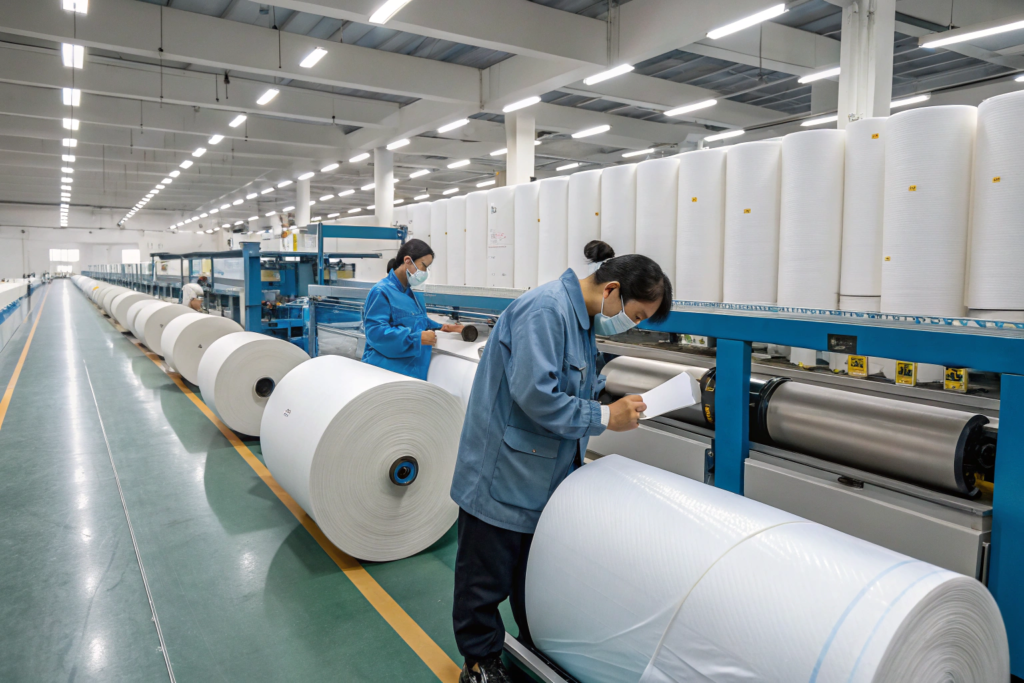
Before any fabric is wrapped, it undergoes final inspection:
Final quality check: Every roll is examined one last time for defects that might have been missed earlier. This is our last chance to catch problems.
Moisture content measurement: For moisture-sensitive fabrics, we measure moisture content with handheld meters. If too high, rolls are not packaged until dry.
Roll weight and length verification: Final measurements recorded on packaging documentation.
Customer-specific requirements: Some clients request special folding, interleaving with acid-free tissue, or specific labeling. This is verified before wrapping.
Photographic documentation: For high-value shipments, we photograph each roll with its label, creating visual records for insurance and claims purposes.
For a Japanese kimono fabric client (extremely high value, traditional materials), we conduct a pre-packaging inspection with their representative present via video link. Every roll is examined together before wrapping begins. Final inspection is the last line of defense.
How do we ensure correct labeling and documentation?
Lost or mislabeled fabric is almost as bad as damaged fabric. Our labeling system ensures you know exactly what you're receiving:
Roll labels: Every roll receives a label with: order number, style number, color name/code, lot number, roll number, length, width, weight, and date. Labels are waterproof and securely attached.
Barcode tracking: All rolls are scanned into our inventory system with barcodes. This creates a digital record linking each roll to its production history.
Packing list: Detailed packing list shows every roll in every carton or on every pallet, with all specifications.
Container loading report: For full container loads, we provide a loading diagram showing where each pallet is positioned, with photos.
Certificate of inspection: For clients requiring third-party verification, we coordinate with SGS, QIMA, or other inspectors to certify packaging and loading.
For a US government contractor (strict documentation requirements), we provide a complete "chain of custody" record from final inspection through container sealing, with timestamps and photos at every step. Documentation proves what happened.
What role does the QC team play in packaging?
Our QC team doesn't stop at fabric inspection—they oversee packaging too:
Packaging material verification: QC checks that the right materials are being used for each order. No substituting cheaper film or thinner edge protectors.
Process monitoring: QC observes packaging operations to ensure procedures are followed—correct tension on strapping, proper placement of edge protectors, adequate overlap on wrapping.
Random audits: QC randomly selects packaged rolls for "unwrap and rewrap" inspection to verify that internal quality wasn't damaged during packaging.
Documentation review: QC reviews all paperwork before shipment, ensuring labels match packing lists and all required documents are present.
Container inspection: Before loading, QC inspects containers for cleanliness, damage, odors, and moisture. Any issues trigger cleaning or container rejection.
For a German pharmaceutical client (cleanliness standards), our QC team uses white-glove inspections of containers before loading—literally wiping surfaces to check for contamination. QC oversight extends through shipment.
What Special Packaging Options Are Available for Different Fabrics?
Not all fabrics need the same protection. We've developed specialized packaging for different fiber types, constructions, and end uses.
How do we package delicate or luxury fabrics?
For fabrics that need extra care:
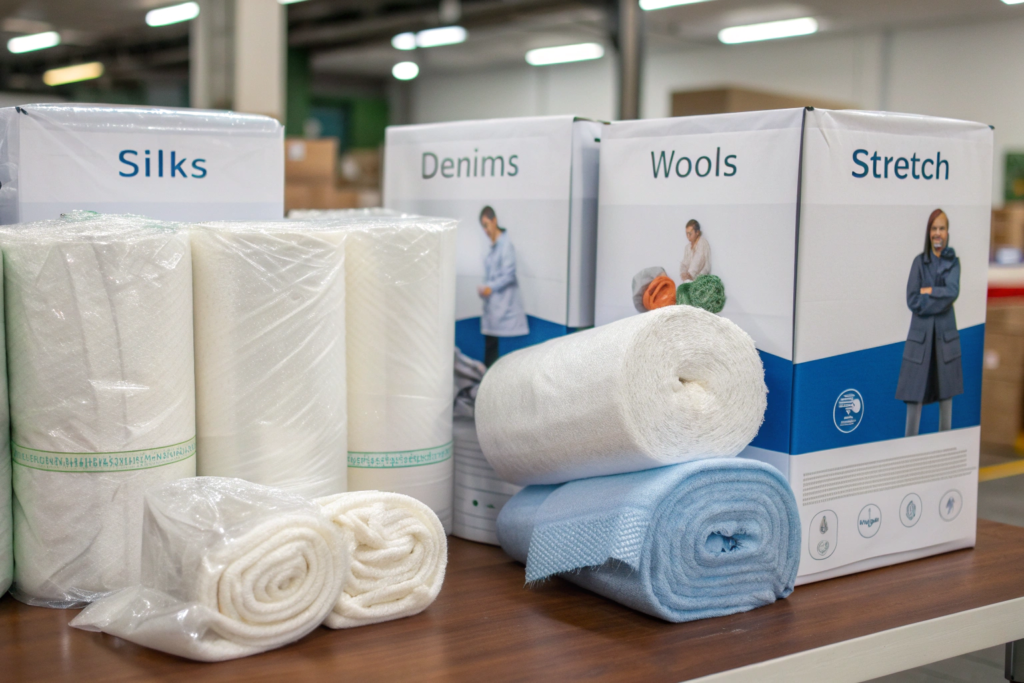
Silk and fine wools: Rolled on cardboard tubes covered with acid-free tissue to prevent chemical transfer. Interleaved with acid-free tissue between layers. Wrapped in polyethylene, then additional protective layer.
Velvet and chenille: Rolled pile-side out on large-diameter tubes to prevent pile crushing. Never folded. Suspended in cradle packaging for shipment.
Embroidered fabrics: Covered with soft non-woven interlining before rolling to protect embroidery from abrasion. Edge protection reinforced.
Hand-dyed or artisan fabrics: Individual wrapping for each piece, with clear labeling of artisan and dye lot. Photographic documentation of each piece.
For an Italian luxury brand, we developed custom "coffin" cartons for their most delicate fabrics—rigid boxes that prevent any compression during transit. The cost is significant, but the fabric value justifies it. Luxury fabrics deserve luxury packaging.
What packaging works for performance and technical fabrics?
Technical fabrics have their own requirements:
Coated fabrics: Rolled with coating facing out to prevent self-adhesion. Separator sheets between layers if coating might stick.
Stretch fabrics: Rolled with minimal tension to prevent stretching. Wrapped loosely, labeled "do not compress."
Waterproof/breathable membranes: Protected from punctures with smooth surfaces. Labeled to indicate membrane side.
FR-treated fabrics: Special handling to maintain flame-retardant properties. Packaging materials must not contaminate treatment.
For a US military contractor, we developed packaging that maintains FR treatment integrity—no cardboard contact with fabric (cardboard acidity can affect some treatments), sealed in moisture barriers to prevent mildew, clearly labeled "FR-treated—do not use fabric softener." Technical fabrics need technical packaging.
How do we handle split shipments and partial orders?
Not every order ships complete. Our systems handle complexity:
Partial shipment documentation: Clear paperwork indicating what's shipping now, what's coming later. Roll numbers and quantities clearly stated.
Hold for complete: If a client prefers, we hold complete orders until ready, packaging individual pieces but storing them together.
Split container loading: For shared containers, we clearly separate and identify each client's fabric within the container, with physical barriers between.
Reconciliation: Upon completion, we provide final documentation reconciling all shipments against the original order.
For a Danish furniture manufacturer receiving fabric in waves to match production, we hold completed rolls in climate-controlled storage, packaging each as it's finished but shipping only when requested. Flexible fulfillment requires organized systems.
What Quality Standards Govern Our Packaging?
We don't make up our own rules—we follow international standards and client specifications.

What ISO standards apply to packaging?
Our packaging operations follow:
ISO 9001: Quality management system covering all packaging processes. Third-party audited annually.
ISO 2230: Guidelines for storage of rubber products (relevant for elastic fabrics and spandex-containing materials).
ISO 4180: General rules for packaging—complete, filled transport packages.
ISO 11620: Performance standards for packaging materials (strength, durability).
We maintain certification to relevant standards and document compliance for client audits. Standards provide a framework for quality.
How do we test packaging effectiveness?
We don't assume packaging works—we test it:
ISTA testing: International Safe Transit Association protocols simulate real-world shipping hazards—vibration, shock, compression, humidity. We test new packaging designs before first use.
Drop testing: Packaged rolls dropped from specified heights to simulate handling impacts.
Compression testing: Stacked pallets tested under load to ensure bottom rolls survive.
Environmental testing: Temperature and humidity cycling to simulate ocean freight conditions.
Field feedback: We track damage claims and adjust packaging based on real-world results. If a particular route shows issues, we modify packaging accordingly.
For a Australian client with a history of damage from other suppliers, we conducted ISTA 3E testing (simulated truck and ocean transport) on our packaging before shipping. The test passed; their first shipment arrived perfect. Testing proves what confidence assumes.
What client-specific standards can we accommodate?
Every client has unique requirements. We've accommodated:
Marks & Spencer packaging standards: Specific requirements for labeling, pallet configuration, and documentation.
IKEA IWAY standards: Social and environmental requirements including packaging materials.
Walmart sustainability guidelines: Recyclable packaging requirements.
Military specifications: MIL-STD-2073 for packaging of defense materials.
Automotive industry standards: AIAG guidelines for packaging and labeling.
For a Toyota supplier, we implemented their specific packaging and labeling requirements, including barcode formats and pallet configurations that integrate with their warehouse systems. Client standards become our standards.
The result of all this attention to packaging is simple: our fabric arrives in the condition you expect. Not "mostly okay." Not "we can work around it." Perfect, every time.
Conclusion
Fumao Fabric's on-site packaging system ensures damage-free shipping through multiple layers of protection. Moisture protection (inner plastic wrapping, desiccant packets, container moisture control) prevents water damage during ocean freight. Physical protection (edge protectors, stable pallet configuration, strapping, dunnage bags) prevents crushing and shifting. Snag and abrasion protection (smooth outer wraps, separator sheets, facing direction) preserves fabric surfaces.
On-site packaging gives us control over every step: final inspection before wrapping, correct labeling and documentation, QC oversight throughout. Specialized packaging options address different fabric needs—delicate fabrics require tissue interleaving and large-diameter tubes; technical fabrics need specific handling for coatings and treatments; performance fabrics demand tension control and moisture management.
Quality standards (ISO 9001, ISTA testing, client-specific requirements) provide the framework for consistent excellence. We test packaging designs before use and adjust based on real-world feedback.
The investment in proper packaging is tiny compared to the cost of damaged fabric. A few dollars of plastic and cardboard protects thousands of dollars of fabric—and more importantly, protects your production schedule, your customer relationships, and your brand reputation.
If you're sourcing fabric and want to ensure it arrives in perfect condition, I invite you to experience the Fumao difference. Our on-site packaging team treats every roll as if it were their own. Contact our Business Director, Elaine, directly at elaine@fumaoclothing.com. Tell her about your fabric, your destinations, and your concerns. She'll connect you with our logistics team, and we'll develop a packaging plan that protects your investment.
Because your fabric should arrive looking exactly as it did when it left our factory—beautiful, perfect, ready to become something amazing.