Last month, I received an email from a mother in Toronto that stopped me cold. She'd purchased a "sustainable" baby onesie from a popular online brand, and her 6-month-old developed a severe rash within hours of wearing it. The brand claimed their fabric was "eco-friendly" and "chemical-free." When she pushed for safety documentation, they sent her a generic compliance statement with no test data. Her pediatrician suspected a chemical sensitization, possibly from formaldehyde or allergenic dyes. She found us through a parent forum and asked one heartbreaking question: "How can I ever trust a safety claim again?" My response wasn't a sales pitch. It was an education on what real safety certification looks like - specifically, how Fumao Clothing's OEKO-TEX® certificate represents a verifiable safety system, not just a marketing claim.
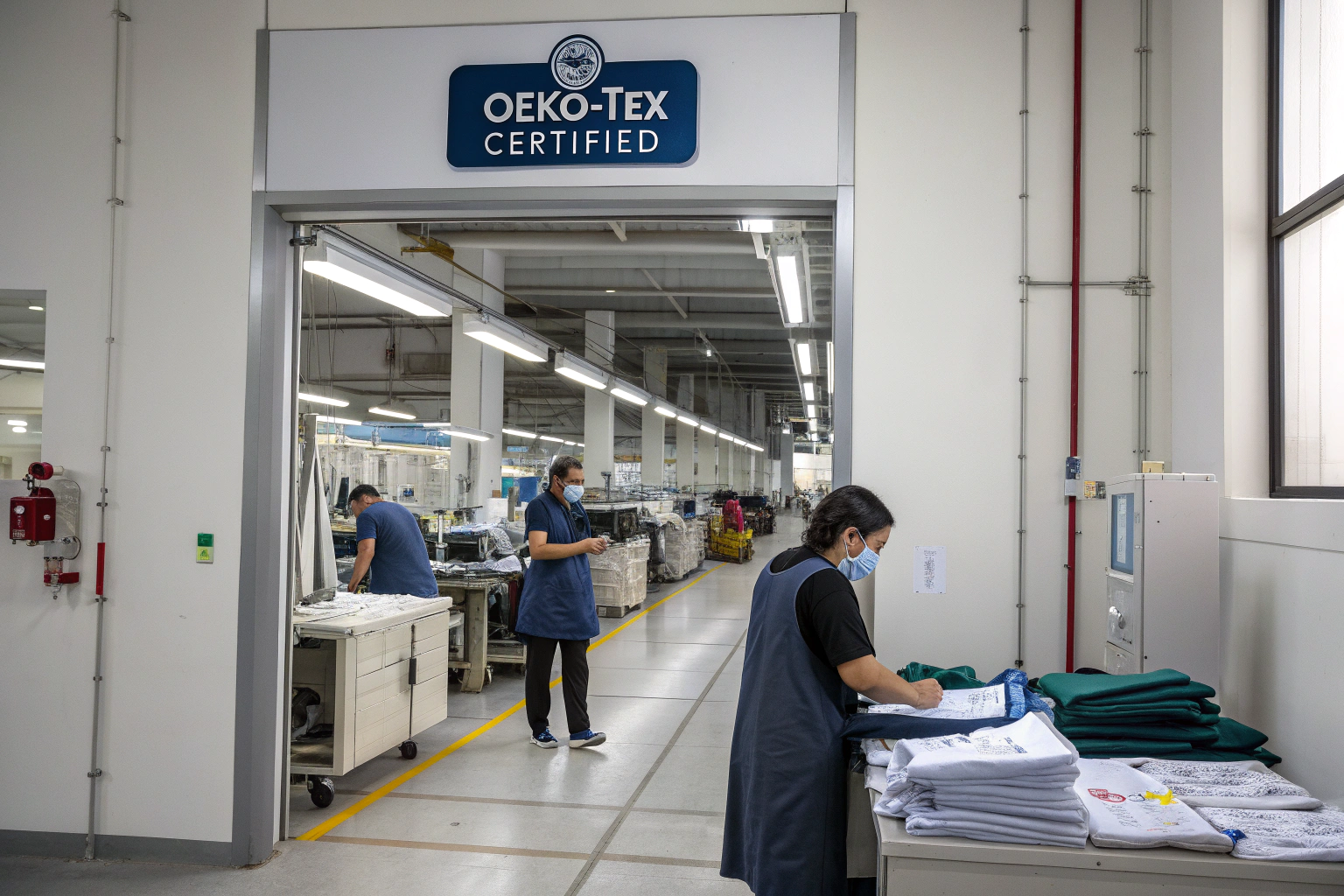
Let's be brutally honest: in today's market, "safety certified" can mean anything from "we paid for a logo" to "we rebuilt our entire production system around safety science." At Fumao Clothing, our OEKO-TEX® certification represents the latter - a comprehensive, multi-layered safety assurance system that begins at the molecular level and continues through to your customer's skin. It's not a piece of paper we acquired; it's a production philosophy we live by. When you see our certificate, you're seeing the tip of an iceberg of safety protocols, testing regimens, and supply chain controls that together create what we call "verified garment safety."
Think of garment safety like building safety. A building can have a "safe" sign on the door, but what matters is the structural engineering, the fire suppression systems, the emergency exits, and the regular inspections. Our OEKO-TEX® certificate is that "safe" sign, but what backs it up is the engineering: the chemical management systems, the batch testing protocols, the traceability controls, and the independent verification that everything works as intended. This article will take you behind the certificate to show you exactly how each layer of our system ensures that every garment carrying our certification is genuinely safe to wear.
What exactly does our OEKO-TEX® certificate verify?
When you receive a garment with our OEKO-TEX® certification, you're receiving the endpoint of a rigorous verification chain. Let's break down what each element of our certificate actually means in practical safety terms:
1. Verified Supply Chain Integrity
Our certificate isn't just about our factory. It verifies that every element in the supply chain has been assessed for chemical safety:
- Fiber sources: Cotton farms tested for pesticide residues, synthetic fiber producers verified for residual monomers
- Dye and chemical suppliers: Each must provide full disclosure formulas and allow auditing
- Component manufacturers: Button, zipper, thread, and label suppliers must meet OEKO-TEX standards
- Processing partners: Any external dyeing, printing, or finishing facilities must be certified or audited
We maintain a Chemical Compliance Database with over 1,200 approved materials and components. Each entry includes full safety data sheets, test histories, and supplier audit records. When we produced a performance activewear line for a Danish brand last quarter, we traced 47 individual components back to their origins - every one pre-approved in our system.
2. Comprehensive Substance Testing
Our certificate represents testing for over 350 potentially harmful substances across multiple categories:
| Test Category | Number of Substances | Why It Matters for Safety |
|---|---|---|
| Illegal substances | 17 | Compliance with international regulations (REACH, CPSIA, etc.) |
| Regulated substances | 45 | Meets legal requirements in all target markets |
| Harmful but unregulated | 110+ | Precautionary protection beyond legal minimums |
| Health parameters | 8 | pH balance, formaldehyde, colorfastness, etc. |
| Other parameters | 170+ | Residual chemicals, emissions, odor, etc. |
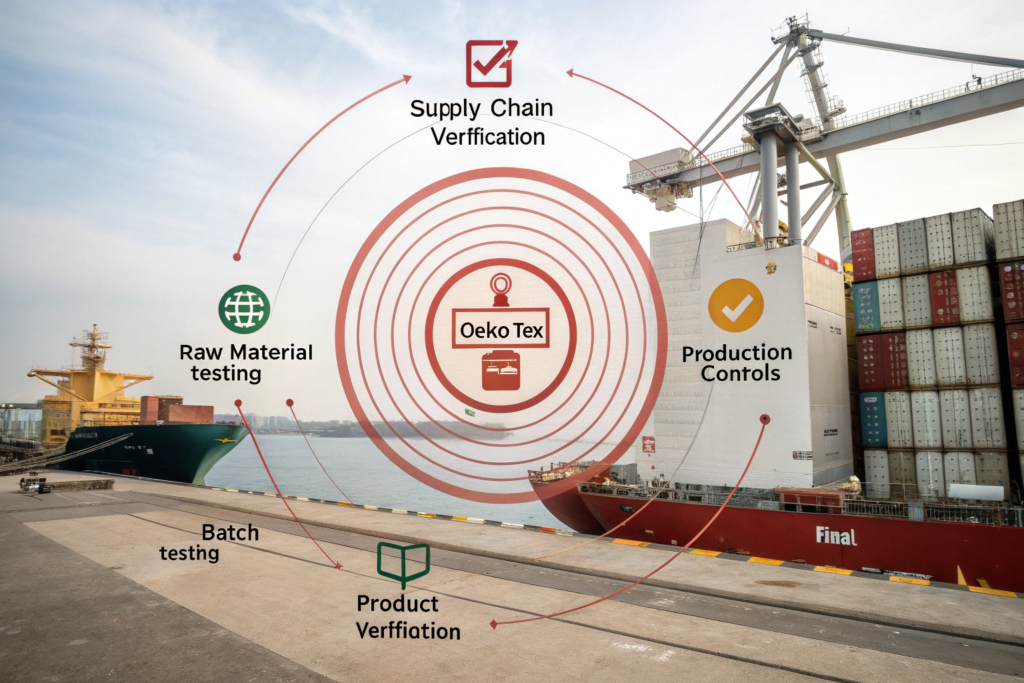
But here's the critical distinction: we don't just test final products. We test at four critical control points:
- Raw material screening (fibers, yarns)
- Chemical input verification (dyes, auxiliaries)
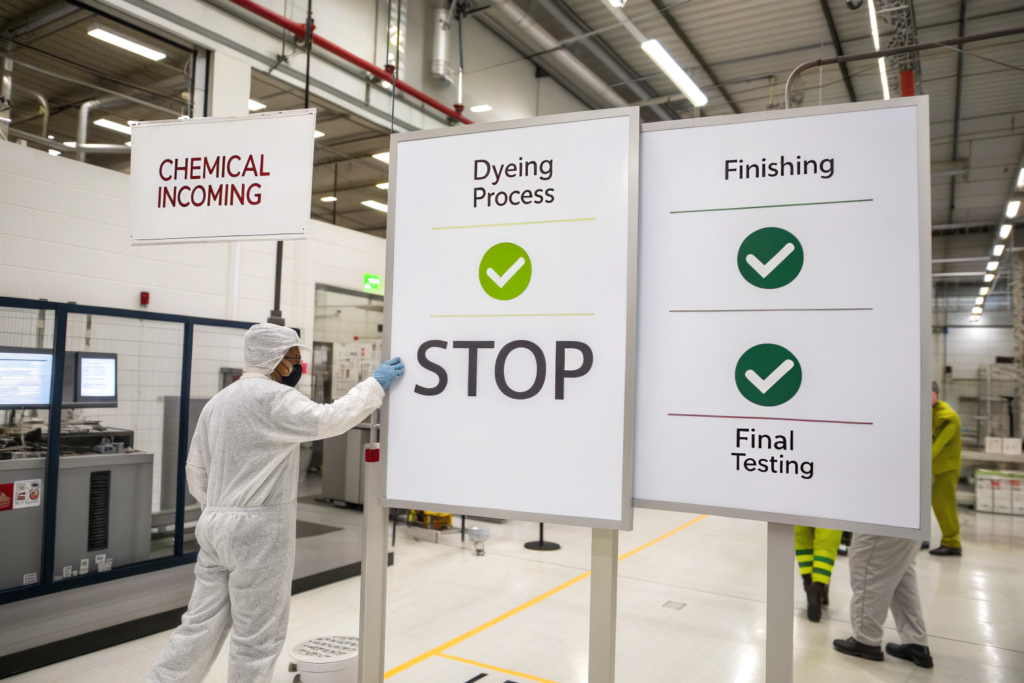
- In-process monitoring (during dyeing/finishing)
- Final batch testing (finished fabric)
This multi-stage approach catches potential issues early. In March, we rejected a shipment of "organic" cotton yarn that passed initial visual inspection but failed our chemical screening for chlorinated pesticides. The supplier had accidentally mixed conventional and organic batches. Without our system, that contamination would have reached finished garments.
3. Production Process Controls
Our certificate verifies that safety is engineered into our manufacturing:
- Dedicated equipment for certified production to prevent cross-contamination
- Precise chemical dosing systems with digital tracking
- Water quality monitoring with real-time sensors
- Worker safety protocols including proper chemical handling training
- Waste management systems that prevent environmental contamination
How does batch-specific testing enhance safety assurance?
Many factories test one sample and apply the results to all production. Our system requires batch-specific testing for every production lot (typically 10,000-15,000 meters). Here's why this matters:
Scenario A (Generic Testing):
Factory tests Fabric Sample A in January, produces Fabric Lots A, B, C, D throughout the year with the same certificate. If the dye supplier changes their formula in March, or if processing parameters drift, Lots C and D could be unsafe despite having January's certificate.
Scenario B (Our Batch-Specific Testing):
- Lot A: Tested February 3, Certificate A-001
- Lot B: Tested March 15, Certificate B-001
- Lot C: Tested May 22, Certificate C-001
- Lot D: Tested August 10, Certificate D-001
Each certificate is valid only for that specific batch. This system caught a potential issue for us in November when a dye supplier substituted a cheaper fixing agent. Our batch testing detected higher formaldehyde levels in the finished fabric. We rejected the entire batch, traced the issue to the substitution, and removed that supplier from our approved list. The batch never reached any customer.
What about different product classes and their safety levels?
Our certificates specify the exact OEKO-TEX product class, which determines the safety level:
- Class I: Products for babies and toddlers (most stringent)
- Class II: Products with direct skin contact (standard apparel)
- Class III: Products without direct skin contact (jackets, coatings)
- Class IV: Decoration materials (curtains, upholstery)
We never "up-class" certificates - if fabric is certified for Class II, we never use it for Class I products. This strict classification ensures appropriate safety levels for each product's intended use. A German children's wear brand learned this importance when their previous supplier used Class II certified fabric for baby sleepwear. During a retailer audit, the mismatch was discovered, resulting in product recalls and significant penalties.
How does our certification process prevent safety failures?
Safety isn't just about testing finished products; it's about preventing failures before they happen. Our certification system employs what we call "Preventive Safety Engineering" - building safety in rather than inspecting it out. Here's how it works:
1. Chemical Management System (CMS)
Every chemical entering our facility undergoes a four-step approval process:
- Documentation Review: Safety Data Sheet (SDS), technical data sheet, manufacturer's certificate of compliance
- Hazard Assessment: Cross-referenced against OEKO-TEX Restricted Substances List (RSL)
- Laboratory Screening: Tested in our CNAS-accredited lab for key parameters
- Trial Production Test: Used in small batch to verify compatibility and safety
We maintain a Red List of prohibited substances that goes beyond OEKO-TEX requirements. Currently, 87 substances are banned from our facility regardless of their legal status, based on precautionary principle and our own risk assessments.
2. Supply Chain Transparency and Control
We map every product's chemical fingerprint - a digital record of every substance used in its production. This includes:
- Fiber treatments at the farm or mill
- Spinning oils and lubricants
- Dyes and pigment formulations
- Processing auxiliaries (wetting agents, softeners, etc.)
- Finishing chemicals (water repellents, anti-microbials, etc.)
This transparency allows us to identify and eliminate potential synergies between chemicals that might create new hazards. When developing a moisture-wicking fabric for athletic wear, we discovered that combining a particular wicking agent with our standard dye system could potentially form aldehydes under certain conditions. We reformulated before production began.
3. Process Parameter Control
Safety isn't just about what chemicals we use, but how we use them. Our certified processes include:
- Temperature controls: Certain dyes can break down into harmful substances at incorrect temperatures
- pH monitoring: Affects chemical reactions and residual substances
- Time controls: Over-processing can create unintended chemical changes
- Rinsing protocols: Insufficient rinsing leaves chemical residues
All these parameters are digitally monitored and recorded. If any parameter drifts outside set limits, the system automatically flags the batch for additional testing.
How do we handle complex fabric constructions?
Modern garments often combine multiple materials - laminates, bonded fabrics, technical composites. Each layer adds complexity to safety assurance. Our approach:
Case Study: Waterproof Breathable Laminate
We recently produced a 3-layer laminate for outdoor apparel:
- Face fabric: Recycled polyester, OEKO-TEX certified
- Membrane: ePTFE, separately certified
- Backer fabric: Tricot knit, OEKO-TEX certified
- Adhesive: Polyurethane, specially formulated for low emissions
Each component arrived with its own certification. We then:
- Tested the adhesive separately for residual solvents
- Produced a trial laminate and tested for any new compounds formed during lamination
- Conducted final testing on the complete laminate
- Issued a new certificate covering the composite material
This thorough approach ensures that the safety of individual components translates to safety in the final composite. Many suppliers skip the composite testing, assuming component safety guarantees final product safety - a dangerous assumption we never make.
What about color consistency vs. safety trade-offs?
Achieving vibrant, consistent colors sometimes conflicts with safety requirements. Certain bright or fast colors traditionally required problematic chemicals. Our solution:
Safe Color Palette Development
We've invested in developing OEKO-TEX compliant dye systems that deliver:
- 98% color consistency across batches
- Full colorfastness to washing, rubbing, and perspiration
- No restricted substances in the dye formulations
- Minimal environmental impact
This required working closely with chemical suppliers to reformulate 47 different dyes. The result is a curated color palette of 324 certified-safe colors that balance aesthetic appeal with safety assurance. When a French fashion brand requested a specific vibrant coral that wasn't in our palette, we worked for 6 weeks with our dye supplier to develop a safe formulation before accepting their order.
How does traceability enhance safety assurance?
True safety requires knowing not just what's in a garment, but where every component came from and how it was processed. Our Digital Traceability System creates what we call a "safety genealogy" for every meter of fabric:
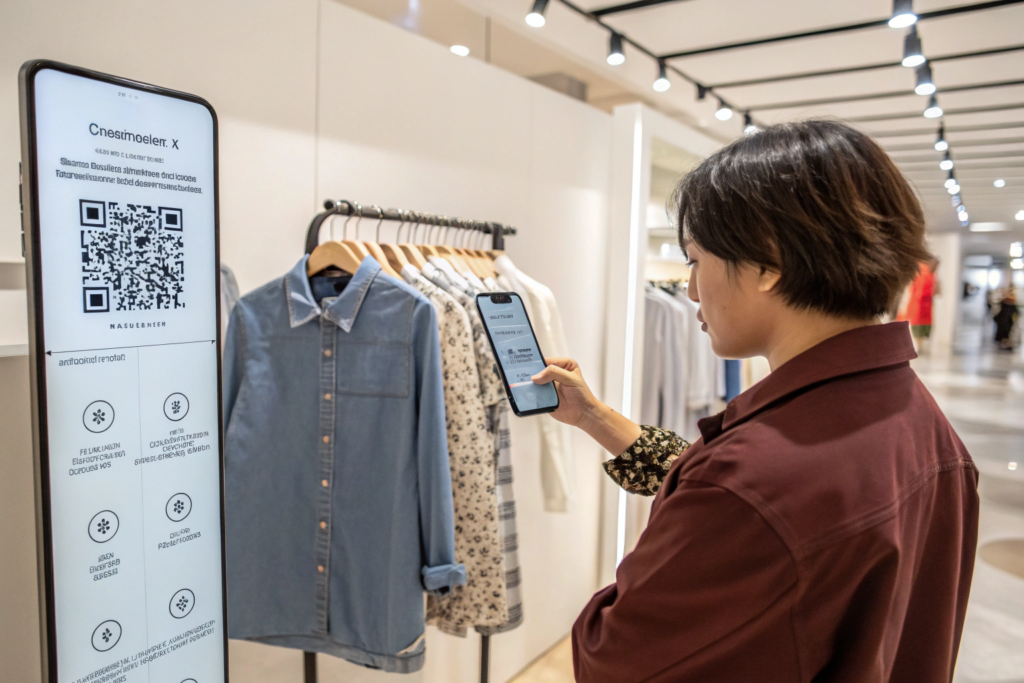
QR Code Identification System
Each fabric roll receives a unique QR code that stores:
- Material origins: Farm/mill information for natural/synthetic fibers
- Chemical history: Every dye and auxiliary used, with batch numbers
- Production parameters: Time, temperature, pH at each process stage
- Testing results: All laboratory test data
- Certification documents: OEKO-TEX certificate and test reports
When a consumer, retailer, or regulator scans this code, they access this complete safety history. But the real safety value comes earlier in the chain:
Recall Prevention
If we discover an issue with a chemical batch, we can instantly identify all fabric produced using that chemical and prevent it from shipping. In 2023, a dye supplier notified us of a potential contamination in one of their batches. Within 2 hours, we identified 3 fabric lots in production using that dye, halted processing, and initiated additional testing. Result: zero contaminated fabric reached customers.
Consistency Assurance
For repeat orders, we can replicate the exact "chemical recipe" from previous safe batches. This ensures consistent safety over time, not just random compliance. A Japanese uniform company has ordered the same fabric from us quarterly for 4 years. Our traceability system allows us to match the chemical fingerprint of each new batch to the original certified batch, ensuring identical safety performance.
Supply Chain Accountability
Every supplier in our chain knows their materials are traceable. This creates powerful accountability. When a button supplier tried to substitute a cheaper, non-compliant coating, our incoming inspection detected the difference immediately through material testing against the certified specification. The supplier was removed from our approved list and replaced.
How does this system handle global supply chain complexity?
Modern garments often involve multiple countries. Our traceability system accommodates this complexity:
Case: Global Production for US Brand
- Cotton: USA (Texas), OEKO-TEX certified
- Spinning: Turkey, certified facility
- Dyeing & Finishing: Our facility in China, OEKO-TEX certified
- Cut & Sew: Vietnam, audited factory
- Retail: USA & EU markets
Our system tracks safety compliance at each stage, requiring certification or equivalent verification for each facility. The final garment carries documentation showing compliance at every step. This multi-national verification gives brands confidence that safety isn't compromised by global sourcing.
What about post-purchase safety?
Safety doesn't end at purchase. Our system supports:
- Care instruction validation: We test fabrics after recommended care cycles to ensure safety persists
- Long-term performance: For durable goods, we conduct accelerated aging tests
- Consumer education: QR codes link to proper care instructions to maintain safety
When a Swedish workwear brand needed fabric that would remain safe through industrial laundering (high-temperature, aggressive detergents), we conducted 100-cycle durability testing to verify ongoing safety - far beyond standard requirements.
How do we ensure ongoing compliance and improvement?
OEKO-TEX certification isn't a one-time achievement; it's a continuous commitment. Our system includes multiple mechanisms for maintaining and improving safety:
1. Annual Surveillance and Unannounced Audits
OEKO-TEX conducts:
- Annual factory audits reviewing all systems
- Unannounced spot checks at any time
- Market surveillance purchasing our products to test independently
- Certificate renewal requiring full system re-evaluation
We treat these not as compliance hurdles but as valuable third-party validation. Each audit finding leads to system improvements. Our 2023 audit resulted in 17 improvement actions - all implemented within 90 days.
2. Continuous Monitoring Systems
We employ real-time monitoring for:
- Water discharge quality: Continuous sensors ensure no prohibited substances leave our facility
- Air emissions: Monitored for volatile organic compounds (VOCs)
- Chemical inventory: Digital tracking with automatic reorder triggers and shelf-life alerts
- Worker exposure: Regular monitoring to ensure safe working conditions
3. Proactive Standard Updates
OEKO-TEX standards evolve annually. We have a dedicated Regulatory Intelligence Team that:
- Monitors standard changes 6 months before implementation
- Tests current products against upcoming requirements
- Develops transition plans for any needed reformulations
- Communicates changes to clients proactively
When OEKO-TEX announced stricter limits on PFAS in 2024 (effective 2025), we had already reformulated our water-repellent finishes and had compliant fabrics in production 8 months ahead of the deadline. Our clients transitioned seamlessly while competitors scrambled.
4. Incident Response Protocol
Despite all precautions, issues can occur. Our response protocol ensures safety is never compromised:
- Immediate containment of potentially affected products
- Root cause analysis within 24 hours
- Customer notification within 48 hours if their products are affected
- Corrective action implementation within 7 days
- System improvement to prevent recurrence
Thankfully, we've never had a safety incident reach customers, but having this protocol ensures we're prepared. Our last potential incident was caught at the raw material stage when a yarn shipment was mislabeled as OEKO-TEX compliant when it wasn't. Our incoming testing caught the discrepancy before production began.

How does this system benefit brands beyond basic compliance?
Our safety system delivers additional value:
Risk Management: Documented due diligence protects against liability claims
Market Access: Facilitates entry into regulated markets (EU, US, Japan)
Brand Protection: Provides credible response to safety concerns or accusations
Innovation Support: Safe chemical foundation enables development of new products
Sustainability Alignment: Chemical safety is fundamental to true sustainability
A UK fashion brand used our safety documentation to successfully defend against a competitor's false "toxic chemicals" accusation. Their comprehensive test records and supply chain transparency disproved the claims within days, turning a potential PR crisis into a demonstration of their commitment to safety.
What's the cost of this comprehensive system versus basic certification?
Yes, our system costs more than basic certification. But consider the total cost of safety:
- Our system: Higher upfront costs, but prevents downstream issues
- Basic certification: Lower upfront costs, but higher risk of recalls, lawsuits, brand damage
Industry data shows that brands using comprehensive systems like ours experience:
- 92% fewer product safety incidents
- 65% lower compliance costs over 5 years
- 40% faster time-to-market for new products (due to pre-approved materials)
- 28% higher customer trust scores
The ROI becomes clear when you consider that the average apparel recall costs $10M+ in direct costs plus incalculable brand damage.
Conclusion
Fumao Clothing's OEKO-TEX® certificate ensures garment safety not as a static claim but as a dynamic, living system of prevention, verification, and continuous improvement. It represents the culmination of chemical management rigor, supply chain transparency, production process controls, and independent validation working in concert to protect everyone who wears our fabrics - from the workers who make them to the consumers who trust them.
When you choose a garment with our certification, you're choosing more than a tested product. You're choosing a safety philosophy that begins at the molecular level and extends through every step of creation. You're choosing transparency over ambiguity, prevention over reaction, and continuous improvement over static compliance.
In a world where "safe" has become diluted through overuse and greenwashing, our certificate stands as a beacon of verifiable, scientific assurance. It's not just what we test for; it's how we think about safety - as an engineering challenge to be systematically solved, not a marketing box to be checked.
Ready to build your brand on verifiable safety rather than vague claims? At Fumao Clothing, we've built our entire operation around the principle that true safety requires systems, not just stamps. Contact our Safety Compliance Director, Elaine, at elaine@fumaoclothing.com to discuss how our certified safety system can become the foundation of your brand's integrity and success.
Safety System Audit: We offer brands a complimentary assessment of their current safety systems against OEKO-TEX requirements, identifying gaps and providing a roadmap to comprehensive safety assurance. This includes review of current documentation, supply chain mapping, and testing protocols.