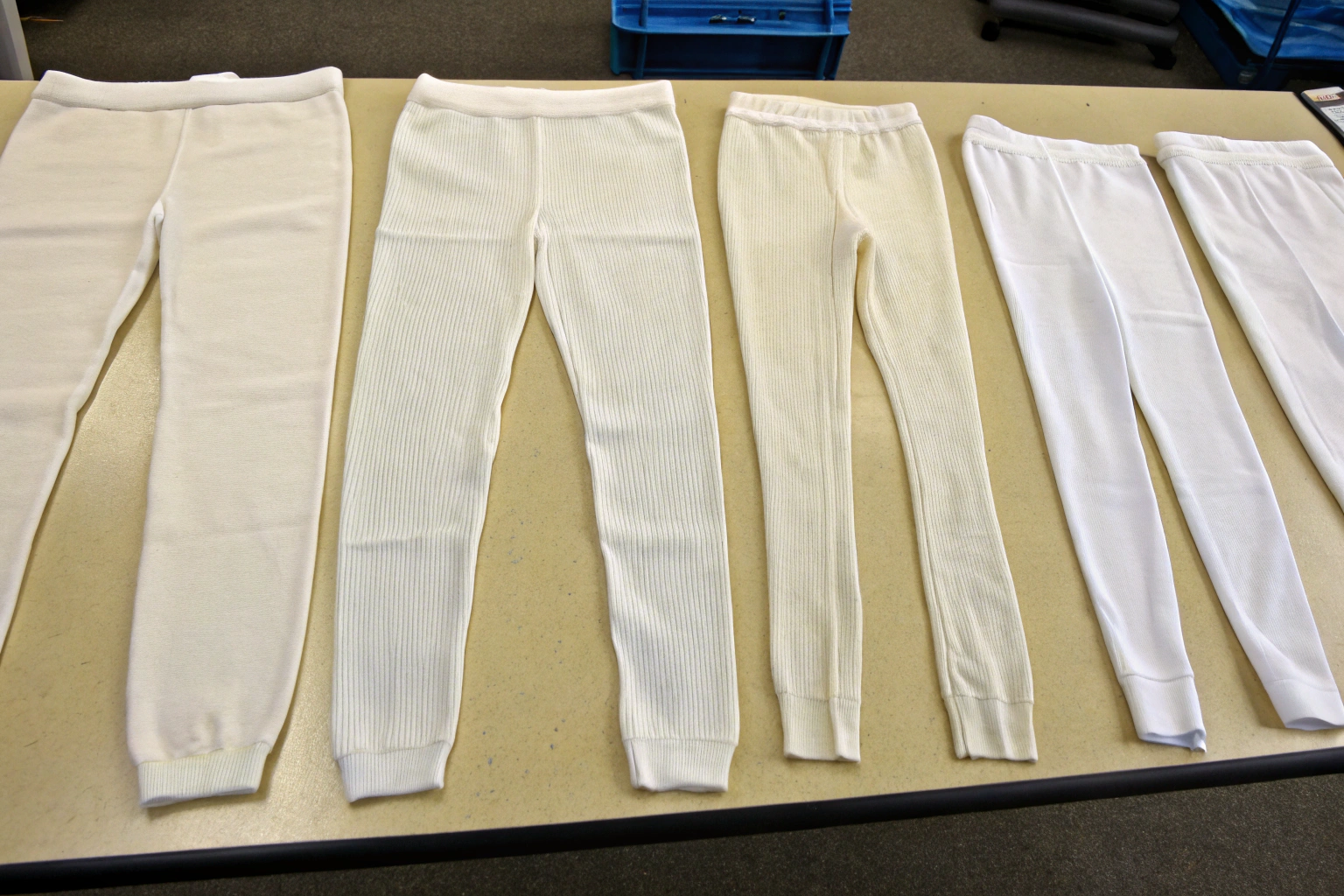
I’ll never forget the crisis call we got from a Miami-based activewear brand last year. They’d launched their first white legging collection, only to receive hundreds of customer complaints and social media posts about the fabric becoming see-through during squats and bends. The embarrassing "white legging test" videos went viral, and they had to recall the entire collection—a $150,000 lesson in why knit gauge selection matters profoundly for opacity in white fabrics.
Choosing the right knit gauge to prevent transparency in white leggings requires balancing three key factors: needle count (gauge), yarn density and composition, and fabric construction. For reliable opacity in white leggings, target 18-22 gauge knits with tight stitch density (28-32 courses per inch), use higher denier yarns (40D-70D) with circular cross-sections, and consider double-knit or interlock constructions rather than single jersey. The fabric should achieve a minimum cover factor of 1.2-1.4 and pass the stretch opacity test where the fabric remains opaque when stretched to 30-40% beyond its resting state.
The transparency challenge is particularly acute with white leggings because the fabric must prevent shadowing of undergarments and skin tones while maintaining stretch and comfort. Having solved this problem for numerous activewear brands, I’ve developed a systematic approach that combines technical specifications with practical testing. Let’s examine the key factors that separate opaque white leggings from those that fail the real-world test.
What knit gauge specifications ensure maximum opacity?
The foundation of legging opacity begins with the knitting machine gauge and how it interacts with yarn selection. Many manufacturers make the critical mistake of choosing gauge based on hand-feel alone rather than mathematical opacity calculations.
Knitting machine gauge refers to the number of needles per inch on the machine cylinder. For white leggings, we recommend 18-22 gauge machines as the optimal range. Lower gauges (12-16) create spaces that are too large between yarns, resulting in visible gaps when stretched. Higher gauges (24-32) use finer yarns that may not provide sufficient coverage despite the tighter spacing. Our testing shows 20 gauge provides the ideal balance, creating approximately 140-160 wales per inch that maintain opacity during 30-40% stretch typical in yoga and athletic movements.
The cover factor calculation provides a mathematical approach to opacity. This formula considers yarn diameter, stitch density, and fabric thickness. For reliable opacity in white leggings, we target a cover factor of 1.2-1.4, calculated as (courses per inch + wales per inch) × yarn diameter. Achieving this typically requires 28-32 courses per inch and 26-30 wales per inch with yarns of 40-70 denier. We recently developed a fabric with 20 gauge, 30 courses/inch, and 28 wales/inch using 50D yarn that achieved a cover factor of 1.35 and passed all opacity tests.
Why does yarn denier matter more than gauge alone?
The relationship between yarn thickness and needle spacing determines opacity. A 28-gauge machine with 20D yarn will be more transparent than an 18-gauge machine with 70D yarn, despite the higher needle count. The yarn must completely fill the spaces between needles when the fabric is at rest and maintain coverage during stretching. Our opacity testing shows that 40D yarns represent the minimum viable denier for white leggings, with 50-70D providing more reliable performance. Understanding these fundamental relationships between yarn size and knit gauge is essential for effective fabric specification.
How does stitch length affect the opacity equation?
Stitch length controls how much yarn is allocated to each loop, directly influencing fabric density and coverage. Tighter stitch lengths (2.8-3.2mm) create denser fabrics with better opacity but reduced stretch and comfort. Looser stitch lengths (3.5-4.0mm) improve stretch but sacrifice coverage. For white leggings, we optimize at 3.0-3.4mm stitch length, which provides sufficient yarn allocation for coverage while maintaining the 30-40% stretch range required for activewear. Our quality control measures stitch length variation to ensure consistency within ±0.1mm across production batches.
What yarn selection strategies prevent transparency issues?
Yarn engineering provides powerful tools for enhancing opacity beyond basic gauge selection. The right fiber composition, cross-section, and spinning method can dramatically improve coverage without compromising other performance characteristics.
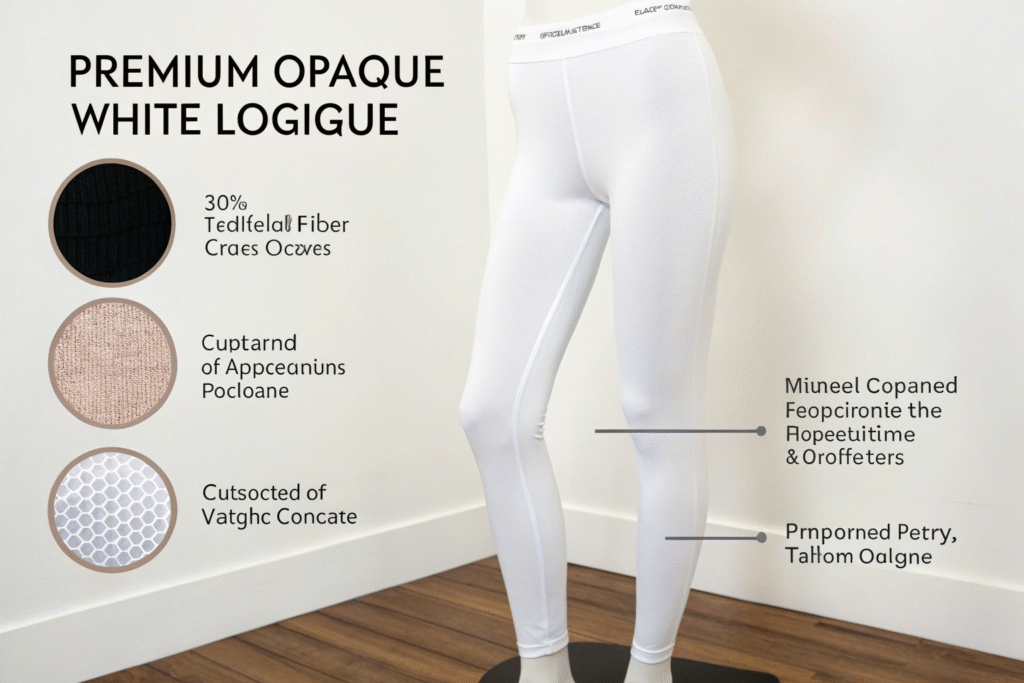
Fiber cross-section significantly influences light transmission and opacity. Circular cross-sections reflect light uniformly but offer less coverage than modified cross-sections. Trilobal or multilobal fibers (shaped like clovers or stars) scatter light more effectively, reducing transparency by 15-20% compared to round fibers of equivalent denier. Hollow fibers provide the greatest opacity improvement—up to 30% better coverage—by creating internal light scattering surfaces. Our premium opaque white leggings use hollow conjugated fibers that trap and scatter light while maintaining a lightweight feel.
Fiber composition and blend ratios offer another opacity enhancement strategy. While 100% polyester dominates performance activewear, strategic cotton blends (15-25%) can improve opacity due to cotton’s natural fiber irregularity and better coverage. However, cotton reduces moisture-wicking performance, so we typically reserve this approach for lifestyle legging applications. Micro-denier polyester (0.5-1.0 denier per filament) creates more fiber surface area within the same fabric weight, improving coverage by creating more light-scattering interfaces.
Why do bright versus semi-dull fibers affect perceived opacity?
Fiber luster changes how light interacts with the fabric surface. Bright (shiny) fibers reflect light directly, which can emphasize any gaps in the fabric structure. Semi-dull or full-dull fibers diffuse light, reducing the visual impact of minor transparency. Our testing shows semi-dull fibers reduce perceived transparency by 20-25% compared to bright fibers in identical fabric constructions. This is why most performance white leggings use semi-dull yarns—they provide better visual coverage even when technical opacity measurements are similar.
How can twist levels and spinning methods enhance coverage?
Yarn twist affects how fibers pack together in the fabric. Higher twist levels (25-35 twists per inch) create denser yarn structures with less space between fibers, improving opacity but potentially creating a stiffer hand-feel. Air-jet spinning produces smoother yarns with better coverage than ring spinning due to more parallel fiber alignment. Our optimized approach uses medium twist levels (20-25 TPI) with air-jet spinning to balance opacity with the softness expected in premium activewear. The development of these advanced spinning techniques for performance fabrics has been crucial for opacity optimization.
What fabric construction techniques maximize coverage?
Beyond gauge and yarn selection, the knitting construction itself offers powerful options for enhancing opacity. Different knit structures create dramatically different coverage properties, even with identical yarns and gauges.
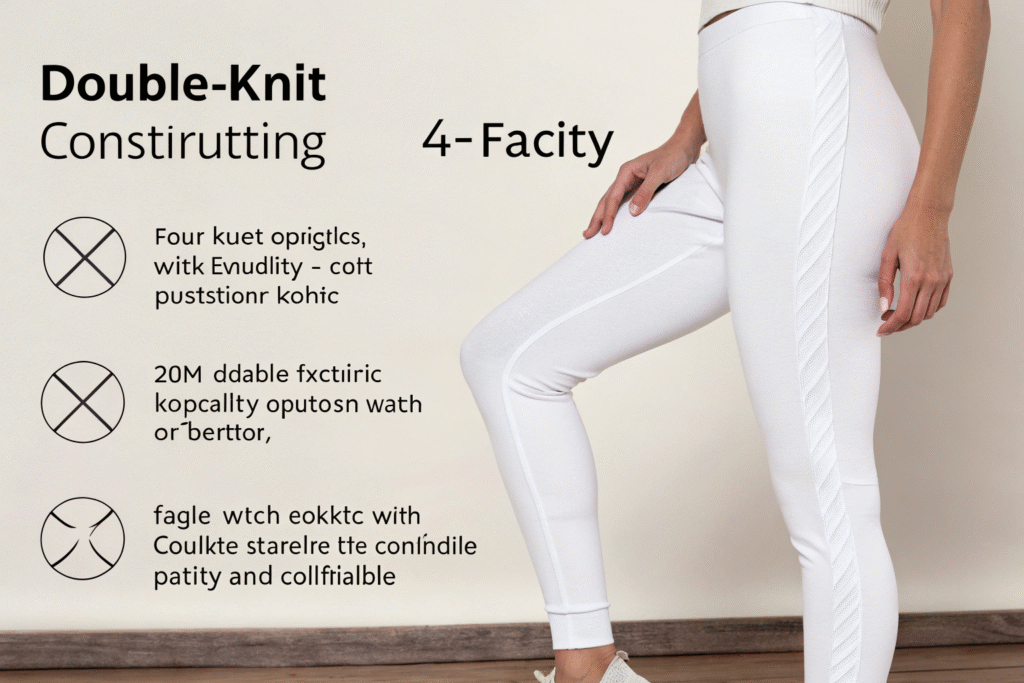
Double-knit constructions provide inherent opacity advantages by creating two layers of fabric simultaneously. The face and back layers are interlocked, creating a fabric that’s essentially two layers in one. While heavier than single knits, double knits offer near-perfect opacity with the right yarn selection. We’ve developed a double-knit for white leggings that weighs 240gsm but provides better opacity than 300gsm single knits, with the additional benefit of four-way stretch from the interlocking structure.
Interlock knits offer another excellent option for opacity, particularly for consumers who prefer a smoother hand-feel. The interlock structure is essentially two 1×1 rib fabrics knitted together, creating a stable, double-thick fabric with smooth surfaces on both sides. While less stretchy than single jersey, interlock provides excellent opacity with minimal show-through. Our 180gsm interlock white fabric outperforms 220gsm single jersey in opacity testing while maintaining adequate stretch for yoga and training applications.
How can strategic layering within single fabrics improve opacity?
Some of the most advanced solutions use combination techniques within single knit constructions. Plated fabrics feed two yarns simultaneously—typically a spandex core with a polyester covering—creating better coverage than either yarn could achieve alone. Miss-stitch patterns create intentional density variations, placing more yarn in critical coverage areas. We’ve developed a proprietary construction that increases yarn density in the front thigh and seat areas while maintaining standard density elsewhere, optimizing opacity where it matters most without unnecessary weight addition.
Why does fabric weight (GSM) often mislead opacity decisions?
Many designers use fabric weight as a shorthand for opacity, but this can be misleading. A 200gsm fabric with poor construction can be more transparent than a 160gsm fabric with optimized structure. The distribution of mass matters more than the total weight. Our testing shows cover factor and specific construction provide better opacity predictors than GSM alone. A 180gsm double-knit consistently outperforms a 220gsm single jersey in opacity tests, demonstrating why understanding fabric construction beyond basic weight specifications is essential for making informed decisions.
How should you test for real-world opacity performance?
Laboratory specifications provide a starting point, but real-world opacity validation requires testing methodologies that simulate actual wearing conditions. Our comprehensive testing protocol has identified critical gaps between theoretical and practical opacity.
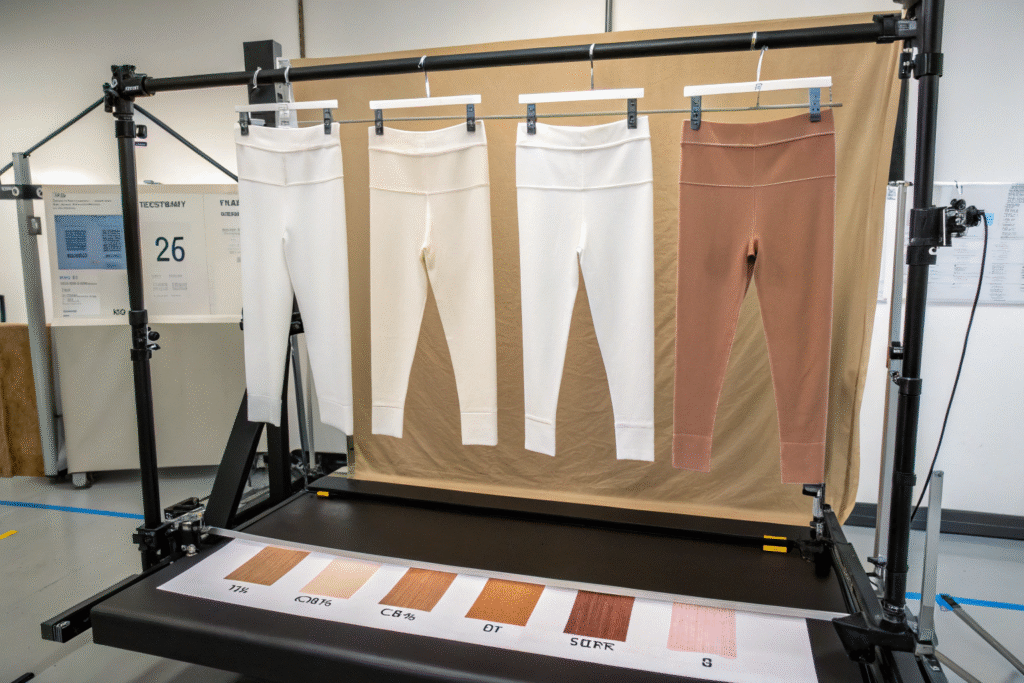
The stretch opacity test is our primary validation method. We mount fabric samples on a stretching apparatus and observe them against standardized skin tone and undergarment panels at 30%, 40%, and 50% stretch levels. The fabric must maintain complete opacity at 30-40% stretch—the typical range during athletic movements like lunges and squats. Our premium fabrics maintain opacity even at 50% stretch, providing a safety margin for extreme movements. This test revealed that many commercially available white leggings fail at just 20-25% stretch, explaining the widespread transparency complaints.
The multi-lighting environment test addresses how opacity changes under different light conditions. Fabrics that appear opaque in dressing room lighting may become transparent in direct sunlight or under bright gym lighting. We test samples under five standardized light sources: D65 (daylight), TL84 (store lighting), LED (modern gym lighting), and direct sunlight simulation. A fabric must pass all lighting conditions to receive our opacity certification. This testing caught a potential issue with a fabric that passed laboratory tests but became noticeably transparent under specific LED spectrums.
What are the limitations of standard opacity testing methods?
Many manufacturers rely on simple "hold up to light" tests that don’t account for stretch or different lighting conditions. The Opacity Meter (TAPPI T425) used in paper industry provides numerical values but doesn’t simulate fabric stretch. Our proprietary testing apparatus combines stretch simulation with calibrated light transmission measurement, providing both quantitative data and visual assessment under realistic conditions. Developing this comprehensive testing approach for stretch fabric opacity required significant investment but has eliminated opacity-related returns for our clients.
How does color consistency affect perceived opacity?
Interestingly, the specific shade of white influences perceived opacity. Bright blue-white shades can appear more transparent than neutral or warm whites because they create higher contrast with skin tones. We offer three white variants—blue-white, neutral white, and warm white—with specific recommendations for different skin tone ranges. This nuanced approach helps brands match their white selection to their target demographic, reducing transparency complaints even with technically identical fabrics.
Conclusion
Selecting the right knit gauge for opaque white leggings requires a systematic approach that balances gauge selection with yarn engineering and construction optimization. The 18-22 gauge range provides the foundation, but true opacity comes from combining the right yarn denier (40D-70D), fiber cross-section (multilobal or hollow), and construction technique (double-knit or interlock) to create fabrics that maintain coverage during dynamic movement across different lighting environments.
The most successful white legging programs use a combination of technical specifications and rigorous real-world testing, including stretch opacity validation and multi-lighting assessment. This comprehensive approach ensures that leggings perform not just in laboratory conditions but in the yoga studio, gym, and outdoor environments where transparency issues typically emerge.
If you’re developing white leggings and want to avoid transparency issues, we can provide specific gauge recommendations, yarn specifications, and testing protocols tailored to your price point and performance requirements. Our technical team has extensive experience solving opacity challenges across different market segments. Contact our Business Director, Elaine, at elaine@fumaoclothing.com to discuss your legging project and receive our White Legging Opacity Guide with complete technical specifications and testing protocols.