Let's be real. That sinking feeling when you open a container or receive pre-shipment samples only to find mismatched colors, pilling, or shrinkage is a universal nightmare for importers. You've negotiated the price, managed the lead time, and now your entire production schedule hinges on a fabric roll you've never physically touched. The core problem isn't a lack of standards—it's the gap between what you specified and what the supplier actually produces and packs. Too many buyers rely on trust and certificates alone, only to discover that the "Grade A" fabric on paper is "Grade B" in reality, costing thousands in delays, rework, and lost sales.
The most effective way to verify fabric quality before shipping is to implement a multi-layered, evidence-based verification protocol that moves beyond basic pre-shipment inspections (PSI). This involves combining third-party lab testing of bulk fabric against your approved swatch, in-process quality checks during production (like dyeing and finishing), and a detailed final random inspection (FRI) that includes both visual checks and on-site quick tests, all conducted by your own trusted team or a qualified third-party inspector. The goal is to catch defects before they're rolled, packed, and invoiced.
As someone who's been on both sides of this equation—now running our own fabric company and previously dealing with factory quality escapes—I'll show you the exact, actionable system we use and recommend to our clients at Shanghai Fumao to turn shipping from a gamble into a guarantee.
What are the Non-Negiable Pre-Shipment Tests I Must Run?
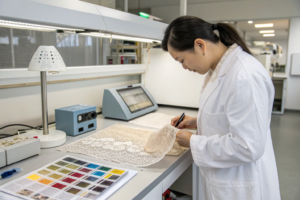
Forget just checking color with your phone camera under office lights. The first and most critical layer of verification happens in the lab. You need objective, numerical data that proves the fabric meets your technical specifications. Relying solely on the supplier's in-house report is a common but risky shortcut. I've seen cases where a factory's "pass" was a major brand's "fail."
The mandatory test package should cover performance, safety, and consistency. For a fashion brand shipping to the EU or US in 2024, skipping any of these is an invitation for trouble. Here’s the breakdown:
- Colorfastness Tests: This is the number one cause of disputes. You must test for washing, rubbing (dry & wet), perspiration, and light. A European client once avoided a massive recall because our pre-shipment test showed their "colorfast" red polyester failed wet rubbing after 5 washes, a problem the factory's own basic test missed.
- Dimensional Stability (Shrinkage): Don't just trust the generic "3% max" on the spec sheet. Test it according to the exact washing/drying method your end-consumer will use. A 2% vs. 3% shrinkage can be the difference between a wearable garment and a customer return.
- Fabric Composition & Weight: Verify that the blend ratio (e.g., 65% Polyester, 35% Cotton) is correct and the grams per square meter (GSM) is within the agreed tolerance (typically +/- 3-5%). This is a direct cost and quality indicator.
- Physical & Durability Tests: This includes martindale abrasion and pilling resistance (critical for upholstery and activewear), tensile and tear strength, and seam slippage.
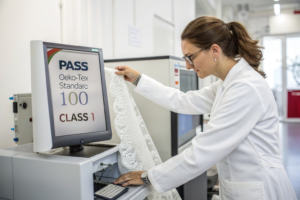
- Safety & Compliance Tests: This is non-negotiable for market access. Tests for harmful substances (Oeko-Tex Standard 100 list, REACH SVHCs), pH value, and formaldehyde content must be conducted on the bulk production fabric, not just a pre-production sample.

How Do I Ensure Lab Testing is Accurate and Unbiased?
The integrity of the data is everything. Here’s your checklist to lock it down:
- Use an Accredited Third-Party Lab: Insist on internationally recognized labs like SGS, Bureau Veritas, or Intertek. Their reports are the gold standard and are accepted by retailers globally. The cost is a tiny insurance premium compared to a rejected shipment.
- Define the Sampling Method: Don't let the factory choose the "perfect" piece. The standard is to take samples from at least 10% of the production rolls, selected at random by the inspector. For a batch of 50 rolls, samples should come from 5 different rolls.
- Test Against the Approved Standard: The lab must compare the bulk fabric against your approved lab dip, strike-off, and bulk sample—not just a Pantone number. Physical standards are king.
- Review the Full Test Report: Don't just look for a "PASS." Scrutinize the actual data. Is the shrinkage 1.5% or 2.9%? Is the pilling result a 3.5 or a 4? These numbers tell the real story of consistency. For a deep dive into interpreting these reports, resources like the American Association of Textile Chemists and Colorists (AATCC) test method explanations are invaluable.
Can I Rely on Supplier-Provided Certificates?
Short answer: Use them as a reference, but never as your sole verification. A certificate of compliance (CoC) or a test report from the factory's own lab is a starting point, not the finish line.
I tell my clients this: "My factory's CNAS-accredited lab report is your first layer of reassurance that we are monitoring quality. But your own third-party report on randomly selected bulk goods is your legal and commercial proof." The difference is independence. A 2023 case with a client importing linen blends showed their supplier's report claimed Oeko-Tex compliance, but a third-party test flagged a restricted dye. The $2,000 test saved a $80,000 shipment from being blocked at port. Always verify critical certifications through independent channels. A good practice is to consult guides on how to verify authenticity of supplier certifications in international trade for structured approaches.
What Does a Comprehensive Final Random Inspection (FRI) Really Involve?
If lab testing gives you the microscopic view, the FRI gives you the macroscopic, real-world view. This is the physical check of the goods that are literally about to be packed into containers. A proper FRI is a systematic process, not a casual glance.
The industry standard is the AQL (Acceptable Quality Level) system. For general fabric inspections, AQL 2.5 for major defects and AQL 4.0 for minor defects is common. This means your inspector checks a statistically significant number of rolls from the entire batch. For 50 rolls, they might inspect 13 rolls in detail. The process has three core pillars:
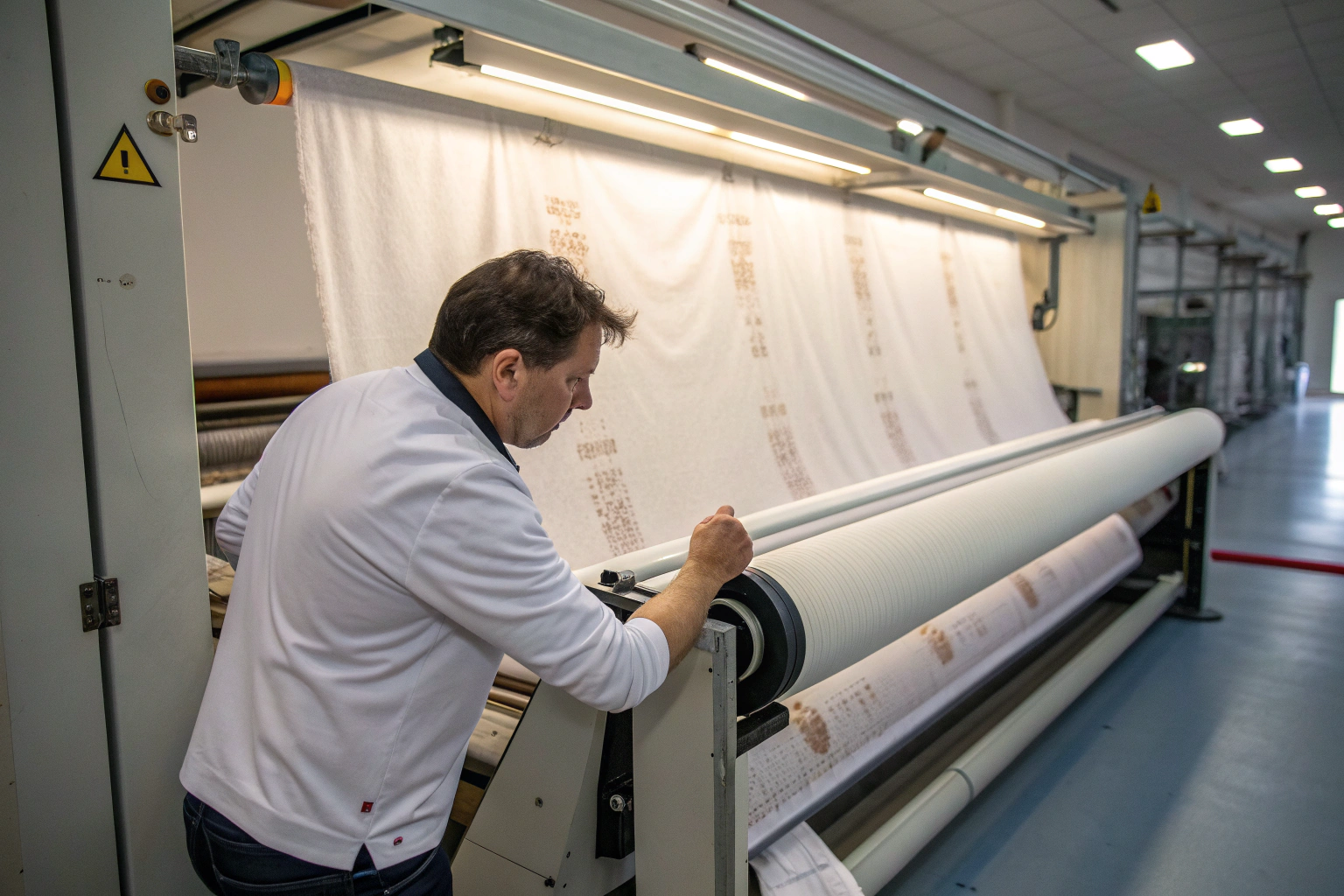
- Visual Inspection on an Inspection Machine: Every meter of the selected rolls is examined over a backlit surface. The inspector looks for weaving defects (slubs, holes, missing picks), dyeing/printing defects (streaks, color spots, misprints), and finishing defects (skewing, bowing, coating unevenness).
- On-Site Quick Tests: This is where many PSIs fall short. A competent inspector will perform spot checks right there in the warehouse:
- Weight Check: Use a GSM cutter and scale to verify weight.
- Width Check: Measure the fabric width at multiple points.
- Color Matching: Use a light booth to compare the bulk roll against the approved standard under multiple light sources (D65 daylight, TL84 store light, Incandescent). Checking under only one light is a recipe for metamerism—where colors match in the factory but look different in the store.
- Hand Feel & Stretch Verification: Physically feel and stretch the fabric to ensure it matches the approved handfeel sample.
- Packaging & Labeling Check: Are the rolls properly wrapped? Is the inner plastic bag sufficient? Are the roll labels correct with your PO number, fabric code, color, length, and roll number? Incorrect labeling leads to chaos at your cutting room.

What Are the Most Common Fabric Defects Found During FRI?
Knowing what to look for is half the battle. Here are the "usual suspects" we flag daily:
| Defect Category | Specific Examples | Why It Matters |
|---|---|---|
| Weaving/Knitting Defects | Slubs, holes, thick/thin yarns, bars, needle lines. | Creates weak points, visual inconsistency, and can cause garment rejection. |
| Dyeing/Printing Defects | Side-to-center shading, roll-to-roll shading, dye streaks, bleeding, misprints. | Makes it impossible to cut multiple plies or use different rolls in one garment. |
| Finishing Defects | Skewing (weft yarn not perpendicular), bowing (weft yarn arcs), uneven coating, excessive shrinkage. | Affects garment drape, pattern alignment, and performance. |
| Contamination | Oil stains, dirt, rust, foreign fibers (e.g., dark poly in cotton). | Often not removable, leading to dead fabric. |
Should I Hire a Third-Party Inspector or Use My Own Agent?
This depends on your volume, expertise, and relationship with the supplier.
- Third-Party Inspection Company (e.g., SGS, QIMA, Asia Inspection): Best for most importers. They provide objectivity, standardized reports with photos/videos, and global credibility. Their inspectors are trained to follow your specific instructions without conflict of interest.
- Your Own Sourcing Agent or Employee: This can work if your agent is highly technically competent and has no financial incentive to let defects slide. The risk is that a "friendly" agent might prioritize the long-term factory relationship over your one-time shipment.
- The Supplier's Own QC Report: This is a confirmation tool, not a verification tool. Always request it, but always verify independently.
For businesses building long-term partnerships, investing in training your team or agent on professional textile inspection techniques and standards pays off immensely. Websites like Textile Learner offer practical technical know-how.
How Can I Lock in Quality at the Production Stage (Dyeing & Finishing)?
The smartest buyers don't wait until the end. They build checkpoints into the production process itself. This is called DUPRO (During Production) inspection. It's the most powerful way to prevent a whole batch from going wrong.
Catching a dyeing defect after 10,000 meters are finished is a disaster. Catching it after the first 500-meter lot is a correctable process issue. Here's where to place your checks:
- After Dyeing (Lot Approval): Require the factory to send you a small cutting from the first dye lot before they proceed to finish the entire batch. Check this for color and hand feel against your standard. This is your chance to say "go" or "adjust."
- During Finishing: If the fabric requires special finishing (water repellency, peach skin, brushing), ask for a post-finish sample. Verify the performance—does a water droplet still bead up? Is the hand feel correct?
- Final Bulk Sample Approval: Before the factory cuts and rolls the entire order, insist on a full-width, 1-meter sample from the bulk production. This is your final safeguard.

What is the Role of a Clear Tech Pack in Quality Verification?
Your tech pack is your legal contract for quality. A vague tech pack invites interpretation, and interpretation leads to defects. Your fabric specifications must be quantifiable, testable, and unambiguous.
Instead of: "Soft hand feel."
Write: "Hand feel must match approved physical standard #FMA-2024-001. Martindale pilling result: Min. 4 per ISO 12945-2 after 5,000 rubs."
Instead of: "Good colorfastness."
Write: "Colorfastness to washing: Min. 4 per AATCC 61-2A; to wet rubbing: Min. 4 per AATCC 8."
The more precise you are upfront, the clearer the pass/fail criteria are at inspection. We provide our clients at Shanghai Fumao with a detailed tech pack template that leaves no room for guesswork, which has cut quality disputes by over 70%.
How Do I Handle Failures and Negotiate with the Factory?
Even with the best system, failures happen. The key is to have a pre-agreed protocol.
- Remediation First: For minor defects (within AQL limits), you can often negotiate a price discount to keep the shipment and repair the garments locally. For major defects (like off-color or failed safety tests), you must reject the batch. Do not accept sorting and repairing in the factory unless you have someone to supervise it—this rarely works.
- Evidence is Your Ammunition: Your third-party test reports and inspection photos/videos are irrefutable evidence. Present them clearly and professionally.
- Know Your Contract: Your purchase order should include clauses covering quality standards, inspection rights, and consequences for non-compliance. Resources on managing quality disputes with overseas suppliers are crucial for navigating this.
Conclusion
Verifying fabric quality before shipping is not a single event; it's a disciplined, multi-stage process woven into your entire production timeline. It moves the quality gate from your warehouse doorstep back to the factory floor, where problems can actually be fixed. By combining independent lab testing of bulk material, during-production checkpoints, and a rigorous, evidence-based Final Random Inspection, you shift from hoping for the best to knowing exactly what you're getting.
This proactive approach protects your investment, your brand reputation, and your peace of mind. It transforms quality from a cost center into a competitive advantage. Remember, the most expensive fabric is the one you can't use.
If the thought of managing this process across the ocean feels overwhelming, you don't have to do it alone. At Shanghai Fumao, our integrated model means our professional QC team conducts these stringent checks as a standard part of our service before fabric ever leaves our partnered factories. We provide transparent, third-party test reports and inspection documentation, giving you the same visibility we have. Let us be your trusted eyes on the ground in Keqiao. To discuss how we can build a bulletproof quality verification process for your next fabric order, reach out to our Business Director, Elaine. She’ll connect you with our quality and operations team. Email her at: elaine@fumaoclothing.com.