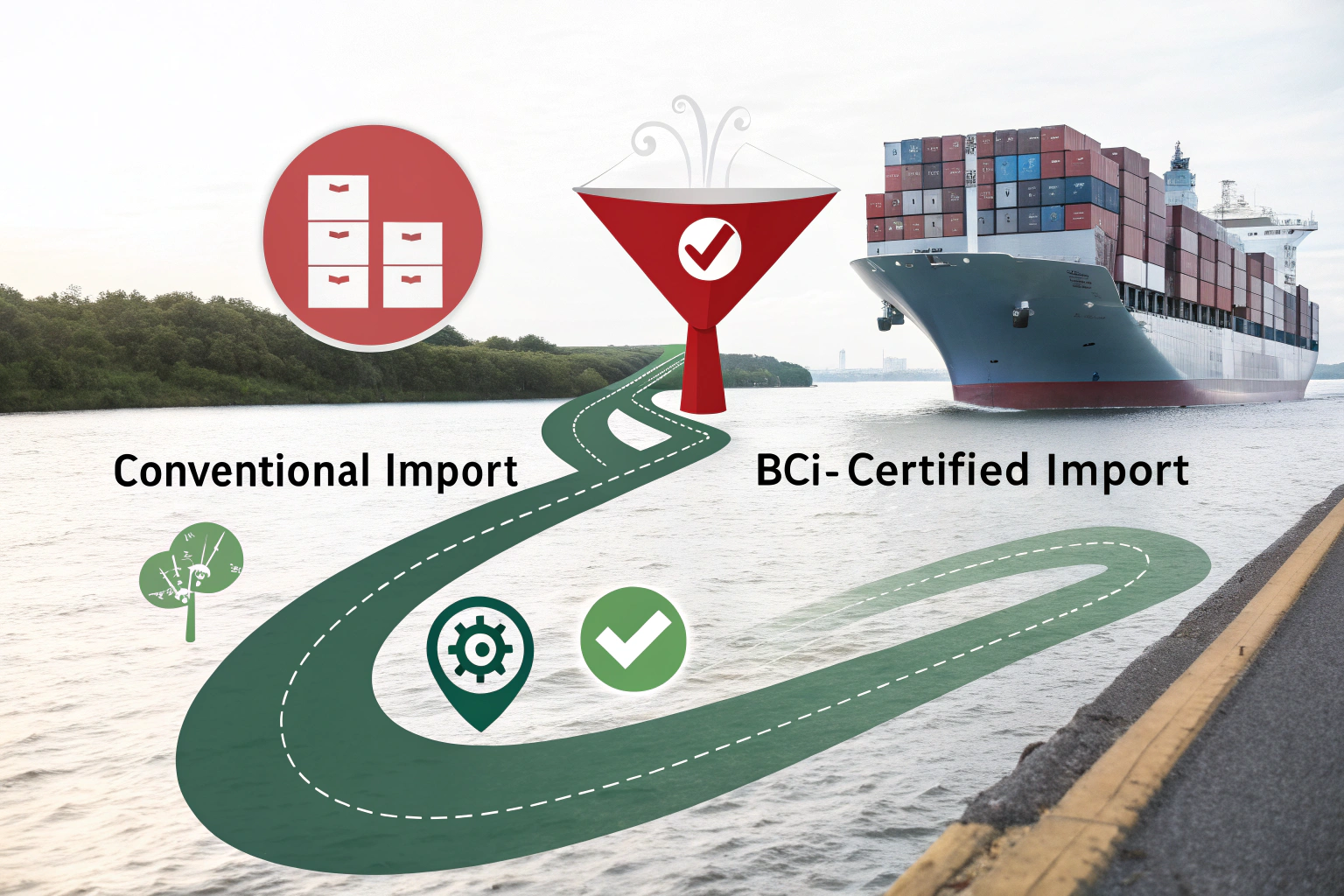
You've just been notified by your freight forwarder that your container is being held at customs. The reason? Insufficient documentation to prove compliance with forced labor regulations. Now you're facing demurrage fees, delayed store shipments, and frantic calls to your supplier for paperwork you didn't know you needed. This logistical nightmare is becoming common, and it's where BCI certification shifts from a "nice-to-have" to a critical supply chain tool.
BCI certification provides a pre-verified, audited paper trail that directly addresses the growing documentation demands of customs authorities and big-box retailers. It's not just about cotton; it's about creating a smoother, more defensible import pathway that reduces your risk of costly delays and rejections at key points in the logistics chain.
This article will map the specific ways BCI's established system—its licenses, transaction certificates, and farm-level audits—translates into tangible logistical advantages. We'll show you how to leverage these documents to clear customs faster, satisfy retailer compliance teams, and build a more resilient import process.
Your Pre-Clearance Advantage: The BCI Paper Trail
When your shipment lands, customs brokers need to prove its admissibility. Increasingly, this means proving the goods weren't made with forced labor. Generic supplier letters of guarantee are no longer enough. Authorities and retailers want evidence—a verifiable chain of custody back to the raw material.
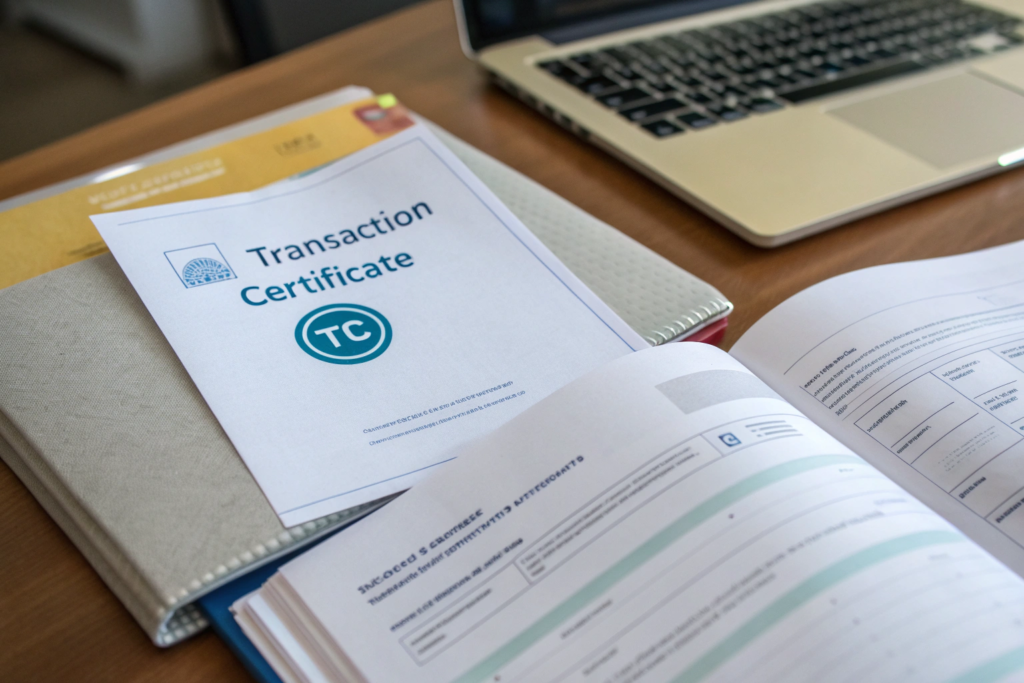
This is where BCI's system provides a ready-made solution. The Transaction Certificate (TC) is a standardized, internationally recognized document that tracks the volume of BCI cotton from licensed farm groups through the supply chain to you, the importer. It's not a marketing piece; it's a financial instrument backed by third-party audits. Having this TC in your shipment documentation packet is like having a pre-approved passport for your cotton content, significantly de-risking the customs declaration process. For importers, understanding modern customs compliance requirements for textiles is non-negotiable.
What Specific Logistics Documents Does BCI Provide?
A BCI-certified shipment should come with a clear document package that bolsters your import dossier:
- Supplier's BCI License: Proof your fabric manufacturer is an authorized participant.
- Transaction Certificate (TC) for Your Order: The core document. It details the volume of BCI cotton, the unique IDs of the supplying and receiving entities (e.g., our mill, Shanghai Fumao, and your trading company), and the date. It links your fabric to a licensed origin.
- Supporting Test Reports: While not a BCI document, pairing the TC with lab reports (e.g., composition, forced labor screening) from a CNAS-accredited lab like ours creates a powerful evidence bundle.
In practice, we've seen this work. In March 2024, a client importing 15,000 kg of BCI cotton fleece into the Port of Long Beach faced a UFLPA "withhold release" query. Within 24 hours, we provided the full TC trail, our BCI license, and the mill's audit summary. The shipment was released within 72 hours, while other containers without such documentation faced weeks-long investigations. This TC is your first line of defense. Learn more about building a robust import documentation package from logistics experts.
How Does This Paperwork Integrate with My Freight Forwarder's Process?
You need to be proactive. Don't wait for a request. Provide these BCI documents to your freight forwarder during the booking process, so they can be appended to the Customs Entry Summary (CBP Form 7501) and the Importer Security Filing (ISF). Forwarders are not mind-readers; equipping them with strong compliance documentation helps them clear your goods faster.
Treat your BCI TC like a certificate of origin. Instruct your forwarder to reference it under the "Additional Information" section of customs filings. This pre-emptive disclosure demonstrates "reasonable care" and "due diligence," which customs authorities look upon favorably. It turns a reactive scramble into a proactive, streamlined procedure. Resources from the National Customs Brokers & Forwarders Association of America (NCBFAA) often discuss integrating sustainability credentials into customs filings.
Mitigating Retailer & Border Compliance Hurdles
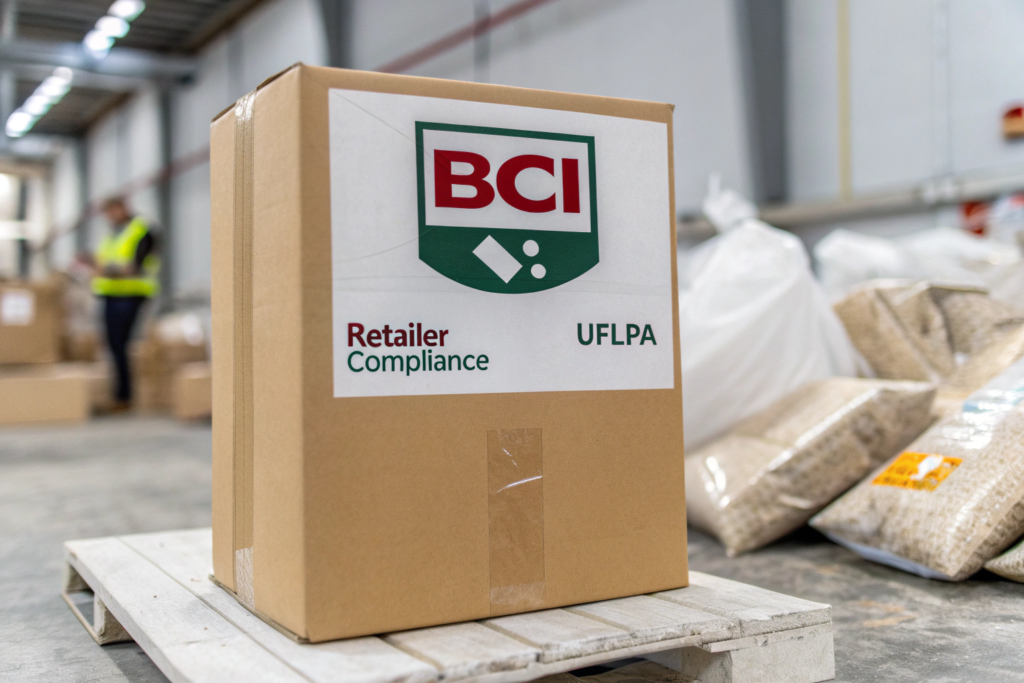
Beyond customs, your biggest logistical gatekeepers are often your own customers—the major retailers. Their Responsible Sourcing or Ethical Compliance teams have mandates just as strict as any government. They require vendors to complete lengthy questionnaires and provide proof of ethical sourcing. BCI certification is widely recognized and accepted by these teams as a valid standard.
Having BCI simplifies this vendor onboarding and annual audit process immensely. Instead of describing complex, unverified farm relationships, you can simply provide your supplier's BCI license number and the TCs for your orders. It's a standardized answer to a universal question. This saves you and your compliance team dozens of hours per year.
How Does BCI Satisfy Retailer "Ethical Sourcing" Questionnaires?
Most retailer questionnaires have a section on raw material sourcing, specifically asking about policies and proof regarding forced labor, child labor, and environmental management. BCI provides direct answers:
- Forced/Child Labor: "Our fabric is made with BCI-certified cotton, which prohibits forced and child labor through its Principles and Criteria and third-party audits."
- Traceability: "We maintain Transaction Certificates that provide chain-of-custody traceability for the BCI cotton content."
- Environmental: "BCI promotes water stewardship and reduced pesticide use at the farm level."
We had a client supplying a major big-box retailer in the U.S. Midwest. The retailer's new compliance portal required uploading certificates for all material claims. Our client simply uploaded the BCI TCs we provided for each purchase order. Their account was approved without the need for a costly third-party social audit of the spinning mill—a process that saved them over $15,000 and 8 weeks of lead time. This is a key example of leveraging certifications to streamline retailer compliance.
Does BCI Help with Specific Regulations Like the UFLPA?
Yes, directly. The Uyghur Forced Labor Prevention Act (UFLPA) creates a "rebuttable presumption" that goods made wholly or in part in China's Xinjiang region are made with forced labor and are barred from entry. To import, you must provide "clear and convincing evidence" to the contrary.
BCI certification is one of the few structured programs that can contribute to this evidence package for cotton goods. While it does not guarantee region-of-origin exclusion (cotton is a globally traded commodity), it provides a critical layer: proof of an audited ethical sourcing system. A BCI TC shows that the cotton was sourced through a program with forced labor prohibitions and farm-level checks. When combined with other evidence (like supply chain mapping from your supplier), it forms a substantial part of your rebuttal argument. Official guidance on building a UFLPA compliance strategy is available from U.S. Customs and Border Protection (CBP).
The Hidden Logistical Benefit: Supply Chain Stability
Logistics isn't just about moving boxes; it's about planning. The greatest disruption is an unexpected one—a supplier being blacklisted, a shipment rejected, a relationship terminated due to compliance failure. BCI certification promotes supply chain stability by de-risking your supplier relationships.
When you work with a BCI-licensed supplier like Shanghai Fumao, you are partnering with a company that has already invested in a verifiable, audited system. This lowers the risk of a catastrophic compliance failure that could suddenly sever your supply line. It makes your sourcing more predictable and your logistics planning more reliable.
How Does This Reduce "Fire Drills" and Emergency Air Freight?
Fewer quality and compliance surprises mean fewer last-minute scrambles. Consider this chain of events without a certified system:
- A retailer's random test finds banned substances or raises forced labor flags.
- They embargo your goods in their warehouse.
- You must now urgently produce replacement goods, often via expensive air freight, while also providing documentation you may not have.
With BCI, the documentation is already in your file, ready to submit. The farm-level controls reduce the risk of banned pesticide residues. This proactive stability prevents the need for crisis-mode logistics. In our experience, clients who standardize on BCI cotton report a significant drop in these kinds of "fire drill" scenarios. They can stick to their planned ocean freight schedules with confidence. This stability is a core component of building a resilient apparel supply chain.
Can BCI Certification Actually Lead to Fewer Shipping Inspections?
While no certification guarantees a "green lane," a history of clean, well-documented shipments builds a positive profile with customs authorities. Consistent use of verifiable certifications like BCI signals that you are a knowledgeable, compliant importer. Over time, this can reduce the likelihood of your shipments being selected for intensive, time-consuming physical examinations.
Think of it as building a good credit score with customs. Each properly documented BCI shipment is a positive mark. This isn't a formal program, but it's a practical reality observed by seasoned logistics managers. Providing your customs broker with strong documentation like BCI TCs makes their job easier and helps build that trustworthy profile for your import entity. Forums for global trade compliance professionals often share insights on reducing inspection rates.
Conclusion
BCI certification, when fully leveraged, is far more than a tag on a garment. It is an operational tool that simplifies the complex, document-heavy world of international textile logistics. It provides the verified paperwork that customs and retailers increasingly demand, turning a potential bottleneck into a smooth pathway.
By integrating BCI's Transaction Certificates and licenses into your import documentation workflow from the start, you proactively mitigate the biggest risks facing importers today: customs holds, retailer rejections, and supply chain disruptions. You replace uncertainty with evidence, and delays with predictability.
Ready to streamline your import process and sleep easier knowing your documentation is audit-ready? Partner with a supplier who understands the logistics value of certification from the inside out. At Shanghai Fumao, we don't just ship you BCI fabric; we provide the complete documentation package and expertise to help you clear borders and satisfy compliance teams seamlessly. Contact our Business Director, Elaine, to discuss how we can make your next import shipment your smoothest one yet: elaine@fumaoclothing.com.