You're not just selling clothes; you're selling an identity, a set of values, a promise to your customer. In today's crowded wholesale fashion market, a powerful brand story is what separates the commodity from the coveted. But when your supply chain is complex and stretched across continents, how do you ensure that your story isn't just words on a tag? How do you prove that your commitment to "doing better" is woven into every fiber?
The bridge between a compelling narrative and verifiable action is often built with credible, third-party certifications. This is where the Better Cotton Initiative (BCI) becomes more than an agricultural program—it becomes a strategic storytelling asset for your wholesale brand. BCI provides the tangible, auditable backbone that supports claims of responsibility, allowing you to speak with confidence about the origin and impact of the cotton in your collections. It turns abstract values into a concrete supply chain choice that retailers and end-consumers can understand and trust.
For wholesalers, this isn't just about ethics; it's about competitive edge, buyer confidence, and future-proofing your business. Let's explore how integrating BCI cotton into your sourcing strategy actively builds and fortifies your brand's story at every level of the wholesale journey.
Why Does Transparency Matter to Wholesale Buyers Now?
The wholesale buyer's role has evolved. They are no longer just purchasing agents evaluating price and style; they are gatekeepers for their own brand's reputation and their customers' values. Retailers, from large department stores to boutique shops, are under immense pressure to answer questions about sustainability and ethics. When they place a bulk order with you, they are implicitly trusting you with a piece of their own brand story.
A 2023 survey by the National Retail Federation indicated that over 65% of retail buyers have formal ESG (Environmental, Social, and Governance) criteria they must evaluate in their sourcing decisions. They need evidence. A vague claim of "sustainable cotton" is a red flag. BCI provides that evidence through its global standard and chain-of-custody system. When you can present a BCI Transaction Certificate and explain the principles behind it, you're not just selling a product; you're selling peace of mind and reduced risk for your buyer. You make their job easier and their buying decision more defensible.

How Can BCI Differentiate Your Brand at Trade Shows?
Trade shows are battlegrounds of sameness. Rows of booths display similar trends, cuts, and price points. Your story is your standout feature. Imagine your booth signage not just saying "Premium Cotton," but "Made with Better Cotton – Ask Us About Our Impact." This immediately signals a deeper commitment and opens a more meaningful conversation.
We see this at the Intertextile Shanghai fair every year. Brands that lead with certifications like BCI attract more qualified, serious buyers. They spend less time haggling over pennies and more time discussing partnership, innovation, and shared values. In 2024, one of our clients, a European wholesaler of casualwear, prominently featured their BCI partnership. They reported a 40% increase in meaningful leads compared to the previous year, with buyers specifically citing the clear sustainability narrative as a key differentiator. Your booth becomes a destination for buyers who are building responsible assortments.
Does BCI Help Secure Orders from Eco-Conscious Retailers?
Absolutely. For retailers specializing in eco-fashion or those with strong corporate sustainability mandates, BCI is often a minimum entry requirement or a highly weighted factor. It acts as a filter. These retailers actively seek out wholesale partners who can align with their published goals, such as "sourcing 100% more sustainable cotton by 2025."
Having BCI in your portfolio demonstrates that you speak their language and are on the same journey. It transforms your sales pitch from "We can make this for you" to "We can help you achieve your brand's goals." This alignment can be the deciding factor in winning a major account over a competitor who only competes on price. It’s about becoming a strategic vendor, not just a supplier.
How to Communicate BCI's Value to End-Consumers?
The ultimate recipient of your story is the person who wears the garment. While the average consumer may not know the acronym "BCI," they understand concepts like "better farming," "water saving," and "fairer conditions for farmers." Your job as a wholesaler (and your retailers' job) is to translate the certification into relatable benefits.
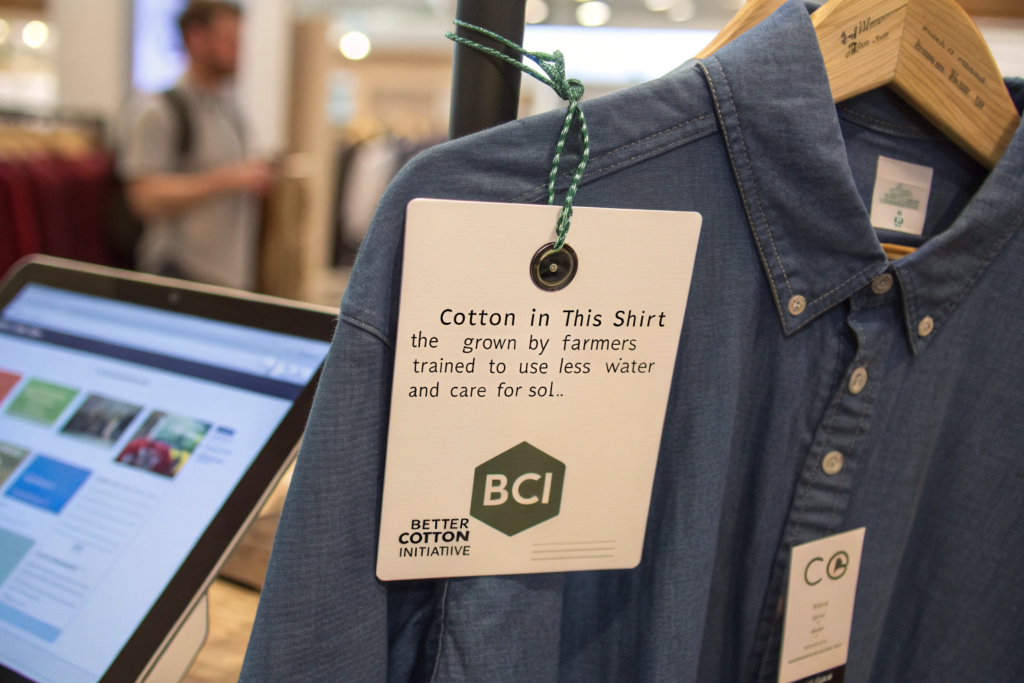
This communication happens on hangtags, in lookbooks, on your website's "Sustainability" page, and through social media content. The narrative should be simple and human-centric: "The cotton in this shirt was grown by farmers trained to use less water and care for the soil." BCI provides logos, claim guidelines, and often consumer-facing marketing assets that make this translation easy and legally compliant. This empowers your retail customers to tell a powerful, authentic story at the point of sale.
What Are Effective Messaging Angles for Hangtags and Marketing?
Avoid jargon. Use benefit-oriented language that connects to universal values:
- Environmental Angle: "This piece uses cotton from farms working to reduce their environmental footprint." Link to resources on comparing the water footprint of different textiles for deeper consumer education.
- Social Angle: "Supporting better working conditions and training for cotton farming communities."
- Quality & Care Angle: "Better cotton starts with better practices, resulting in a fabric we trust for its quality and feel." (This ties back directly to the QC benefits, creating a holistic story).
A successful case from our work at Shanghai Fumao: A US-based wholesale brand for organic baby clothes wanted to expand into more affordable, yet still responsible, lines. We developed a BCI cotton interlock. Their hangtag read: "Soft on skin, kinder to the earth. Made with Better Cotton, supporting farming families." This simple message resonated with parents, allowing the brand to access a broader market without compromising its ethical core.
Can BCI Content Drive Engagement on Social Media?
Yes, it provides authentic, visual content. You can share:
- Farmer Stories: Short videos or photos of BCI farmer training (using provided assets).
- Process Insights: "From seed to shirt" snippets showing how the certified cotton moves through the supply chain.
- Impact Stats: Simple infographics on water saved or hectares under better management.
This type of content builds transparency and trust far more effectively than generic product shots. It gives your brand a human face and a purpose beyond fashion. Retailers can repurpose this content, creating a cohesive narrative from wholesaler to shop floor.
How Does BCI Build Long-Term Trust and Brand Equity?
A brand story is a long-term investment. Trust is earned through consistency and proof over time. BCI isn't a one-season campaign; it's a commitment to a continuous improvement system. By consistently sourcing BCI cotton across multiple seasons and collections, you demonstrate steadfastness in your values. This builds deep equity with buyers and consumers who are tired of "greenwashing" and fleeting trends.
It signals that your brand is mature, responsible, and in it for the long haul. This perception of stability and integrity is priceless in the wholesale business, where retailers seek reliable partners they can grow with over years. It turns transactional relationships into strategic partnerships.

Does BCI Support Compliance with Evolving Regulations?
The regulatory landscape is tightening. The EU's forthcoming Corporate Sustainability Reporting Directive (CSRD) and various due diligence laws will require larger companies to disclose environmental and social impacts in their supply chains. For wholesalers supplying to these markets, having a mapped and certified supply chain for key materials like cotton is becoming a compliance issue, not just a marketing one.
BCI provides a structured framework for collecting and reporting relevant data on cotton sourcing. Proactively adopting it future-proofs your business against regulatory shocks and positions you as a leader, not a follower, in compliance. This is a powerful part of the story when pitching to large, publicly-traded retail groups.
How Can BCI be the Foundation for a Broader Sustainability Narrative?
Think of BCI as Chapter 1 of your brand's sustainability story. It’s a credible, achievable starting point that establishes your commitment. From this solid foundation, you can build more complex chapters. You can layer on other initiatives:
- Chapter 2: "We now blend our BCI cotton with recycled polyester."
- Chapter 3: "Our dyehouses using this fabric are achieving ZDHC wastewater standards."
- Chapter 4: "We are investing in regenerative agriculture projects with our farming groups."
This progressive narrative shows evolution and deep commitment. At Shanghai Fumao, we help brands craft this journey. For instance, we worked with a Scandinavian workwear brand to first switch their core canvas to BCI cotton (Chapter 1). The following year, we helped them develop a version blended with recycled fibers for a specific line (Chapter 2), which they successfully marketed as an innovation upgrade, strengthening their brand story significantly.
What Are the Practical First Steps to Weave BCI Into Your Story?
Starting is simpler than it seems. It begins with a conversation with your fabric supplier.
- Ask the Question: "Can you provide this style using BCI cotton?" A capable supplier like us will immediately understand and guide you on availability, cost, and lead time implications.
- Start Small: Pilot BCI in one of your best-selling, core fabrics—like a staple jersey or twill. This minimizes risk and allows you to test the process and consumer response.
- Gather the Evidence: Insist on the BCI Transaction Certificate for your order. This is your proof, your story's primary source material.
- Plan Your Communication: Work with your marketing team or agency to develop the simple messaging for hangtags and digital channels using BCI's brand guidelines.
The key is partnership. Choose a supplier who doesn't just sell you fabric but understands and supports your brand-building mission. Their expertise can help you navigate the specifics and avoid pitfalls, ensuring your story is both beautiful and true.

How to Choose a Supplier That Amplifies Your BCI Story?
Your supplier is an extension of your brand. Partner with one who is genuinely integrated into the sustainable ecosystem. Look for:
- Direct Membership or Partnership: Are they a BCI Retailer & Brand member or have direct ties to BCI-licensed mills?
- Traceability Systems: Can they seamlessly provide TCs and trace the cotton flow?
- Shared Vision: Do they see sustainability as a core service? Do they offer related options like low-impact dyeing techniques or recycled blends?
At Fumao, we view our role as enablers of our clients' stories. We provide the verified materials, the documentation, and the sourcing intelligence to make your claims unshakable. We help you tell a story you can stand behind with complete confidence.
Conclusion
In wholesale fashion, where competition is fierce and margins are tight, your brand story is your most valuable asset. It's the reason buyers choose you over countless others and the reason consumers become loyal advocates. The Better Cotton Initiative offers a powerful, credible, and market-tested tool to strengthen that story from the ground up.
It provides the transparency buyers demand, the relatable narrative consumers trust, and the foundational credibility for long-term brand equity. It transforms your sourcing decision from a back-office function into a front-and-center pillar of your brand identity.
Ready to weave a more responsible and compelling story into your next collection? Partner with a supplier who provides more than just fabric, but the narrative infrastructure you need. At Shanghai Fumao, we combine over 20 years of textile expertise with a deep commitment to certified, sustainable materials like BCI cotton. Let's collaborate to build a brand story that resonates, endures, and drives sales. Contact our Business Director, Elaine, at elaine@fumaoclothing.com to start writing your next chapter.