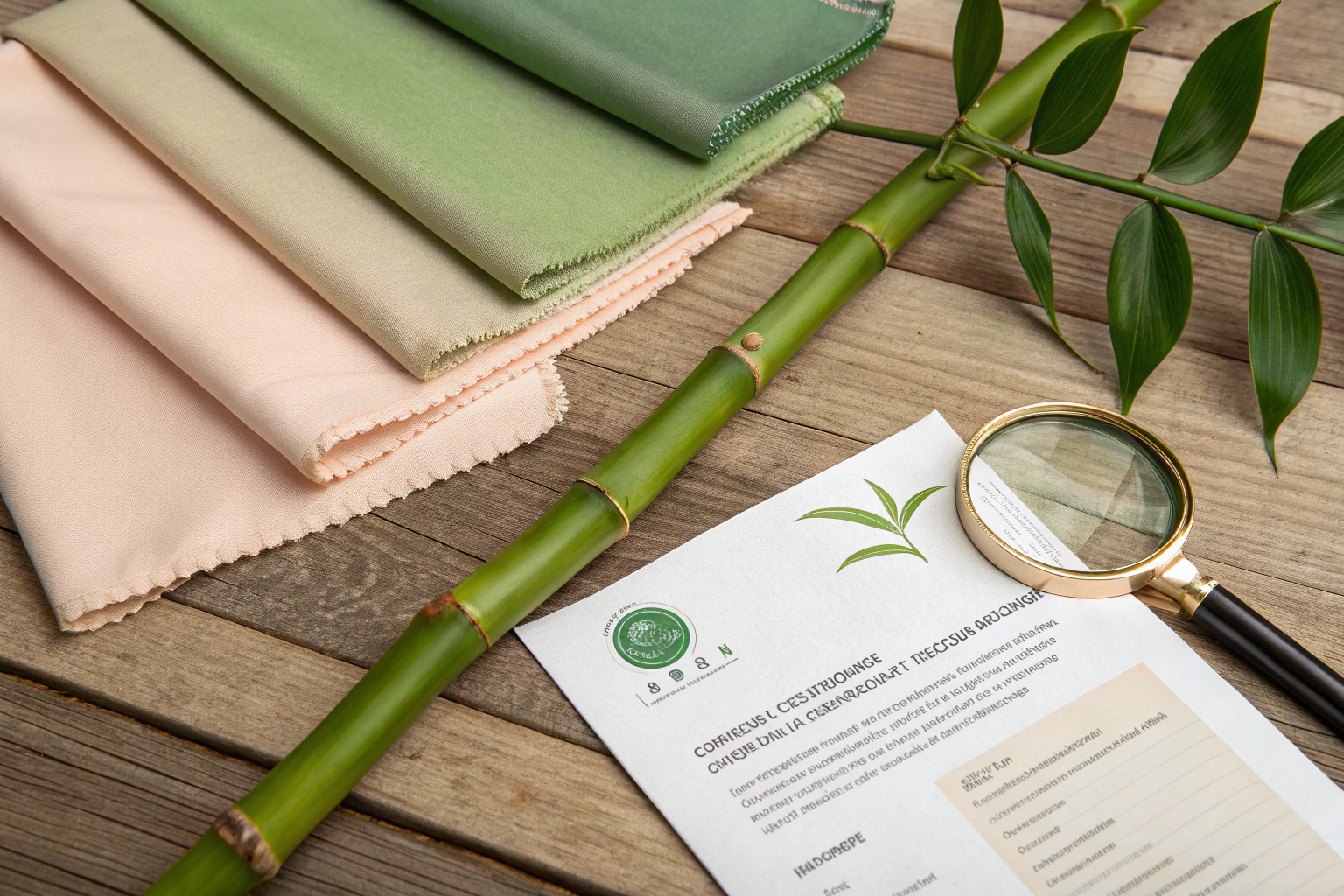
A few years ago, I got a call from a buyer at a sustainable fashion startup in California. She was excited. She'd found a supplier offering "bamboo viscose" fabric at a great price, and the marketing materials made it sound like an eco-miracle—"grown without pesticides," "biodegradable," "sustainable." She was ready to place a massive order for her new line of summer dresses. Before she signed, she asked me, as a more experienced supplier, to take a look at the sample and the certifications. I ran a few basic tests and asked for the supplier's environmental permits. Within a week, she had dodged a bullet. The fabric was cheap, but the production process was a nightmare, and the "eco" claims were pure fiction.
The honest, and somewhat complicated, answer is that bamboo viscose can be a sustainable option, but it absolutely is not automatically sustainable. The term "bamboo" sounds natural and green, but the reality is that turning a hard, woody bamboo stalk into soft, silky fabric requires intensive chemical processing. The sustainability of the final fabric depends almost entirely on how that processing is done. If it's done in a poorly regulated factory using outdated technology, bamboo viscose can be highly polluting. But if it's done in a modern facility with closed-loop systems, responsible chemical management, and proper certification, bamboo viscose can be a genuinely eco-friendly choice, offering a renewable resource with a lower environmental footprint than many conventional fabrics.
This is the nuance that gets lost in marketing. As someone who has been in this industry in Keqiao for over 20 years, I've seen both the best and the worst of bamboo viscose production. I've walked through factories that looked like something out of a horror movie—chemical smells, untreated wastewater, workers with minimal protection. And I've visited state-of-the-art facilities that are cleaner and more efficient than many cotton mills. The difference isn't the bamboo; it's the manufacturer. Let me break down exactly what you need to know to make an informed decision.
What Is Bamboo Viscose and How Is It Actually Made?
First, let's clarify terminology. "Bamboo viscose" is the most common term, but technically, it's "viscose" (or "rayon") made from bamboo cellulose. There's also "bamboo lyocell," which is a different, newer process. And there's "mechanically processed bamboo," which is rare and produces a fabric more like linen. Most of what you see in the market is bamboo viscose.
The process starts with bamboo stalks. They are chopped, crushed, and soaked in a chemical solution to dissolve the cellulose and create a pulpy substance. This pulp is then treated with more chemicals, often including carbon disulfide and caustic soda, to create a viscous solution. This solution is then extruded through tiny holes (a spinneret) into a chemical bath, where it solidifies into fibers. Those fibers are then spun into yarn, woven or knitted into fabric, and finally dyed and finished. It's an intensive, multi-step chemical process.
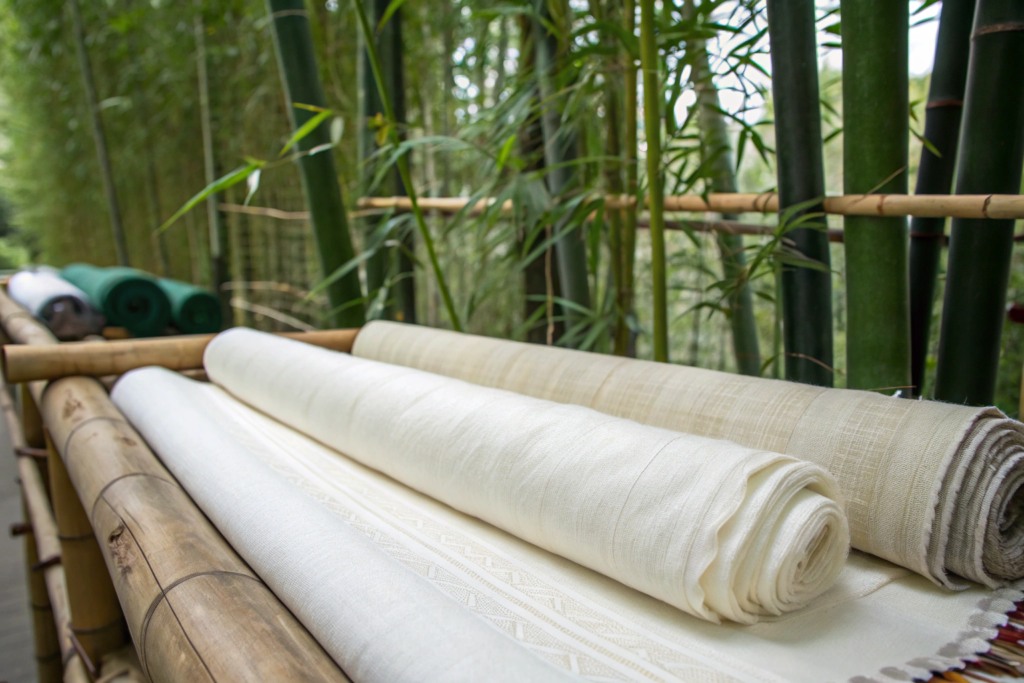
Is bamboo farming itself as sustainable as it sounds?
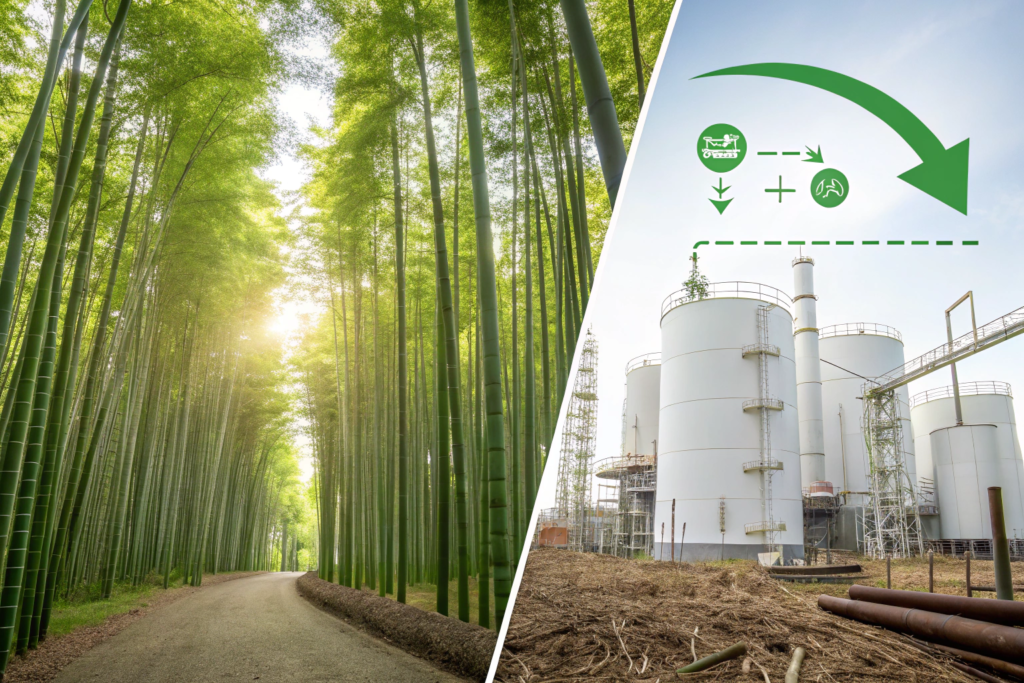
Generally, yes, the farming part is quite sustainable. Bamboo is a remarkable plant. It grows incredibly fast—some species can grow a meter in a day. It doesn't require fertilizer or pesticides to thrive. It can grow on marginal land that isn't suitable for food crops. It helps prevent soil erosion and sequesters carbon efficiently. So, the raw material has a strong sustainability profile.
However, there are nuances. To meet massive industrial demand, some bamboo is now grown in large monoculture plantations, which can reduce biodiversity compared to natural forests. And the transportation of bamboo from often remote growing regions to processing facilities adds to its carbon footprint. But compared to water-intensive cotton or petroleum-based synthetics, the agricultural phase of bamboo is a clear winner. (The Food and Agriculture Organization of the UN has reports on bamboo's environmental benefits.)
What are the environmental concerns with the chemical processing?
This is the heart of the problem. The traditional viscose process uses harsh chemicals, including carbon disulfide, which is toxic to workers and the environment if not handled properly. The process also consumes large amounts of water and energy, and if the wastewater is not treated, it can release those chemicals into rivers and communities.
The worst-case scenario is a factory with no environmental controls. These factories release untreated wastewater containing zinc, sulfates, and other pollutants. They emit carbon disulfide into the air, endangering workers' health. The resulting fabric might be cheap, but the environmental and human cost is devastating. I've seen these factories, and they give the entire industry a bad name. This is why "bamboo viscose" has a controversial reputation. (The Changing Markets Foundation has published several investigative reports on the viscose industry.)
How Can I Identify Sustainably Produced Bamboo Viscose?
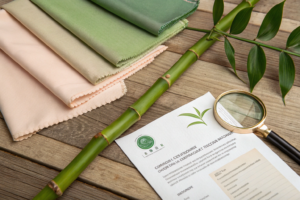
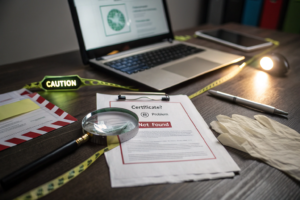
This is where you, as a buyer, need to become a detective. You cannot rely on the word "bamboo" or even "eco-friendly" on a supplier's website. You need to look for third-party verification that the processing was done responsibly. The fiber itself is sustainable; the question is whether the factory processing it deserves that label.
We have a saying in our office: "Trust, but verify." Any supplier can send you a sample and a beautiful story. The ones who are genuinely sustainable will be happy to provide the documentation to prove it. The ones who are hiding something will become evasive when you ask for certificates or factory details.
What certifications should I look for on bamboo viscose?
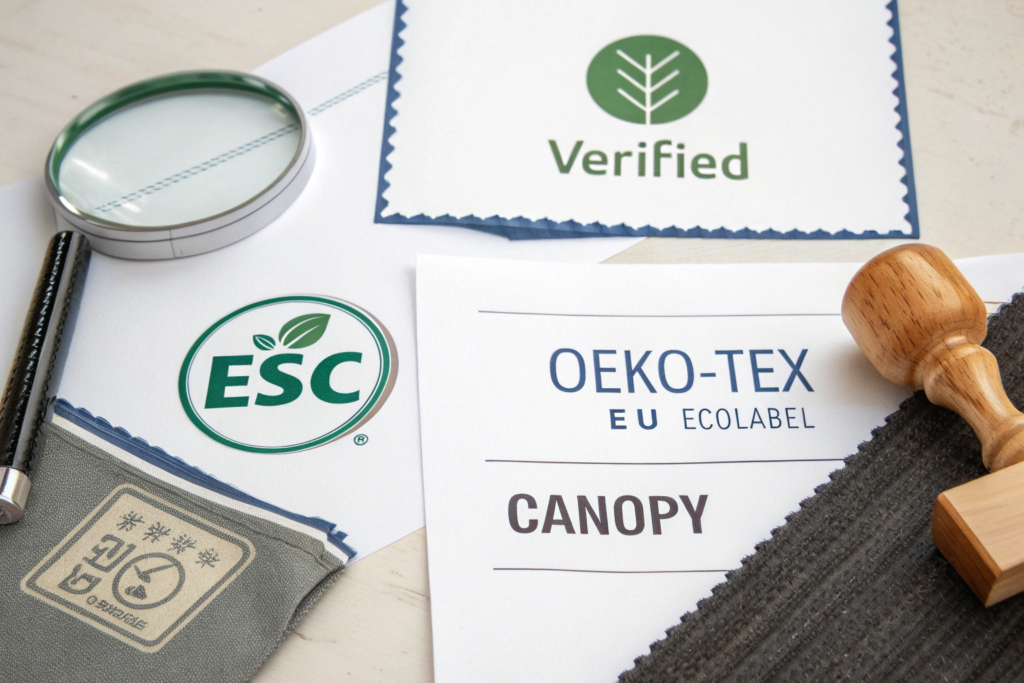
This is your most powerful tool. Look for these specific certifications:
- FSC (Forest Stewardship Council) Certification: This ensures that the bamboo pulp comes from responsibly managed forests. It's not enough that it's bamboo; it needs to be certified bamboo.
- OEKO-TEX Standard 100: This certifies that the finished fabric is free from harmful substances. It's a good baseline for product safety.
- EU Ecolabel or Nordic Swan: These are stringent European certifications that cover the entire production process, including chemical use and emissions. If a bamboo viscose fabric has an EU Ecolabel, you know the processing was held to a high standard.
- CanopyStyle Certification: This is a specific initiative focused on viscose supply chains. Canopy evaluates producers and ranks them based on their environmental performance, including avoiding ancient and endangered forests. Look for suppliers who are "green shirts" in Canopy's rankings.
When a client from a UK-based ethical fashion brand asked us about bamboo viscose in 2023, we didn't just say "we have it." We provided our FSC certificate for the pulp, our OEKO-TEX certificate for the fabric, and our CanopyStyle ranking. We also shared the name of our pulp supplier so they could verify. That's the level of transparency required. (The Canopy Planet website has their "Hot Button" report ranking viscose producers.)
What is "bamboo lyocell" and is it better than bamboo viscose?
Yes, bamboo lyocell is significantly better from an environmental perspective. It uses a different production process—the same closed-loop system used for Tencel lyocell. In this process, a non-toxic solvent (usually NMMO) is used to dissolve the cellulose, and over 99% of that solvent is recovered and reused. There's no toxic chemical discharge, and the process is much cleaner overall.
Bamboo lyocell is also often a higher quality fiber. It's stronger, more durable, and has an even softer handfeel than bamboo viscose. The downside is that it's more expensive and less widely available. But for brands that are serious about sustainability, bamboo lyocell is the clear choice over traditional viscose. We've been working with a bamboo lyocell supplier in China since 2021, and the quality and environmental profile are exceptional. (Lenzing, the maker of Tencel, also produces a bamboo lyocell fiber under their "Ecovero" brand.)
How Does Bamboo Viscose Compare to Other Sustainable Fabrics?
You have choices. Organic cotton, hemp, Tencel, recycled polyester—each has its own sustainability profile. Bamboo viscose sits in a specific niche. It's not automatically the "best" choice, but it has unique properties that make it valuable for certain applications. The key is to understand its strengths and weaknesses relative to the alternatives.
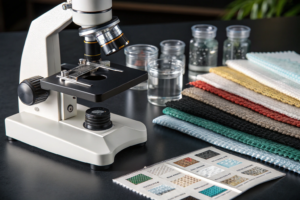
I often do comparative presentations for clients. We put swatches of different fabrics side-by-side, discuss their environmental footprints, their performance characteristics, and their costs. Bamboo viscose often wins on softness and drape, but it can lose on durability and environmental certainty if not properly certified.
Bamboo Viscose vs. Organic Cotton: Which is greener?
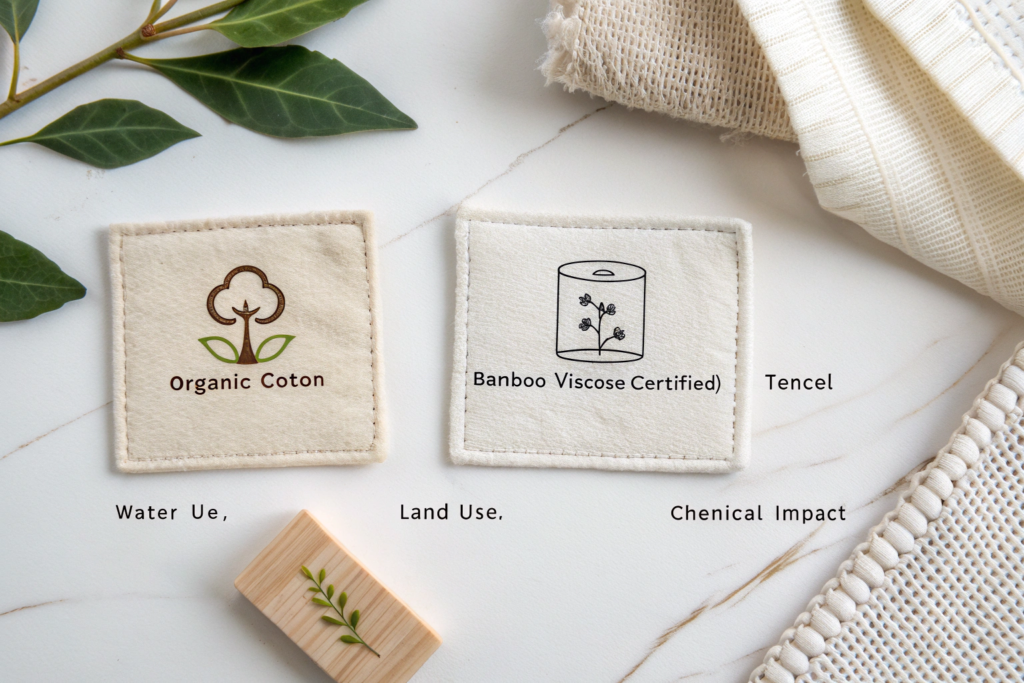
This is a close fight, and the answer depends on your priorities. Organic cotton has a simpler, more transparent supply chain. It's grown without pesticides and processed with less intensive chemistry. Its environmental impact is well-studied and understood. However, organic cotton still uses significant water (though less than conventional) and land.
Bamboo viscose wins on land use and water efficiency at the farming stage. Bamboo grows faster and with less water than cotton. But it loses on the processing stage, where the chemical impact can be high. A truly sustainable choice might be organic cotton if you prioritize simplicity and transparency, or certified bamboo viscose (with FSC and EU Ecolabel) if you prioritize land-use efficiency and a unique, silky handfeel. For a client from a French lingerie brand, we recommended a blend: organic cotton for the main body of a bralette for its breathability, and bamboo viscose for the trim and straps for its silky softness against the skin. (The Textile Exchange Materials Market Report compares the environmental impacts of different fibers.)
Bamboo Viscose vs. Tencel: Which is the better eco-fiber?
Tencel (lyocell) is almost always the winner in a direct environmental comparison. The closed-loop production process of Tencel is simply cleaner than the traditional viscose process used for most bamboo. Tencel also has stricter raw material sourcing requirements (FSC-certified wood). And Tencel fibers are generally higher quality—stronger, more consistent, and less prone to pilling.
However, bamboo viscose has its advocates. Some argue that bamboo as a raw material is more renewable and faster-growing than the trees used for Tencel (usually eucalyptus or spruce). And when bamboo viscose is produced in a modern, well-regulated facility with responsible chemical management, the gap narrows. For a client from a US-based bedding brand, we ultimately recommended Tencel for its consistent quality and guaranteed closed-loop production, but we also offered a premium bamboo viscose option for clients who specifically wanted the "bamboo" story. (This article from Common Objective compares Tencel and bamboo viscose.)
What Are the Performance Trade-Offs of Bamboo Viscose?
Sustainability is important, but your fabric also has to perform. Bamboo viscose has some fantastic properties, but it also has limitations that you need to understand before you commit to a large order. The "handfeel" is the star attraction, but durability and care requirements are important considerations, especially for certain product categories.
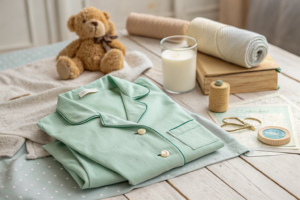
We've supplied bamboo viscose for everything from baby blankets to evening gowns. Each application requires a different approach. A baby blanket needs to be soft but also durable enough for constant washing. An evening gown needs drape and elegance but may not need the same level of abrasion resistance. Understanding these nuances is key to successful product development.
Is bamboo viscose durable enough for everyday kids' wear?
This is a common concern, and it's valid. Bamboo viscose fibers, especially if they are from a lower-quality source or improperly processed, can be weaker than cotton or Tencel. They can be prone to pilling and may lose strength when wet. For kids' wear, which gets washed frequently and worn hard, this can be a problem.
However, high-quality bamboo viscose from a reputable supplier, with proper yarn construction (higher twist) and fabric structure (tighter knit), can be perfectly durable. We developed a bamboo viscose jersey for a Dutch children's wear brand in 2023 specifically for everyday t-shirts. We used a higher-twist yarn and a compact knit structure. We also added a bio-polishing step to reduce pilling. The resulting fabric tested well for abrasion and pilling, and the client's customer feedback has been positive. The key is to engineer for durability, not just assume the fiber will be strong enough. (The ASTM standards for fabric durability are the benchmark for testing.)
How does bamboo viscose behave when washed?
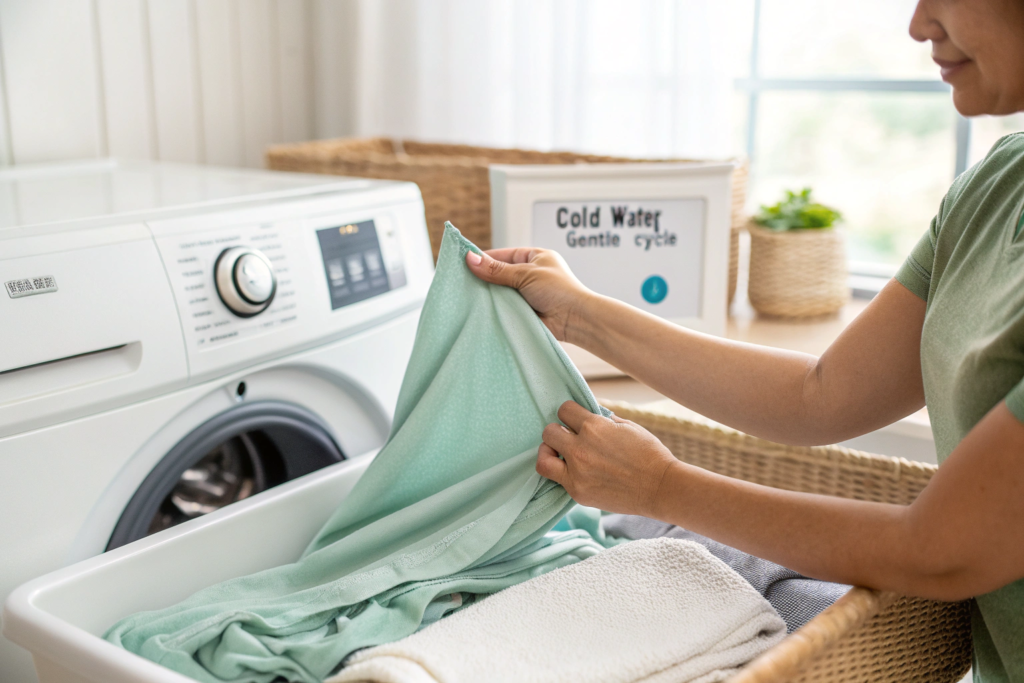
Bamboo viscose can shrink more than cotton if not properly pre-shrunk. It can also be prone to wrinkling. And because it's a cellulosic fiber, it can lose strength when wet, so it needs to be handled gently in laundering.
We always recommend that our clients include clear care instructions with bamboo viscose garments: machine wash cold, gentle cycle, tumble dry low or line dry. We also pre-shrink all our bamboo viscose fabrics in-house before shipping, running them through a compacting machine that controls shrinkage to less than 3-5% (depending on the construction). For a client from a Canadian loungewear brand, we provided detailed shrinkage data for every batch of bamboo viscose fabric we shipped. They used this data to create accurate garment specs and avoid costly surprises. (This guide from Textile School explains the properties of viscose rayon.)
What Questions Should I Ask a Bamboo Viscose Supplier?
You are now equipped with the knowledge to be a savvy buyer. The final step is knowing what questions to ask. A good supplier will welcome these questions. A bad supplier will try to deflect or give vague answers. I've compiled a list of the most critical questions based on two decades of experience.
When a new client comes to us asking about bamboo viscose, I don't wait for them to ask. I volunteer this information. I want them to feel confident in their choice. If a supplier hesitates or can't answer these questions clearly, consider it a major red flag.
Can you provide your FSC chain-of-custody certificate for the bamboo pulp?
This is question number one. It proves that the bamboo used to make your fabric came from responsibly managed forests. A supplier should be able to provide this certificate from their pulp supplier. If they can't, you have no way of knowing if your "bamboo" came from a sustainable source or from a clearcut forest.
We keep our FSC certificate on file and share it with any client who asks. We also maintain records from our pulp supplier tracing each batch of fiber back to its origin. This is the level of traceability required for genuine sustainability. (The FSC's certificate database allows you to verify certificates.)
Is your bamboo viscose made using a closed-loop production system?
This is the million-dollar question about processing. If the answer is "yes," ask for details. Which solvents are used? What is the recovery rate? Can you provide documentation from the fiber producer? If the answer is "no" or "I'm not sure," you are likely dealing with a traditional, potentially polluting viscose process.
Some of the best bamboo viscose today comes from producers using closed-loop or "lyocell" technology. They are transparent about their processes. We work with a mill that publishes its annual environmental report, including solvent recovery rates and wastewater treatment data. That's the kind of partner you want. (The ZDHC Foundation's Gateway is a resource for finding chemical information.)
Do you have third-party test reports for restricted substances?
This ensures your fabric is safe for consumers. Ask for test reports from accredited labs like SGS, ITS, or BV, showing compliance with REACH (EU) or CPSIA (US) standards. A reputable supplier will have these reports readily available.
We test every batch of bamboo viscose fabric in our own CNAS-accredited lab, and we also send random samples to third-party labs for verification. We provide these reports to our clients as a matter of course. It's not just about passing a test; it's about building trust. (The SGS website explains the various restricted substance testing protocols.)
Conclusion
So, can bamboo viscose really be considered a sustainable option? The answer is a qualified yes—but only if you do your homework. The bamboo plant itself is a remarkably sustainable resource: fast-growing, low-input, and land-efficient. However, the conventional viscose process used to turn that plant into fabric can be highly polluting and environmentally damaging. The key to genuine sustainability lies in the processing. You must look for third-party certifications like FSC for the raw material, and EU Ecolabel or OEKO-TEX for the processing. You must ask about closed-loop production systems and verify claims with documentation. You must understand the performance trade-offs—the incredible softness and drape versus the potential for shrinkage and the need for gentle care. Bamboo viscose can be a wonderful, eco-friendly choice, but only when sourced from responsible, transparent, and certified suppliers.
This is exactly the kind of honest, rigorous approach we take at Shanghai Fumao. We don't just sell bamboo viscose; we help you navigate its complexities. With over 20 years of experience in Keqiao, we offer both traditional bamboo viscose (from our most responsible partners) and premium bamboo lyocell (with closed-loop production). We provide full documentation: FSC certificates, OEKO-TEX reports, and third-party test data. We'll walk you through the options, explain the trade-offs, and help you choose the right fabric for your specific product and your sustainability goals. If you're ready to explore bamboo viscose with a partner you can trust, please reach out to our Business Director, Elaine. She can answer your questions, share our certifications, and help you find the perfect fabric for your next collection. Email her directly at elaine@fumaoclothing.com. Let's make sustainable choices, together.