

Let me be straight with you. In my twenty years of supplying fabric from Keqiao to the world, I’ve seen trends come and go. But when European brands—especially those in Germany, France, the Nordics, and the UK—start calling a specific certification a “must-have,” you pay attention. That’s what’s happened with the Better Cotton Initiative (BCI). It’s moved from a “nice-to-have” to a non-negotiable for many. If you’re a supplier and BCI isn’t on your radar, you’re likely already out of the conversation with a significant chunk of the European market.
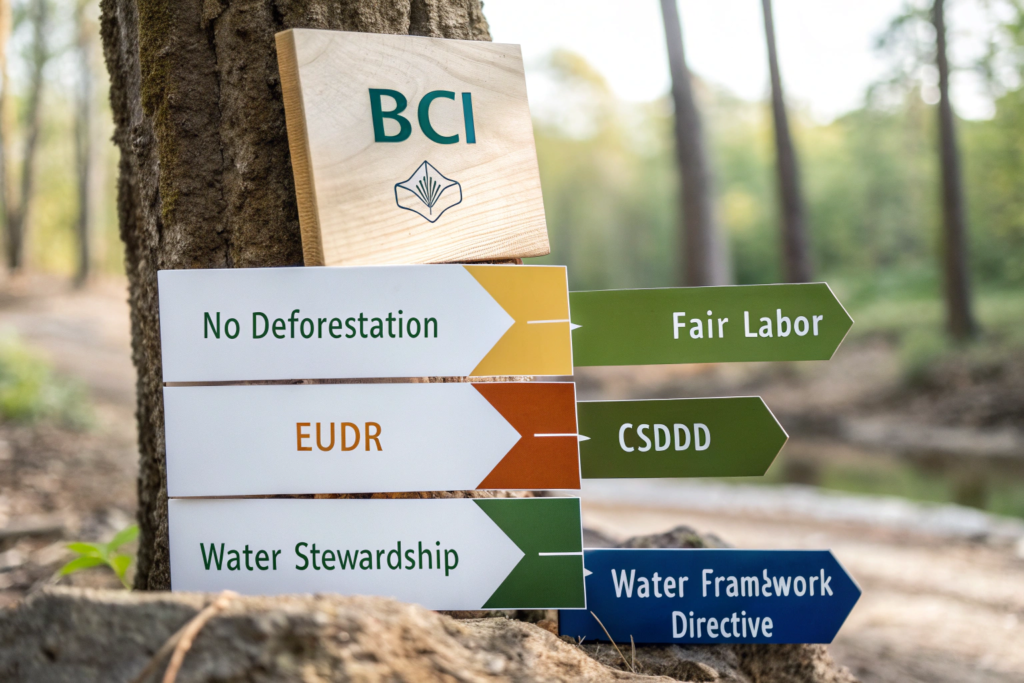
The core reason is alignment with a regulatory and consumer tsunami. For European partners, BCI isn’t just about cotton; it’s about verifiable risk management. It directly addresses the demands of EU legislation like the upcoming EU Deforestation Regulation (EUDR) and the Corporate Sustainability Due Diligence Directive (CSDDD), which require proof of sustainable and ethical sourcing. BCI provides a ready-made, globally recognized system to demonstrate due diligence on environmental and social points in the cotton supply chain—something much harder to prove from scratch.
Here’s the reality: European brands are under immense pressure. Their consumers are the most environmentally conscious in the world. Their governments are passing laws that hold them legally accountable for their supply chains. And their investors are scrutinizing ESG reports. In this high-stakes environment, a supplier who can’t speak the language of verified sustainability isn’t just unattractive; they’re a liability. I’ve seen it firsthand. In late 2022, a major French retailer abruptly halted negotiations with a capable Chinese factory simply because they couldn’t provide a BCI Transaction Certificate for their staple cotton twill. The door slammed shut. That certificate was the deal-breaker.
So, why exactly has BCI become this critical gatekeeper? It’s not about one single thing. It’s about how BCI intersects with the entire European business ecosystem—from legal compliance to storytelling. Let’s unpack the specific pressure points that make BCI a deal-maker or deal-breaker.
How Does BCI Address Core EU Sustainability Regulations?
This is the most concrete, non-negotiable reason. European brands aren’t adopting BCI purely for marketing; they’re doing it for compliance survival. New EU laws are shifting the burden of proof squarely onto the importer (the brand) and, by extension, onto us, their suppliers.
The EU Deforestation Regulation (EUDR), coming into force soon, requires companies to prove that commodities like cotton were not produced on land deforested after December 2020. They need geolocation data of the farms. While BCI’s mass-balance system doesn’t provide physical traceability to a bale, its principles and farmer training explicitly prohibit deforestation. For a brand, sourcing BCI cotton is a strong, auditable step in building a due diligence system that EU regulators will accept. It shows proactive risk management.
Similarly, the CSDDD will require large companies to identify, prevent, and mitigate environmental and human rights abuses in their value chains. BCI’s Principles & Criteria cover decent work, soil health, and water stewardship. When a brand sources BCI cotton, they are integrating a pre-vetted social and environmental management system into their supply chain. For them, it’s a scalable solution. For us at Shanghai Fumao, it meant investing early to get our supply chain BCI-aligned. In 2023, this allowed us to seamlessly support a German workwear brand in preparing their first CSDDD-aligned audit report, securing their partnership.
Can a supplier survive in the EU market without BCI certification?
Technically, yes, but your market shrinks dramatically. You become viable only for:
- Brands dealing in very low-price, commodity-level goods where price is the sole driver (a shrinking segment in Europe).
- Brands fully committed to other, often stricter, certifications like GOTS or Fairtrade, where BCI would be redundant.
- Small, niche artisanal brands with hyper-local, fully traceable supply chains.
For the vast majority of commercial fashion, sportswear, and corporate uniform brands, not having BCI access limits you. It’s like trying to enter a modern highway without a compatible electronic toll pass—you’ll be redirected to slow, back-road business. You might still get there, but you’ve lost the efficiency and speed your partners need. Understanding the key differences between BCI and GOTS for EU brands is crucial for positioning your offerings correctly.
How does BCI simplify a brand’s due diligence reporting?
It provides a standardized framework and data. Instead of a brand sending dozens of different questionnaires to each supplier about farming practices, they can request the BCI Transaction Certificate and the supplier’s license number. This feeds directly into their sustainability software and reporting. It’s a common language. The due diligence process for managing supply chain due diligence under the EU CSDDD is immensely complex. BCI acts as a pre-verified module that brands can plug in, saving them thousands of hours of verification work. As a supplier, providing this is a massive value-add.
Why is BCI More Critical Than Price for EU Brand Identity?
In many markets, the conversation starts and ends with price per meter. In Europe, especially with mid-to-premium brands, the conversation starts with values per meter. The brand’s identity is inextricably linked to its sustainability narrative. Consumers don’t just buy a product; they buy into a story. BCI provides a chapter in that story that is credible, recognizable, and easy to communicate.
A “made from sustainable materials” claim is now considered greenwashing unless backed up. BCI, administered by a reputable multi-stakeholder non-profit, provides that backup. It allows a brand to say, “We use Better Cotton, sourced from farmers trained to use water efficiently and care for the soil.” This is tangible. It resonates with the European consumer’s desire for positive impact, not just less harm. I worked with a Danish children’s wear brand in early 2023. They were comparing our BCI-certified organic cotton interlock with a cheaper, conventional alternative. They chose ours, despite a 22% higher fabric cost, because their marketing team calculated that the “BCI + Organic” story would increase conversion rates on their website by an estimated 15%. For them, the certification was a revenue driver, not a cost.
How does BCI trust translate to consumer loyalty?
It reduces “green guilt” and builds long-term trust. The European consumer is skeptical. They’ve been burned by vague claims. A recognizable logo like BCI’s acts as a shortcut to trust. It’s a signal that the brand has done the homework. This trust reduces purchase hesitation and fosters loyalty because the consumer feels aligned with the brand’s values. It’s no longer just a transaction; it’s a shared statement. When you, as a supplier, enable that trust, you become a strategic partner, not just a vendor.
What happens when a brand’s competitors all adopt BCI?
It creates a baseline. When major retailers like H&M, IKEA, and Adidas (all founding members of BCI) publicly commit to it, it sets a new industry standard. For smaller brands, not using BCI can then be perceived as lagging or irresponsible. It becomes a competitive disadvantage. Their buyers will ask, “If everyone else can do it, why can’t you?” This peer pressure within the European market is immense. We saw this with a UK-based sustainable activewear label. They came to us specifically because their previous fabric mill in South Asia could not provide BCI cotton for their polyester-cotton blends. They were losing shelf space in key eco-conscious retailers to competitors who could.
How Do BCI’s Limitations Affect Sourcing Strategies?
Now, let’s be honest. BCI is not perfect, and sophisticated European brands know this. The mass-balance system is often a point of critique. It means a brand buying BCI cotton isn’t necessarily getting a physically distinct “Better Cotton” fiber. They’re funding the production of Better Cotton elsewhere in the system. For brands that want full physical traceability (like some luxury or heritage brands), this can be a deal-breaker. They might opt for organic or recycled fibers instead.
Therefore, the most successful suppliers don’t just offer BCI. They offer a portfolio of sustainable options and guide the brand to the right tool for the job. BCI is the workhorse for making large-volume basic collections more sustainable. GOTS organic is for the pure, natural fiber line. Recycled polyester is for closing the loop. At Shanghai Fumao, we’ve built this portfolio. For instance, in April 2024, we helped a Spanish fast-fashion client develop a three-tier collection: a high-volume line in BCI cotton jersey, a premium line in GOTS organic cotton velour, and an athleisure line in BCI cotton blended with Repreve® recycled polyester. This strategic mix maximized their overall sustainability impact while managing costs.
When should a brand choose GOTS or recycled over BCI?
Here’s a simple decision framework European brands use:
| Certification Choice | Best For… | Trade-off |
|---|---|---|
| BCI Cotton | Large-scale mainstream collections, blends, workwear, items where cost & scale are key. | No physical traceability; a step-wise improvement model. |
| GOTS Organic Cotton | Core sustainable lines, babywear, skin-contact basics, marketing a “100% organic” story. | Significant cost premium (30-50%+), tighter supply. |
| Recycled Polyester (e.g., rPET) | Sportswear, outerwear, accessories, marketing a “circular economy” story. | Concerns over microplastics; different fiber properties. |
A supplier who understands and can articulate these differences becomes a consultant. We don’t just say “we have BCI.” We say, “For your volume polo shirts, BCI cotton is the most impactful and cost-effective choice. For your signature organic tee, let’s use this GOTS jersey. And for your recycled track pants, here’s our rPET blend.” This builds immense credibility. Resources like the Textile Exchange’s Material Sustainability Index are often used by brands to make these comparisons, and being conversant in this data is key.
How can suppliers bridge the traceability gap of mass-balance?
Transparency is key. While you can’t provide farm-to-fabric tracking with mass-balance, you can strengthen the story. We provide:
- Transaction Certificates: The essential proof of purchase.
- Information on Sourcing Regions: “This BCI cotton was sourced from licensed farms in Xinjiang, China / India / Turkey.” (Note: Xinjiang sourcing requires extreme diligence and documentation due to existing regulations).
- Impact Data: Sharing the general impact metrics from BCI’s annual reports (e.g., x% less water used by BCI farmers).
This layered transparency shows the brand you understand the system’s nuances and are committed to its intent.
What Practical Steps Must a Supplier Take to Become BCI-Ready?
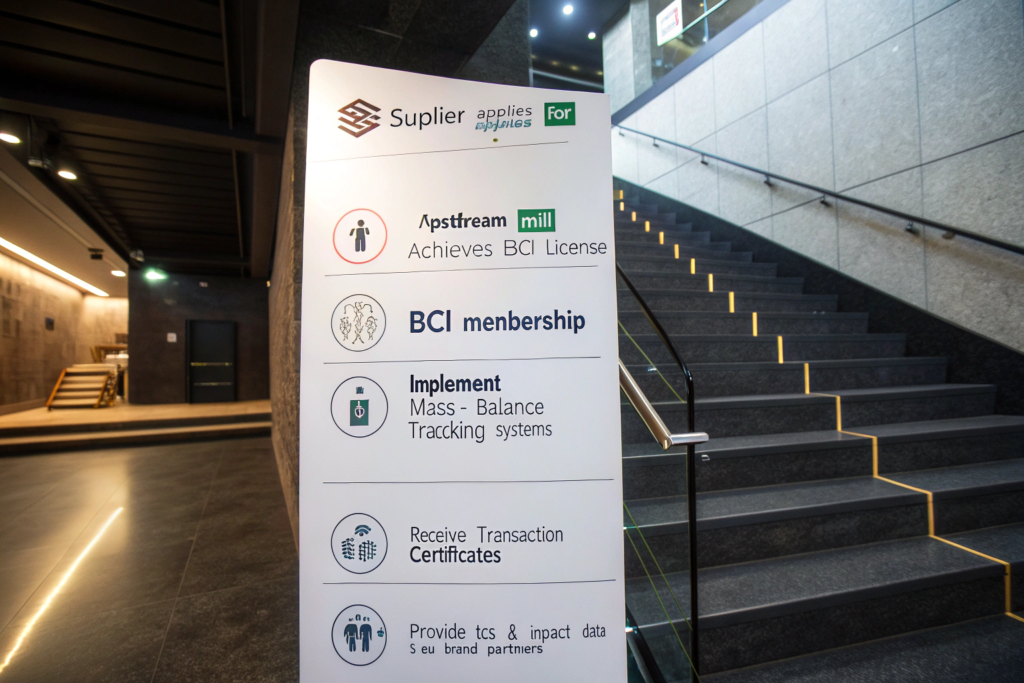
Becoming a credible BCI supplier for European partners isn’t just about buying a certificate. It’s about integrating the system into your operations. The first step is for your company to become a BCI Member and then for your upstream spinning or weaving mill to be BCI Licensed. You cannot sell “BCI Cotton” unless you are purchasing it from a licensed supplier and can issue the Transaction Certificate (TC) to your buyer.
The process involves an audit of your supply chain management systems to ensure you can correctly track and claim BCI cotton volumes. It’s an investment in time and money, but it’s an investment in market access. When we at Shanghai Fumao went through this process in 2021, it streamlined our own internal tracking and gave us a structured way to talk about sustainability with all clients, not just Europeans.
What are the common pitfalls in implementing BCI for export?
- Treating it as just a certificate: It’s a supply chain management system. If your internal tracking is sloppy, you risk making incorrect claims, which is a major liability for your brand partner.
- Sourcing from non-licensed mills: This breaks the chain. You must verify your mill’s license is current. We maintain a digital dashboard with our mill partners’ certification statuses to avoid this risk.
- Poor communication with the brand: Be clear about what BCI does and does not guarantee. Overpromising leads to lost trust. We always explain the mass-balance concept upfront to set correct expectations. Guides on implementing responsible sourcing systems for garment factories often highlight these very pitfalls.
How does BCI integration impact other business areas?
Positively, in several ways:
- Quality Control: The discipline of tracking fiber origin often improves overall material tracking.
- Finance: It can open doors to green financing or loans with better terms, as banks increasingly look at ESG performance.
- Team Morale: Many employees, especially younger ones, take pride in working for a company that takes tangible steps on sustainability. It’s good for recruitment and retention.
Conclusion
So, is BCI a deal-breaker for European brand partners? Absolutely, for the mainstream market. It has become the baseline credential for doing business, driven by an unstoppable combination of consumer demand, competitor action, and—most forcefully—hard EU law. It’s no longer a niche preference; it’s a prerequisite for risk management and market access.
For suppliers, this isn’t a threat; it’s a clarion call to upgrade. Embracing BCI is not just about keeping up; it’s about positioning yourself as a forward-thinking, compliant, and strategic partner. It shows you speak the language of modern European commerce. You’re not just selling fabric; you’re selling supply chain security and brand integrity.
If you’re looking to strengthen or establish your partnerships with European brands, the journey starts with aligning your offerings with their core values and legal requirements. At Shanghai Fumao, we’ve navigated this shift not as a burden, but as an opportunity to deepen our client relationships and build a more resilient business. We’ve integrated BCI, organic, and recycled options into a coherent sustainability portfolio that gives our partners confidence.
Ready to ensure your supply chain meets the European standard? Let’s discuss how to build your BCI-compliant sourcing strategy. Contact our Business Director, Elaine, who specializes in guiding suppliers and brands through this essential transition. Start the conversation at elaine@fumaoclothing.com.








