So you want to launch a sustainable line with OCS (Organic Content Standard) certified clothing. You’ve seen the market demand, you believe in the ethics, but the big question looms: "What will this actually cost me?" If you’re only looking at the price per garment from a supplier, you’re setting yourself up for surprises. The true cost of OCS sourcing is a layered equation, where upfront price is just one variable.
The real expense isn’t just in the fabric tag. It’s in the rigorous supply chain management, the certification verification, the specialized production, and the logistics of integrity. Choosing OCS is an investment in brand value and consumer trust, but to do it profitably, you need to see the full financial picture. Blind spots in this calculation can turn a promising sustainable line into a loss-making venture.
Many brands make the mistake of comparing the FOB cost of an OCS tee to a conventional cotton tee and balk at the 20-30% difference. But that’s like comparing the price of a hand-built wooden table to a flat-pack one—you’re paying for integrity, traceability, and a process that values quality over sheer speed. Let’s break down the real cost structure, from the field to your warehouse, so you can budget with confidence and avoid the hidden fees that eat into your margin.
Where Does the Premium for OCS Organic Cotton Come From?
The first cost bump is in the raw material itself. OCS-certified organic cotton isn’t just regular cotton grown without pesticides. It’s part of a documented, audited system from farm to gin. The premium starts at the farm level: organic farming typically has lower yields per acre and requires more manual labor for weed control, using natural fertilizers. This fundamental agricultural reality sets a higher baseline cost for the fiber.
But the cost doesn’t stop at the farm gate. The certification and traceability overhead is a significant line item. Every entity in the chain—the farmer group, the ginner, the spinner, the knitter/weaver—must be individually OCS certified by an accredited body (like Control Union or SGS). This involves annual audit fees, licensing costs, and the internal administrative work of maintaining segregation and documentation. This cost is distributed and passed through the chain. When you buy OCS fabric, you’re paying for this verified pedigree.
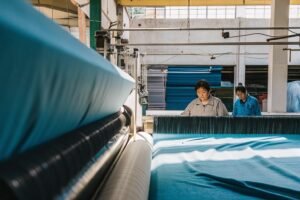
Then comes the processing premium. Spinning and weaving organic cotton can sometimes require adjustments. The fibers, often longer and less processed initially, may need gentler handling and slower machine speeds to prevent breakage, impacting production efficiency. At Shanghai Fumao, we factor this in from the start. For example, in 2023, we sourced OCS cotton for a series of jersey fabrics for a US-based basics brand. The yarn cost was 25% higher than conventional, and the knitting efficiency was about 5% slower. Being transparent about this from the quote stage allowed the brand to price their final product correctly, leading to a successful launch with healthy margins.

Is OCS Cotton Fabric Really 30% More Expensive?
The "30% more" rule of thumb is a starting point, but it’s overly simplistic. The actual premium varies wildly based on three factors:
- Fabric Construction: A simple OCS single jersey might carry a 20-25% premium. A complex OCS organic cotton satin jacquard, due to lower production volumes and more delicate handling, could be 40-50% more than its conventional counterpart.
- Order Volume: Like anything, economies of scale apply. The premium percentage decreases as your order volume increases because the fixed costs of certification and setup are amortized over more meters. A 10,000-meter order will have a better cost-per-meter ratio than a 1,000-meter order.
- Dyeing & Finishing: Low-impact dyeing processes, which are often paired with OCS fabrics for true sustainability, can be more expensive than conventional dyeing. Specialized eco-finishes (like stone washing with enzymes instead of pumice) also add cost.
A useful exercise is to analyze the true cost per wear of sustainable vs. fast fashion garments. This perspective, often discussed in industry reports, shifts the focus from upfront cost to long-term value, which aligns perfectly with the OCS proposition.
What Are the Hidden Costs in the OCS Supply Chain?
These are the costs that don’t appear on the initial invoice but will hit your bottom line if not managed:
- Testing Costs: OCS requires verification. You or your supplier must conduct testing to verify organic content and ensure no contamination with prohibited substances. This testing, often at a lab like ours (CNAS-accredited), is an additional cost.
- Documentation & Admin: Managing the Transaction Certificates (TCs) for every batch requires dedicated staff time on both sides. This administrative burden has a cost.
- Minimum Order Quantity (MOQ) Impact: Because of the segmented supply chain, MOQs for OCS fabrics and garments can be higher than for conventional ones, tying up more capital.
- Risk of Rejection: If a batch fails certification verification at any point, the entire lot may be rejected, representing a total loss. This risk premium is built into the price by responsible suppliers.
How Do Production Costs Differ for OCS Garments?
Moving from OCS fabric to finished garments introduces another layer of cost differentiation. It’s not just sewing; it’s sewing with a material that often behaves differently and within a system that demands rigorous compliance.
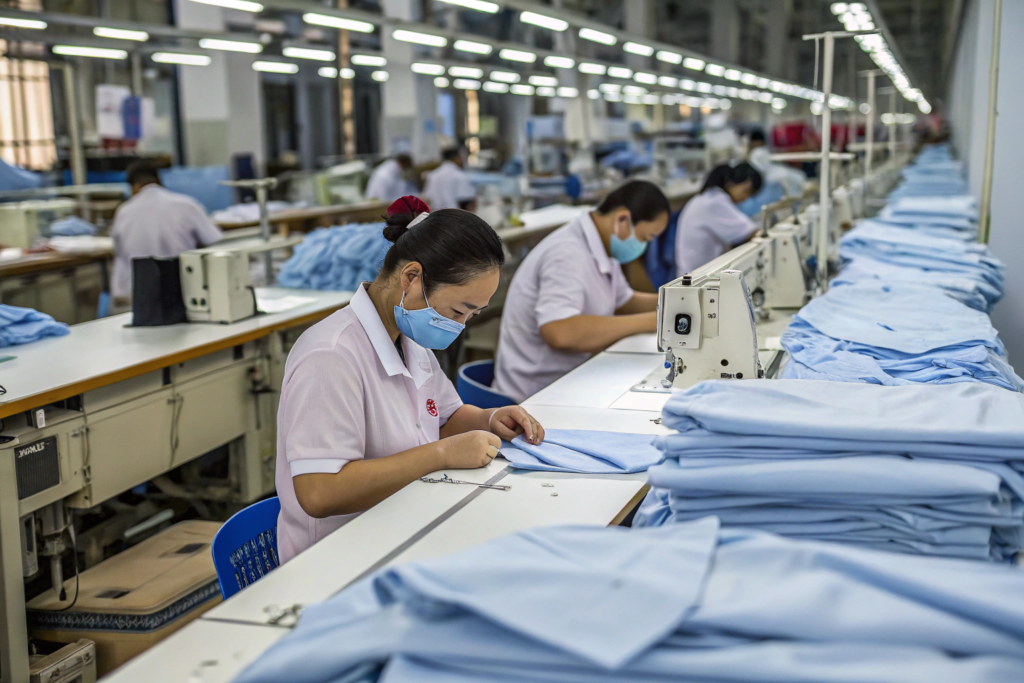
The cutting and sewing efficiency can be slightly lower. As mentioned, OCS fabrics can be softer or more prone to stretching, requiring skilled operators and sometimes slower line speeds to ensure accuracy. A good factory will have a separate line or trained team for sustainable fabrics. At our dedicated garment lines, we account for this. For a recent order of OCS cotton linen shirts for a Scandinavian brand, our sewing line efficiency was tracked at 92% compared to 95% for equivalent conventional linen, a small but real cost factor we transparently included in our CMT (Cut, Make, Trim) quote.
Furthermore, trim and component sourcing becomes more expensive and complex. To maintain the OCS claim, every component representing over 5% of the final product’s weight (like thread, pocketing, or ribbing) should ideally be OCS or recycled. Sourcing OCS-certified thread or GOTS-certified labels in small quantities carries a premium and longer lead times.
Why Does "CMT" Cost More for OCS Items?
The CMT (Cost of Manufacturing) is often higher for OCS garments for three concrete reasons:
- Specialization: Factories that properly handle OCS materials often invest in training and separate processes, justifying a higher labor rate.
- Quality Control Intensity: Inspection needs to be more thorough. Checking for defects is one thing; also verifying that no non-compliant materials were accidentally introduced is another. This more rigorous QC takes more time.
- Documentation Integration: The factory must seamlessly integrate your garment’s production data into the OCS chain of custody documentation. This administrative task is part of their service.
A table comparing cost drivers:
| Cost Driver | Conventional Garment | OCS Certified Garment | Impact on CMT |
|---|---|---|---|
| Fabric Handling | Standard procedures | Slower, more careful handling | +5-8% |
| Component Sourcing | Bulk, standard suppliers | Sourced from certified vendors, smaller quantities | +3-10% |
| In-process QC | Standard AQL checks | AQL + material compliance checks | +2-5% |
| Paperwork | Basic shipping docs | Full OCS TC documentation package | +Fixed Fee |
Can You Save Money Through Smart Design Choices?
Absolutely. Design for manufacturability is your biggest lever to control final cost. Here’s how:
- Simplify Constructions: Choose styles that are efficient to cut and sew. A simple crewneck OCS sweatshirt will have a much better cost profile than a zip-up hoodie with multiple pockets and a contrasting hood lining.
- Limit Trims: Design around using the main OCS fabric. Avoid unnecessary non-organic elastics, zippers, or complex embroideries that are hard to source certified.
- Standardize Colors: Stick to a core palette of standard, low-impact dye colors. Each custom color match involves new dye baths and lab dips, adding cost and time. We helped a Dutch brand reduce their OCS jersey cost by 8% simply by moving from 10 custom colors to 5 standard ones from our stock palette.
What Are the Logistics & Certification Fees?
Your OCS goods are ready. Now come the final costs to get them to you legally and compliantly. These are often overlooked in initial budgeting.
Logistics: There is no inherent logistics premium, but your choices matter. Shipping a full container load (FCL) is always more cost-effective per unit than less than container load (LCL). Given the higher value of OCS goods, investing in FCL shipping for better security and lower per-unit cost is wise. Also, consider incoterms like DAP vs. DDP for US apparel imports; understanding who bears the risk and cost at each transit point is crucial for accurate landed cost calculation.
Certification Fees: This is critical. The final OCS Certificate for your shipment is issued by a certification body. Who pays this fee? This must be clarified upfront with your supplier. Sometimes it’s included in the FOB price, sometimes it’s a separate charge. The fee can range from a few hundred to over a thousand dollars per shipment, depending on value and complexity. Always ask: "Is the final OCS Certificate cost included in this quote?"

What Does the OCS Audit and Certification Process Cost?
Let’s demystify the certification costs for you, the buyer:
- Brand Certification (If Applicable): If you want to use the OCS logo on your hangtags, your company may need its own OCS scope certification. This involves an audit of your management system and costs several thousand dollars annually.
- Transaction Certificate (TC) Fee: For each shipment, a TC is issued. The cost is typically borne by the final seller in the chain (your supplier) but is built into your price. It’s a direct fee paid to the certifier.
- Testing Fees: Lab tests for organic content verification are an additional, necessary cost. At Shanghai Fumao, we bundle this into our service for core clients, but it’s a line item you should see.
A real case: In 2024, a UK brand working with us on OCS knitwear had a budget of $2,000 for certification and testing per container. Our transparent quote included the TC fee and testing at our lab, totaling $1,850, coming in under their budget and preventing a last-minute scramble.
How Do Tariffs and Duties Apply to OCS Clothing?
OCS certification does not confer any special tariff advantages. Your OCS organic cotton trousers will be classified under the same Harmonized System (HS) code as conventional cotton trousers and subject to the same import duties (e.g., general rate of 16.5% for most US apparel imports from China). The higher declared value of the OCS goods will, however, result in a higher absolute duty dollar amount.
This makes accurate valuation and classification essential. Working with a supplier experienced in export documentation, like us, ensures the commercial invoice correctly details the product and value, minimizing the risk of customs delays or penalties that incur storage and demurrage fees—a hidden cost that can be devastating.
How to Calculate Your Total Landed Cost?
The Total Landed Cost is your ultimate number—the cost of the goods sitting in your warehouse, ready to sell. It’s the sum of:
Product Cost (FOB) + Shipping & Insurance + Import Duties & Taxes + Certification & Logistics Fees + Inland Freight (to your warehouse) + Cost of Capital (for the time goods are in transit)
For an OCS order, you must add one more component: Compliance Risk Mitigation Cost. This is the value of working with a vertically integrated, certified supplier like Shanghai Fumao that manages the chain internally. While our FOB price might be slightly higher than a trader’s, it eliminates the massive hidden cost of a broken certification chain or a rejected shipment.

What’s a Realistic Budget for a Small OCS Collection?
Let’s create a hypothetical model for a small US brand importing 2,000 units of an OCS organic cotton t-shirt:
| Cost Component | Estimated Cost | Notes |
|---|---|---|
| Fabric & Manufacturing (FOB) | $8.00/unit | Based on a 2,000 unit order of mid-weight jersey. |
| OCS Certification (TC) & Testing | $0.50/unit | Fixed fee spread across units. |
| Ocean Freight (LCL) & Insurance | $0.80/unit | From Shanghai to LA. |
| US Import Duty (16.5%) | $1.32/unit | 16.5% of FOB value ($8). |
| Customs Brokerage & Fees | $0.30/unit | |
| Inland Freight in US | $0.40/unit | Port to warehouse. |
| Total Landed Cost per Unit | $11.32 | |
| Suggested Retail Price (4x Markup) | ~$45.00 | Common industry markup for sustainable brands. |
This model shows how a $8 FOB shirt becomes an $11.32 cost center. Missing any of these components in planning would destroy your margin.
Can Sourcing from China for OCS Still Be Cost-Effective?
Yes, unequivocally. China offers unparalleled scale, a mature textile infrastructure with increasingly sophisticated sustainable production hubs (like Keqiao), and competitive efficiency. The key is not to seek the lowest FOB price, but the most reliable and transparent total cost.
A supplier that offers integration—from certified fabric to finished garment—saves you money by reducing risk, administrative hassle, and timeline overruns. The cost of a two-week delay because of certification issues can far outweigh a $0.50/unit saving on FOB. Our clients find that our all-inclusive, transparent pricing model for OCS products, while not the cheapest upfront, delivers the best and most predictable total value and landed cost in the market.
Conclusion
Sourcing OCS-certified clothing involves a nuanced cost structure that extends far beyond the price of a garment on an Alibaba listing. The true cost encompasses a premium for responsible raw material, investments in specialized production, necessary certification overhead, and careful logistics planning. The brands that succeed with OCS are those who budget for this full picture, viewing the costs as an investment in product integrity, consumer trust, and long-term brand equity.
Trying to cut corners on any of these costs—by choosing the cheapest fabric source, an uncertified factory, or skipping proper documentation—invites financial risk that can dwarf the initial "savings." The most cost-effective strategy is to partner with a supplier who provides transparency and control over the entire chain.
At Shanghai Fumao, we build our partnerships on this transparency. We provide detailed cost breakdowns, manage the intricate OCS compliance internally, and leverage our integrated production to keep timelines tight and predictable. Let us help you navigate the real costs of OCS, so you can launch your sustainable line with confidence and clear margins. To get a transparent quote and cost breakdown for your OCS project, contact our Business Director, Elaine, at elaine@fumaoclothing.com.