You might think OCS (Organic Content Standard) is all about farming and paperwork, not the clothes on the factory floor. That’s the mistake that costs brands thousands. Here’s the truth: OCS certification fundamentally alters the quality control landscape in garment production. It’s not about adding a new checklist; it’s about integrating a forensic-level tracking system into every single quality decision. If your factory’s QC process doesn’t actively protect the chain of custody, your entire certification is a house of cards waiting to collapse at the first audit. Quality control isn’t just about stitch defects anymore—it’s about data integrity.
OCS requires a dual-focus quality control regime: one for the physical quality of the garment (fit, construction, finish) and one for the integrity of the certified organic material (mass balance, segregation, documentation). The two are inseparable. This means QC inspectors must verify not only that a seam is straight, but also that the fabric in that seam is from the correct OCS-certified roll, that the thread used is accounted for, and that any waste is tracked. It’s QC for the product and QC for the proof.
Let’s break down exactly how this works on the ground, from the cutting table to the shipping carton. This is the operational reality that separates compliant production from a compliance nightmare.
The Foundational Layer: Material Receipt & Segregation
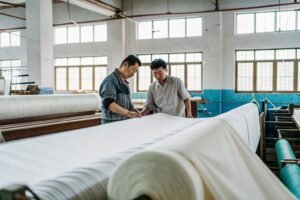
The first and most critical QC checkpoint happens before a single garment is cut. If the wrong material enters the production stream, nothing that follows can be certified. This stage is about absolute control and verification at the factory’s receiving dock. The factory’s QC team here acts more like forensic auditors than textile inspectors.
They must confirm that the physical material matches the documentary promise. This isn’t a spot check; it’s a 100% verification process for certified lots. The concept of “segregation” is not just a good practice—it’s a mandatory OCS requirement to prevent commingling with conventional materials.

How is incoming OCS fabric verified and logged?
The process must be systematic:
- Document-Check: The factory QC must receive the OCS Transaction Certificate (TC) from the fabric supplier before or with the fabric. They verify that the TC details (supplier, product, batch/lot number, quantity) match the purchase order.
- Physical Verification: Each fabric roll or piece is inspected for its lot number marking (usually on the selvedge or a tag). This lot number is cross-referenced with the TC. No lot number, no entry into the certified production system.
- Weight/Quantity Check: The total received weight or length is recorded and must align with the TC within a reasonable tolerance (for moisture loss, etc.).
- Initial Quality Check: While checking for defects, they also note if the fabric appears consistent with the certified description (e.g., 100% organic cotton jersey).
We had a client in 2023 whose previous factory missed a critical step: the fabric rolls had the right TC, but the lot numbers on the rolls were from a different, non-certified batch that the mill had shipped by mistake. Our receiving QC caught this because our system flagged the lot number mismatch against the expected TC list. This saved the brand from producing 8,000 units of uncertified garments.
What are the specific segregation protocols required?
Segregation must be physical and systematic:
- Dedicated Storage: OCS fabric rolls must be stored in a separate, clearly marked area. They cannot be stacked with or adjacent to conventional fabrics.
- Labeling: Every roll, bundle, and carton must be tagged or marked as "OCS" throughout its journey in the factory.
- Dedicated Production Lines: While not always mandatory for OCS (unlike GOTS), best practice and audit security dictate running OCS orders on specific lines or during dedicated time blocks, with thorough machine cleaning in between to remove lint and residue from conventional materials.
- Waste Management: Off-cuts and scraps from OCS fabric must be collected separately. Their weight is tracked, and they must be disposed of or recycled in a way that prevents them from re-entering the conventional stream (e.g., sold to a specialized recycler).
Failure here is a top reason for certification failure. The system is designed to make mixing impossible for honest actors and easily detectable for auditors.
In-Process Control: Tracking the Certified Material Flow
Once the certified fabric is released to the cutting room, the QC focus shifts to mass balance tracking. This is the continuous, real-time accounting of certified material. The goal is simple: the weight of certified fabric that goes into the cutting room must equal the weight of cut panels + cut waste + any retained fabric. This accounting continues through sewing.
This turns every cutter and sewing line supervisor into a data point. QC’s role is to ensure these data points are collected accurately and consistently.

How is the OCS mass balance maintained during cutting and sewing?
The process requires both procedure and technology:
During Cutting:
- Input Weight: The exact weight of the fabric roll issued to the cutting table is recorded.
- Output Weights: The total weight of the cut garment panels (by size bundle) is recorded. Simultaneously, the weight of all fabric off-cuts (waste) is collected and recorded.
- Reconciliation: (Fabric Weight In) must = (Panels Weight Out) + (Waste Weight). A small tolerance is allowed for moisture loss and micro-dust. Significant discrepancies indicate a tracking error or potential material loss/mixing.
During Sewing:
- While not always weighing every piece, the factory must have a system to track the number of garments produced from the cut panels.
- Any further waste (e.g., trim waste) from OCS-specific components (like OCS labels, if used) should also be tracked.
This data is compiled into a Mass Balance Record for the entire production order. This record is a core document an auditor will examine. It’s the mathematical proof that your 5,000 organic cotton t-shirts contain the organic cotton you paid for.
What are the QC checks for non-fabric components (thread, labels, trims)?
OCS certifies the organic content, not every component. However, QC must ensure that:
- Non-Organic Components are Documented: The types and estimated weights of non-organic components (polyester thread, plastic buttons, care labels) are recorded. These are factored into the final product’s composition claim (e.g., "95% organic cotton, 5% other materials").
- No Contamination: Components must not introduce a substance that would violate relevant safety standards (like OEKO-TEX). The factory should use OEKO-TEX certified thread as a best practice.
- Label Accuracy: The QC final audit must include a 100% check that the sewn-in composition/care label accurately reflects the certified content and includes any required certification logos or license numbers.
A common pitfall is the care label. If the label says "100% Organic Cotton" but the garment uses polyester thread and plastic buttons, the claim is false. The label must state the accurate percentage. Our QC team includes a mandatory "label content vs. BOM (Bill of Materials) verification" step for every OCS order.
Final Audit & Documentation: The Last Gate
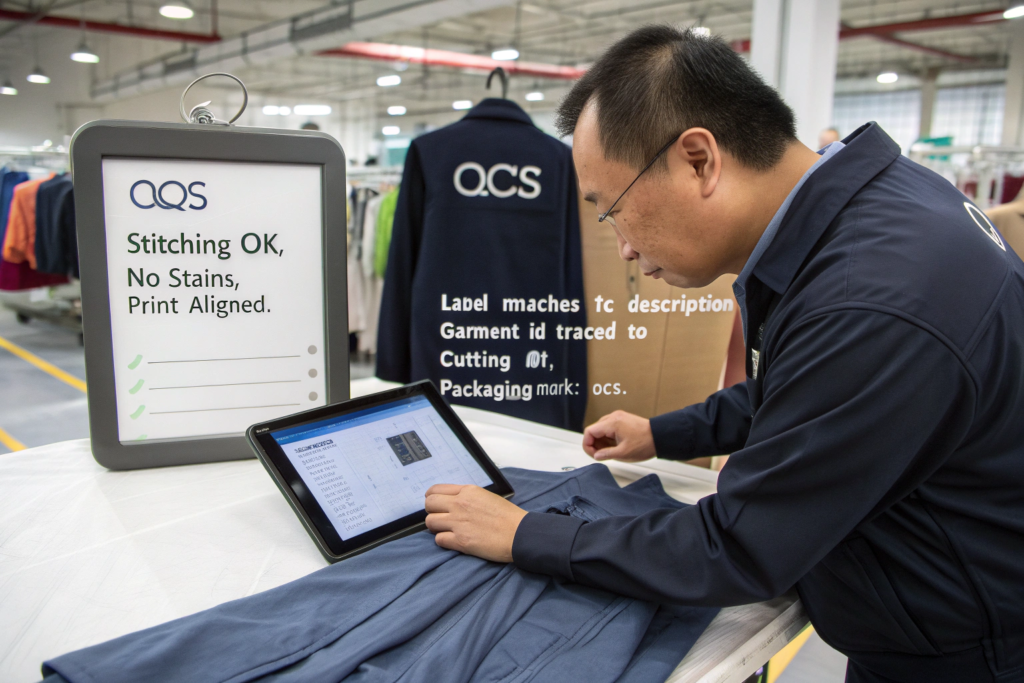
The Final Random Inspection (FRI) under AQL standards takes on a new dimension with OCS. It’s not just the last chance to catch quality defects; it’s the final verification that the certification data aligns with the physical shipment. This audit ties every previous step together and generates the final evidence for the OCS Transaction Certificate (TC).
The inspector must use a hybrid checklist that covers both standard garment quality (AQL) and OCS-specific conformance.
What does the final OCS-conformance audit include?
The audit verifies the following chain is unbroken for the sampled garments:
- Traceability: Can the specific garment be traced back to the cutting lot, and hence to the original OCS fabric lot? This is often done via bundle tickets or barcodes.
- Label & Marking Verification: 100% check that the correct OCS label is present and accurate. Also, check that shipping cartons are marked to indicate certified contents.
- Documentation Review: The inspector (or a separate compliance officer) reviews the complete dossier before shipment:
- All incoming fabric TCs.
- Mass Balance Records for the order.
- The draft Commercial Invoice and Packing List.
- The application for the final OCS TC.
- Physical vs. Document Match: A final spot-check ensuring the quantity and description of goods ready to ship match the details on the pending TC application.
Only when this hybrid audit passes can the factory legitimately apply for the final TC and release the goods for shipment.
How is the final OCS Transaction Certificate generated?
The factory (or the brand, if they hold the certificate) compiles all the tracked data—the input TCs, the mass balance records, the production records—and submits it to their certification body (e.g., Control Union). They apply for the TC for this specific shipment. The certifier reviews the paperwork and, if satisfied, issues the final TC. This TC is the legal document that travels with the commercial documents. It is the definitive proof you provide to your customers, retailers, or customs officials. The entire QC process from receipt to final audit is what makes this TC valid. If the QC was weak, the TC is fraudulent.
The Role of Technology and Supplier Partnership
Managing this level of QC manually is prone to error and incredibly slow. The factories that excel at OCS production are those that leverage technology—from simple barcode scanners to integrated ERP systems—to automate data capture at key points (receiving, cutting, finishing). This reduces human error and provides real-time visibility.
As a brand, your choice of factory is therefore a choice of their technological and procedural capability. You are not just auditing their sewing quality; you are auditing their data management systems.

What systems should a competent OCS factory have in place?
Look for evidence of:
- Digital Tracking: At minimum, a system to log fabric lot numbers and track them through cutting and sewing. Advanced factories have real-time dashboards.
- Integrated Weighing Stations: Digital scales at cutting that feed data directly into the tracking system.
- Document Management: A secure, organized digital repository for all TCs, test reports, and audit records, easily accessible for you or an auditor.
- Staff Training: Clear evidence that cutting room staff, line supervisors, and QC inspectors are trained in OCS segregation and documentation procedures.
A factory without these systems will struggle with consistency and is a higher risk. We invested in a cloud-based traceability platform after a 2022 audit highlighted manual record-keeping as a potential weakness. Now, clients can get a real-time snapshot of their order’s OCS status, which has become a unique selling point.
How can brands collaborate with factories on OCS QC?
True success comes from partnership:
- Provide Clear Specifications: Include OCS requirements explicitly in your tech pack and quality manual.
- Participate in Pre-Production Meetings: Discuss and agree on the segregation, tracking, and labeling protocols before bulk fabric arrives.
- Conduct Joint QC Training: Offer to train their QC staff on your specific quality standards, integrating them with OCS requirements.
- Share Audit Results: If you conduct a third-party audit, share the findings constructively to help them improve.
This collaborative approach turns the factory’s QC department into an extension of your own. The cost of this partnership is far lower than the cost of a failed shipment or a revoked certificate.
Conclusion
The quality control required by OCS for garment production is a comprehensive, data-driven discipline that fuses traditional craftsmanship with supply chain forensics. It demands that factories control not only the quality of the stitch but the integrity of the story behind every fiber. This dual focus—on product and proof—is what makes OCS-certified garments a credible, low-risk proposition in a skeptical market.
For brands, understanding this requirement is crucial. It empowers you to select the right manufacturing partners, ask the right questions, and build a supply chain where quality and transparency are manufactured into the product itself.
If you are seeking a manufacturing partner whose quality control systems are built to protect both your product’s integrity and its certification, you need a partner with depth. At Shanghai Fumao, our vertically integrated model allows us to embed OCS traceability and rigorous QC from yarn to finished garment. Contact our Business Director, Elaine, to discuss how we can produce your OCS-certified line with uncompromising quality control: elaine@fumaoclothing.com. Let’s manufacture trust, stitch by documented stitch.