Let’s get straight to the point. Can you get OCS certified men’s wear from a Chinese factory? Absolutely, yes. But here’s the real question you should be asking: Can you get OCS certified men’s wear that doesn’t compromise on style, durability, or commercial viability? That’s where 90% of brands get it wrong. They find a factory that can check the “organic” box, only to end up with boxy polos, stiff shirts, and fabrics that pill after three washes—garments that feel more like a sustainability punishment than a premium product. The certification is the baseline; the real challenge is achieving it without sacrificing the quality and aesthetic that defines modern men’s wear.
Yes, you can get genuine, fully traceable OCS (Organic Content Standard) certified men’s wear from Chinese factories, provided you partner with manufacturers who specialize in combining rigorous certification processes with advanced fabric development and precise tailoring for the men’s market. The key is moving beyond generic “organic cotton” suppliers to experts who understand the specific weight, drape, and performance needs of men’s shirting, knits, and outerwear.
I’ll show you not just that it’s possible, but how it’s done successfully—from fabric sourcing to final stitch—so you can source men’s wear that’s both ethically sound and commercially sharp.
Sourcing the Right Fabric: Beyond Basic Organic Cotton
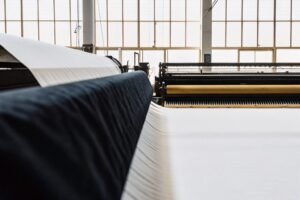
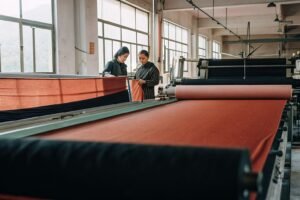
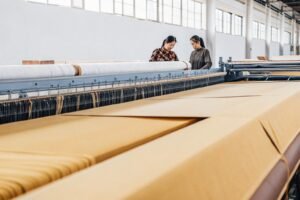
The foundation of any great men’s wear piece is the fabric. For OCS certification, the fabric must be traceable. But for men’s wear, it must also have the right hand-feel, drape, and durability. A standard 180gsm single jersey might work for a basic tee, but it will fail in a polo shirt that needs structure or a chore jacket that needs substance. The factory you choose must have access to—or better yet, produce—a diverse range of OCS-certified fabrics specifically engineered for men’s applications.
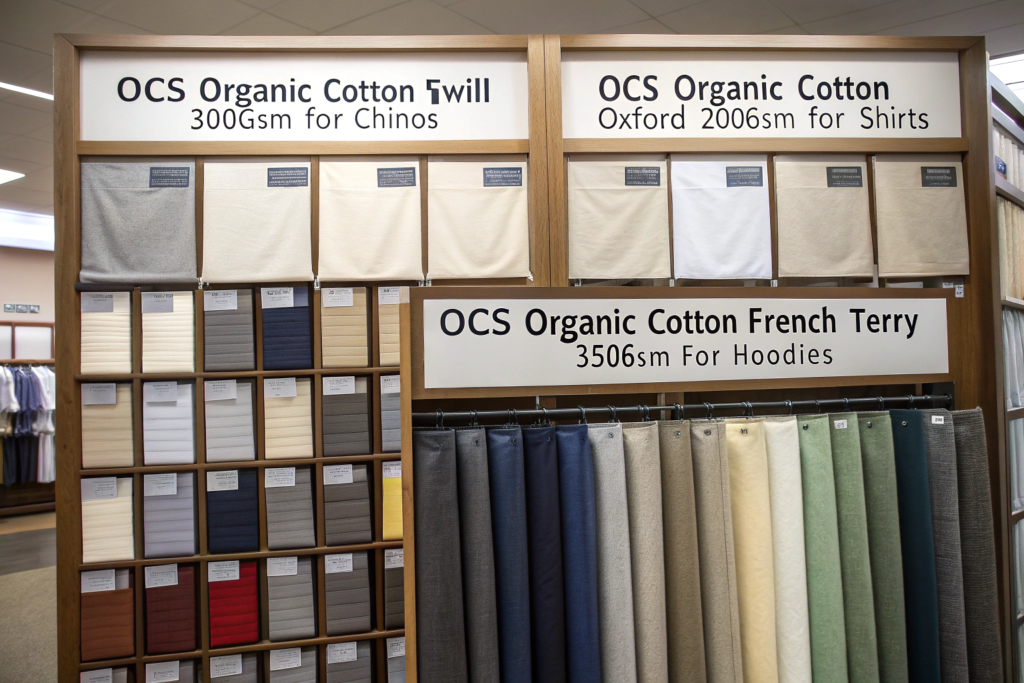
This means looking for suppliers who talk about fabric in terms of weight (gsm), weave construction, and finish, not just “organic cotton.” They should offer options like organic cotton twills for chinos, organic cotton-poplin or oxford for shirts, and heavier organic cotton jersey or French terry for knits and loungewear.
What are the best OCS fabrics for tailored men’s pieces (Shirts, Chinos)?
For tailored looks that need to hold a shape and offer durability, you need woven fabrics with body.
- Shirting: Look for OCS-certified organic cotton poplin (around 120-140gsm) for smooth, year-round shirts, or organic cotton oxford (180-200gsm) for a more rugged, textured casual shirt. The best factories will also offer organic cotton-linen or cotton-Tencel™ blends under OCS for improved drape and breathability. The finishing (pre-shrinking, mercerization) is critical here to prevent excessive shrinkage and maintain a sharp appearance.
- Chinos & Trousers: OCS-certified organic cotton twill is the gold standard. Weight is key: 280-320gsm provides the ideal heft and durability for chinos that will last multiple seasons without looking sloppy. The twill weave should be tight to resist abrasion. A Swiss brand we worked with in 2023 sourced a custom 300gsm OCS twill from us for their signature chino. By specifying a post-weave brushing finish, we achieved a soft hand-feel that avoided the stiff "new denim" feel, resulting in a 40% repeat order rate from their retail partners.
How to ensure fabric performance (colorfastness, pilling) for men’s wear?
Men’s wear is subjected to frequent washing and wear. Certification doesn’t automatically mean performance. You must demand and review independent lab test reports for every fabric lot.
- Colorfastness: Check for Colorfastness to Washing (ISO 105-C06) and Perspiration (ISO 105-E04). Ratings should be at least 4 (on a scale of 1-5) for premium men’s wear. Fading or bleeding is unacceptable.
- Pilling Resistance: Use Martindale or Random Tumble Pilling tests (ASTM D4970). A rating of 3.5-4 is good for knitwear; 4+ is ideal for woven trousers.
- Dimensional Stability (Shrinkage): This is non-negotiable. Shrinkage should be less than 3% in both length and width after washing. Good factories pre-shrink fabric (sanforize) to achieve this.
A factory that cannot provide these test results for their OCS fabrics is not a true partner for men’s wear. They are selling a certificate, not a product. At Shanghai Fumao, our in-house CNAS lab runs these tests as a standard protocol, and we share the reports with clients as part of the fabric approval process. This upfront validation saved a UK brand from a potential recall on 10,000 units of organic cotton polo shirts in early 2024 when our pilling test caught a substandard yarn batch.
Navigating Design & Development with Certification Constraints
Designing OCS-certified men’s wear requires forethought. You can’t simply substitute an organic fabric into an existing conventional design and expect the same result. The design must be optimized for the material’s properties, and all components must be vetted for compliance. This stage is where a factory’s technical expertise becomes invaluable.
A skilled factory will guide you on design adjustments—like seam allowances, interfacing choices, and trim specifications—to ensure the final garment not only meets certification but also achieves the desired fit and finish.

What are the limitations for trims, threads, and interlinings?
OCS certifies the organic content. Non-fabric components are typically not organic, but they must be managed correctly.
- Thread: 100% organic cotton thread is weak. Most men’s wear requires durable polyester core-spun thread. This is acceptable under OCS but counts as part of the non-organic content in the final product’s composition calculation.
- Interlining/Fusing: Critical for collars and cuffs. Most fusibles are synthetic. You must ensure the fusing is low-temperature and OEKO-TEX certified to prevent chemical contamination and ensure it bonds well with organic cotton without damaging it.
- Buttons, Zippers, Labels: These are almost never organic. Their use is permitted, but they contribute to the “other materials” percentage. Your factory should have a vetted library of compliant, high-quality trims. It’s wise to research sustainable trim sourcing options for apparel manufacturing early in the process.
The factory must accurately calculate the final organic content percentage (e.g., “92% Organic Cotton, 8% Other Materials”) for the OCS Transaction Certificate. Guesswork here invalidates the certification.
How does certification affect sampling and lead times?
Expect the sampling process to be more deliberate, but not necessarily slower if managed well.
- Proto Sample: Can be made in a similar, non-certified fabric to check fit and design.
- Pre-Production (PP) Sample: Must be made with the exact OCS-certified fabric and trims intended for bulk. This sample is your binding quality and certification standard. Approving it is crucial.
- Lead Times: Add 1-2 weeks for sourcing certified fabric (though vertical factories like ours hold stock). The critical path is ensuring the PP sample is approved before the certified fabric is cut for bulk. Rushing this leads to disaster. A German client’s sleek bomber jacket project in Q2 2024 was delayed by 10 days because their chosen non-compliant interior binding had to be resourced. However, this delay prevented a bulk production error that would have cost weeks and thousands of dollars.
Production Execution: Precision for the Men’s Market
Men’s wear consumers have a sharp eye for detail. Crooked seams, inconsistent stitching, and poor fit are instantly noticeable and kill brand credibility. Production in an OCS-certified factory should, in theory, be more precise due to the systemic controls in place. Your job is to ensure those controls are directed at men’s wear-specific quality points.
This means implementing Inspection checkpoints focused on the hallmarks of quality men’s apparel: alignment of patterns (especially plaids or stripes), symmetry of pockets, precision of topstitching, and consistency of hardware application.

What are the key quality control points for OCS men’s wear?
Your QC checklist should merge standard menswear checks with OCS-specific verifications:
| QC Checkpoint | Menswear Focus | OCS Certification Focus |
|---|---|---|
| Fabric Inspection | Consistent color/weave across panels. | Verify OCS lot number on fabric roll matches documentation. |
| Cutting | Precise pattern matching for stripes/plaids. | Ensure cutting lays are segregated; no mixing of certified/non-certified fabric. |
| Sewing | Consistent stitch density (SPI), clean topstitching, secure bar tacks. | Use of approved thread. Record of cut-piece waste for mass balance. |
| Finishing | Even hemming, secure buttons, proper pressing without shine. | Correct OCS/GOTS labels sewn in. Final garment weight recorded. |
| Final Audit | Fit, symmetry, overall appearance to PP sample. | 100% label verification: Does the sewn-in composition/care label match the OCS TC? |
A factory that excels here will have QC staff trained specifically in menswear standards. In 2023, a Los Angeles-based streetwear brand partnered with us for OCS-certified sweatsuits. Our QC team implemented a 100% inspection on pocket alignment and drawstring attachment—two high-failure points for men’s casual wear. The result was a return rate below 0.5%, cementing a long-term partnership.
How is the OCS mass balance tracked during garment production?
This is the factory’s responsibility, but you should understand it. The factory must record:
- Input Weight: Total weight of OCS-certified fabric received for your order.
- Output Weight: Total weight of finished garments + weight of fabric waste (off-cuts).
- Verification: The output cannot exceed the input. This “mass balance” proves that the organic material claimed in the finished goods is physically accounted for. Reputable factories have software for this; others use manual logs. The data feeds directly into the application for your Transaction Certificate (TC). If they can’t explain this process simply, walk away.
The Commercial Case: Pricing, MOQs, and Market Positioning
Let’s talk business. OCS-certified men’s wear commands a premium, but it must be justified by superior quality and a clear brand story. Your factory partner should help you build the commercial model, not just give you a price per piece.
Minimum Order Quantities (MOQs) can be a hurdle. Large, generic garment factories might have high MOQs for custom OCS items. The sweet spot is often a factory with vertical fabric control (like us at Shanghai Fumao), which can offer more flexible MOQs because they produce the certified fabric in-house and can allocate smaller runs.
How to structure pricing for profitable OCS men’s wear?
Build your cost model transparently:
- Fabric Premium: The core added cost.
- Certification & Testing Fees: Includes cost of TC, lab tests.
- Potential Trim Surcharge: Compliant, higher-quality trims may cost more.
- Production Efficiency Factor: A well-run certified factory may have lower error rates, offsetting some cost.
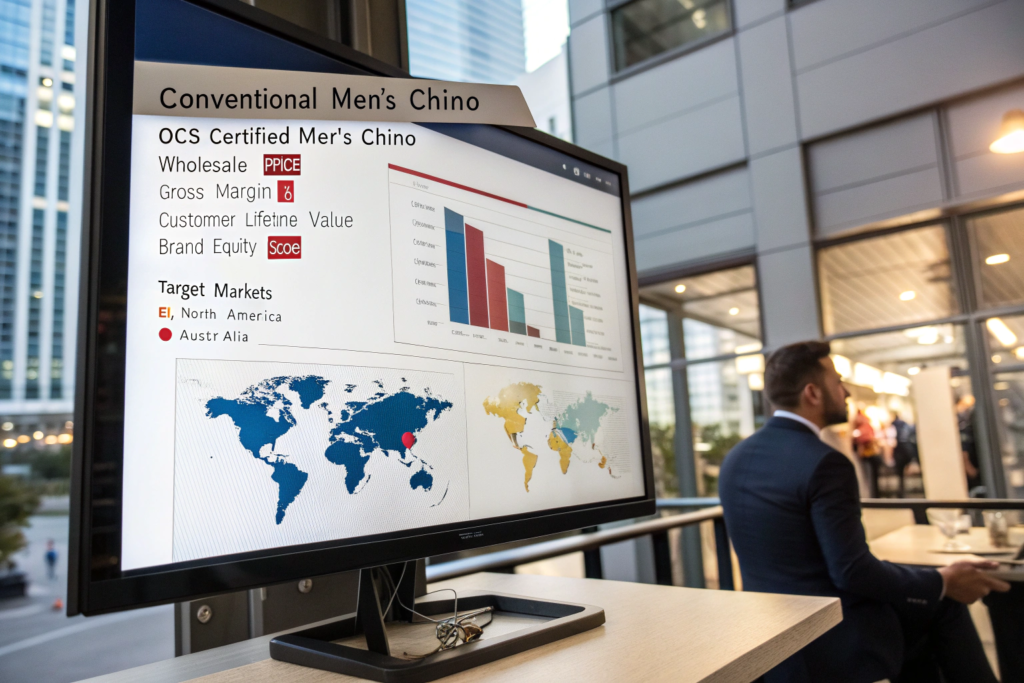
Your wholesale price should reflect not just these costs, but the value of reduced risk for your retail partners. You are selling certainty. For instance, you can price a OCS organic cotton shirt 25-35% higher than a conventional equivalent, focusing the narrative on verifiable provenance and durability. A New York-based DTC brand used this model in 2024, marketing their OCS shirts as "The Last Shirt You’ll Need to Buy." Their customer acquisition cost dropped as the strong story improved conversion rates.
What are realistic MOQs from a qualified Chinese factory?
It varies, but here’s a realistic range from a specialized, vertical supplier:
- Woven Shirts/Chinos: 500 – 1,000 pieces per style/color.
- Knitwear (Polos, Tees, Sweats): 1,000 – 2,000 pieces per style/color.
- Small-Batch Development: For truly new fabric development or ultra-premium lines, some partners (like us) can go as low as 300-500 pieces with mutual commitment.
The key is to ask about fabric-led MOQs. If the factory must order 5,000 meters of custom OCS fabric from a mill, your garment MOQ will be high. If they weave the fabric themselves, they can run 1,000 meters for you. Always ask, "What is the fabric MOQ behind this garment MOQ?"
Conclusion
Getting OCS-certified men’s wear from a Chinese factory is not only possible—it’s a powerful route to building a differentiated, responsible, and profitable brand. The journey requires moving beyond the basic certification search to finding a manufacturing partner that is also a fabric specialist, a technical guide, and a quality-obsessed producer for the men’s market. When these elements align, the result is men’s wear that stands up to scrutiny on the hangtag, in the fit, and over years of wear.
The brands that win in this space are those that see their factory not as a cost center, but as a core component of their product integrity and brand story.
If you are ready to develop OCS-certified men’s wear that doesn’t compromise, you need a partner with the right depth. At Shanghai Fumao, we combine vertical control over OCS fabric production with a dedicated focus on the precision and quality demands of the modern men’s wear market. Contact our Business Director, Elaine, to start a conversation about your collection: elaine@fumaoclothing.com. Let’s craft menswear that defines the new standard.