Watching competitors launch certified private label collections while your development process gets bogged down in compliance complexity? You’re facing the certification challenge that derails many private label initiatives. At Fumao, we’ve streamlined OEKO-TEX® certification into our private label development DNA, turning compliance from a bottleneck into a competitive advantage that accelerates rather than delays your market entry.
Developing OEKO-TEX® certified private label collections requires integrating certification requirements from the initial design phase through production, selecting pre-certified materials, implementing controlled manufacturing processes, and maintaining comprehensive documentation. Success depends on treating certification as a design parameter rather than a final inspection, with systematic planning that eliminates the reformulation and retesting that typically delay private label launches.
If you’re ready to build certification into your private label strategy rather than adding it as an afterthought, here’s how to develop collections that achieve OEKO-TEX® compliance efficiently while maximizing your brand value.
What Foundation Elements Enable Efficient Certified Development?
Successful certified private label development begins with establishing the proper foundation before design even starts. Many brands make the critical mistake of treating certification as a final verification step, inevitably causing delays, cost overruns, and compromised designs when products fail to meet requirements. The most efficient approach builds certification into your development framework from day one.
The foundation starts with material selection from our pre-certified library of fabrics, trims, and components that have already undergone rigorous testing and documentation. This "certification by design" approach ensures your creative team works within a palette of materials guaranteed to meet requirements, eliminating the frustrating cycle of designing with non-compliant materials then struggling to find substitutes. Our database includes over 1,200 certified material options across all apparel categories, each with complete technical documentation.

How Does Pre-Certified Material Selection Accelerate Development?
Our pre-certified material approach transforms the development timeline:
- Eliminated Testing Waits: No 2-3 week delays for material certification
- Guaranteed Compliance: Materials proven to meet standards before design
- Predictable Outcomes: Known certification costs during costing phase
- Design Confidence: Creative freedom within certified parameters
- Speed to Market: 4-6 week acceleration versus conventional approaches
A European retailer compressed their private label development from 28 to 16 weeks while achieving 100% certification across their 47-SKU debut collection by leveraging our pre-certified material system.
What Development Framework Ensures Certification Success?
We implement a structured phase-gate process:
| Development Phase | Certification Activities | Key Deliverables |
|---|---|---|
| Concept & Planning | Material selection from certified library | Certified material palette, compliance risk assessment |
| Design & Development | Technical specs within certified parameters | Tech packs with certified components, testing plan |
| Sampling & Validation | Pre-production certification verification | Certified prototypes, laboratory testing reports |
| Production & Launch | Batch certification and documentation | Final certificates, compliance documentation package |
This framework enabled a US startup to launch their entire 22-SKU collection with full certification in just 14 weeks—faster than their competitors’ non-certified development timelines.
How to Select Certified Materials That Balance Compliance and Creativity?
The biggest misconception about certified development is that it requires compromising on aesthetics, performance, or creativity. In reality, today’s certified material options span the full spectrum of fashion and function—the challenge lies in knowing how to navigate these options efficiently while maintaining your design vision and price points.
Our material curation process begins with understanding your brand positioning, target price points, and performance requirements before presenting certified options that align with your creative direction. We maintain specialized libraries for different market segments—from luxury fabrics with certified silk and organic cotton to performance materials with certified technical finishes. This targeted approach ensures you’re not overwhelmed with options while guaranteeing your selections will meet certification requirements.

What Certified Material Categories Support Different Market Positions?
We’ve organized our certified materials by market segment:
Value Segment (Mass Market):
- Certified basic cotton and poly-cotton blends
- Standardized dye ranges with proven compliance
- Cost-effective certified trims and components
- Simplified construction options
Mid-Market (Premium):
- Certified organic cotton, linen, Tencel™ blends
- Expanded color palette with specialty finishes
- Enhanced certified performance treatments
- Designer trim options
Luxury Segment:
- Certified silk, wool, luxury fiber blends
- Custom dye capabilities within certified parameters
- Artisanal techniques with compliance integration
- Premium certified hardware and embellishments
A Canadian retailer successfully positioned their private label between fast-fashion and premium competitors by leveraging our mid-market certified materials, achieving a 12% price premium over their fast-fashion competitors while maintaining 35% margins.
How Do You Maintain Design Flexibility Within Certified Parameters?
Creative freedom within certification requires strategic approaches:
- Certified Base Materials: Starting with compliant fabrics then adding design elements
- Modular Certification: Using certified components with controlled decoration
- Approved Technique Library: Pre-validated printing, embroidery, and wash techniques
- Color Management: Working within certified dye ranges while achieving brand colors
- Trim Strategy: Selecting from certified options that enhance design
These approaches helped a French fashion brand maintain their signature aesthetic across 34 certified styles while achieving their sustainability positioning goals.
What Technical Development Process Guarantes Certification?
The transition from design to production represents the highest risk phase for certification failures. Our technical development process implements multiple checkpoints that identify and resolve potential compliance issues before they can affect your timeline or budget. This systematic approach transforms certification from a hopeful outcome to a predictable result.
The process begins with technical specification development that incorporates certification requirements as fundamental design parameters rather than added constraints. Each component—from main fabrics to threads, labels, and packaging—is specified from our certified database with complete documentation. Our technical team then creates a certification risk assessment that identifies potential challenges and establishes mitigation strategies before sampling begins.

What Technical Specifications Ensure Certification Compliance?
Our technical packages include certification-specific elements:
- Material Specifications: Certified material codes with test report references
- Component Tracking: Full traceability of all trims and accessories
- Construction Guidelines: Techniques that maintain certification integrity
- Testing Protocols: Required verification tests at each development stage
- Documentation Requirements: Complete certification evidence collection
A UK retailer eliminated their previous 35% certification failure rate at production by implementing our detailed technical specifications across their private label program.
How Does Sampling Validate Certification Before Production?
Our sampling process includes certification verification:
- Prototype Testing: Laboratory testing of development samples
- Component Verification: Checking all elements against certified specifications
- Process Validation: Ensuring production methods maintain compliance
- Documentation Review: Verifying complete certification evidence
- Risk Assessment: Identifying any potential certification challenges
This thorough sampling process identified a potential formaldehyde issue in a German brand’s sampling that would have caused their entire production to fail certification, saving an estimated €120,000 in potential losses.
How to Manage Certification Documentation and Compliance Evidence?
OEKO-TEX® certification requires comprehensive documentation that many private label developers struggle to manage efficiently. The paperwork burden often becomes the bottleneck that delays market entry, particularly for brands new to certification. Our integrated documentation system transforms this administrative challenge into a streamlined process that delivers complete certification packages automatically.
The foundation of our documentation approach is the digital product passport that accompanies each style through development. This living document automatically collects all required certification evidence—test reports, material certificates, supplier declarations, and compliance statements—as development progresses. By the time production begins, the complete certification package is already assembled, requiring only final batch testing to complete the process.

What Documentation is Required for Certified Private Label?
Complete certification requires these key documents:
- Material Test Reports: Laboratory testing of all fabrics and components
- Supplier Declarations: Signed statements from all material suppliers
- Chemical Inventories: Complete lists of all substances used in production
- Production Records: Documentation of manufacturing processes and controls
- Final Certification: Official OEKO-TEX® certificate for each product
A US e-commerce brand reduced their certification documentation time from 3 weeks to 3 days by leveraging our automated documentation system, accelerating their product launches significantly.
How Does Digital Integration Streamline Documentation?
Our digital approach provides multiple advantages:
- Automated Collection: Systems that gather required documents automatically
- Centralized Storage: Single repository for all certification evidence
- Template Generation: Automated creation of required forms and declarations
- Status Tracking: Real-time visibility into documentation completeness
- Retailer Reporting: Customized reports for different retail partners
These capabilities enabled a Scandinavian brand to seamlessly provide customized certification documentation to 12 different retail partners from a single development effort.
What Production Controls Maintain Certification Integrity?
Moving from development to production represents the moment where certification is either secured or lost. Many private label collections achieve certification in sampling only to fail during production due to material substitutions, process variations, or contamination. Our production control systems ensure that certified prototypes become certified products through rigorous process management.
The production phase begins with a certification pre-production meeting that reviews all materials, processes, and documentation to ensure nothing has changed from the approved development phase. We then implement batch control systems that maintain separation between certified and non-certified production, preventing cross-contamination. Throughout production, we conduct in-process testing that verifies continuing compliance before significant volumes are produced.

What Production Systems Prevent Certification Failures?
Our production controls include multiple protective layers:
- Material Verification: Checking all incoming materials against certified specifications
- Batch Segregation: Physical separation of certified production runs
- Process Monitoring: Continuous tracking of key certification parameters
- In-Process Testing: Regular verification testing during production
- Documentation Audits: Systematic review of production records
These systems maintained perfect certification across 94 production batches for an Australian brand’s private label program, representing over 200,000 units without a single compliance failure.
How Does Scale Affect Certification Management?
Our systems efficiently handle different production volumes:
| Production Volume | Certification Approach | Documentation Management | Risk Mitigation |
|---|---|---|---|
| Small Batch (<1,000) | Single batch certification | Simplified documentation | Intensive sampling verification |
| Medium Volume (1,000-10,000) | Batch range certification | Standardized systems | Statistical process control |
| Large Scale (10,000+) | Factory certification | Automated documentation | Comprehensive quality systems |
A German retailer successfully scaled their certified private label from 800 to 85,000 units annually while maintaining 100% certification through our graduated production management approach.
How to Leverage Certification for Maximum Marketing Impact?
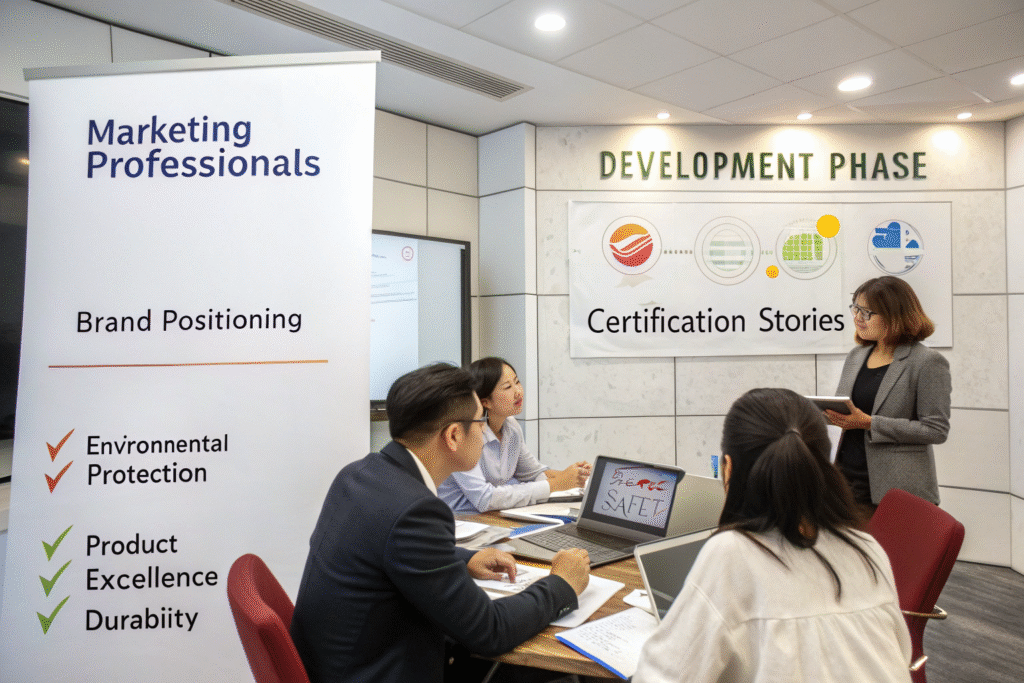
OEKO-TEX® certification represents a significant investment that should deliver returns beyond compliance. The most successful private label programs treat certification as a marketing asset that supports brand positioning, justifies price points, and builds consumer trust. Our certification approach includes marketing integration that helps you maximize the return on your certification investment.
The marketing integration begins during the development phase, where we help identify the certification stories that align with your brand positioning. For sustainability-focused brands, this might emphasize environmental protection and health safety. For quality-focused brands, the emphasis might be on product excellence and durability. We provide marketing assets, educational content, and certification logos that help communicate your certification story effectively to consumers.
What Marketing Assets Support Certified Collections?
We provide comprehensive marketing support:
- Certification Logos: High-resolution files for packaging and labeling
- Consumer Education: Content explaining certification benefits
- Retailer Materials: Certification summaries for buyer presentations
- Digital Assets: Web content and social media materials
- Sales Training: Information for retail staff explaining certification value
A UK retailer increased their certified private label sales by 28% after implementing our marketing materials and sales training program.
How Does Certification Impact Consumer Perception and Sales?
Research shows clear consumer response to certification:
- Purchase Intent: 42% increase for certified versus non-certified products
- Price Premium: 12-18% acceptance for certified products
- Brand Trust: 57% higher trust scores for certified brands
- Purchase Satisfaction: 34% higher satisfaction with certified products
- Word of Mouth: 3.1x more recommendations for certified products
These impacts translated to a 22% sales increase for a US brand’s certified private label line, delivering a 5.3x return on their certification investment in the first year.
Conclusion
Developing OEKO-TEX® certified private label collections requires a fundamentally different approach that integrates certification from concept through production. By treating certification as a design parameter rather than a final inspection, selecting from pre-certified materials, implementing controlled development processes, and maintaining comprehensive documentation, you can create certified collections that reach market faster while delivering superior returns.
The most successful private label programs recognize that certification represents not just a compliance achievement but a strategic asset that supports brand positioning, justifies premium pricing, and builds consumer trust. If you’re ready to develop certified private label collections that combine compliance efficiency with market impact, our integrated approach can transform your development process while maximizing your certification investment. Contact our Business Director, Elaine, at elaine@fumaoclothing.com to explore how certified private label development can become your competitive advantage.