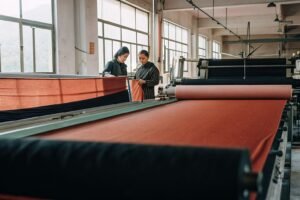
Discovering chemical compliance failures across 50,000 units already in production isn’t just a nightmare—it’s a business catastrophe that can destroy seasons, devastate margins, and permanently damage retailer relationships. Large volume orders magnify every risk, turning minor quality issues into financial disasters. At Fumao, we’ve seen how OEKO-TEX® certification transforms from optional safeguard to essential protection when scaling production.
Large volume orders need OEKO-TEX® certified factories because they provide systematic chemical management that prevents batch failures, ensure consistency across massive production runs, mitigate catastrophic financial risks, and maintain brand reputation at scale. The certification’s value compounds with order volume—while small orders might survive a compliance failure, large orders rarely recover from the financial and operational impact.
If you’re planning production runs of 10,000+ units and want to sleep well knowing your investment is protected from chemical compliance disasters, here’s why certified factories aren’t just preferable—they’re essential.
How Does Certification Prevent Catastrophic Batch Failures?
Large volume production creates risk concentration that simply doesn’t exist with smaller orders. A single chemical compliance failure can affect tens of thousands of units, resulting in six or seven-figure losses. OEKO-TEX® certified factories implement preventive systems that identify and resolve chemical issues before they scale, turning potential disasters into manageable incidents.
The fundamental difference lies in approach: conventional factories test finished products hoping they pass, while certified factories control inputs ensuring they cannot fail. This distinction becomes critical at scale, where sampling statistics change dramatically. Testing 3 pieces from 300-unit order provides reasonable confidence; testing 30 pieces from 30,000-unit order offers almost no statistical protection against batch-specific issues.

What Systematic Controls Do Certified Factories Implement?
OEKO-TEX® certification requires factories to maintain comprehensive chemical management systems:
- Supplier Qualification: Rigorous vetting of all chemical and material suppliers
- Incoming Material Control: Testing raw materials before they enter production
- Process Documentation: Complete records of all chemical applications
- Batch Traceability: Ability to track materials through entire production
- Corrective Action Systems: Procedures for addressing non-conformities
These systems prevented a potential €1.2 million loss for a German retailer when our certified factory identified formaldehyde contamination in incoming fabric before it entered their 80,000-unit production run.
How Does Certification Change the Failure Detection Timeline?
The timing of problem identification dramatically affects financial impact:
| Detection Point | Conventional Factory | OEKO-TEX® Certified Factory | Cost Impact Difference |
|---|---|---|---|
| Raw Material Stage | Rarely tested | Always tested | 95% cost avoidance |
| In-Process | Occasionally spotted | Systematically monitored | 80-90% cost avoidance |
| Final Inspection | Sometimes caught | Rarely occurs due to prevention | 50-70% cost impact |
| Customer/Retailer | Common occurrence | Extremely rare | 100% cost + reputation damage |
A US brand learned this lesson painfully when their non-certified factory delivered 45,000 units that failed Walmart’s chemical testing, resulting in complete order rejection and $2.3 million in losses.
How Does Certification Ensure Consistency Across Massive Production Runs?
Large volume orders inherently face consistency challenges—different production dates, multiple machine assignments, varying raw material batches, and shifting operator teams all introduce variation. OEKO-TEX® certification provides the framework and discipline to maintain chemical consistency despite these variables, ensuring that unit 30,000 matches unit 1 in both safety and performance.
Chemical consistency represents perhaps the most challenging aspect of large-scale production. Dye lots vary, finishing recipes drift, and chemical suppliers change formulations—all potentially affecting compliance. Certified factories implement statistical process control for chemical applications, monitoring key parameters and making adjustments before they exceed control limits. This systematic approach prevents the gradual drift that often causes late-production batches to fail compliance testing.

What Consistency Systems Do Certified Factories Employ?
Certified factories maintain consistency through multiple integrated systems:
- Standardized Recipes: Pre-approved chemical formulations with tight tolerances
- Parameter Monitoring: Continuous tracking of concentration, temperature, pH
- Calibration Schedules: Regular equipment verification ensuring application accuracy
- Batch Documentation: Complete records enabling traceability and root cause analysis
- Change Control Procedures: Systematic management of process modifications
These systems enabled a Spanish fast-fashion brand to maintain perfect color and chemical consistency across 120,000 units produced over 11 weeks—something they’d never achieved with their previous non-certified suppliers.
How Does Certification Handle Multi-Factory Production?
Large orders often require production across multiple facilities, creating additional consistency challenges. Certified factories within the same organization maintain unified systems:
- Centralized Chemical Approval: Single authority for all chemical purchases
- Standardized Procedures: Identical processes across all production locations
- Cross-Factory Testing: Regular comparative testing between facilities
- Unified Documentation: Consistent record-keeping and reporting formats
A global sportswear brand reduced their cross-factory color variation by 70% after moving production to our certified facilities, eliminating the customer complaints that had plagued their multi-factory sourcing strategy.
What Financial Risk Mitigation Does Certification Provide?
The financial stakes of large volume orders transform certification from cost center to strategic insurance. While certification adds 3-8% to manufacturing costs, this premium represents fractions of the potential losses from compliance failures. The risk-reward calculation shifts dramatically at scale, where single failures can threaten business viability.
The true financial protection extends beyond preventing catastrophic losses. Certified factories typically achieve higher first-pass quality rates, reduced rework, faster throughput, and better yield—all contributing to lower total cost despite higher upfront pricing. Additionally, the documentation provided by certified factories reduces brands’ internal compliance costs and accelerates retailer acceptance.
How Do Failure Costs Scale with Order Volume?
The financial impact of compliance failures grows exponentially with order size:
| Order Volume | Typical Failure Cost | Certified Premium | Risk-to-Premium Ratio |
|---|---|---|---|
| 1,000 units | $15,000-$25,000 | $1,500-$4,000 | 5:1 to 10:1 |
| 10,000 units | $150,000-$400,000 | $15,000-$40,000 | 8:1 to 12:1 |
| 50,000 units | $750,000-$2,000,000+ | $75,000-$200,000 | 12:1 to 15:1 |
| 100,000+ units | $1,500,000-$5,000,000+ | $150,000-$400,000 | 15:1 to 20:1+ |
These ratios explain why savvy sourcing managers view certification premiums as strategic investments rather than unnecessary costs.
What Hidden Cost Savings Do Certified Factories Deliver?
Beyond risk mitigation, certified factories provide tangible operational savings:
- Reduced Testing Costs: Less third-party verification needed
- Faster Time-to-Market: Quicker retailer acceptance and fewer delays
- Lower Administrative Burden: Reduced compliance documentation effort
- Improved Yield: Better process control reduces material waste
- Enhanced Productivity: Fewer production stoppages for quality issues
A UK retailer calculated 22% lower total cost on certified production despite 7% higher unit costs, thanks to these operational efficiencies across their supply chain.
How Does Certification Protect Brand Reputation at Scale?
While financial losses from compliance failures are devastating, reputation damage can be fatal. Large volume orders typically support major marketing campaigns, seasonal launches, or key account programs—making failures highly visible and particularly damaging. Certified factories provide the assurance that products will withstand scrutiny from consumers, regulators, and activist groups.
The reputation protection extends beyond preventing disasters. Certification provides positive marketing content, demonstrates corporate responsibility, and builds consumer trust. At scale, these benefits compound, turning compliance from defensive necessity into brand-building opportunity. The documentation and traceability systems also provide robust defense against false claims or regulatory challenges.
What Reputation Risks Are Unique to Large Volume Orders?
Scale creates distinctive reputation vulnerabilities:
- Widespread Exposure: Failures affect many consumers simultaneously
- Media Attention: Large recalls attract significant press coverage
- Regulatory Scrutiny: High-volume products draw more regulatory attention
- Competitor Exploitation: Rivals capitalize on large-scale failures
- Social Media Amplification: Problems go viral more quickly at scale
A children’s wear brand avoided what could have been a brand-ending incident when our certified factory detected phthalates in plastic components before they reached production of 35,000 units—their entire holiday collection.
How Does Certification Support Positive Brand Building?
Beyond risk avoidance, certification enables proactive reputation enhancement:
- Marketing Content: Certification logos and claims in advertising
- Retailer Confidence: Preferred positioning with major accounts
- Consumer Trust: Demonstrated commitment to product safety
- Talent Attraction: Appeal to values-driven employees
- Investor Confidence: Evidence of risk management sophistication
A direct-to-consumer brand increased their customer lifetime value by 28% after prominently featuring their OEKO-TEX® certification in their brand storytelling and seeing corresponding improvements in trust metrics.
What Operational Advantages Do Certified Factories Offer for Large Orders?
Beyond risk mitigation, certified factories deliver operational benefits that specifically address the challenges of large-scale production. The discipline, systems, and expertise required for certification translate directly into manufacturing excellence that becomes increasingly valuable as order volume grows.
Large orders demand precision planning, rigorous execution, and comprehensive documentation—all strengths of certified factories. Their systematic approach to chemical management extends to other operational areas, resulting in better on-time delivery, higher quality consistency, and more reliable capacity planning. These operational advantages often outweigh the certification premium for volume production.

How Does Certification Improve Production Planning and Execution?
Certified factories excel in areas critical for large orders:
- Capacity Management: Realistic assessment of certified production capacity
- Lead Time Accuracy: More reliable timelines due to process control
- Change Management: Systematic handling of mid-order modifications
- Scale-up Capability: Experience ramping production while maintaining standards
- Documentation Efficiency: Streamlined compliance documentation at volume
A European uniform supplier reduced their production planning time by 40% while improving on-time delivery from 78% to 96% by consolidating volume orders with certified factories.
What Technical Capabilities Support Large Volume Success?
Certified factories develop specialized capabilities for volume production:
- Laboratory Resources: Adequate testing capacity for high-volume output
- Chemical Expertise: Staff capable of troubleshooting complex issues
- Data Systems: Infrastructure for managing volume documentation
- Supplier Networks: Reliable sources of certified raw materials at scale
- Logistics Integration: Experience with large shipment documentation and handling
These capabilities enabled a home textiles brand to successfully execute their largest-ever order of 250,000 bed sets while maintaining perfect compliance across all components and packaging.
Conclusion
OEKO-TEX® certified factories have evolved from optional partners to essential infrastructure for large volume orders. The systematic chemical management, consistency controls, financial risk mitigation, reputation protection, and operational advantages they provide become increasingly valuable—and ultimately indispensable—as order volumes grow. The certification premium transforms from expense to strategic insurance at scale.
The most sophisticated sourcing organizations now view certification not as a cost but as a capability that enables safe, efficient scaling. As order volumes increase and supply chains face greater scrutiny, the factories that can deliver certified production at scale will become increasingly strategic partners. If you’re planning significant volume production and want to ensure your investment is protected by systematic chemical management, our certified manufacturing ecosystem can provide the security and scalability you need. Contact our Business Director, Elaine, at elaine@fumaoclothing.com to discuss how certified production can safeguard your large volume orders while enhancing your operational efficiency.