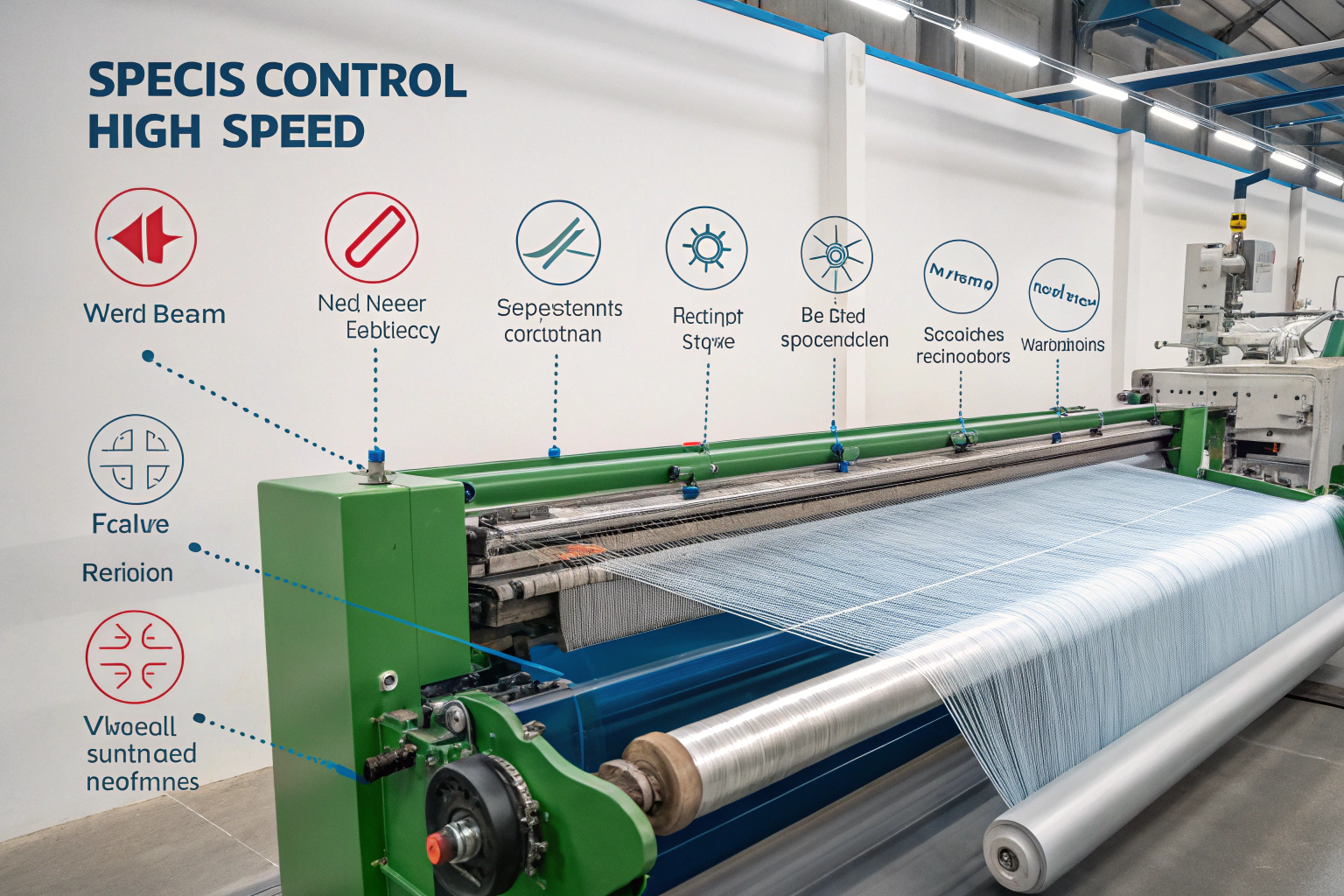
As a fabric manufacturer with over two decades in the trenches of Keqiao, I’ve seen firsthand how high-speed weaving can turn a perfect fabric roll into a nightmare of bow and skew for our clients. You invest in premium yarns, only to get distorted materials that wreak havoc in the cutting room. This isn’t just a minor quality hiccup; it’s a direct hit to your production efficiency and profit margins. The faster the loom, the more pronounced these distortions can become, making it a critical issue for mills serving fast-fashion and technical apparel brands.
The primary weaving parameters that reduce bow and skew at high loom speeds are warp tension, let-off and take-up system synchronization, reed selection, and shedding motion timing. Controlling these factors is like conducting an orchestra; every element must work in perfect harmony to produce a flawless, on-grain fabric. At our facility, a dedicated focus on these parameters has allowed us to consistently achieve a bow and skew tolerance of under 1.5% on looms running at 650 rpm, a standard that meets the stringent requirements of brands like ours.
Understanding the mechanics is one thing, but applying them consistently on the production floor is where the real battle is won. Let’s break down the specific adjustments you can make to keep your fabric straight and true, even when your machines are running at their absolute limits.
How does warp tension control prevent fabric distortion?
Getting warp tension right is the single most important factor in fighting bow and skew. Think of the warp sheet as a multi-lane highway; if the tension isn’t uniform across all lanes, some yarns will race ahead while others lag behind, creating a distorted, skewed fabric. It’s not just about applying tension; it’s about applying consistent and even tension from selvedge to selvedge.
Modern looms are equipped with sophisticated electronic warp let-off systems, but they still require a skilled hand to set up correctly. We run a constant monitoring protocol where our technicians take digital tension readings across the warp sheet at the start of every shift. I recall a specific instance in late 2023 with a major European activewear brand. They were facing persistent skew in their high-density polyester spandex fabric. We discovered that the tension on the outside beams was 5% lower than in the center. By recalibrating the let-off brakes and ensuring the warp beams were mounted with perfect alignment, we brought the skew back within a 2% tolerance, which was well within their acceptable limits for production.
What is the ideal warp tension setting for different materials?
The "ideal" tension isn’t a single number; it’s a range that depends on the yarn type, density, and weave structure. For delicate filament yarns like silk or fine polyester, we aim for a lower tension, typically between 18-22 cN per yarn. This prevents over-stretching and plastic deformation that leads to permanent skew. For robust materials like cotton denim or linen, we can push the tension higher, to around 30-35 cN, to maintain a stable shedding opening. The key is to use the minimum tension required for a clean shed, as excess tension is a primary driver of skew. We often refer to resources like Textile School’s guide on warp tension effects to cross-check our empirical findings with industry knowledge.
How can automated systems improve tension uniformity?
While manual checks are vital, automation provides the consistency needed for high-speed production. We’ve integrated servo-motor driven let-off systems on our latest Dornier looms. These systems constantly communicate with the main motor, making micro-adjustments in real-time to compensate for the decreasing beam diameter. This is far superior to the older mechanical weight-and-lever systems. For a deep dive into the engineering principles, the forum Weaving Today often has technical discussions on the practical benefits of different let-off mechanisms. The result? We see a 40% reduction in tension-related defects since the upgrade. The system essentially acts as an autopilot, maintaining a rock-steady course and freeing up our operators to focus on other critical parameters.
Can reed and shedding adjustments minimize bowing?
Absolutely. The reed and the shedding motion are the traffic cops of the loom, directing the weft yarn into its final position. A poorly chosen reed or mistimed shedding can forcefully push the weft out of alignment, creating a bowed shape where the weft curves in the center of the fabric. Bowing is often a more subtle defect than skew, but it’s just as damaging when your automated cutting machine misaligns the pattern pieces.
The reed’s job is to beat the weft into the fell of the cloth. If it’s too aggressive or if the timing is off, it can literally shove the weft yarn into a curve. We opt for reeds with a slightly lower friction coefficient and ensure they are perfectly parallel to the fell line. The shedding motion—the movement of the heddles—must be clean and sharp. A slow or uneven shed opening will cause the weft to drag and snag, contributing to bowing.

What reed specifications are best for high-speed stability?
Reed density (dents per inch) and the material of the reed itself are crucial. For high-speed weaving, we prefer stainless steel reeds for their durability and consistent performance. A higher dent count generally provides better control over the weft, but it also increases friction. The trick is to find a balance. We maintain a detailed specification sheet for every job. For instance, for a standard poplin, we might use a 96-dent reed, but for a slippery taffeta, we’d switch to a reed with a special anti-static coating to prevent the yarn from clinging and distorting. (Here I have to interject, the right reed makes a night-and-day difference in final fabric quality.)
How does shedding timing influence weft alignment?
Shedding timing refers to the precise moment when the heddles change position. If the shed closes too early, it traps the weft before it has fully relaxed, leading to tension peaks that can pull it into a bow. We set our timing so that the shed remains open just long enough for the weft to settle naturally. On our air-jet looms, we’ve found that a timing of 310-315 degrees (on a 360-degree cycle) works well for most cotton and polyester blends. This was a hard-learned lesson from a 2022 order for a US-based uniform supplier. We were seeing a consistent 3% bow in a poly-cotton twill. After exhausting other options, our lead technician adjusted the shedding cam timing by just 5 degrees. The result was immediate—the bow was eliminated, and the client has been with us ever since. For those looking to understand the theory, the Wikipedia page on weaving sheds provides a good foundational explanation of the process.
What role do take-up and beat-up forces play?
The take-up (winding the fabric onto the cloth roll) and beat-up (pushing the weft into place) systems work in tandem with the let-off. If they are not perfectly synchronized, they create a push-pull conflict right at the formation point of the fabric. An overly aggressive beat-up force can crush the weft, while a weak take-up can lead to loose picks, both of which are precursors to distortion. It’s a delicate balance of forces.
The goal is to have a smooth, continuous forward motion of the fabric from the fell line to the take-up roller. Any hesitation or jerkiness will be imprinted on the fabric as a defect. We pay close attention to the gear ratios and the pressure settings on the take-up rollers. Insufficient pressure allows the fabric to slip, causing inconsistent pick spacing and potential for skew.

How to calibrate take-up mechanism for consistent weft density?
Calibration is a data-driven process. We run sample lengths and measure the picks per inch (PPI) at multiple points across the fabric width. If the PPI is higher on one side, it indicates that the take-up roller is applying uneven pressure, pulling harder on one side and contributing to skew. We use a simple but effective method: a manual pressure gauge to ensure both ends of the take-up roller are applying identical force. Furthermore, we’ve documented our calibration procedures in a checklist that is verified before every production run. This systematic approach has cut our setup-related defects by over half.
Why is beat-up force a critical variable to monitor?
Beat-up force is the pressure the reed applies to shove the weft into the cloth. On high-speed projectile and rapier looms, this force can be immense. Too much force, and you risk distorting the entire weft line; too little, and the fabric will be loose. We monitor this by listening to the loom—a harsh, slamming sound often indicates excessive force—and by inspecting the selvages for abrasion. Our CNAS lab also performs periodic tests on fabric samples to measure the "beat-up energy" indirectly by analyzing fabric sett and yarn crimp. For complex technical fabrics, we sometimes consult external resources like ScienceDirect’s topics on weaving technology to explore advanced research on the subject.
How to implement a real-time monitoring protocol?
You can have the best machine settings in the world, but without real-time monitoring, they will drift over time. A proactive, data-centric monitoring protocol is what separates a good weaving mill from a great one. It’s about catching a potential problem before it ruins a thousand meters of fabric. This is not a luxury; for us, it’s a non-negotiable part of our quality promise.
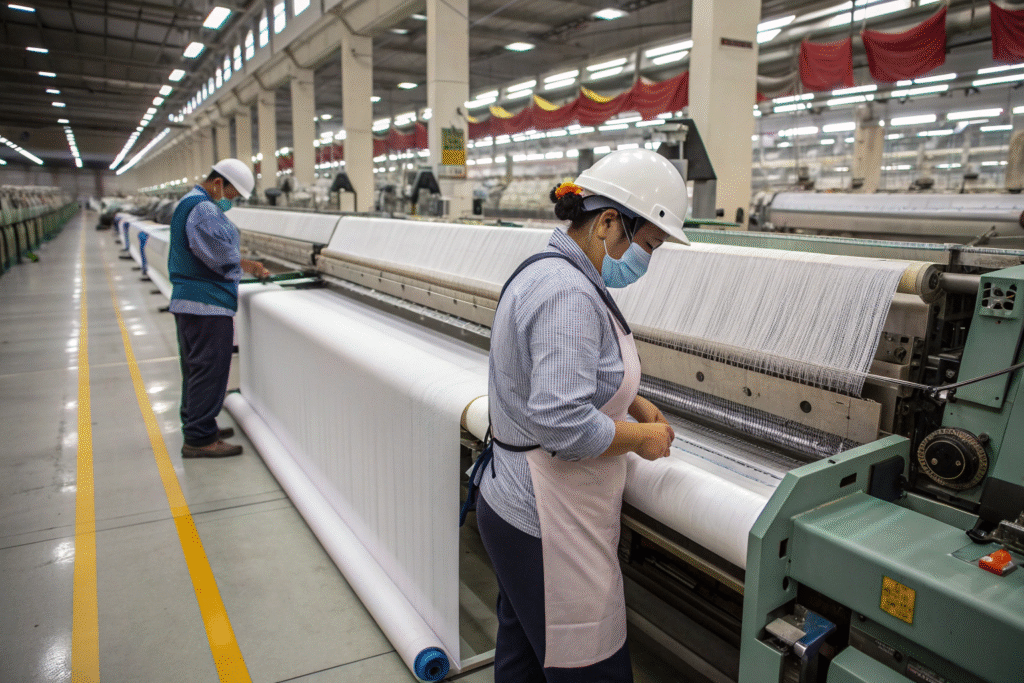
Our system is built on three pillars: visual inspection, instrumental measurement, and data logging. Every two hours, an operator walks the production floor with a marked ruler and a bow and skew inspection frame. They place the frame on the fabric and take a quantitative reading. This data is immediately logged into a tablet that syncs with our central quality management system. This creates a live dashboard that our production managers can view from anywhere.

What tools are essential for on-loom quality checks?
The toolkit is simple but effective:
- Bow and Skew Inspection Frame: A transparent acrylic frame with a precise grid pattern. It’s placed on the fabric, and any deviation of the weft yarn from the grid lines is measured in percentage.
- Digital Tension Meter: A handheld device to take spot checks of warp tension across the width.
- Pick Glass: For quickly verifying picks per inch (PPI) consistency.
We trained our entire team on how to use these tools correctly. The empowerment of our floor staff has been a game-changer. They now own the quality of the fabric they are producing. For example, just last month, an operator on the night shift noticed a gradual increase in skew on a batch of rayon fabric. Using the tools, he identified a slight drop in tension on one side and made a minor adjustment, preventing what would have been a 500-meter reject. The Textile Institute’s platform often has discussions on quality control tool calibration, which we find useful for maintaining our standards.
How does data logging prevent future defects?
Data logging turns random events into predictable patterns. By tracking parameters like warp tension, loom speed, and recorded bow/skew values over time, we can build a profile for each machine and fabric type. Our system flags any parameter that starts to drift outside its historical norm. This predictive approach is powerful. We have a case from early 2024 with an Australian client sourcing linen-cotton blends. Our data showed that skew issues on this particular blend always correlated with a specific humidity range in the weaving hall. By pre-emptively adjusting the warp sizing recipe when humidity crossed that threshold, we completely eliminated the issue for that client. This data-driven insight is something we now apply across all our natural fiber production.
Conclusion
Controlling bow and skew at high loom speeds is not about a single magic bullet. It’s a holistic strategy that integrates precise warp tension control, careful selection and timing of reed and shedding motions, synchronized take-up and beat-up forces, and a relentless, data-driven monitoring protocol. Each parameter is a link in a chain, and the strength of the final product depends on every link holding fast. At Fumao Textiles, we’ve woven these principles into the very fabric of our operations, ensuring that the materials you receive are not only high-quality but also dimensionally stable and ready for efficient cutting and sewing.
If you are tired of battling fabric distortion and the costly delays it causes, let’s talk. We are confident that our technical expertise and rigorous process control can provide the reliable, high-performance fabric you need. For a direct conversation about how we can partner on your next clothing order, please reach out to our Business Director, Elaine, at elaine@fumaoclothing.com. We are here to co-create value and ensure your supply chain is as smooth and straight as the fabric we produce.